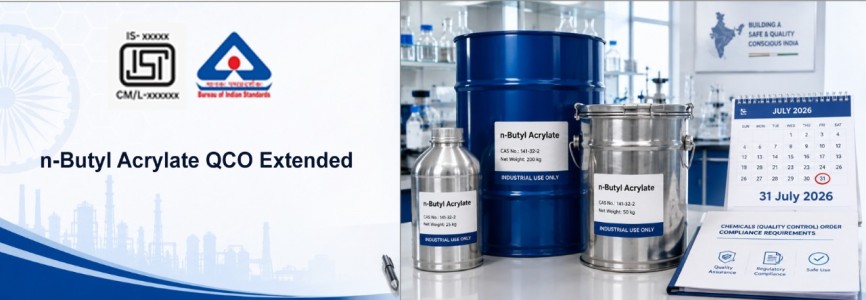



Manufacturers, foreign suppliers and importers dealing in n-Butyl Acrylate have received a short additional compliance window. Through S.O. 3729(E) dated 9 July 2026, the Central Government extended the temporary non-applicability of the relevant Indian Standard from 10 July 2026 to 31 July 2026. The change is limited and should not be treated as a permanent withdrawal of the Quality Control Order. Businesses using this chemical in paints, coatings, adhesives, polymers or other industrial supply chains should use the remaining period to confirm product coverage, licence readiness and post-deadline procurement plans.
Notification at a Glance
|
Particular |
Official Detail |
|
Order |
Amendment concerning the n-Butyl Acrylate (Quality Control) Order, 2021 |
|
Notification Number |
S.O. 3729(E) |
|
Issuing Authority |
Ministry of Chemicals and Fertilizers, Department of Chemicals and Petrochemicals |
|
Order Date |
9 July 2026 |
|
Product |
n-Butyl Acrylate |
|
Applicable Indian Standard |
IS 14709:1999 |
|
Revised Date |
31 July 2026 |
|
Nature of Change |
Temporary suspension period extended by replacing 10 July 2026 with 31 July 2026 |
The Amendment Gives More Time, Not a Permanent Exemption
The July order does not rescind the n-Butyl Acrylate Quality Control Order. It modifies the proviso already inserted in April 2026. The April amendment had made conformity to the Indian Standard inapplicable from 10 April 2026 to 10 July 2026 because of global exigencies and supply-chain disruption. The July order changes only the end date of that period to 31 July 2026.
This distinction matters commercially. A temporary suspension allows covered businesses to continue operating during the specified period without the conformity requirement applying in the manner stated by the order. It does not automatically settle the position for goods manufactured, imported, dispatched or sold after the revised date. BIS currently lists 31 July 2026 as the enforcement date for n-Butyl Acrylate under IS 14709:1999. Unless another official amendment is issued, affected businesses should prepare on the basis that the compliance requirement will operate after the suspension period.
Which Material Falls Within This Update?
The official BIS compulsory-certification listing identifies the product as n-Butyl Acrylate and maps it to IS 14709:1999. Businesses should not assume that every acrylate, acrylic monomer or similarly named chemical is covered by the same standard. Methyl Acrylate, Ethyl Acrylate and other petrochemicals may be governed by different standards and separate orders.
The practical review should be based on the exact product name, chemical identity, specification, grade, intended use and supporting documents such as the safety data sheet, certificate of analysis, purchase specification and customs description. Where a blended formulation contains n-Butyl Acrylate but is not sold as n-Butyl Acrylate, technical classification may require closer examination. Businesses should verify the requirement based on their exact product category, applicable Indian Standard and date of implementation.
Who Needs to Act Before the Suspension Ends?
Indian manufacturers should check whether their manufacturing unit has, or needs, a valid BIS licence under the applicable Scheme-I route. A trading entity cannot replace the manufacturing unit’s certification responsibility merely by obtaining a test report in its own name.
Foreign manufacturers supplying the Indian market should review the Foreign Manufacturers Certification Scheme route and coordinate with an Authorised Indian Representative where applicable. Indian importers should verify the certification status of the overseas manufacturing unit before planning shipments that may arrive, clear or be placed in the market after the enforcement date.
Brand owners, distributors and industrial users should also conduct supplier due diligence. A purchase contract stating that the material meets an Indian Standard is not the same as confirming that the required BIS certification and Standard Mark conditions are fulfilled. Traders should avoid building inventory based only on the assumption that the suspension will be extended again.
The Dates Chemical Businesses Should Separate Clearly
|
Compliance Event |
Relevant Date |
Business Impact |
|
Original QCO publication |
24 December 2021 |
The n-Butyl Acrylate Quality Control Order, 2021 was published as S.O. 5438(E). |
|
Temporary suspension introduced |
10 April 2026 |
Conformity was made inapplicable for the period beginning on this date. |
|
Earlier suspension end date |
10 July 2026 |
This date was replaced by the July amendment. |
|
Revised suspension end/enforcement date |
31 July 2026 |
Businesses should prepare for compliance after the temporary window, subject to any later official order. |
A Practical Compliance Plan for the Remaining Window
-
Confirm that the material supplied or imported is correctly identified as n-Butyl Acrylate and not another acrylate or a different formulation.
-
Map the product to IS 14709:1999 and review the scope, grades, testing parameters and marking requirements relevant to the manufacturing unit.
-
Check whether an existing BIS licence already covers the factory, product and variety proposed for sale in India.
-
Where no licence exists, evaluate the applicable Scheme-I or FMCS pathway depending on whether the manufacturer is located in India or abroad.
-
Review laboratory testing availability and prepare representative product samples in line with the applicable certification process.
-
Prepare factory information, manufacturing process details, quality-control arrangements, in-house testing facilities and product specifications.
-
Align shipment, production and purchase schedules with the 31 July 2026 date instead of relying on the possibility of another extension.
-
Review labels, invoices, product descriptions and the use of the Standard Mark only after the appropriate licence has been granted and is valid.
Documents and Factory Readiness to Review
The exact application checklist will depend on the certification route and the product requirements. Common preparations may include business registration records, factory address and legal status, manufacturing-process flow, machinery details, testing-equipment details, product specifications, raw-material controls, quality-control plan, test reports, brand or trademark authorisation, and declarations required by BIS. For a foreign manufacturer, AIR documents and the prescribed FMCS forms may also be relevant.
A business should not wait for the final week merely to collect paperwork. Chemical certification may involve technical scrutiny, factory-related assessment, sample testing, responses to observations and payment of applicable dues. The July amendment does not promise that an application filed before 31 July will automatically permit continued supply after that date.
Commercial Risks of Waiting for Another Extension
Delayed preparation can affect import planning, customer commitments and plant operations. A shipment may face customs or regulatory queries if the product becomes mandatorily subject to BIS requirements and the manufacturing source is not appropriately licensed. Indian manufacturers may be unable to lawfully apply the Standard Mark or place covered goods in the market without the required approval.
Other practical consequences may include production interruption, urgent supplier replacement, unplanned warehousing, rejected customer deliveries, loss of tender eligibility and inventory that cannot be commercially used as originally planned. Enforcement action may also arise under the applicable BIS law and the QCO. No specific penalty amount is stated here because the July amendment itself only extends the suspension date.
Practical Example: An Importer Planning an August Shipment
Consider an Indian company importing n-Butyl Acrylate from an overseas manufacturing unit. The importer has a supplier test certificate showing the chemical composition, but the foreign factory does not hold the applicable BIS licence. The temporary suspension may support transactions during the stated window, but the importer should not assume that the same documents will be sufficient for an August shipment. The overseas manufacturer may need to complete the appropriate BIS certification route, and the importer should align purchase orders and dispatch dates with the official enforcement position.
n-Butyl Acrylate Compliance Checklist
-
Exact chemical identity and product grade verified
-
IS 14709:1999 applicability confirmed
-
31 July 2026 date recorded in procurement and production plans
-
Existing BIS licence and scope checked
-
Domestic or FMCS certification route identified
-
Testing and factory readiness assessed
-
Technical and legal documents compiled
-
Overseas supplier and AIR coordination completed, where relevant
-
Labels and Standard Mark usage reviewed
-
Post-deadline shipments and inventory plan aligned
Where Compliance Calendar LLP Can Support Your Business
Compliance Calendar LLP can assist manufacturers, importers and foreign suppliers with product-applicability assessment, identification of the relevant Indian Standard, certification-route planning, Scheme-I and FMCS documentation, AIR coordination, testing support, application filing, reply preparation for queries and post-licence compliance guidance. The support is designed around the actual factory, product grade and supply chain; approval and timelines remain subject to BIS scrutiny and completion of all applicable requirements.
Preparing Before 31 July Is Safer Than Reacting After It
The July 2026 order provides a brief extension intended to address supply-chain disruption, but it does not remove n-Butyl Acrylate from the BIS compliance. Businesses should use the remaining period to confirm whether their exact material is covered, verify the applicable standard, review the manufacturer’s licence position and plan testing or application work without delay. Importers should coordinate directly with the foreign manufacturing unit, while Indian manufacturers should ensure that factory and quality-control arrangements are ready. Correct classification and early preparation can prevent urgent shipment changes, customer disruption and avoidable inventory exposure after the revised date.
Frequently Asked Questions
Q1. Is BIS certification mandatory for n-Butyl Acrylate?
Ans. BIS lists n-Butyl Acrylate under IS 14709:1999 on its Scheme-I compulsory-certification page. The July 2026 order temporarily suspends the operation of the conformity requirement only up to the revised date. Businesses should verify the latest official position before manufacturing, importing or selling the product after 31 July 2026.
Q2. What exactly changed on 9 July 2026?
Ans. S.O. 3729(E) replaced the earlier suspension end date of 10 July 2026 with 31 July 2026. The order did not rescind the underlying Quality Control Order and did not create a permanent exemption.
Q3. Does the extension apply automatically to every acrylic chemical?
Ans. No. The order is specifically for n-Butyl Acrylate. Other acrylates and chemical formulations may have different standards and QCO positions. Product identity should be checked through technical documents and the applicable Indian Standard.
Q4. Can an importer rely only on a foreign laboratory report?
Ans. A laboratory report may support technical assessment, but it should not be treated as a substitute for the BIS licence required under the applicable compulsory-certification framework. The foreign manufacturing unit’s certification position must be checked.
Q5. Who applies when the product is made outside India?
Ans. Under the FMCS framework, the foreign manufacturer applies for the BIS licence and nominates an Authorised Indian Representative in the prescribed manner. The Indian importer should coordinate the application and ensure that the actual supplying factory is covered.
Q6. Will goods ordered before 31 July automatically remain exempt afterward?
Ans. The July order does not provide a general answer for every shipment or stock situation. Treatment can depend on the exact transaction, manufacturing date, import stage and later official instructions. Businesses should obtain product-specific advice rather than relying only on the purchase-order date.
Q7. Are MSMEs exempt from this QCO?
Ans. The July amendment does not state an MSME exemption. Any concession or exemption must be supported by the applicable official order. Businesses should verify the requirement for their exact enterprise category and product.
Q8. How can Compliance Calendar LLP assist?
Ans. CCL can review applicability, identify the standard, assess the domestic or FMCS route, prepare documentation, coordinate testing, support AIR formalities, file the application and handle BIS queries.


_crop10_thumb.jpg)





_for_FY_2025-26_crop10_thumb.jpg)




_learn_crop10_thumb.jpg)


_Filing_Due_Dates_for_FY_2024-25_learn_crop10_thumb.jpeg)






_of_GST_Act_learn_crop10_thumb.jpg)


_Under_GST_learn_crop10_thumb.jpg)


_crop10_thumb.jpg)


_crop10_thumb.jpg)


_learn_crop10_thumb.jpg)


_of_the_Income_Tax_Act_learn_crop10_thumb.jpg)


_learn_crop10_thumb.jpg)



_learn_crop10_thumb.jpg)


_crop10_thumb.jpg)





_in_The_Income_Tax_Act,_1961_learn_crop10_thumb.jpg)


_learn_crop10_thumb.jpg)


_of_the_Income_Tax_Act_learn_crop10_thumb.jpg)

_Of_Income_Tax_Act_learn_crop10_thumb.jpg)


_learn_crop10_thumb.jpg)


_learn_crop10_thumb.jpg)
_crop10_thumb.jpg)



_learn_crop10_thumb.jpg)
_for_Import_and_Export_learn_crop10_thumb.jpg)




















_crop10_thumb.jpg)