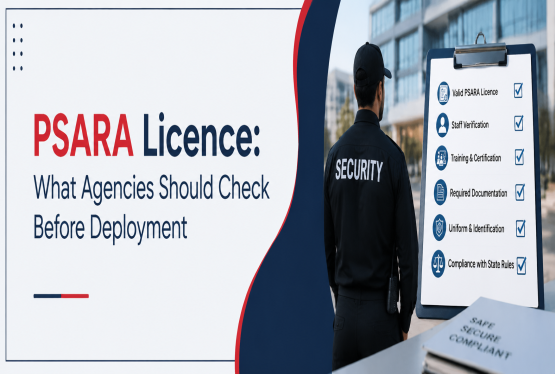



Private security services are now required in almost every sector. Offices, malls, factories, residential societies, warehouses, hotels, hospitals, schools, events and construction sites all need security arrangements for safety and protection However, providing security services is not the same as providing normal manpower. Security personnel are responsible for guarding people, premises, property, assets and goods.
Because of this sensitive nature, private security agencies are regulated under the Private Security Agencies (Regulation) Act, 2005, commonly known as the PSARA Act. The main question for business owners is: When is PSARA License mandatory? PSARA License becomes mandatory when a business commercially provides private security services to another person, company, society, institution or organization.
If a business provides security guards, bouncers, bodyguards, event security staff, security supervisors or any person engaged in protection work, it must check PSARA applicability. The name of the business does not matter much. Even if the business calls itself a manpower agency, facility management company, event support agency or protection service provider, PSARA may still apply if the actual work is security.
PSARA License is Mandatory Before Starting Security Agency Business
PSARA License is mandatory before starting the business of a private security agency. A business should not first deploy guards and then apply for the license later. The law does not allow a person to commence or carry on the business of a private security agency without a valid license.
This means that if a person wants to start a security guard agency, bouncer service, bodyguard service or event security business, the license should be obtained before taking clients. Starting without PSARA License can create legal and business problems. It may also affect client trust and vendor approval.
Mandatory for Providing Security Guards to Clients
The most common situation where PSARA License is mandatory is the supply of security guards to clients. If an agency provides guards to offices, societies, factories, malls, warehouses, hotels, hospitals or schools, it is providing private security services. Security guards usually perform duties like gate control, visitor verification, entry and exit management, night patrolling, parking supervision and protection of property.
These duties clearly fall under security services. Therefore, the agency providing such guards must have PSARA License. For example, if an agency provides guards to a corporate office for visitor checking and access control, PSARA License is required. Similarly, if guards are deployed at a factory gate for vehicle checking and material movement control, the agency must be licensed.
Mandatory for Residential Society Security
PSARA License is mandatory for agencies providing security guards to residential societies, apartments, gated communities and housing complexes. Guards deployed in residential societies manage visitor entry, verify delivery persons, control parking access and protect residents and property. These services are directly related to security and access control.
A residential society hiring guards for its own premises does not become a security agency. But the external agency supplying guards to society must have PSARA License. For example, if an agency provides guards at the main gate and tower entry points of a housing society, PSARA License is mandatory for that agency.
Mandatory for Commercial Offices and Corporate Buildings
Security agencies providing guards to offices, IT parks, corporate towers, co-working spaces and business center’s must obtain PSARA License. In commercial buildings, guards manage visitor entry, employee access, reception security, parking areas and restricted zones. Their work is not ordinary administrative support. It is protection and access control.
If an agency deploys guards at a corporate office, it is carrying on private security business. Therefore, PSARA License is mandatory. Large companies usually conduct vendor checks before appointing a security agency. PSARA License is commonly required during such checks.
Mandatory for Malls, Showrooms and Retail Stores
PSARA License is mandatory for agencies providing guards to malls, showrooms, supermarkets, retail chains, jewellery stores and shopping complexes. Retail security involves customer movement, theft prevention, baggage checking, entry control and protection of goods.
Security guards may also handle parking areas, emergency situations and crowd movement. If an agency provides guards for these duties, PSARA License is required. For example, guards deployed at a jewellery showroom to protect stock and manage entry are performing security duties. The agency providing them must be licensed.
Mandatory for Factories and Industrial Units
PSARA License is mandatory when guards are supplied to factories, manufacturing units, industrial plants and production facilities. Factories have machinery, raw material, finished goods, workers, vehicles and restricted areas. Security is required to protect these assets.
Industrial guards usually manage gate entry, labour movement, vehicle checking, material gate pass verification and night patrolling. These activities are clearly security-related. If an agency provides guards to a factory or industrial unit, it must have PSARA License before deployment.
Mandatory for Warehouses and Logistics Hubs
Warehouse and logistics security is another area where PSARA License becomes mandatory. Agencies providing guards to warehouses, transport hubs, courier centres, cold storage units, e-commerce warehouses and distribution centres require PSARA License.
Warehouse guards check trucks, monitor loading and unloading, maintain gate records and prevent theft or pilferage. These duties involve protection of goods and property. Therefore, if an agency supplies security staff for warehouse or logistics operations, PSARA License is required.
Mandatory for Event Security Services
PSARA License is mandatory for businesses providing security personnel for events. Events may be temporary, but security services provided at events are still covered if the personnel are deployed for protection, crowd control or access management. Event security may be required for concerts, exhibitions, corporate functions, product launches, sports events, religious gatherings, weddings and celebrity appearances.
Security staff may manage entry gates, VIP areas, backstage movement, crowd discipline, parking control and emergency response. If an agency provides guards or bouncers for these functions, PSARA License becomes mandatory. Calling the staff “event marshals” or “crowd support staff” does not change the legal nature if their actual duty is security.
Mandatory for Bouncer Services
Businesses providing bouncer services must check PSARA applicability seriously. Bouncers are commonly deployed at clubs, bars, hotels, restaurants, lounges, concerts, private events and celebrity functions. Their role usually includes entry control, crowd discipline, handling disputes and protecting people or premises.
These are security-related functions. If a business provides bouncers to clients for payment, PSARA License is mandatory. A bouncer service should not be treated as casual manpower supply. It is connected with protection and crowd control.
Mandatory for Bodyguard and Personal Protection Services
PSARA License is mandatory for businesses providing bodyguards, personal security officers, VIP protection staff or escort security. Bodyguards are appointed for the safety of individuals. This may include business owners, celebrities, senior executives, foreign visitors, public figures or high-net-worth individuals. If a business provides such personnel to clients, it is providing private security services.
The service may be called personal protection, executive protection, close protection or VIP security. But if the purpose is safety and protection, PSARA applicability arises. Bodyguard services are sensitive and require proper verification, training and supervision. Therefore, operating without PSARA License can be risky.
Mandatory for Facility Management Companies Providing Security Guards
Many facility management companies provide housekeeping, maintenance, pantry staff, office support and security guards under one contract. If a facility management company provides security guards to clients, PSARA License is mandatory for the security component. The company cannot avoid PSARA by saying that security is only one part of the facility management package.
For example, if a facility management company provides housekeeping staff and security guards to a corporate office, PSARA License is required. Many businesses start with housekeeping services and later add security services. Once they start deploying guards, PSARA compliance becomes necessary.
Mandatory for Hotels, Clubs and Restaurants
Hotels, restaurants, clubs, resorts, lounges, banquet halls and entertainment venues often require security guards and bouncers. Security is needed for guest safety, entry control, parking management, crowd discipline and property protection. If an agency provides guards or bouncers to these establishments, PSARA License is mandatory.
Hospitality security involves direct interaction with guests and the public. Any incident can create legal and reputational issues. Therefore, hotels and clubs generally prefer licensed security agencies.
Mandatory for Schools, Colleges and Hospitals
PSARA License is mandatory for security agencies providing guards to schools, colleges, universities, coaching center’s, hospitals and clinics. These places involve sensitive responsibilities because guards deal with students, patients, visitors, attendants and staff.
In schools, guards manage student entry, visitor checking and school bus movement. In hospitals, guards manage emergency entry, patient attendant movement, ward access and restricted areas. These are security duties. Therefore, the agency providing such guards must have PSARA License.
Mandatory for Construction Sites and Real Estate Projects
Construction sites and real estate projects require guards to protect material, machinery, tools, vehicles and site offices. Agencies providing guards to builders, contractors, developers and infrastructure companies must obtain PSARA License. Construction site guards manage gate entry, labour movement, vehicle access, night patrolling and theft prevention. These duties are directly related to protection of property. If an external agency is appointed for construction site security, PSARA License is mandatory for that agency.
Mandatory for Bank, ATM and Cash-Related Security
Security services for banks, ATMs, financial institutions and cash-related activities are highly sensitive. Agencies providing guards for bank branches, ATM points, cash vans, cash loading operations or financial premises must have PSARA License. Bank and ATM security involves protection of money, customers, equipment and premises.
In some cases, additional requirements may also apply, especially where armed guards or cash transportation are involved. Financial institutions usually check security agency documents carefully before appointments. PSARA License is one of the key documents.
Mandatory for Security Supervisors and Field Officers
PSARA License is not limited only to guards. If an agency provides security supervisors, field officers or site officers to manage guard deployment at client premises, PSARA compliance may still apply. Supervisors manage duty rosters, inspect guard performance, coordinate with clients and ensure discipline at the site.
Their role is part of the security service structure. For example, if an agency provides one supervisor and ten guards to a corporate building, PSARA License is mandatory.
Mandatory When Security Services Are Advertised
If a business advertises itself as a security agency, guard provider, bouncer provider, bodyguard agency or event security provider, PSARA License should be obtained before accepting clients. Advertising security services without license can create compliance risk.
For example, if a website says, “we provide trained security guards for offices, societies, factories and events,” the business is clearly offering private security services. In such a case, PSARA License becomes necessary before starting operations.
Manpower Supply vs Security Services
Not every manpower supplier needs PSARA License. If a business only provides housekeeping staff, office boys, drivers, helpers, loaders, technicians or pantry staff, PSARA may not apply. But if the manpower supplied is used for guarding, visitor checking, patrolling, entry control or protection of property, PSARA License becomes mandatory.
The actual duty matters more than the designation. A person may be called “support staff,” but if he is controlling entry and guarding premises, the service is security in nature.
Is PSARA Required for In-House Guards?
PSARA mainly applies to agencies providing security services to others. If a company directly hires guards only for its own office, factory or premises, it may not be treated as a private security agency.
However, if the same company starts supplying guards to other businesses or individuals for payment, PSARA License becomes mandatory. The difference is simple. Using guards for own premises is different from commercially providing guards to clients.
State-Wise Applicability of PSARA License
PSARA License is generally State-specific. A license obtained in one State does not automatically allow the agency to operate in another State. If an agency wants to provide guards in multiple States, it should check the licensing requirement for each State.
For example, an agency licensed in Delhi should not assume that it can provide guards in Haryana, Uttar Pradesh, Rajasthan or Maharashtra without proper license coverage. This is important for agencies working with corporate clients having offices in different States.
Practical Checklist to Check PSARA Applicability
A business should check PSARA License requirement if it is doing any of the following:
-
Providing security guards to clients
-
Supplying bouncers or bodyguards
-
Offering event security or crowd control
-
Deploying guards at offices, societies, factories, malls or hotels
-
Providing security supervisors or field officers
-
Charging clients for protection of persons, property or premises
-
Advertising security services online or offline
If the answer is yes, PSARA License is likely to be mandatory. The business should not treat such services as ordinary manpower supply.
Consequences of Operating Without PSARA License
Operating a security agency without PSARA License can create legal and business problems. Since security services involve safety of people and property, authorities take compliance seriously. An unlicensed agency may face legal action, difficulty in getting contracts and rejection in tenders.
Clients may refuse to work with an agency that does not have a valid PSARA License. Problems can become more serious if theft, misconduct, injury, dispute or security failure happens at the client site. Without license, the agency’s legal position becomes weak.
Conclusion
PSARA License is mandatory when a business commercially provides private security services to others. This includes providing security guards, bouncers, bodyguards, event security personnel, security supervisors or any staff involved in guarding persons, property, premises, goods or assets.
The requirement applies to offices, societies, malls, factories, warehouses, hotels, schools, hospitals, events, construction sites, logistics hubs, banks and other establishments. The actual nature of work is more important than the name used for the service. If personnel are performing guarding, access control, visitor checking, crowd management, patrolling or protection duties, PSARA License should be obtained. For any business planning to start security services, PSARA License should be completed before commencing operations.
FAQ’S
Q1. When is PSARA License mandatory?
Ans. PSARA License is mandatory when a business provides private security services to clients for payment.
Q2. Is PSARA required for security guard services?
Ans. Yes, if an agency supplies security guards to offices, societies, factories or other clients.
Q3. Is PSARA License required for bouncer services?
Ans. Yes, bouncer services generally require PSARA License because they involve security and crowd control.
Q4. Is PSARA required for bodyguard services?
Ans. Yes, businesses providing bodyguards or personal protection staff need PSARA License.
Q5. Do event security agencies need PSARA License?
Ans. Yes, agencies providing event security, crowd control or entry management need PSARA License.
Q6. Does a manpower supplier need PSARA License?
Ans. Only if the manpower is used for security duties like guarding, checking or patrolling.
Q7. Is PSARA required for in-house guards?
Ans. Generally, no, if guards are hired only for own premises and not supplied to others.
Q8. Is one PSARA License valid across India?
Ans. No, PSARA License is generally State-specific.
Q9. Do facility management companies need PSARA License?
Ans. Yes, if they provide security guards as part of their services.
Q10. Can a security agency start work before PSARA License?
Ans. No, PSARA License should be obtained before starting private security agency services.


_crop10_thumb.jpg)





_for_FY_2025-26_crop10_thumb.jpg)





_learn_crop10_thumb.jpg)


_Filing_Due_Dates_for_FY_2024-25_learn_crop10_thumb.jpeg)





_of_GST_Act_learn_crop10_thumb.jpg)


_Under_GST_learn_crop10_thumb.jpg)


_crop10_thumb.jpg)


_crop10_thumb.jpg)


_learn_crop10_thumb.jpg)


_of_the_Income_Tax_Act_learn_crop10_thumb.jpg)


_learn_crop10_thumb.jpg)



_learn_crop10_thumb.jpg)


_crop10_thumb.jpg)





_in_The_Income_Tax_Act,_1961_learn_crop10_thumb.jpg)


_learn_crop10_thumb.jpg)


_of_the_Income_Tax_Act_learn_crop10_thumb.jpg)

_Of_Income_Tax_Act_learn_crop10_thumb.jpg)


_learn_crop10_thumb.jpg)


_learn_crop10_thumb.jpg)
_crop10_thumb.jpg)




_learn_crop10_thumb.jpg)
_for_Import_and_Export_learn_crop10_thumb.jpg)


























_crop10_thumb.jpg)