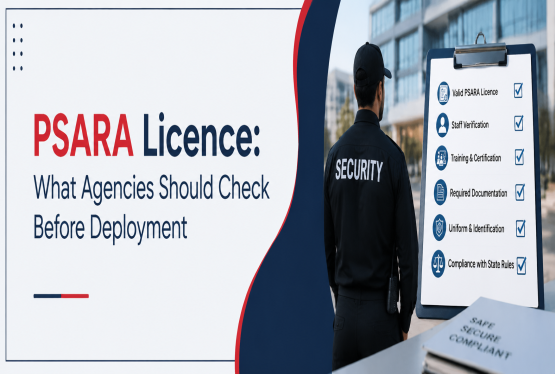



The Private Security Agencies Regulation Act, 2005, commonly known as PSARA, regulates private security agencies in India. Any person or entity planning to start a private security agency must obtain a PSARA licence from the State Controlling Authority before commencing operations. One of the most important steps in this licensing process is police verification.
Police verification under PSARA is conducted to check the character and antecedents of the applicant, directors, partners, proprietors and, in many cases, security guards and supervisors. Since private security agencies deal with public safety, manpower deployment, premises protection and sensitive client locations, the law requires proper background verification before approval or deployment. The Ministry of Home Affairs lists the Private Security Agencies Regulation Act, 2005 and related rules as the governing framework for regulation of private security agencies in India.
Meaning of Police Verification under PSARA
Police verification under PSARA means checking whether the applicant or concerned person has any criminal record, adverse police report, doubtful background or security-related concern. It helps the licensing authority decide whether the applicant is fit to run a private security agency. The verification is generally carried out by the local police authority based on the residential address, business address and details submitted in the PSARA application. Depending on the state rules, verification may be required for the proprietor, partners, directors, principal officer, guards and supervisors.
Why Police Verification Is Required
Private security agencies deploy guards at residential societies, companies, factories, banks, malls, hospitals, educational institutions and other sensitive locations. These guards may control entry, monitor visitors, handle emergency situations and protect property. Therefore, police verification is required to ensure that persons connected with the agency do not have serious criminal antecedents or doubtful conduct. It protects clients, employees, public institutions and society at large. In recent enforcement discussions, authorities have also highlighted the need for employee verification and proper documentation by private security agencies.
Who Needs Police Verification under PSARA?
Police verification may be required for the following persons:
- Proprietor of the security agency
- Partners of a partnership firm
- Directors of a company
- Designated partners of an LLP
- Principal officer or authorised representative
- Security guards
- Supervisors
- Key managerial or operational staff, wherever applicable
The exact requirement may differ from state to state because PSARA is implemented through state-level rules and procedures.
Documents Required for Police Verification
The common documents required for police verification under PSARA include:
- Aadhaar card
- PAN card
- Passport-size photograph
- Address proof
- Identity proof
- Proof of business address
- Affidavit or declaration
- Details of directors, partners or proprietor
- Incorporation documents of the entity
- Application form for character and antecedent verification
- Police verification form, as prescribed by the state
- Self-declaration regarding criminal record, if required
Some states may also ask for residence details for a specific number of previous years, local police station details, or separate forms for guards and supervisors.
Step-by-Step Police Verification Process under PSARA
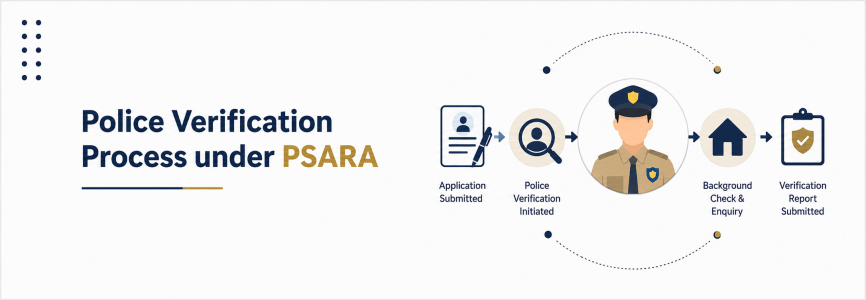
1. Preparation of Documents
The applicant must first collect all identity, address, business and entity-related documents. The details should be accurate and consistent across PAN, Aadhaar, incorporation documents and address proof.
2. Filing of PSARA Application
The PSARA application is filed before the State Controlling Authority. The application generally includes details of the applicant, business entity, registered office, directors or partners, training arrangement, manpower plan and required documents.
3. Submission of Police Verification Forms
Along with the licence application, police verification or character antecedent forms may be submitted. These forms contain personal details, address history, identity proof and declarations. In some states, police verification is initiated online through the PSARA portal, while in others, physical forms may still be required.
4. Forwarding to Police Authority
After submission, the application is forwarded to the concerned police authority. The police may verify the applicant’s residential address, business address and criminal background. The report may be handled by the local police station, district police office or higher police authority, depending on the state rules.
5. Field Verification
In many cases, a police officer may visit the residential or business address of the applicant. The officer may check whether the applicant actually resides or operates from the given address. The police may also ask basic questions about the applicant’s business, occupation, family details or local reference.
6. Criminal Record Check
The police authority checks whether the applicant has any pending criminal case, conviction, adverse report or security concern. A clean record supports the PSARA application. If any adverse record is found, the application may be delayed, questioned or rejected depending on the seriousness of the matter.
7. Submission of Police Report
After verification, the police submit a report to the Controlling Authority. This report may be favourable, adverse or pending due to incomplete information. A favourable report helps the applicant move forward in the PSARA licensing process.
8. Review by Controlling Authority
The Controlling Authority reviews the police verification report along with the PSARA application and other documents. If everything is satisfactory, the licence may be approved. If there is any deficiency, the authority may issue a clarification or require additional documents.
Police Verification of Security Guards
Apart from the applicant or agency owner, security guards and supervisors also require character and antecedent verification. State rules generally require the agency to satisfy itself about the character and antecedents of guards before deployment.
For example, Delhi rules mention verification of character and antecedents of guards and supervisors, including verification by the agency, certificate produced by the person, or report from the police authority. This means private security agencies should not casually hire guards without proper identity checks, address proof and background verification.
Importance of Maintaining Verification Records
A PSARA-licensed agency should maintain proper records of all guards and supervisors. These records may include:
- Name and photograph
- Address proof
- Identity proof
- Police verification status
- Training record
- Date of joining
- Deployment location
- Employment details
- Attendance and duty record
- Exit details, if the person leaves employment
Maintaining these records helps the agency prove compliance during inspection, renewal or enquiry.
Common Reasons for Delay in Police Verification
Police verification under PSARA may be delayed due to:
- Incorrect address
- Name mismatch in documents
- Incomplete form
- Missing identity proof
- Pending criminal case
- Non-availability during police visit
- Wrong police station jurisdiction
- Unclear business premises details
- Incomplete director or partner details
- Delay in report submission by police authority
To avoid delay, applicants should ensure that all documents are complete, updated and properly matched.
What Happens If Police Verification Is Adverse?
If the police report is adverse, the PSARA application may be rejected or kept pending. The applicant may be asked to submit clarification, supporting documents or explanation. An adverse report does not always mean automatic rejection, but serious criminal background, false information or security concerns can affect approval. The final decision is generally taken by the Controlling Authority based on the Act, state rules and facts of the case.
Role of the Controlling Authority
The Controlling Authority is responsible for granting, renewing, suspending or cancelling PSARA licences. Police verification is only one part of the overall approval process. The authority also checks eligibility, documents, training arrangements, business premises, compliance capability and prescribed fees before granting the licence.
Practical Compliance Tips
Private security agencies should follow these practical steps:
- Verify every guard before deployment.
- Keep police verification records safely.
- Do not submit false address or identity details.
- Maintain proper employee files.
- Update records when guards change location.
- Use written employment and deployment records.
- Train guards as per PSARA requirements.
- Renew licence before expiry.
- Cooperate with police and licensing authority.
- Avoid hiring persons with doubtful background.
Conclusion
Police verification under PSARA is not just a formality. It is a key compliance requirement that helps ensure trust, safety and accountability in the private security industry. A security agency handles sensitive responsibilities, and therefore the background of its owners, officers and guards must be properly checked. Proper documentation, timely verification and clean records can make the PSARA licence process smoother and reduce the risk of rejection, delay or future penalty. For every private security agency, police verification should be treated as a core compliance step before starting operations and before deploying manpower at client locations.
FAQs
Q1. What is police verification under PSARA?
Ans. Police verification is the process of checking the character, address and criminal background of the applicant and relevant persons connected with a private security agency.
Q2. Is police verification mandatory for PSARA licence?
Ans. Yes, police verification is generally required as part of the PSARA licensing process. The exact procedure may vary from state to state.
Q3. Who conducts police verification under PSARA?
Ans. The concerned local police authority conducts verification and submits its report to the Controlling Authority.
Q4. Is police verification required for security guards?
Ans. Yes, guards and supervisors generally need character and antecedent verification before being deployed by a private security agency.
Q5. Can PSARA licence be rejected due to adverse police report?
Ans. Yes, an adverse police report may lead to rejection or delay, especially if serious criminal or security concerns are found.
Q6. How long does police verification take?
Ans. The timeline differs by state and police jurisdiction. Delays may happen if documents are incomplete or address details are incorrect.
Q7. What documents are needed for police verification?
Ans. Common documents include Aadhaar, PAN, address proof, photographs, business proof, verification form and self-declaration.
Q8. Can a guard work before police verification is completed?
Ans. This depends on state rules and agency policy. However, proper verification should be completed before regular deployment to avoid compliance risk.
Q9. What if the applicant has changed address recently?
Ans. The applicant should provide correct current and previous address details with valid proof to avoid verification delay.
Q10. Why is police verification important for security agencies?
Ans. It helps ensure that only trustworthy and properly verified persons are involved in private security services.


_crop10_thumb.jpg)





_for_FY_2025-26_crop10_thumb.jpg)





_learn_crop10_thumb.jpg)


_Filing_Due_Dates_for_FY_2024-25_learn_crop10_thumb.jpeg)




_of_GST_Act_learn_crop10_thumb.jpg)


_Under_GST_learn_crop10_thumb.jpg)


_crop10_thumb.jpg)


_crop10_thumb.jpg)


_learn_crop10_thumb.jpg)


_of_the_Income_Tax_Act_learn_crop10_thumb.jpg)


_learn_crop10_thumb.jpg)


_learn_crop10_thumb.jpg)


_crop10_thumb.jpg)





_in_The_Income_Tax_Act,_1961_learn_crop10_thumb.jpg)


_learn_crop10_thumb.jpg)


_of_the_Income_Tax_Act_learn_crop10_thumb.jpg)

_Of_Income_Tax_Act_learn_crop10_thumb.jpg)


_learn_crop10_thumb.jpg)


_learn_crop10_thumb.jpg)
_crop10_thumb.jpg)



_learn_crop10_thumb.jpg)
_for_Import_and_Export_learn_crop10_thumb.jpg)


















_crop10_thumb.jpg)