


Private security agencies play an important role in maintaining safety and security across commercial establishments, residential societies, industries, educational institutions, hospitals, and other organisations. With increasing demand for professional security services, agencies must ensure that their operations follow the law established by the government. In India, private security agencies are regulated under the Private Security Agencies Regulation Act, 2005 (PSARA). The Act provides guidelines for establishing and operating private security agencies and makes obtaining a PSARA Licence mandatory before providing security services.
However, obtaining a PSARA Licence is only the first step. A security agency must also ensure that proper checks are completed before deploying security guards at any client location. From verifying personnel credentials to maintaining training standards and documentation, every stage of deployment requires careful compliance. A properly managed deployment process not only helps agencies maintain legal compliance but also improves service quality, client trust, and operational efficiency.
Understanding PSARA Licence
The Private Security Agencies Regulation Act, 2005 was introduced to regulate private security agencies operating in India. The Act aims to ensure that security agencies provide professional services through trained and verified personnel. A PSARA Licence is issued by the respective Controlling Authority appointed by the state government. It allows a private security agency to legally provide security services within the permitted jurisdiction.
Security agencies involved in activities such as:
- Providing security guards
- Providing armed or unarmed security services
- Managing security personnel for private organisations
- Offering security-related manpower solutions
are generally required to obtain a PSARA Licence before starting operations.
Why PSARA Compliance Matters Before Deployment
Deployment of security personnel involves direct responsibility for the safety of people, property, and assets. Therefore, agencies must ensure that every security guard deployed at a site meets required standards.
Non-compliance can create several challenges, including:
- Legal complications
- Loss of client confidence
- Operational risks
- Contractual issues
- Regulatory penalties
A proper pre-deployment verification system helps agencies ensure that only qualified and compliant personnel are assigned to security duties.
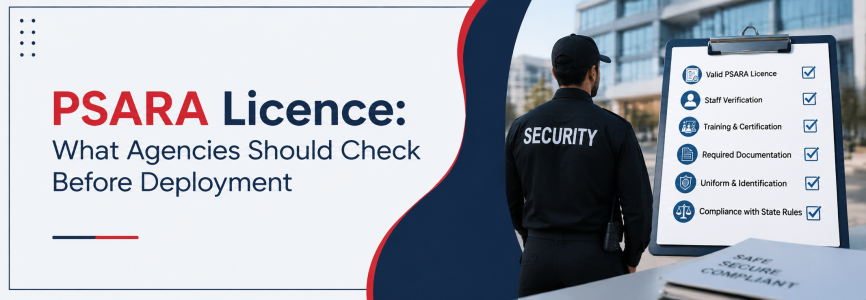
Key Checks Agencies Should Perform Before Security Guard Deployment
1. Verify Valid PSARA Licence Status
Before accepting security contracts or deploying guards, agencies should ensure that their PSARA Licence is valid and active.
Important checks include:
- Licence validity period
- Approved state jurisdiction
- Permitted activities
- Renewal status
- Compliance with applicable state rules
Operating without a valid licence can lead to regulatory action and may affect the agency’s credibility in the market. Agencies should also regularly monitor licence renewal timelines to avoid disruption in operations.
2. Complete Background Verification of Security Guards
One of the most important responsibilities of a private security agency is conducting proper background verification of security personnel.
Before deployment, agencies should verify:
- Identity documents
- Residential address
- Previous employment details
- Criminal background records
- Character verification
Background checks help reduce security risks and ensure that deployed guards are suitable for handling sensitive responsibilities. A systematic verification process also demonstrates professionalism and builds confidence among clients.
3. Ensure Security Guards Meet Eligibility Requirements
Security agencies should confirm that every security guard satisfies the eligibility criteria prescribed under applicable rules.
Generally, agencies should check:
- Age requirements
- Physical fitness
- Educational qualifications where applicable
- Identity documentation
- Medical fitness
Deploying trained and eligible personnel improves the effectiveness of security operations.
4. Provide Mandatory Training Before Deployment
Training is a crucial part of security guard preparation.
A security guard should receive training related to:
- Security procedures
- Access control management
- Emergency response
- Fire safety awareness
- First aid basics
- Crowd management
- Communication skills
- Surveillance practices
Proper training enables guards to respond effectively during emergencies and perform their duties professionally. Agencies should maintain records of training provided to each security guard.
5. Verify Uniform and Identification Requirements
Security personnel represent the agency at the client’s premises. Therefore, maintaining proper identification standards is essential.
Before deployment, agencies should ensure:
- Approved uniform
- Identity card
- Agency identification details
- Required badges or markings
- Professional appearance
Proper identification helps visitors and employees recognise authorised security personnel. It also prevents confusion between authorised guards and unauthorised individuals.
6. Maintain Complete Employee Documentation
Before deployment, agencies should maintain proper records of every security guard.
Important documents may include:
- Aadhaar card or identity proof
- Address proof
- Photographs
- Training certificates
- Medical fitness records
- Employment records
- Police verification documents
Maintaining organised records helps agencies respond quickly during inspections, client audits, or regulatory reviews.
7. Understand Client Site Requirements
Every client location has different security requirements. A residential society, warehouse, hospital, corporate office, and industrial facility may require different security arrangements.
Before deployment, agencies should understand:
- Site location
- Security risks
- Number of guards required
- Working shifts
- Entry and exit procedures
- Emergency protocols
- Special security instructions
A proper site assessment helps agencies deploy suitable personnel according to the client’s needs.
8. Prepare Duty Allocation and Deployment Plan
A structured deployment plan helps avoid confusion and improves operational control.
Agencies should define:
- Guard responsibilities
- Shift timings
- Reporting structure
- Supervisor details
- Emergency contact information
A well-prepared duty allocation system ensures smooth coordination between the agency, guards, and clients.
9. Ensure Supervisor Availability
Security supervisors play an important role in monitoring deployed guards and maintaining service quality.
Before deployment, agencies should decide:
- Supervisor assignment
- Inspection schedules
- Reporting mechanism
- Complaint handling process
Regular supervision helps identify operational issues and ensures that guards follow client instructions properly.
10. Maintain Compliance Records
Documentation is an essential part of PSARA compliance.
Agencies should maintain records related to:
- Security guard deployment
- Training
- Attendance
- Salary payments
- Client agreements
- Licence documents
- Employee verification
Proper record management helps agencies demonstrate compliance whenever required.
Common Mistakes Security Agencies Should Avoid
Deploying Guards Without Proper Verification
One of the biggest mistakes agencies make is deploying personnel without completing background checks. This can create security risks and negatively impact the agency’s reputation.
Ignoring Training Requirements
Security services require skills and preparedness. Deploying untrained guards may affect service quality and emergency response capabilities.
Failure to Maintain Records
Missing documentation can create difficulties during inspections and client audits. Agencies should maintain updated records throughout their operations.
Providing Services Without Proper Licence Coverage
A PSARA Licence is issued for specific states and conditions. Agencies should ensure that their operations fall within the permitted scope.
Not Updating Client Agreements
Security contracts should clearly mention:
- Scope of services
- Number of guards
- Responsibilities
- Payment terms
- Compliance obligations
Clear agreements reduce disputes between agencies and clients.
Role of Technology in Security Agency Compliance
Modern security agencies are increasingly adopting technology to improve deployment management.
Technology solutions can help with:
- Digital attendance tracking
- Guard monitoring systems
- Mobile reporting applications
- Training management
- Client communication platforms
Using technology improves transparency and allows agencies to manage large-scale operations efficiently.
Benefits of Following Proper Deployment Checks
A compliant deployment process provides several advantages:
Improved Client Trust
Clients prefer agencies that follow proper verification and compliance procedures.
Better Security Services
Trained and verified guards can provide more reliable protection.
Reduced Legal Risks
Following PSARA requirements helps agencies avoid compliance issues.
Stronger Business Reputation
Professional compliance practices improve market credibility.
How Compliance Calendar LLP Helps with PSARA Licence and Compliance
Managing PSARA requirements can involve multiple legal and procedural steps. Compliance Calendar LLP assists security agencies with professional support for:
- PSARA Licence application
- Document preparation
- Compliance guidance
- Renewal assistance
- Regulatory support
With proper guidance, agencies can focus on providing quality security services while ensuring compliance with applicable requirements.
Conclusion
A PSARA Licence provides the legal foundation for operating a private security agency in India, but compliance does not end after obtaining the licence. Proper planning before deployment is equally important for maintaining service quality and meeting regulatory expectations.
Security agencies should carefully check licence validity, personnel verification, training standards, documentation, uniforms, and client requirements before deploying guards. A systematic compliance approach helps agencies build trust, improve operational efficiency, and provide professional security solutions. By following proper PSARA guidelines, security agencies can create a stronger foundation for sustainable growth in the private security sector.
FAQs
Q1. What is a PSARA Licence?
Ans. A PSARA Licence is a mandatory approval required for private security agencies operating in India. It regulates the functioning of security agencies and ensures that security services are provided through trained and verified personnel.
Q2. Is PSARA Licence mandatory before deploying security guards?
Ans. Yes, private security agencies generally need a valid PSARA Licence before providing security services or deploying guards for clients.
Q3. What checks should be completed before security guard deployment?
Ans. Agencies should verify guard backgrounds, training records, identity documents, eligibility requirements, uniform standards, and site-specific security requirements before deployment.
Q4. Why is background verification important for security guards?
Ans. Background verification helps agencies confirm the identity, history, and suitability of security personnel before assigning them responsibilities involving safety and protection.
Q5. Do security guards require training before deployment?
Ans. Yes, security guards should receive appropriate training related to security procedures, emergency response, safety practices, and professional conduct before deployment.
Q6. Can a security agency operate without a PSARA Licence?
Ans. Operating a private security agency without the required PSARA Licence may result in legal consequences and regulatory action.
Q7. How long is a PSARA Licence valid?
Ans. The validity period of a PSARA Licence depends on applicable state rules and approval conditions. Agencies should monitor renewal requirements to continue operations smoothly.
Q8. What documents should security agencies maintain?
Ans. Agencies should maintain licence documents, employee records, verification documents, training certificates, attendance records, and client agreements.
Q9. Can PSARA Licence holders provide services in multiple states?
Ans. A PSARA Licence is generally issued according to state-specific requirements. Agencies planning expansion into other states may need to fulfil additional licensing requirements.
Q10. How can agencies ensure PSARA compliance after obtaining the licence?
Ans. Agencies should maintain updated records, conduct regular training, monitor guard deployment, follow reporting requirements, and ensure compliance with applicable state regulations.


_crop10_thumb.jpg)





_for_FY_2025-26_crop10_thumb.jpg)





_learn_crop10_thumb.jpg)


_Filing_Due_Dates_for_FY_2024-25_learn_crop10_thumb.jpeg)





_of_GST_Act_learn_crop10_thumb.jpg)


_Under_GST_learn_crop10_thumb.jpg)


_crop10_thumb.jpg)


_crop10_thumb.jpg)


_learn_crop10_thumb.jpg)


_of_the_Income_Tax_Act_learn_crop10_thumb.jpg)


_learn_crop10_thumb.jpg)



_learn_crop10_thumb.jpg)


_crop10_thumb.jpg)





_in_The_Income_Tax_Act,_1961_learn_crop10_thumb.jpg)


_learn_crop10_thumb.jpg)


_of_the_Income_Tax_Act_learn_crop10_thumb.jpg)

_Of_Income_Tax_Act_learn_crop10_thumb.jpg)


_learn_crop10_thumb.jpg)


_learn_crop10_thumb.jpg)
_crop10_thumb.jpg)




_learn_crop10_thumb.jpg)
_for_Import_and_Export_learn_crop10_thumb.jpg)






























_crop10_thumb.jpg)