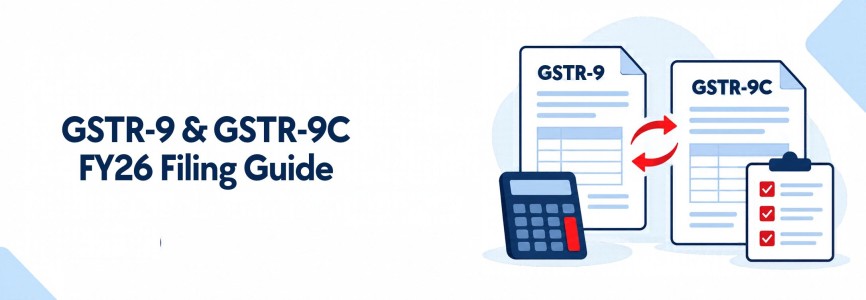



Annual GST compliance involves reviewing the transactions reported during the financial year, reconciling them with accounting records and identifying differences in turnover, tax liability and input tax credit. For applicable taxpayers, this process includes filing Form GSTR-9 and Form GSTR-9C. Although these forms relate to the same financial year, they perform different functions.
GSTR-9 presents the annual GST position, while GSTR-9C explains the reconciliation between financial statements and GST disclosures. Preparing them accurately requires a review of sales, purchases, credit notes, tax payments, input tax credit and adjustments reported in subsequent periods. In this article, FY26 refers to the financial year beginning on 1 April 2025 and ending on 31 March 2026. The normal deadline for the applicable GSTR-9 and GSTR-9C filings is 31 December 2026, subject to any notified extension.
What Is GSTR-9?
GSTR-9 is the annual return filed by applicable regular taxpayers under GST. It consolidates prescribed information relating to outward supplies, inward supplies, input tax credit, tax payments, refunds, demands and other relevant disclosures. Businesses report transactions through monthly or quarterly GST returns during the year. The annual return requires them to examine that information together and present the annual position in the prescribed format.
For example, a business may have issued an invoice during March 2026 but reported it in a subsequent period. It may also have reversed certain input tax credit during the year or corrected an earlier outward supply disclosure. These transactions must be reviewed and reflected according to the annual return instructions. GSTR-9 should therefore be prepared using both the filed returns and the underlying books of accounts. System-generated figures provide a starting point, but they do not replace the taxpayer’s responsibility to verify the information.
What Is GSTR-9C?
GSTR-9C is a self-certified reconciliation statement applicable to specified taxpayers whose aggregate turnover exceeds the prescribed limit. Its purpose is to reconcile the financial statements with the annual GST return. The statement identifies differences in turnover, taxable value, tax liability and input tax credit and requires appropriate explanations.
The figure reported as revenue in financial statements may differ from GST turnover because accounting principles and GST provisions do not always recognise transactions in the same way or at the same time. GSTR-9C provides a structured method of explaining these differences. Under the current requirements, GSTR-9C is self-certified by the taxpayer. The earlier requirement for separate certification of the reconciliation statement by a chartered accountant or cost accountant has been removed. However, self-certification does not remove a financial statement audit requirement arising under company law, income-tax law or another applicable law.
Legal Provisions Governing Annual GST Compliance
Section 44 of the CGST Act
Section 44 provides the statutory basis for annual GST returns. It requires covered registered persons to furnish the annual return and permits the inclusion of a self-certified reconciliation statement. The section also identifies excluded categories and allows notified exemptions. Businesses should therefore assess annual filing obligations by considering the statutory provisions, applicable notifications and their registration category.
Rule 80 of the CGST Rules
Rule 80 prescribes the annual return requirements, including the normal filing deadline and the turnover threshold for GSTR-9C. Under the general rule, GSTR-9 is due by 31 December following the end of the relevant financial year. GSTR-9C is also required by that date where the taxpayer falls within its scope.
Section 47 of the CGST Act
Section 47 governs late fees for delayed return filing. The applicable annual return late fee must be read with notifications providing reduced amounts for specified turnover categories. Late fees are separate from additional tax and interest. A taxpayer who files late and also identifies unpaid tax may need to address each liability independently.
Difference Between GSTR-9 and GSTR-9C
| Particulars | GSTR-9 | GSTR-9C |
| Nature | Annual GST return | Self-certified reconciliation statement |
| Main purpose | Presents annual GST disclosures | Explains differences between financial statements and GST disclosures |
| General applicability | Applicable above Rs.2 crore aggregate turnover, subject to exclusions | Applicable where aggregate turnover exceeds Rs.5 crore, subject to exclusions |
| Information reviewed | Supplies, ITC, tax paid and other prescribed details | Turnover, taxable value, tax and ITC reconciliation |
| Filing responsibility | Taxpayer | Taxpayer |
| Normal FY26 deadline | 31 December 2026 | 31 December 2026 |
These thresholds apply alongside the relevant exclusions and exemptions. The assessment should use aggregate turnover as defined under GST rather than an informal estimate of sales.
Applicability of GSTR-9 and GSTR-9C for FY26
Aggregate Turnover Up to Rs.2 Crore
Registered persons whose aggregate turnover does not exceed Rs.2 crore are exempt from filing the annual return under the notification applicable from FY 2024–25 onwards. This exemption covers FY 2025–26 under the current provisions. A business should nevertheless calculate turnover correctly before concluding that it is exempt.
Exemption from the annual return does not remove other obligations. Applicable periodic returns, tax payments, recordkeeping and responses to departmental communications must continue.
Aggregate Turnover Above Rs.2 Crore and Up to Rs.5 Crore
Applicable regular taxpayers within this turnover range must file GSTR-9. GSTR-9C is not required solely because turnover exceeds Rs.2 crore. For instance, an otherwise covered taxpayer with aggregate turnover of Rs.4.5 crore would generally file GSTR-9 without GSTR-9C.
The business must still perform sufficient reconciliation to prepare the annual return accurately, even though a separate reconciliation statement is not required.
Aggregate Turnover Exceeding Rs.5 Crore
Applicable taxpayers whose aggregate turnover exceeds Rs.5 crore must file both GSTR-9 and GSTR-9C. The word “exceeds” is important. Turnover of exactly Rs.5 crore does not trigger GSTR-9C solely under this threshold.
Once both forms apply, the business should prepare them together. Completing the reconciliation statement before finalising GSTR-9 can reveal differences that would otherwise be discovered only after the annual return has been filed.
Meaning of Aggregate Turnover
Aggregate turnover is calculated on an all-India basis for persons having the same PAN. It includes the values specified in the statutory definition, such as taxable supplies, exempt supplies, exports and inter-State supplies.
GST and cess are excluded. Inward supplies on which the recipient pays tax under reverse charge are also excluded from this calculation. Aggregate turnover should not be confused with taxable turnover alone. A business with substantial exempt supplies may cross the annual filing threshold even where its taxable sales are comparatively low.
Example of PAN-Based Turnover
Suppose a company has turnover of Rs.3.4 crore under its Delhi GST registration and Rs.2.2 crore under its Maharashtra registration. Its combined turnover is Rs.5.6 crore, assuming no further adjustments are required. GSTR-9C applicability must be assessed using this combined amount rather than testing each registration separately against Rs.5 crore. The relevant filings are then prepared GSTIN-wise, supported by a reconciliation allocating the financial statement figures to each registration.
Taxpayers Outside the General GSTR-9 Requirement
Specified categories are excluded from the general annual return requirement. These include Input Service Distributors, persons paying tax under Section 51 or Section 52, casual taxable persons and non-resident taxable persons. The law also provides an exclusion for specified government departments and local authorities whose accounts are subject to the prescribed public audit arrangements.
These exclusions should be understood in relation to the relevant registration. An entity’s regular business GST registration should not automatically be treated as exempt merely because the entity separately holds a TDS registration. Composition taxpayers follow the annual compliance requirements applicable to their category rather than the regular taxpayer’s GSTR-9 process. Where a taxpayer changed registration category during the year, the relevant periods and obligations require separate examination.
Important Due Dates for FY 2025–26
| Compliance requirement | Relevant date |
| Financial year covered | 1 April 2025 to 31 March 2026 |
| Normal GSTR-9 filing deadline | 31 December 2026 |
| Normal GSTR-9C filing deadline | 31 December 2026 |
| General Section 16(4) cut-off for taking FY26 ITC | 30 November 2026 or furnishing the relevant annual return, whichever is earlier |
Businesses should distinguish between the annual filing deadline and the earlier limits governing credit claims or corrections.
Why the ITC Cut-Off Matters
Under the general Section 16(4) rule, input tax credit relating to an invoice or debit note cannot be taken after 30 November following the relevant financial year or furnishing the annual return, whichever is earlier. Therefore, filing GSTR-9 before completing the ITC review can shorten the ordinary time available to take eligible credit.
For example, a business planning to file its annual return during October 2026 should first complete the review of eligible FY26 invoices. It should not assume that filing the annual return leaves the ordinary credit window open until November. Fresh credit must be taken through the prescribed return mechanism and must satisfy all applicable conditions. Entering an amount in GSTR-9 does not itself create an ITC claim.
Documents and Records Required
Annual GST compliance becomes easier when the business prepares a complete working file before beginning the forms.
| Record | Purpose |
| Financial statements | Establish the annual accounting position |
| Trial balance and general ledger | Identify relevant balances and adjustments |
| Sales register | Verify outward supplies and tax classifications |
| Purchase and expense registers | Review credit eligibility and reverse charge |
| Credit and debit note registers | Examine transaction adjustments |
| GSTR-1, GSTR-1A and IFF data, where applicable | Verify outward supply reporting |
| GSTR-3B returns | Verify tax liabilities, credit and payments |
| GSTR-2B downloads | Support invoice-level ITC review |
| Table 8A document details | Explain annual credit differences |
| Import and export records | Support cross-border disclosures |
| Electronic ledgers | Verify payment and credit utilisation |
| DRC-03 acknowledgements | Track additional amounts already paid |
| GSTIN-wise reconciliation schedules | Support allocation across registrations |
The records should be organised so that each material annual return figure can be traced back to its supporting transactions.
Turnover Reconciliation for Annual GST Filing
Reconcile the Sales Register with Outward Supply Returns
The first step is to compare the sales register with GSTR-1 and other applicable outward supply statements. The review should cover taxable value, GST amounts, customer classifications, exports, credit notes, debit notes and amendments.
Differences may arise because an invoice was omitted, reported twice, entered under the wrong GSTIN or disclosed in a later period. Each difference should be identified and assigned an appropriate explanation. Simply changing the sales register total to match the return does not resolve the underlying issue.
Compare Outward Supply Reporting With GSTR-3B
The next step is to compare outward supply information with the liability declared in GSTR-3B. An invoice may have been correctly reported in GSTR-1 while the related tax was not included in GSTR-3B. Alternatively, tax may have been paid even though the outward supply disclosure was incomplete.
The reconciliation should distinguish a reporting error from a payment shortfall. This distinction determines whether the business needs a correction, additional payment or an explanation supported by records.
Reconcile Accounting Revenue with GST Turnover
Accounting revenue may differ from turnover under GST because of timing, valuation or transaction treatment. Potential differences include advances, unbilled revenue, asset disposals, branch transactions and journal adjustments.
For example, an amount may be recognised as revenue under an accounting policy in a different period from the applicable GST time of supply. The correct approach is to explain the difference and assess its tax impact. Every accounting difference should be examined on its facts. It should not automatically be treated as additional taxable turnover.
Input Tax Credit Reconciliation
ITC reconciliation should examine both amounts and eligibility. Matching the annual total in the purchase register with GSTR-3B is insufficient where the underlying invoices contain timing differences or ineligible credit.
Match Purchase Records With GSTR-2B
Compare the purchase and expense registers with the relevant GSTR-2B information. Common differences include invoices missing from supplier reporting, incorrect recipient GSTINs, duplicate accounting entries and documents appearing in a later period.
A document appearing in GSTR-2B is an important part of the review, but it does not establish every condition for credit. The business must separately consider receipt, business use, documentation and other statutory requirements.
Identify Blocked or Ineligible Credit
The business should examine expenditure for restrictions under the applicable ITC provisions. Transactions requiring attention may include personal expenses, specified employee-related expenditure, certain motor vehicle costs and construction-related expenses.
The legal treatment depends on the facts and any applicable exceptions. The working should record why credit was accepted, reversed or excluded. This provides a clearer basis for annual reporting than relying only on ledger names.
Review Credit Reversals
Businesses should review reversals arising from the relevant legal requirements, including those connected with supplier payment, exempt supplies, non-business use or other specified circumstances.
Temporary reversals should be distinguished from permanent ineligibility. The business should also track whether a later event allowed the credit to be reclaimed. Without separate records, the same amount may be omitted, duplicated or placed in the wrong annual return category.
Separate Fresh Credit from Reclaims
A reclaim of credit reversed earlier is different from a fresh claim against an invoice. This distinction matters when completing annual return tables. Businesses should maintain separate schedules for current-year credit, previous-year credit, reversals and reclaims.
The reporting should follow the applicable form instructions. An earlier year’s treatment should not be copied without checking whether it remains appropriate.
Explain Table 8A Differences
Table 8A uses system-derived credit information based on the applicable GSTR-2B data. Differences between Table 8A and credit actually claimed can arise for several reasons. These may include timing, ineligibility, reversals and documents requiring separate treatment.
A difference should be investigated before deciding its effect. It should not automatically be treated as excess credit or as an amount available for a fresh claim.
Reverse Charge Review
Reverse-charge liabilities are often identified through expense-ledger review rather than the sales register. Businesses should examine transactions that may fall within notified reverse-charge provisions, including relevant domestic services and imports of services.
The review should identify the nature of the transaction, applicable provision, taxable value, tax payment and related credit treatment. Not every purchase from an unregistered supplier attracts reverse charge. Applicability depends on the relevant statutory provision and notification. A separate reverse-charge schedule helps connect the liability discharged with the accounting records and any credit subsequently taken.
Important Disclosures in GSTR-9
-
Outward and Inward Supply Information: The annual return requires classification of relevant supplies under the prescribed categories. Businesses should distinguish taxable supplies from exempt, nil-rated, non-GST and other reportable transactions. Credit notes, debit notes and amendments should be reviewed to prevent duplication.
-
Input Tax Credit Information: The ITC disclosures should reconcile credit availed, reversals, ineligible amounts and other prescribed categories. The figures should be supported by workings that explain differences between accounting records, system-generated information and filed returns.
-
Tax Paid: The return includes prescribed information concerning tax liability and payment. Businesses should verify tax heads and the relationship between cash payments, credit utilisation and amounts discharged separately.
-
Subsequent-Period Adjustments: Transactions relating to FY26 may have been reported or adjusted during the following financial year within the permitted time. These items require separate tracking so that the annual return reflects the correct financial year without duplicating amounts.
-
Other Disclosures: Refunds, demands, HSN summaries and other applicable information should be reviewed against supporting records. Businesses should check the FY26 form instructions and portal validations before assuming that a disclosure is optional.
Important Reconciliations in GSTR-9C
-
Turnover Reconciliation: The turnover reconciliation connects the relevant financial statement figure with the turnover reported for GST purposes. For a business with multiple registrations, the GSTIN-wise allocation should be supported by reliable schedules. Any difference between the financial statements and registration-level records should be explained.
-
Taxable Turnover and Tax Reconciliation: The reconciliation should examine whether the correct tax was determined on the relevant transactions. Rate differences, omitted liabilities, classification errors and reverse-charge items should be considered separately. An unexplained difference should not be removed merely by inserting a balancing amount.
-
ITC Reconciliation: The ITC reconciliation connects accounting records with annual GST credit disclosures. Timing differences, ineligible amounts and other adjustments should be explained clearly. The business should also identify whether an unresolved difference creates an actual liability.
Additional Liability Identified During Reconciliation
Annual review may reveal tax that was not paid through periodic returns. Additional liability declared through annual compliance must be discharged using the appropriate payment procedure, including Form GST DRC-03 where applicable. Merely reporting the liability in GSTR-9 does not establish that payment has been made.
Applicable interest must also be assessed separately. Where the business has already paid an amount, its working should record the payment reference, period and reason. This helps avoid paying the same liability again during annual reconciliation. Similarly, a reconciliation difference does not automatically establish a refund entitlement. Any refund must satisfy the applicable legal requirements and procedure.
Late Fees for GSTR-9 and GSTR-9C
The applicable late fee depends on the turnover category and the relevant statutory concessions.
| Aggregate turnover | Combined daily late fee under CGST and SGST/UTGST | Combined maximum |
| Up to Rs.5 crore, where annual filing is required | Rs.50 | 0.04% of turnover in the State or Union Territory |
| Above Rs.5 crore and up to Rs.20 crore | Rs.100 | 0.04% of turnover in the State or Union Territory |
| Above Rs.20 crore | Rs.200 | 0.50% of turnover in the State or Union Territory |
These combined figures reflect the corresponding Central and State or Union Territory provisions. Any specific notified relief must be examined separately. The turnover category determining the daily rate should be distinguished from the State or Union Territory turnover used for the maximum calculation.
Effect of Delayed GSTR-9C
Where GSTR-9C is required, annual compliance is complete only when both GSTR-9 and GSTR-9C are furnished. Consequently, filing GSTR-9 before the deadline does not prevent late fees if the required GSTR-9C remains pending beyond the due date.
For example, assume that GSTR-9 is filed on 24 December 2026 and the applicable GSTR-9C is filed on 10 January 2027. The delay is assessed through completion of the annual filing, subject to the applicable provisions and any extension. The late fee should not be understood as two independent overlapping annual return charges for the same period.
Step-by-Step Preparation and Filing Process
Step 1: Confirm Applicability
Calculate PAN-based aggregate turnover and identify the relevant registration category. Determine whether the business must file GSTR-9 alone, both forms or qualifies for an exemption. Keep the turnover calculation in the compliance file.
Step 2: Complete Pending Periodic Returns
Check that the applicable periodic returns for FY26 have been filed. Annual return preparation should use a complete set of filed data. Pending returns can affect the availability of the annual return facility and the reliability of the reconciliation.
Step 3: Download GST Data
Download relevant return summaries, GSTR-2B information, Table 8A details and electronic ledgers. Preserve these downloads with clear dates and descriptions so that the review can be reproduced later.
Step 4: Prepare Reconciliation Schedules
Prepare separate schedules for turnover, tax payments, ITC, reverse charge and subsequent-period adjustments. Record the reason for each material difference and identify the action required.
Step 5: Review Outstanding Issues
Examine additional liabilities, missed eligible credit, duplicate entries and transactions requiring legal interpretation. Resolve these issues before finalising the annual return wherever possible.
Step 6: Prepare and Preview GSTR-9
Access the annual return facility, select FY 2025–26 and review the system-populated information. Complete the applicable disclosures and compare the draft with the approved working schedules. Particular attention should be given to non-editable fields and portal validations.
Step 7: Complete GSTR-9C Where Applicable
Prepare the reconciliation statement using the final financial statements and GST workings. Check that explanations are consistent with GSTR-9 and that the prescribed supporting documents are ready.
Step 8: File and Preserve Evidence
Complete authentication through the permitted method and confirm successful filing. Retain filed forms, acknowledgements, reconciliation schedules, supporting documents and payment evidence together.
Can GSTR-9 and GSTR-9C Be Revised?
GSTR-9 cannot be revised after filing. There is also no ordinary revision facility for a filed GSTR-9C. Businesses should therefore review both forms carefully before submission. A successful upload or portal validation does not confirm that the legal treatment is correct.
If a mistake is discovered later, the available response depends on its nature. Additional payment, a documented explanation or another permitted procedure may be required. The business should preserve a clear record of the error, its impact and the action taken.
Common Mistakes to Avoid
A frequent error is testing the turnover threshold separately for each GSTIN instead of calculating PAN-based aggregate turnover. Another is accepting every auto-populated figure without checking the books and underlying documents. Businesses may also overlook reverse-charge expenses, confuse temporary credit reversals with permanent ineligibility or mix previous-year reclaims with fresh current-year ITC.
Timing errors are equally important. The December annual filing deadline does not extend the ordinary November ITC cut-off. Filing the annual return early can also affect that window. Finally, taxpayers should avoid finalising GSTR-9 while leaving the GSTR-9C reconciliation until later. Preparing the forms together can prevent inconsistencies and reduce the risk of incomplete annual compliance.
Conclusion
GSTR-9 and GSTR-9C compliance for FY 2025–26 requires a careful review of turnover, tax liability, input tax credit and financial records. Businesses should determine applicability using PAN-based aggregate turnover and maintain reliable GSTIN-wise reconciliations.
The normal filing deadline of 31 December 2026 should be considered alongside the earlier ITC cut-off and other applicable correction limits. Completing the review early, explaining differences and discharging outstanding liabilities through the correct procedure can help businesses submit accurate annual filings and maintain a clear compliance record.
Frequently Asked Questions (FAQ’s)
Q1. What is the difference between GSTR-9 and GSTR-9C?
Ans. GSTR-9 is the annual return presenting prescribed GST disclosures. GSTR-9C is a self-certified reconciliation statement explaining differences between financial statements and annual GST reporting, including turnover, tax liability and input tax credit.
Q2. Who is required to file GSTR-9 for FY26?
Ans. Applicable regular taxpayers with aggregate turnover exceeding Rs.2 crore must file GSTR-9, subject to statutory exclusions. Registered persons with turnover up to Rs.2 crore are covered by the exemption applicable from FY 2024–25 onwards.
Q3. When is GSTR-9C mandatory?
Ans. GSTR-9C applies to covered taxpayers whose aggregate turnover exceeds Rs.5 crore during the financial year. Turnover is assessed on an all-India PAN basis, while the relevant reconciliation statements are prepared for the applicable GST registrations.
Q4. What is the due date for FY 2025–26?
Ans. The normal deadline for GSTR-9 and applicable GSTR-9C is 31 December 2026, subject to any notified extension. Businesses should complete their ITC review earlier because the annual filing deadline does not extend the ordinary credit-claim time limit.
Q5. Does GSTR-9C require certification by a chartered accountant?
Ans. GSTR-9C is currently self-certified by the taxpayer. Separate certification of the reconciliation statement by a chartered accountant or cost accountant is not required. Financial statement audits required under other applicable laws remain independent obligations.
Q6. Can additional input tax credit be claimed through GSTR-9?
Ans. No. GSTR-9 is not the mechanism for taking fresh ITC. Eligible credit must be taken through the prescribed return process within the applicable time limit and subject to all legal conditions.
Q7. Can GSTR-9 or GSTR-9C be revised after filing?
Ans. GSTR-9 cannot be revised, and there is no ordinary revision facility for GSTR-9C. Taxpayers should check both forms carefully before filing. Any later error must be assessed for the appropriate payment, explanation or other legally permitted response.
Q8. How should additional tax identified during reconciliation be paid?
Ans. Additional tax should be discharged through the applicable payment procedure, including DRC-03 where appropriate. Interest must be assessed separately. Reporting an amount in the annual return does not itself establish payment of that liability.
Q9. Does filing GSTR-9 on time prevent late fees for GSTR-9C?
Ans. No. Where GSTR-9C is required, annual compliance is complete only after both forms are furnished. A delayed reconciliation statement can therefore result in late fees even if GSTR-9 was filed before the deadline.
Q10. Does exemption from GSTR-9 remove other GST obligations?
Ans. No. Annual return exemption does not remove applicable periodic return, tax payment, recordkeeping or other statutory obligations. The business must continue complying with the requirements relevant to its registration and transactions.
Article last updated on : 26 Oct 2026.










_learn_crop10_thumb.jpg)