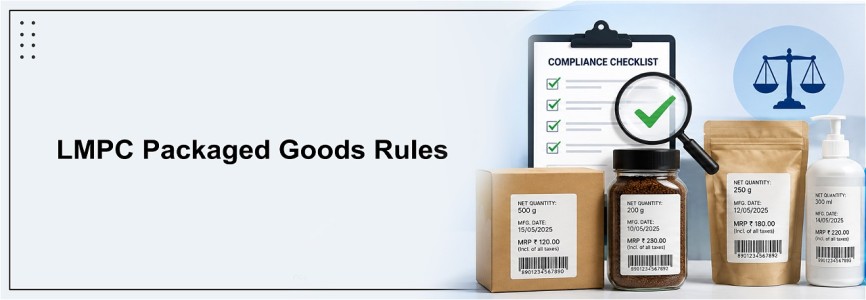



India’s packaged-goods market is governed by several consumer-protection and product-labeling requirements. One of the most important among them is the Legal Metrology (Packaged Commodities) Rules, 2011, framed under the Legal Metrology Act, 2009. These rules prescribe the information that manufacturers, packers and importers must display on pre-packaged commodities before they are offered for sale in India. The objective is to ensure that consumers receive complete and accurate information regarding the identity, quantity, price, origin and responsible business entity connected with a product.
LMPC labeling requirements are important because non-compliance may expose manufacturers, importers, packers, distributors and sellers to inspection, corrective action and penalties. Therefore, businesses should review packaging artwork before printing or importing products and should ensure that all mandatory declarations are clearly visible, legible and consistent with the applicable legal requirements.
What Is LMPC?
LMPC refers to the legal metrology applicable to packaged commodities in India. It operates primarily through the Legal Metrology Act, 2009 and the Legal Metrology (Packaged Commodities) Rules, 2011. These laws regulate how packaged products are measured, declared and presented to consumers. The framework is designed to ensure transparency in transactions involving goods sold by weight, measure or number and to prevent misleading information relating to quantity, price or product identity.
The Rules apply to various categories of packaged goods such as food products, cosmetics, household products, stationery, electronics, toiletries, toys, garments and imported consumer products. However, certain specialised products may also be governed by additional sector-specific labeling requirements.
Meaning of a Pre-Packaged Commodity
A pre-packaged commodity generally refers to a product that is placed in a package before the purchaser is present and where the quantity contained in the package has already been predetermined. The essential feature is that the consumer does not participate in determining the quantity at the time of purchase.
For example, a sealed bottle containing one litre of cooking oil, a 500-gram packet of rice or a package containing ten pens may qualify as pre-packaged commodities. The concept is important because once a product falls within this category, the relevant LMPC declarations become applicable unless a specific exemption is available.
Why LMPC Labeling Is Important
LMPC labeling ensures that consumers are not required to purchase packaged goods without knowing essential product information. A proper label enables the customer to identify the manufacturer or importer, understand the actual quantity being purchased, check the maximum retail price and contact the responsible entity if any complaint arises.
For businesses, proper labeling also reduces the risk of regulatory action and product detention. Therefore, LMPC compliance should form part of the product-launch and packaging-approval process rather than being checked only after goods have already entered the market.
Who Must Comply with LMPC Labeling Rules?
Manufacturers
Manufacturers producing commodities that are packed for retail sale are responsible for ensuring that the package contains the declarations prescribed under the Rules. The manufacturer’s details should be correctly stated, and the quantity, MRP and other relevant information must correspond with the actual product being supplied. Manufacturers should also ensure that changes in address, quantity, packaging or pricing are reflected in the latest packaging artwork.
Packers
A packer may be different from the manufacturer. Where one entity manufactures the product and another packs it, the packaging should identify the relevant businesses in accordance with the Rules. The respective roles should be clearly mentioned so that consumers and regulatory authorities can understand which entity manufactured the product and which entity was responsible for packing it.
Importers
Importers bringing packaged goods into India must ensure that imported packages comply with Indian legal metrology requirements before retail sale. Foreign packaging may not contain declarations such as Indian importer details, Indian MRP, consumer-care information or country-of-origin information in the required format. The importer must therefore review and, where legally permissible, appropriately label the goods for the Indian market.
Brand Owners and Marketers
Brand owners and marketers may also assume responsibility depending on the manner in which their name and address appear on the package. If a label identifies a company as the entity responsible for marketing or selling the goods, the terminology used should be clear. Incorrect or ambiguous representation may create uncertainty regarding responsibility under the Rules.
E-Commerce Businesses
LMPC compliance also extends to the online sale of packaged goods. Mandatory product information that is required under the Rules may also need to be displayed on e-commerce product listings. Therefore, online sellers and marketplaces should ensure that digital product information corresponds with the physical declarations appearing on the actual package.
Mandatory Declarations under LMPC Rules
Name and Address of Manufacturer
A retail package should contain the name and complete address of the manufacturer wherever applicable. The purpose is to allow consumers and enforcement authorities to identify the business responsible for producing the commodity. Merely printing a brand name without identifying the responsible manufacturer may not satisfy the applicable requirements.
The address should be sufficiently complete to identify and communicate with the entity. Businesses should therefore avoid incomplete declarations containing only a city name, abbreviated location or website address where the Rules require a complete address.
Name and Address of Packer
Where the product is packed by an entity different from the manufacturer, the package should appropriately disclose the packer’s name and address. The relationship between the two entities should be clear through descriptions such as “Manufactured by” and “Packed by”.
This distinction becomes important where outsourced packing arrangements are used. Businesses should ensure that contractual arrangements with third-party packers also require compliance with packaging and quantity declarations.
Importer Name and Address
Imported commodities intended for retail sale in India should carry the name and address of the Indian importer. This declaration establishes a responsible entity within India that can be contacted regarding the imported product.
Providing only the overseas manufacturer’s address may be insufficient where Indian importer details are legally required. Importers should therefore verify the package before distribution and ensure that their Indian contact details are correctly stated.
Country of Origin
Imported packaged goods should clearly state the country from which the goods originate. This declaration allows consumers to identify where the product was manufactured or produced. The information should be expressed clearly, such as “Country of Origin: Japan” or “Country of Origin: Vietnam”. Businesses should avoid vague descriptions that do not clearly communicate the actual country of origin.
Common or Generic Name of the Commodity
The package should describe the actual nature of the product through its common or generic name. A trademark or brand name may identify the commercial source of a product but may not adequately explain what the commodity itself is.
For example, where a product is sold under a particular brand, the label may additionally identify it as “Liquid Hand Wash”, “Electric Kettle” or another appropriate generic description. This enables consumers to understand the nature of the goods without relying only on branding.
Net Quantity
The label must specify the quantity of the commodity contained in the package using the appropriate standard unit of weight, measure or number. Examples include 500 g, 1 kg, 750 ml, 2 L or 10 N depending on the product.
The declaration should represent the actual quantity of the commodity and generally exclude the weight of the packaging material. Businesses should maintain appropriate quantity-control systems because a declaration that differs materially from the actual contents may create compliance issues in addition to a labeling defect.
Month and Year of Manufacture, Packing or Import
Where applicable, the month and year of manufacture, packing or import should be declared on the package in the prescribed manner. This information helps consumers identify the age or relevant production period of the product.
The exact declaration may depend on the nature of the goods and sector-specific rules. Therefore, businesses dealing with food, pharmaceuticals, cosmetics or other specially regulated products should also verify whether additional date-related declarations apply.
Best Before or Use by Date
Certain commodities, particularly products that may become unsuitable for consumption or use after a specific period, may require a best-before or use-by declaration. This information helps consumers understand the period during which the product is expected to remain suitable.
Businesses should distinguish between LMPC requirements and sector-specific obligations. For example, packaged food may also be subject to detailed food-labeling regulations, and such additional requirements should be complied with independently.
Maximum Retail Price
The Maximum Retail Price or MRP is one of the most important declarations on retail packaged commodities. It represents the maximum price at which the package may be sold to the consumer and should include applicable taxes.
The MRP should be clearly visible and should not be presented in a manner that confuses the consumer. Businesses should also ensure that the MRP printed on the physical package corresponds with the price information used on websites, marketplaces and other sales channels.
Consumer Care Details
The package should provide appropriate contact details through which a consumer can raise a complaint. These details generally include the responsible entity’s name, address, telephone number and email address as applicable.
Providing active and functional consumer-care information is important because the declaration is intended to provide a genuine grievance-redressal channel. Businesses should periodically verify that customer-care numbers and email addresses printed on packaging remain operational.
Size or Dimensions
Where size or dimensions form an important characteristic of the commodity, the relevant information should be declared in an appropriate manner. This requirement may be particularly relevant for garments, textiles or products sold according to dimensions.
Businesses should use recognised size indicators and metric measurements where required. The labeling approach should accurately correspond with the actual size of the packaged product.
Unit Sale Price
Unit Sale Price helps consumers compare the cost of products sold in different package sizes. Where applicable, the package should indicate the price corresponding to the relevant standard unit such as per gram, kilogram, millilitre, litre, metre or number.
For example, two packages of the same commodity may have different total MRPs because they contain different quantities. Displaying the unit sale price allows the consumer to determine which package provides better value. Businesses should ensure that the calculation is accurate and uses the correct measurement unit.
Principal Display Panel
The Principal Display Panel is the part of the package where mandatory information is prominently displayed. The declarations required under LMPC should be positioned in such a manner that consumers can find and read them without unreasonable difficulty.
Packaging designers should therefore coordinate with the compliance team when deciding the layout. Important declarations should not be placed in hidden corners, below folds or under areas that may later be covered by stickers or seals.
Legibility and Prominence of Declarations
Compliance is not achieved merely by printing mandatory information somewhere on the package. The information must also be readable and sufficiently prominent.
Businesses should avoid extremely small fonts, poor contrast, distorted printing or backgrounds that make declarations difficult to read. Mandatory information should remain visible after the package is sealed, displayed or transported. A compliance review should therefore examine not only the wording of the declarations but also the final printed packaging.
Language of LMPC Declarations
Mandatory declarations may generally be provided in English or Hindi in Devanagari script in accordance with the applicable framework. Businesses may also use additional regional languages depending on their customer base.
Where several languages are used, the translations should remain consistent so that consumers do not receive contradictory information regarding quantity, price, origin or other mandatory particulars.
Use of Stickers on Packages
Stickers are frequently used to add information to imported or already manufactured packaging. However, businesses should not assume that any labeling defect can automatically be corrected through a sticker.
The Rules regulate the alteration of mandatory declarations. Certain additional information may be added through labels where permitted, particularly in relation to imported packages, but stickers should not obscure original mandatory information. Any revision of MRP or other declaration should therefore be carried out strictly in accordance with applicable requirements.
QR Codes, Barcodes and Additional Information
Businesses may include QR codes, barcodes and other digital identifiers on packages for inventory management, customer engagement or additional product information. However, these features generally supplement rather than replace declarations that are required to appear physically on the package.
Accordingly, a company should not move mandatory information exclusively to a QR code unless the applicable law expressly permits such treatment. The principal statutory declarations should continue to be displayed in the prescribed form.
Special Rules for Imported Packages
Imported goods often require additional compliance review because packaging created for overseas markets may not satisfy Indian requirements. Common problems include missing Indian importer details, missing MRP in Indian currency, absence of country-of-origin information and incomplete consumer-care details.
Importers should review product packaging before retail distribution and ensure that all required Indian declarations are included. Where permitted, an appropriate Indian-market label may be added before sale. Importers should also ensure that imported quantity units correspond with recognised Indian legal metrology standards.
LMPC Requirements for E-Commerce
Online product listings should generally reproduce the relevant mandatory declarations required under the LMPC framework, subject to the exclusions and conditions prescribed under the Rules. This means that consumers purchasing goods online should have access to important product information before placing an order.
E-commerce businesses should therefore coordinate product-data management with physical-label compliance. If the physical package states one net quantity, MRP or country of origin but the website states another, the inconsistency may create both consumer and regulatory concerns.
Country-of-Origin Requirements for Online Platforms
Country-of-origin disclosure is particularly relevant to imported goods sold through e-commerce channels. Businesses should maintain accurate product-origin information in their digital databases so that it can be displayed and filtered as required under the applicable rules and amendments.
E-commerce entities dealing with large product inventories should create internal controls for collecting and validating country-of-origin information from sellers, manufacturers and importers rather than relying on manual updates after products are already listed.
Group Packages and Promotional Packs
Businesses frequently sell products through promotional formats such as combo packs, multi-product packs or “Buy Two Get One Free” offers. Such arrangements require careful LMPC review because the applicable declarations may need to appear on the individual retail packages as well as the combined package depending on the structure.
A promotional outer package should therefore not be assumed to replace all declarations required on constituent retail units. The legal classification of the package should be determined before artwork is finalised.
Wholesale Packages
Wholesale packages are treated differently from ordinary retail packages. Packages intended for wholesale distribution may require declarations relating to the identity of the commodity, manufacturer, importer or packer and the quantity or number of retail packages contained within them.
Businesses should therefore distinguish between packages intended for direct consumer sale and packages designed only for wholesale supply. Applying a standard retail template to all packaging may result in unnecessary or incorrect labeling.
Exemptions from Retail Package Requirements
Certain packaged commodities may fall outside some of the retail-package requirements because of their quantity, intended use or classification. Packages above specified weight or volume thresholds and commodities meant exclusively for qualifying industrial or institutional consumers may receive different treatment.
However, exemptions should be applied cautiously. A company should not assume that a package becomes exempt merely because it is sold to a business customer. The nature of the purchaser, intended use, package size and wording such as “Not for Retail Sale” should be examined before relying on an exemption.
LMPC Registration for Manufacturers, Packers and Importers
Labeling compliance should be distinguished from registration compliance. Manufacturers, packers and importers covered by the relevant provisions may also be required to complete registration formalities under the Packaged Commodities Rules.
Obtaining registration does not mean that every product label is automatically compliant. Similarly, printing correct declarations does not eliminate the need to satisfy registration requirements. Businesses should therefore maintain separate controls for entity-level registration and product-level labeling.
Special Position of Medical Devices
Medical devices may be governed simultaneously by LMPC requirements and specialised medical-device regulations. Therefore, businesses should not rely solely on a generic packaged-commodity checklist when labeling medical devices.
The legal team should determine which declarations are governed by the Legal Metrology framework and which arise from the Medical Devices Rules or other applicable health-sector regulations. Overlapping requirements should be harmonised within the final product label.
Food Products and Other Regulated Commodities
Packaged food products are subject not only to LMPC requirements but also to food-labeling laws administered under the food-safety framework. Likewise, cosmetics, pharmaceuticals, electronics and other regulated products may be subject to additional labeling or certification laws.
Consequently, LMPC should be treated as one layer of compliance. Before launching a product, the business should prepare a consolidated labeling checklist covering all laws applicable to the specific commodity.
Inspection and Enforcement
Legal Metrology authorities may inspect packaged commodities to verify whether mandatory declarations and quantity requirements have been satisfied. Non-compliance may arise from missing declarations, incorrect net quantity, misleading MRP information, incomplete importer details or other labeling defects.
Businesses should therefore maintain internal review records, approved packaging artwork and supporting documentation. These records can help establish that a proper compliance process was followed and can facilitate corrective action if an issue is identified.
Common LMPC Labeling Mistakes
Missing or Incomplete Address
Businesses sometimes print only a trade name, city or website instead of providing the complete details required for the manufacturer, packer or importer. A legally adequate address should be used wherever the Rules require complete identification.
Incorrect MRP Declaration
MRP errors may arise when taxes are added separately, when revised prices are improperly stickered or when online and offline prices are inconsistent. Businesses should carefully control MRP printing and pricing updates.
Incorrect Net Quantity
Using an inappropriate measurement unit or declaring a quantity that differs from the actual content may result in compliance issues. Proper weighing, measuring and quality-control procedures should support the quantity printed on the package.
Missing Country of Origin
Imported goods are particularly vulnerable to this error because foreign-market packaging may not contain a clear country-of-origin declaration. Indian importers should verify this information before distribution.
Incomplete Consumer Care Information
An inactive phone number or outdated email address can undermine the purpose of consumer-care declarations. Contact details should be periodically reviewed whenever packaging is reprinted.
Illegible Declarations
Mandatory declarations should not be hidden within decorative artwork or printed in a font too small to read. Legal compliance teams should examine an actual-size proof rather than only enlarged digital artwork.
Inconsistent E-Commerce Information
Product information displayed online should be checked against the physical package. Differences in MRP, net quantity, importer details or origin can mislead consumers and create compliance concerns.
Practical LMPC Compliance Process
A strong LMPC compliance process should begin with product classification. The company should determine whether the product is a retail package, wholesale package, imported package, group package or exempt package. Once classification is complete, the compliance team should prepare a product-specific declaration checklist.
The packaging artwork should then be reviewed against the checklist before printing. For imported goods, Indian requirements should be examined before the products enter retail circulation. Online product listings should subsequently be verified against the final approved physical label. Businesses should also establish a periodic review process because changes in price, address, importer, product quantity, regulations or packaging format may require labels to be updated.
Conclusion
The Legal Metrology (Packaged Commodities) Rules, 2011 play an important role in protecting consumers by ensuring that packaged goods carry clear and accurate information. Manufacturers, packers, importers, brand owners and e-commerce businesses must ensure that applicable declarations relating to product identity, quantity, price, country of origin, responsible business entities and consumer-care details are properly displayed before products are offered for sale in India.
LMPC compliance is not limited to printing mandatory information on the package. The declarations must also be accurate, legible, properly positioned and consistent with information displayed on e-commerce platforms. Businesses should therefore integrate legal metrology review into packaging design, product launches and import planning. A structured labeling-compliance process can reduce regulatory risk, avoid costly corrections and improve consumer transparency. Where sector-specific laws also apply, such as food, cosmetics or medical devices, businesses should review those requirements alongside LMPC rules.
Frequently Asked Questions (FAQs)
Q1. What are LMPC labeling rules?
Ans. LMPC labeling rules are requirements under the Legal Metrology (Packaged Commodities) Rules, 2011 governing declarations on pre-packaged goods sold in India. They require businesses to disclose information such as manufacturer or importer details, net quantity, MRP, product name, consumer-care information and other prescribed particulars.
Q2. Which products are covered under LMPC labeling requirements?
Ans. LMPC rules generally apply to pre-packaged commodities where the product is packed before the purchaser is present and the quantity is predetermined. They commonly cover packaged food, cosmetics, household products, electronics, garments, stationery, toiletries, imported consumer goods and several other products, subject to specific exemptions.
Q3. What declarations are mandatory on a retail package?
Ans. Mandatory declarations commonly include the manufacturer, packer or importer name and address, common or generic product name, net quantity, applicable month and year information, MRP inclusive of taxes, consumer-care details, country of origin for imported goods and unit sale price where required.
Q4. Is MRP mandatory under LMPC rules?
Ans. MRP is generally required on retail packages covered by the Legal Metrology framework unless a specific exemption applies. The declared retail sale price should represent the maximum amount payable by the consumer and should include applicable taxes. Businesses should also ensure consistency between printed MRP and online product information.
Q5. Is country of origin mandatory for imported packaged goods?
Ans. Yes, imported packaged commodities should generally disclose their country of origin in accordance with the applicable Legal Metrology requirements. Importers should ensure that the declaration is clear and unambiguous. Foreign manufacturer details alone should not be treated as a substitute for an explicit country-of-origin declaration where required.
Q6. What importer details must appear on imported products?
Ans. Imported packaged goods intended for retail sale in India should generally display the name and complete Indian address of the importer. The information should clearly identify the responsible Indian entity. Importers should also verify other declarations such as MRP, country of origin, net quantity and consumer-care details.
Q7. What is meant by net quantity under LMPC?
Ans. Net quantity refers to the actual quantity of the commodity contained in the package, excluding the packaging material. It should be declared using an appropriate standard unit such as grams, kilograms, millilitres, litres, metres or number, depending upon the nature of the product being sold.
Q8. What is Unit Sale Price under LMPC rules?
Ans. Unit Sale Price indicates the price of a commodity per standard unit, such as per kilogram, litre, gram, millilitre, metre or number. It helps consumers compare products sold in different package sizes. The requirement applies to specified packaged commodities, subject to the exemptions provided under the Rules.
Q9. Are consumer-care details mandatory on packaged goods?
Ans. Yes, applicable packages should provide consumer-care information enabling customers to raise complaints. The declaration generally includes the responsible entity's name, address, telephone number and email address. Businesses should ensure that these details remain active and are updated whenever changes occur in customer-support arrangements or business contact information.
Q10. Can mandatory declarations be added through stickers?
Ans. Stickers may be used in certain permitted circumstances, particularly for imported products or specific revised declarations. However, businesses should not assume that every labeling defect can be corrected by placing a sticker over existing information. Mandatory declarations should not be obscured, and any modification must comply with applicable LMPC requirements.


_crop10_thumb.jpg)




_for_FY_2025-26_crop10_thumb.jpg)




_learn_crop10_thumb.jpg)


_Filing_Due_Dates_for_FY_2024-25_learn_crop10_thumb.jpeg)





_of_GST_Act_learn_crop10_thumb.jpg)


_Under_GST_learn_crop10_thumb.jpg)


_crop10_thumb.jpg)


_crop10_thumb.jpg)


_learn_crop10_thumb.jpg)


_of_the_Income_Tax_Act_learn_crop10_thumb.jpg)


_learn_crop10_thumb.jpg)



_learn_crop10_thumb.jpg)


_crop10_thumb.jpg)





_in_The_Income_Tax_Act,_1961_learn_crop10_thumb.jpg)


_learn_crop10_thumb.jpg)


_of_the_Income_Tax_Act_learn_crop10_thumb.jpg)

_Of_Income_Tax_Act_learn_crop10_thumb.jpg)


_learn_crop10_thumb.jpg)


_learn_crop10_thumb.jpg)
_crop10_thumb.jpg)




_learn_crop10_thumb.jpg)
_for_Import_and_Export_learn_crop10_thumb.jpg)



























_crop10_thumb.jpg)