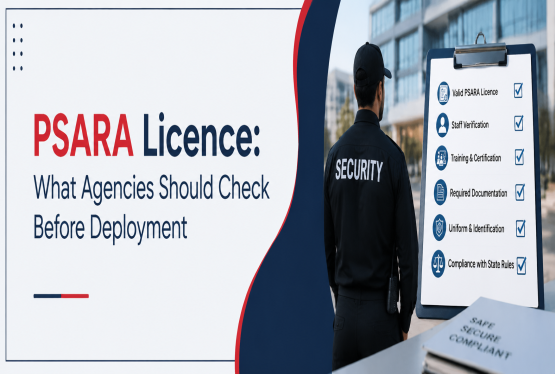




In India, the demand for private security services has increased rapidly because businesses, residential societies, institutions and public-facing establishments need trained security support for protection, crowd control, visitor management and asset safety. Earlier, many security service providers used to operate in an informal manner, but today private security is a regulated activity. Any business that wants to provide security guards, supervisors, armed or unarmed guards, bouncers, bodyguards, manpower for guarding services or security-related support to clients must understand the requirement of a PSARA License.
PSARA stands for Private Security Agencies Regulation Act, 2005. This law regulates private security agencies in India and ensures that agencies providing security services follow proper licensing, training, verification and operational standards. The Act defines a private security agency as a person or body of persons engaged in the business of providing private security services, including training to private security guards or supervisors.
Therefore, PSARA License is not only for large security companies. Even small agencies, manpower suppliers, facility management companies and businesses planning to deploy security personnel for clients may need this license if their services fall within the scope of private security.
What is PSARA License?
PSARA License is a legal permission granted to private security agencies to operate in a particular state or jurisdiction. The license is issued by the Controlling Authority appointed under the Act. The purpose of this license is to ensure that security agencies are genuine, properly verified and capable of providing trained security personnel.
The Private Security Agencies Regulation Act, 2005 was enacted to regulate private security agencies and matters connected with them. The Act came into force in 2006 and is administered under the Ministry of Home Affairs framework, with state-level authorities handling licensing and compliance. Without a valid PSARA License, a business should not operate as a private security agency. Operating without the license may result in legal action, business disruption, rejection from corporate contracts and loss of client trust.
Businesses That Need PSARA License
Private Security Agencies
Private security agencies are the main businesses that require a PSARA License. Any company, LLP, firm, proprietorship or other entity that provides security guards to clients must obtain this license before starting its operations.
These agencies usually deploy guards at offices, factories, warehouses, residential societies, schools, hospitals, malls, banks, events and commercial buildings. Since their work is directly related to protecting people and property, they must follow PSARA rules, including police verification, guard training, proper records, uniforms and other compliance requirements.
Facility Management Companies Offering Security Services
Facility management companies generally provide services like housekeeping, maintenance, pantry staff, pest control, technical support and security services as part of one package. If such a company also provides security guards, gatekeepers, watchmen or security supervisors to clients, then PSARA License becomes necessary.
However, if the company only provides cleaning, maintenance or general support staff, PSARA may not apply. Many facility management businesses unknowingly offer security manpower without checking licensing requirements, while corporate clients, malls, hospitals and IT parks usually prefer vendors with a valid PSARA License to reduce compliance risk.
Manpower Supply Agencies Providing Security Guards
Manpower supply agencies provide different types of staff to businesses, such as office boys, drivers, housekeeping workers, helpers and security guards. If such an agency supplies personnel specifically for guarding or security purposes, then PSARA compliance becomes necessary.
The requirement depends on the nature of the service, not only on the business name. Supplying general office staff may not require PSARA License, but supplying guards or security supervisors for factories, residential apartments, events, warehouses or commercial premises generally falls under PSARA requirements.
Event Security Service Providers
Businesses providing security for events, exhibitions, concerts, sports events, religious gatherings, corporate functions or celebrity appearances may also require PSARA License. Event security usually includes crowd management, entry control, VIP movement, emergency support and protection of people and property.
Even if the security service is temporary, it still falls under private security services when guards, bouncers, supervisors or security personnel are deployed. For large events, licensed security agencies are usually preferred because unlicensed deployment can create legal, safety and compliance risks for the organizer.
Bouncer Services and Personal Protection Agencies
Businesses providing bouncers, bodyguards, personal protection staff or VIP security services should also check PSARA License requirements. These services directly involve the protection of people and property, so they generally fall within the scope of private security services.
Bouncer services are commonly used by clubs, hotels, restaurants, events and celebrities, while bodyguards may be hired by business owners, public personalities and high-net-worth individuals. A business cannot avoid PSARA by using terms like “protection staff,” “safety marshal” or “event marshal” if the actual work is security in nature.
Residential Society Security Service Providers
Security agencies providing guards to apartments, gated communities, housing societies and residential townships must obtain PSARA License. Residential security guards usually manage entry gates, visitor records, vehicle movement, delivery verification and emergency response.
Housing societies should also check whether their security vendor is licensed. Hiring an unlicensed agency can expose the society to safety concerns, verification issues and contractual disputes. A licensed agency gives better assurance that guards are verified, trained and deployed according to prescribed standards.
Industrial and Factory Security Providers
Factories, manufacturing units, warehouses, logistics hubs and industrial parks often require security at gates, loading areas, stores, production units and boundary walls. Agencies providing such industrial security services must have PSARA License.
Industrial security is sensitive because guards may handle entry control, material movement, employee verification, vehicle records and protection of valuable assets. For this reason, businesses prefer agencies with proper licensing, training and compliance systems. For industries dealing with high-value goods, chemicals, electronics, pharmaceuticals or export products, choosing a PSARA-compliant security vendor becomes even more important.
Mall, Hotel and Commercial Building Security Providers
Security agencies providing guards to malls, hotels, commercial complexes, co-working spaces, showrooms and office buildings also require PSARA License. These places have high footfall and require disciplined security management.
The security staff may be responsible for baggage checking, visitor management, parking support, emergency coordination and general safety. Since these activities involve private security services, the agency must be licensed. For premium commercial establishments, PSARA License is also a trust factor. It shows that the agency is not operating casually and has fulfilled legal requirements.
Educational Institution Security Providers
Schools, colleges, coaching centres, universities and hostels often require security guards for student safety, gate control, visitor entry and campus monitoring. Agencies providing guards to such institutions must comply with PSARA requirements.
Security in educational institutions is highly sensitive because it involves children, students, staff and visitors. Institutions should therefore avoid hiring unverified or unlicensed agencies. A PSARA-compliant agency usually maintains guard records, verification details and training standards, which helps institutions maintain a safer environment.
Hospital and Healthcare Security Providers
Hospitals, clinics, diagnostic centres and healthcare institutions also require security services for patient areas, emergency wards, visitor control, parking, medicine stores and sensitive departments. Agencies providing such guards must have PSARA License.
Hospital security requires special care because the environment is sensitive and often crowded. Guards may need to manage emergency situations, patient attendants and restricted areas. A licensed security agency can provide better accountability and structured deployment.
Common Business Structures Eligible for PSARA License
A PSARA License can generally be applied for by different types of business entities, depending on state rules and eligibility conditions. Common structures include:
However, the applicant must satisfy eligibility requirements, verification conditions and documentation standards before the license is granted.
Why PSARA License is Important for These Businesses?
PSARA License is not just a legal formality. It gives a security business the authority to operate professionally. Many corporate clients, government departments, industrial units and large institutions do not appoint security agencies unless they have a valid PSARA License.
The license helps in building credibility, reducing legal risk and improving business opportunities. It also ensures that the agency follows basic standards related to guard training, background verification, uniforms, records and supervision. For a security agency, PSARA compliance can become a strong selling point. It shows clients that the agency is serious, legally compliant and professionally managed.
Conclusion
Any business that provides private security services in India must carefully check whether PSARA License is required. Private security agencies, facility management companies, manpower suppliers, event security providers, bouncer agencies, residential security vendors, industrial security agencies, mall security providers, hospital security agencies and educational institution security service providers usually fall within the scope of PSARA when they deploy security personnel for clients.
The main point is simple: if a business provides guards, supervisors, bouncers, bodyguards or security manpower to another person, company, institution or property, it should not operate without proper PSARA compliance. A valid PSARA License protects the business from legal complications and increases client confidence.
In the security industry, trust and legality matter as much as manpower. Therefore, businesses planning to enter or expand in the private security sector should obtain PSARA License before starting operations and maintain compliance throughout their license period.
FAQ’S
Q1. Who needs PSARA License?
Ans. Any business providing security guards or security services to clients needs PSARA License.
Q2. Do security agencies need PSARA License?
Ans. Yes, all private security agencies must obtain PSARA License before operating.
Q3. Do facility management companies need it?
Ans. Yes, if they provide security guards along with other services.
Q4. Is PSARA required for manpower agencies?
Ans. Yes, if they supply guards or security supervisors.
Q5. Do event security providers need PSARA?
Ans. Yes, if they deploy guards, bouncers or security staff at events.
Q6. Is PSARA required for bouncer services?
Ans. Yes, bouncer services generally fall under private security services.
Q7. Do bodyguard services need PSARA License?
Ans. Yes, personal protection or VIP security services may require PSARA License.
Q8. Can an agency work without PSARA License?
Ans. No, operating without PSARA License can create legal problems.
Q9. Is PSARA required for own office guard?
Ans. Generally, PSARA applies when security services are provided to clients.
Q10. Why is PSARA License important?
Ans. It gives legal approval and builds trust with clients.


_crop10_thumb.jpg)





_for_FY_2025-26_crop10_thumb.jpg)




_learn_crop10_thumb.jpg)


_Filing_Due_Dates_for_FY_2024-25_learn_crop10_thumb.jpeg)




_of_GST_Act_learn_crop10_thumb.jpg)


_Under_GST_learn_crop10_thumb.jpg)


_crop10_thumb.jpg)


_crop10_thumb.jpg)


_learn_crop10_thumb.jpg)


_of_the_Income_Tax_Act_learn_crop10_thumb.jpg)


_learn_crop10_thumb.jpg)



_learn_crop10_thumb.jpg)


_crop10_thumb.jpg)





_in_The_Income_Tax_Act,_1961_learn_crop10_thumb.jpg)


_learn_crop10_thumb.jpg)


_of_the_Income_Tax_Act_learn_crop10_thumb.jpg)

_Of_Income_Tax_Act_learn_crop10_thumb.jpg)


_learn_crop10_thumb.jpg)


_learn_crop10_thumb.jpg)
_crop10_thumb.jpg)




_learn_crop10_thumb.jpg)
_for_Import_and_Export_learn_crop10_thumb.jpg)




















_crop10_thumb.jpg)