


Importing products into India is not just about placing an order with a foreign supplier and clearing the goods through Customs. If you bring pre-packaged products into India for sale, distribution or delivery, you may also need an LMPC Certificate under the Legal Metrology (Packaged Commodities) Rules, 2011. This registration is important because it identifies the importer responsible for the packaged goods in the Indian market.
For example, if you import packed kitchen products, toys, electronic accessories, cosmetics or household items from China and plan to sell them in India, you should check whether LMPC Registration applies to your business. You also need to make sure that the packages carry the declarations required under Indian rules. These may include the importer's name and address, country of origin, net quantity and maximum retail price (MRP). This guide explains what an LMPC Certificate is, who needs it, how to apply, which documents are required and what importers should check before selling their products.
What Is an LMPC Certificate?
An LMPC Certificate is a registration issued under Rule 27 of the Legal Metrology (Packaged Commodities) Rules, 2011. It is commonly called an LMPC Certificate for Importers because the rule requires businesses importing commodities for sale, distribution or delivery to register their name and complete address with the Director or Controller of Legal Metrology.
The certificate helps identify the business bringing packaged goods into India. It is especially relevant when an importer buys ready-packed products from another country and sells them to Indian customers. The registration records the importer and the commodities covered by the application.
One thing importers should understand is that an LMPC Certificate is not a product quality certificate. It does not confirm that a product is safe, technically approved or suitable for use. It is a registration under Legal Metrology rules. Depending on the product, you may also need separate approvals such as BIS certification, FSSAI registration or other licences.
Read Our Guide on : LMPC Registration Full Guide
What is the LMPC full form?
LMPC is commonly used for Legal Metrology (Packaged Commodities). It refers to the rules that control how packaged products are described, measured and labelled before they are sold to consumers.
The purpose is straightforward: a customer should be able to understand what a package contains, how much product is inside, what it costs and who is responsible for selling it. These requirements help prevent misleading information about the quantity and price of packaged goods.
Who Needs an LMPC Certificate in India?
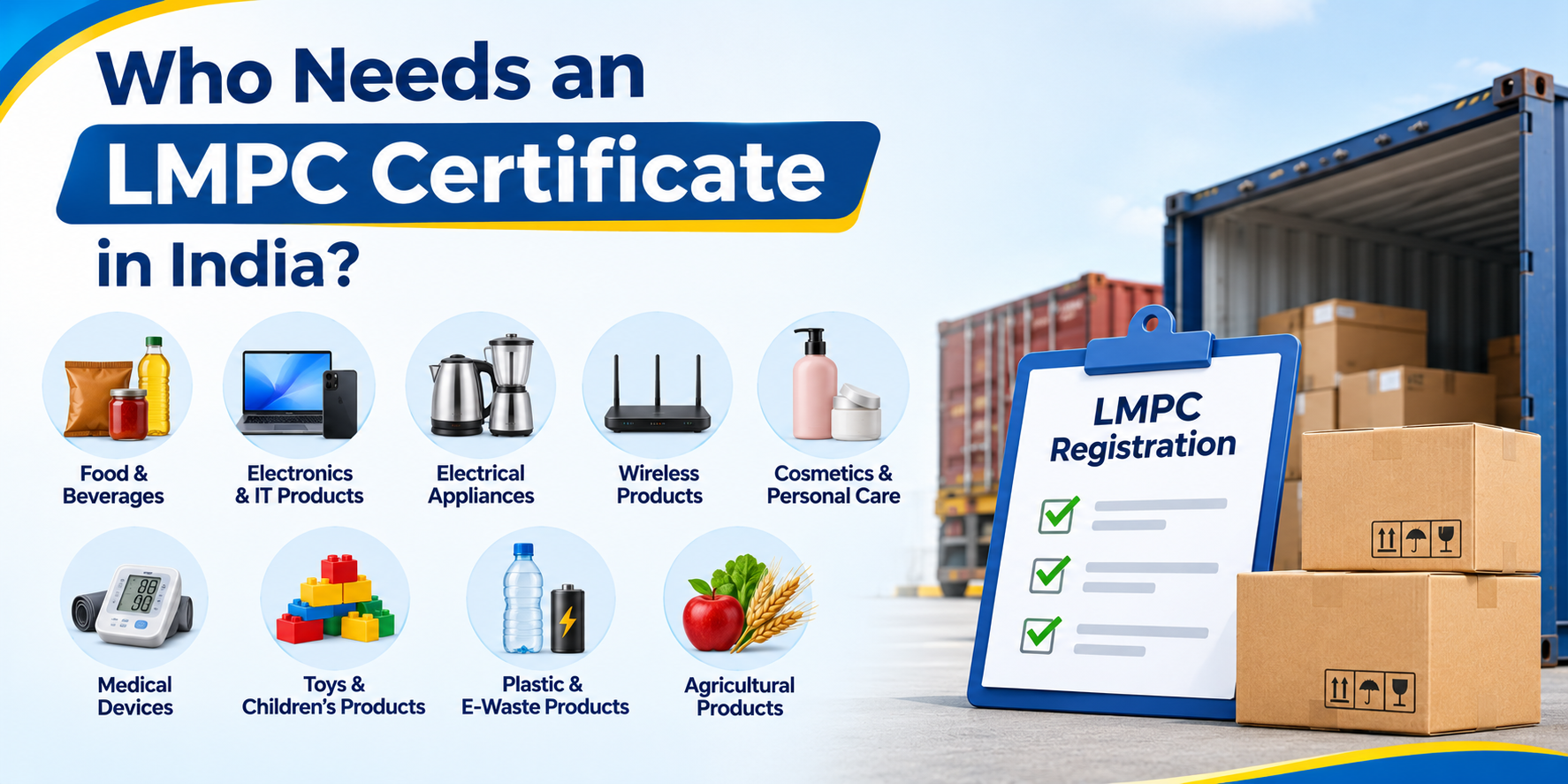
Rule 27 applies to individuals, firms and companies that import commodities for sale, distribution or delivery. So, if your business brings packaged products into India and plans to sell or distribute them here, you should check the registration requirement before placing your first import order.
Imported Products and Other Compliance Requirements in India
|
Product Category |
Examples of Imported Products |
Other Registrations or Approvals to Check |
|
Food and Beverages |
Packaged snacks, chocolates, coffee, tea, spices, dry fruits, sauces and edible oils |
FSSAI Import Licence, food import clearance and applicable food labelling requirements. |
|
Electronics and IT Products |
Mobile phones, laptops, tablets, power banks, Bluetooth speakers, CCTV cameras and computer monitors |
BIS CRS Registration, where the product is covered under mandatory certification. |
|
Electrical Appliances |
LED lights, power adapters, inverters, UPS systems, electric mixers, pressure cookers and other specified appliances |
BIS Certification under the applicable Quality Control Order. |
|
Wireless and Bluetooth Products |
Wi-Fi routers, Bluetooth devices, wireless microphones, smart watches and wireless communication equipment |
WPC Equipment Type Approval (ETA), where applicable, along with relevant BIS requirements. |
|
Cosmetics and Personal Care |
Shampoo, face wash, skincare creams, lotions, perfumes and imported makeup products |
CDSCO Import Registration and compliance with the Cosmetics Rules, 2020, where applicable. |
|
Medical Devices and Healthcare Products |
Surgical instruments, diagnostic equipment, blood pressure monitors, medical devices and certain healthcare products |
CDSCO Import Licence or Registration, depending on the product classification and applicable rules. |
|
Toys and Children's Products |
Plastic toys, dolls, building blocks, puzzles and battery-operated toys |
BIS Certification under the Toys (Quality Control) Order, 2020. |
|
Plastic and Electronic Products |
Plastic-packaged goods, imported electronic equipment, batteries and products with plastic packaging |
EPR Registration under the applicable Plastic Waste, E-Waste or Battery Waste Management Rules, where the importer falls within the regulated producer category. |
|
Agricultural and Food Products |
Seeds, plants, fresh fruits, vegetables and certain agricultural commodities |
Plant Quarantine Permission or Phytosanitary Certificate, where required. FSSAI requirements may also apply to food products. |
|
Agricultural and Processed Products for Export |
Basmati rice, processed fruits, vegetables, honey and other scheduled products |
APEDA Registration (RCMC) may apply when exporting scheduled products. APEDA is primarily relevant to export promotion, not a general import licence. |
Important: These are separate compliance requirements and do not automatically apply to every product in a category. The exact requirement depends on the product, its technical specifications, intended use and the applicable government notification. An importer should check these requirements before placing an order or shipping goods to India.
Consider a business in Delhi that imports 2,000 packaged kitchen appliances from China and sells them through its website and retail stores. The business is importing packaged commodities for sale in India, so it should check its LMPC registration requirement.
Which Products Come Under LMPC Rules?
The rules mainly deal with commodities packed before reaching the buyer, where the package contains a pre-decided quantity. These are known as pre-packaged commodities. Think of a sealed box containing one electric kettle, a bottle containing 200 ml of shampoo or a packet containing 500 grams of coffee. The quantity is decided before the customer buys the product. The buyer cannot change the quantity without opening or changing the package.
This is why importers of ready-packed products need to pay attention to Legal Metrology requirements. The rules cover many everyday products, but the exact applicability must be checked against the definitions and exemptions in the law.
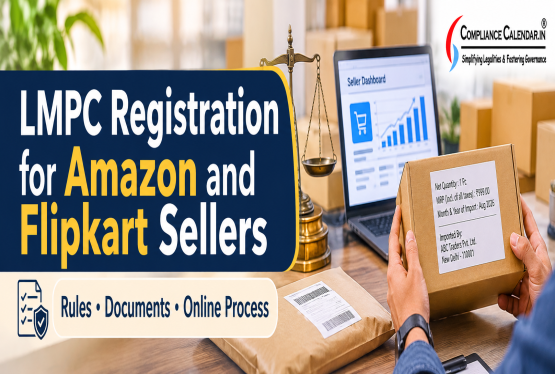
You can also read our guide for : LMPC Registration for Flipkart and Amazon Sellers
What is a pre-packaged commodity?
A pre-packaged commodity is a product placed inside a package without the buyer being present, where the package contains a pre-determined quantity. The package is ready for sale, and the quantity cannot be changed without opening the package or making changes to it.
For example, if an importer brings 500 sealed boxes of electric toothbrushes into India, each containing one toothbrush and its accessories, those boxes may be treated as pre-packaged commodities. The importer should check the applicable declarations and registration requirements before selling them.
What Information Must Be Printed on Imported Product Packages?
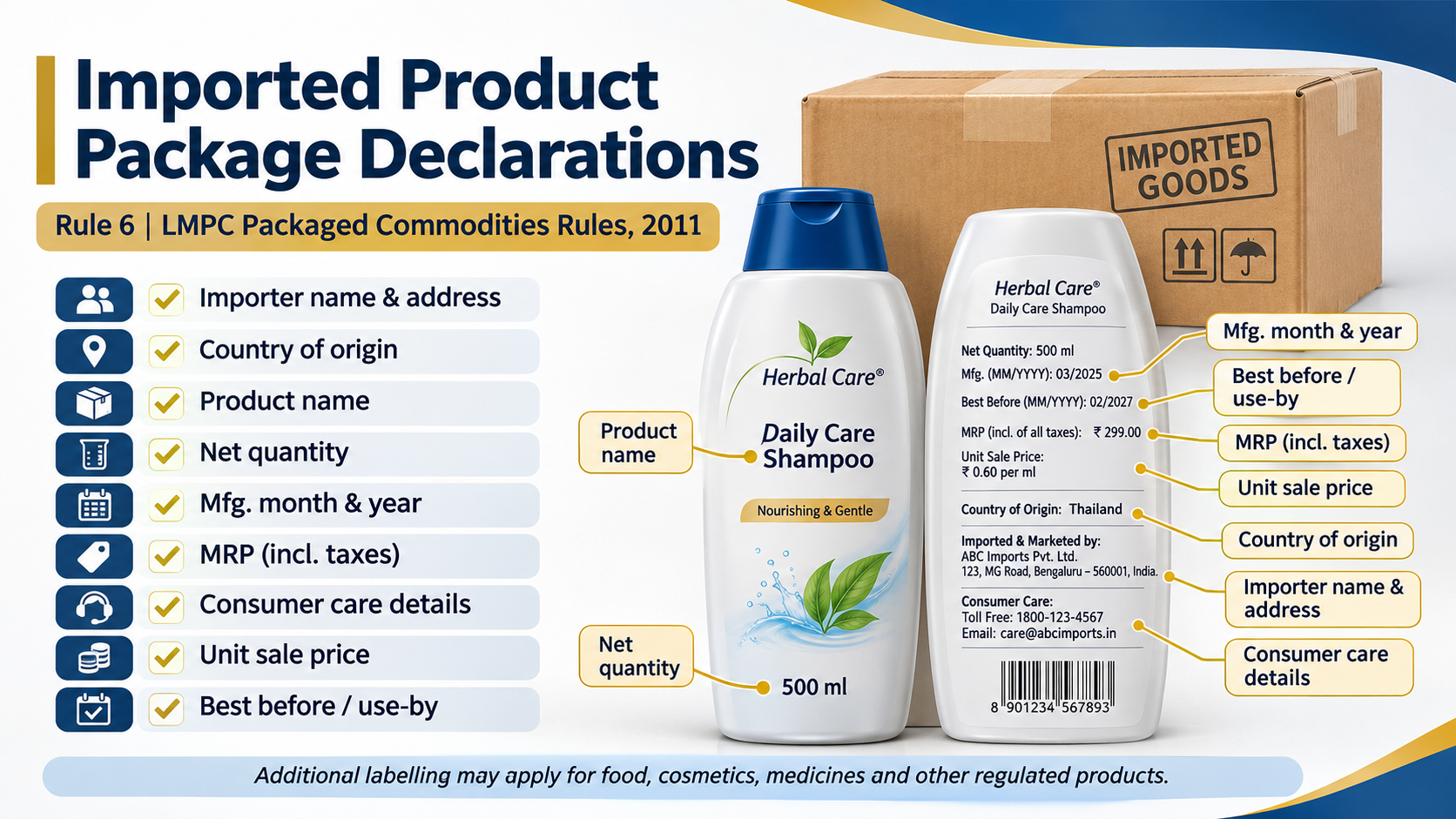
Getting an LMPC Certificate is only one part of compliance. Importers must also check the declarations required on the product packages under Rule 6 of the Legal Metrology (Packaged Commodities) Rules, 2011.
This is where many first-time importers make mistakes. They may receive attractive packaging from a foreign supplier, but the package may not contain all the information required in India. A label that is acceptable in the country of manufacture may still need changes before the product is sold in the Indian market.
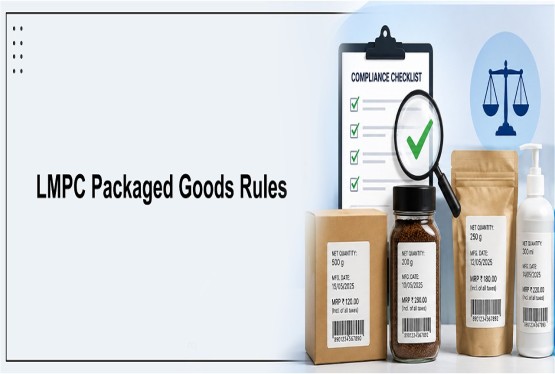
For covered retail packages, the required declarations generally include:
- Name and address of the importer: The Indian business responsible for importing the product.
- Country of origin: The country where the product was made or manufactured, as applicable.
- Common or generic name: The name that clearly tells customers what the product is.
- Net quantity: The weight, measure or number of items inside the package, excluding the packaging.
- Manufacturing details: The month and year of manufacture, where required.
- Maximum Retail Price (MRP): The retail price in Indian currency, inclusive of all taxes.
- Consumer care details: Contact information through which customers can raise complaints or questions.
- Unit sale price: The price per standard unit, where applicable.
- Best before or use-by information: Where required for products whose quality or suitability may change over time.
The declarations are not identical for every product. Food, cosmetics, medicines and other regulated products may have additional labelling requirements under their respective laws.
For example: If you import a 500 ml bottle of shampoo, the package should be checked for the applicable product name, net quantity, importer details, country of origin, MRP and consumer care information. Other product-specific requirements may also apply.
Can an importer add Indian labels after the goods arrive?
Yes, the rules provide a specific arrangement for importers to make mandatory declarations at bonded warehouses operated by Authorised Economic Operators (AEO) Tier-2 and Tier-3 certified operators in India. However, all required declarations must appear on the retail packages before the goods leave those warehouses.
This option was added through the Legal Metrology (Packaged Commodities) Third Amendment Rules, 2026. Importers planning to use it should coordinate with their Customs and warehouse arrangements before the goods arrive. It should not be treated as permission to sell packages with missing declarations.
How to Apply for an LMPC Certificate for Importers?
The application is made to the Director or Controller of Legal Metrology under Rule 27. The exact application method may depend on the state or authority handling the registration. Some authorities provide online applications through their own portals or linked government systems, while the required process and documents should be checked with the relevant Legal Metrology Department.
Before applying, make sure that your business details and product information are ready. The application requires the applicant's name, the complete address of the premises from which the commodities are imported and the names of the commodities being imported.
Step 1: Check whether your products require registration
Start by identifying the products you plan to import. Check whether they are pre-packaged commodities covered by the rules and whether any exemption applies to your particular import.
Step 2: Identify the registering authority
Find the Director or Controller of Legal Metrology responsible for your business. Check the official Legal Metrology Department website for the state or authority concerned to confirm the current application method.
Step 3: Prepare your business information
Keep your legal business name, complete address, contact details and Importer Exporter Code (IEC) ready. You should also prepare a clear list of the products you intend to import.
Step 4: Complete the application
Fill in the registration application with the details requested by the authority. Make sure that the business name, address and commodity descriptions are correct.
Step 5: Attach the supporting documents
Upload or submit the documents required by the registering authority. The exact list may differ depending on the business structure and the authority's application procedure.
Step 6: Pay the prescribed fee
Pay the applicable government fee using the payment method provided by the authority. Keep the payment receipt for your records.
Step 7: Submit the application and respond to queries
Review the application before submitting it. If the authority asks for additional information or corrections, provide the required details.
Step 8: Receive your LMPC Certificate
Once the application is accepted and registration is granted, collect or download the certificate through the method provided by the authority. Keep a copy with your business records.
Do not wait until the shipment has arrived to start checking these requirements. It is better to confirm registration and packaging requirements while planning the import order.
What Documents Are Required for an LMPC Certificate?
The documents depend on the type of business and the requirements of the registering authority. A company, partnership firm and sole proprietorship may not have exactly the same supporting documents.
For a typical importer application, it is useful to keep the following ready:
- PAN card of the business or applicant.
- GST Registration Certificate, where applicable.
- Importer Exporter Code (IEC) issued by DGFT.
- Certificate of Incorporation, partnership deed or other business registration proof, as applicable.
- Proof of the registered or relevant business address.
- Identity and contact details of the authorised person.
- Details of the commodities being imported.
- Product labels or packaging samples, if requested by the authority.
- Details of the responsible director, where the applicant is a company.
The authority may ask for additional documents or information depending on the application. For this reason, treat this as a preparation list rather than a fixed checklist for every importer.
What Is the Government Fee and Validity of an LMPC Certificate?
Under Rule 27, the prescribed application fee for registration is Rs500. If an importer needs to make an alteration in the registration certificate, the prescribed fee under Rule 27(3) is Rs100.
The validity position changed in 2026. Under the Legal Metrology (Packaged Commodities) Third Amendment Rules, 2026, the registration certificate remains valid until it is cancelled. This means that importers should not rely on older information stating that every LMPC Certificate must be renewed after a fixed five-year period.
There is also an important ongoing requirement for companies and firms. They must update their registration details online every year, including changes in their address, the number of products imported and the country of origin. Companies must also provide the name of the director responsible for violations under the Act and rules.
In short, the certificate does not need routine renewal under the amended Rule 27, but the importer must keep its registration information up to date.
What Mistakes Should Importers Avoid?
Importers should avoid these common mistakes:
- Applying for LMPC Registration only after the goods arrive in India.
- Ignoring Indian packaging and labelling requirements.
- Assuming that the foreign supplier already understands India's labelling rules.
- Confusing an Import Export Code (IEC) with an LMPC Certificate, as both serve different purposes.
- Ignoring other product approvals, such as BIS, FSSAI, CDSCO, WPC or EPR, wherever applicable.
- Submitting incorrect or incomplete business and product details.
Checking these requirements before shipping the goods can help importers avoid delays, relabelling costs and compliance problems.
What Happens If an Importer Does Not Follow LMPC Rules?
Importers covered under LMPC Rules must complete the required registration and ensure that their product packages carry all applicable declarations. If they fail to follow these requirements, Legal Metrology authorities may take action under the Legal Metrology Act and the applicable rules.
Depending on the nature of the violation, the action may include:
- Inspection of the imported goods and packaging.
- Directions to correct incorrect or missing declarations.
- Seizure of goods, where legally permitted.
- Monetary penalties under the applicable provisions.
For example, if an importer sells packaged products without mentioning the required importer details, MRP or net quantity, the aut
How Compliance Calendar Can Help with LMPC Registration
For a new importer, it can be difficult to understand which Legal Metrology requirements apply to the products being imported. The application itself may look simple, but choosing the right category, preparing product details and checking the package declarations all need attention.
Compliance Calendar LLP helps businesses understand the LMPC Certificate requirements and prepare for the registration process. We can assist with reviewing the business information, organising the required documents and guiding you through the application process. We can also help you understand the labelling points that need to be checked before your products are sold in India.
Whether you are importing packaged products for the first time or already running an import business, you can contact our team to discuss your requirements.
For any Assistance connect Contact Compliance Calendar LLP at 9988424211 or info@ccoffice.in
Frequently Asked Questions (FAQs)
Q1. What is the LMPC full form?
LMPC is commonly used for Legal Metrology (Packaged Commodities). It refers to the rules that deal with the registration and labelling of packaged commodities in India.
Q2. Is an LMPC Certificate compulsory for importers?
Importers covered under Rule 27 must apply for registration. Businesses importing commodities for sale, distribution or delivery in India should check the requirement before starting their import activity.
Q3. What is an LMPC Certificate for Import?
It is a registration certificate issued under Rule 27 of the Legal Metrology (Packaged Commodities) Rules, 2011. It records the importer's name, address and details of the commodities being imported.
Q4. What is the government fee for LMPC Registration?
The prescribed application fee under Rule 27 is Rs500. The prescribed fee for making an alteration in the registration certificate is ?100.
Q5. What is the validity of an LMPC Certificate?
Under the Third Amendment Rules, 2026, an LMPC registration certificate remains valid until it is cancelled. Companies and firms must also follow the annual online update requirement.
Q6. How long does it take to get an LMPC Certificate?
The processing time depends on the registering authority and whether the application is complete. If the authority asks for corrections or additional information, the applicant should respond promptly.
Q7. Is an IEC the same as an LMPC Certificate?
No. An Importer Exporter Code (IEC) is issued by DGFT for import and export activities. An LMPC Certificate is a separate registration under the Legal Metrology (Packaged Commodities) Rules, 2011.
Q8. Can I import packaged products without an LMPC Certificate?
If your business and products are covered under Rule 27, you must meet the registration requirement. Check the applicable exemptions and registration requirements before importing.
Q9. Is LMPC Registration required for online sellers?
If an online seller imports covered pre-packaged commodities for sale in India, it should check whether Rule 27 registration applies. Selling through an online marketplace does not automatically remove the importer's responsibilities.
Q10. Does an LMPC Certificate confirm product quality?
No. It is a registration under Legal Metrology rules. Separate quality, safety or product approvals may be required depending on the type of goods.
Q11. Can an importer add labels after the products arrive in India?
The 2026 Third Amendment allows mandatory declarations to be made at bonded warehouses of AEO Tier-2 and Tier-3 certified operators. However, all required declarations must be present before the retail packages leave those warehouses.
Q12. Does an LMPC Certificate need renewal every five years?
No. Under the 2026 amendment, the registration certificate remains valid until cancelled. However, companies and firms must update the required details online every year.
Q13. Can an importer sell products without printing the country of origin?
Imported retail packages must carry the applicable country-of-origin declaration. E-commerce entities selling imported products must also follow the separate online listing requirement for country-of-origin information.
Article last updated on : 04 Nov 2026.










_learn_crop10_thumb.jpg)