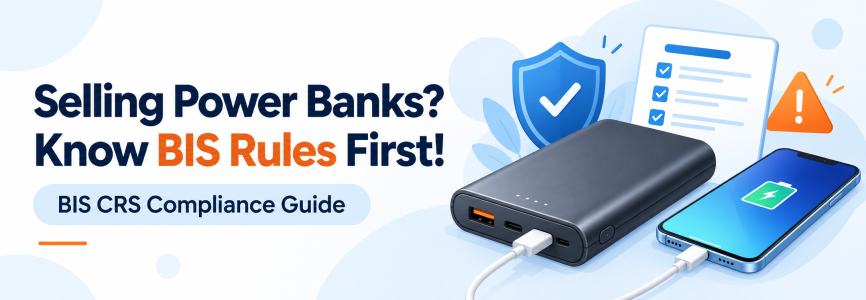



Power banks have become an important part of our daily lives. Whether you are travelling, working in an office, attending college or spending long hours outdoors, a power bank helps you charge your mobile phone when electricity is not available. Because of this growing demand, many businesses in India have started manufacturing, importing and selling power banks. However, selling a power bank is not as simple as purchasing it from a supplier and putting it on the market. There are certain government rules that businesses must follow before selling these products in India.
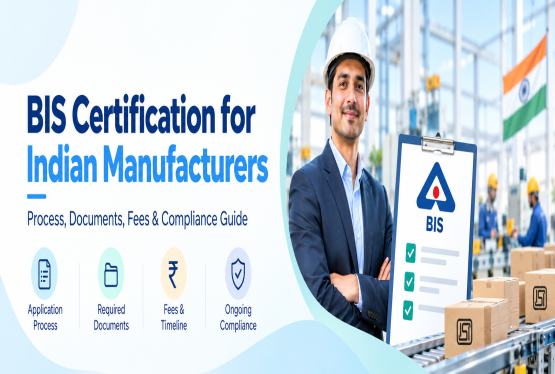
One of the most important requirements is BIS CRS Certification for Power Banks. The Bureau of Indian Standards (BIS) has included power banks used in portable applications under the Compulsory Registration Scheme (CRS). This means that manufacturers must comply with the applicable Indian safety standard and obtain the required BIS registration before placing covered products on the Indian market. If you are planning to start a power bank business, import power banks from China or sell them through Amazon, Flipkart or your own website, understanding BIS rules is important.
What Is BIS CRS Certification for Power Banks?
BIS CRS Certification is a mandatory product registration requirement introduced to ensure that certain electronic and electrical products sold in India meet prescribed safety standards. BIS stands for the Bureau of Indian Standards, which is India's national standards body. CRS means Compulsory Registration Scheme. Under this scheme, manufacturers of notified products must have their products tested in a BIS-recognised laboratory and obtain registration from BIS.
Power banks come under this scheme because they contain electrical components and rechargeable batteries. If they are poorly designed or manufactured using unsafe materials, they may overheat, develop electrical faults or create a fire risk.
For example, imagine that a company manufactures 10,000 power banks and starts selling them without checking their electrical safety. If the products have defective charging circuits, customers may face serious problems. BIS certification helps reduce such risks by requiring products to meet applicable safety requirements.
Is BIS Certification Mandatory for Power Banks in India?
Yes. BIS registration is mandatory for power banks covered under the Electronics and Information Technology Goods (Requirement of Compulsory Registration) Order, 2021, as amended. The requirement applies to relevant power banks manufactured in India and those imported for sale in the Indian market. The compulsory registration requirement for power banks was originally implemented on 13 May 2015. The product remains listed under the BIS Compulsory Registration Scheme in 2026. The important point is that BIS registration is obtained by the manufacturer for the relevant product, manufacturing location, brand and covered models. A trader or seller generally relies on the manufacturer's valid registration rather than obtaining a new manufacturing registration in the trader's own name.
For example, suppose you own an electronics shop in Delhi and purchase power banks from a registered Indian manufacturer. You should verify that the products and models you sell are covered by the manufacturer's valid BIS registration. However, if you plan to manufacture power banks under your own brand, you must ensure that the actual manufacturing facility has the appropriate registration covering your products.
Which Indian Standard Applies to Power Banks?
Every BIS-regulated product must meet a specified Indian Standard. This standard explains the technical and safety requirements that the product must satisfy. Power banks were historically covered under IS 13252 (Part 1):2010, which dealt with the safety of information technology equipment. However, an important regulatory change has taken place.
The Ministry of Electronics and Information Technology notified the migration from IS 13252 (Part 1):2010 and IS 616:2017 to IS/IEC 62368 (Part 1):2023 through notification S.O. 4997(E), dated 29 October 2025. BIS also issued implementation guidance and further updates in 2026. The revised standard covers safety requirements for audio, video, information and communication technology equipment, including notified power banks.
Manufacturers should therefore check the applicable transition and implementation provisions before selecting the standard for a new application or modifying an existing registration. There is also an important difference between the power bank and the battery fitted inside it.
The lithium-ion cells and batteries used in many power banks may require separate compliance with IS 16046 (Part 2):2018, as applicable. Nickel-based portable batteries may fall under IS 16046 (Part 1):2018. A BIS registration for a battery does not automatically replace the registration required for the finished power bank. Similarly, finished-product registration does not automatically remove separate battery compliance obligations. The exact classification depends on the product's construction and applicable BIS guidance.
Who Needs BIS Registration for Power Banks?
BIS registration is mainly the responsibility of the manufacturer. However, importers, brand owners, distributors and online sellers also need to understand the rules.
Indian Power Bank Manufacturers
If your company manufactures power banks in India, you must obtain the applicable BIS registration before manufacturing covered products for sale or distribution in the Indian market. The manufacturing unit must follow the relevant Indian Standard and use the required certification marking after registration is granted.
Foreign Manufacturers
Foreign manufacturers supplying power banks to India are also required to follow applicable BIS CRS requirements.
For example, if a Chinese company manufactures power banks for an Indian electronics brand, the foreign manufacturer must ensure that the products are covered by an appropriate BIS registration. Foreign manufacturers that do not have a qualifying office in India are required to appoint an Authorised Indian Representative (AIR) according to BIS guidelines. The AIR acts as the manufacturer's authorised contact in India for relevant BIS regulatory matters.
Importers of Power Banks
Importers do not automatically need a separate manufacturing registration simply because they import the products. However, they must ensure that the imported power banks are manufactured by a registered manufacturer and that the relevant products, brand and models are covered. Importing unregistered covered power banks can result in customs and regulatory problems.
Online Sellers and Retailers
If you sell power banks through Amazon, Flipkart, Meesho or your own ecommerce website, you must ensure that the products comply with applicable BIS requirements. You should obtain appropriate documentation from the manufacturer or supplier and verify registration details before listing products. A seller should not assume that a product is compliant simply because the supplier says it has BIS approval.
Can You Sell Power Banks Without BIS Certification?
For power banks falling within the mandatory BIS CRS category, the answer is generally no. A covered power bank must comply with the applicable compulsory registration requirements before it can legally be placed on the Indian market, unless a specific exemption applies.
For Example : Suppose you purchase 500 power banks from an overseas supplier at a low price. The supplier offers attractive packaging and agrees to print your brand name on the products. You decide to import the products and sell them online. Before placing the order, you should ask the supplier whether the actual manufacturing unit has valid BIS registration covering those power banks under the intended brand. If the supplier cannot provide valid registration details, importing the products for commercial sale may create compliance problems. You should also verify the registration number and covered product models through the official BIS portal.
Documents Required for BIS CRS Registration of Power Banks
Proper documents are important for completing the BIS registration process. Missing or incorrect information can delay approval. The exact document checklist depends on the type of applicant, manufacturing location and registration application.
Commonly required documents include:
-
Business Registration Document: Documents establishing the legal identity and manufacturing activities of the applicant.
-
Manufacturing Unit Address Proof: Details showing the actual location where the power banks are manufactured.
-
Product Details: Information about power bank models, specifications, ratings, brands and other technical characteristics.
-
BIS-Recognised Laboratory Test Report: A valid report showing that the tested product complies with the relevant Indian Standard.
-
Brand Registration or Brand Authorisation: Documents establishing ownership of the brand or permission to use the brand.
-
Authorisation Letter: Authorisation for the person submitting and signing the registration application.
-
Authorised Indian Representative Documents: Applicable documents and undertakings for foreign manufacturers requiring an AIR.
-
Component Information: Relevant construction details and component information, including batteries, where required.
-
Declarations and Undertakings: Prescribed statements confirming compliance with BIS requirements.
-
Application and Fee Details: Completed registration forms and evidence of applicable payment.
Businesses should ensure that the manufacturer's name, factory address, brand and product details are consistent across their documents. Even small differences between the laboratory report and application details may result in BIS queries.
BIS CRS Registration Process for Power Banks
The registration process involves product testing, document preparation and application submission.
Step 1: Identify the Correct Product Category
The first step is to confirm whether the product falls under the BIS CRS category for power banks used in portable applications. This is important because certain battery-only products may be classified differently.
For example, a finished power bank with charging control circuits is not necessarily treated in the same way as a standalone rechargeable battery.
Step 2: Select a BIS-Recognised Testing Laboratory
Once the product category is confirmed, the manufacturer must arrange testing through a BIS-recognised laboratory approved for the applicable standard. The manufacturer should check the laboratory's testing scope before sending the product.
Step 3: Submit the Power Bank for Testing
The manufacturer sends the required product samples and technical information to the laboratory. The testing process checks the product against relevant safety requirements. Depending on the applicable standard and construction, the examination may involve electrical safety, abnormal operating conditions, temperature-related risks and other prescribed tests. The manufacturer may need to make technical changes if the product does not satisfy the required tests.
Step 4: Obtain the Test Report
After successful testing, the laboratory issues a test report. The test report is an important part of the BIS application because it provides evidence of conformity with the relevant standard. Under the BIS CRS application instructions, the test report should generally be no more than 90 days old when the registration application is submitted.
Step 5: Submit the BIS Registration Application
The manufacturer files the application through the official BIS CRS portal. The application includes details about the manufacturing unit, product, brand, test report and authorised signatory. Foreign manufacturers must also provide the required AIR information and documents.
Step 6: BIS Reviews the Application
BIS examines the submitted application and supporting documents. If BIS identifies missing information or inconsistencies, it may raise a query. The applicant must respond with the necessary corrections or explanations.
Step 7: Registration Is Granted
If BIS is satisfied that the applicant has complied with the applicable requirements, it grants registration. The manufacturer can then use the prescribed Standard Mark with the registration number on covered products according to BIS marking guidelines. The products must continue to comply with the registered specifications and applicable Indian Standard. The process is not complete merely because the laboratory has issued a passing test report. The required BIS registration must also be granted.
How Much Does BIS Certification for Power Banks Cost?
The cost of obtaining BIS CRS registration depends on several factors. There is no single amount that applies equally to every manufacturer. The total expenditure may include BIS application and registration fees, laboratory testing charges, documentation expenses, product modifications, applicable AIR arrangements and professional assistance. The number of product models can also influence the cost because additional testing or model inclusion requirements may apply.
For example, a manufacturer applying for one power bank model may have different testing expenses compared with a manufacturer producing several models with different electrical designs. Businesses should obtain current fee details from the official BIS portal and quotations from recognised laboratories before estimating their total budget.
How Long Does BIS CRS Registration Take?
The time required for registration depends on laboratory testing, document preparation and BIS scrutiny. If the product passes testing and all documents are correct, the process can move more smoothly. However, if the laboratory identifies a product failure or BIS raises questions about the application, additional time may be required.
For example, if the tested power bank does not meet a prescribed safety requirement, the manufacturer may have to modify the product and arrange further testing. Businesses should therefore begin certification planning before finalising large production orders or import shipments.
BIS Marking and Labelling Requirements for Power Banks
After obtaining registration, the manufacturer must follow the applicable BIS Standard Mark and labelling requirements. The relevant BIS CRS Standard Mark generally includes the prescribed conformity statement and registration number. The marking must be used only for products covered by the registration. Manufacturers must also comply with applicable product and packaging labelling rules.
For example, a power bank sold in India may require information such as product identification, electrical ratings, manufacturer or importer details and other declarations under the applicable laws. Where the Legal Metrology (Packaged Commodities) Rules, 2011 apply, the retail package must contain the relevant prescribed declarations. The exact labelling requirements depend on the product and how it is packaged and sold. A manufacturer should not print an incorrect BIS registration number or use another manufacturer's number without proper legal coverage.
What Happens If You Sell Power Banks Without BIS Registration?
Non-compliance with mandatory BIS requirements can result in serious consequences for businesses. The BIS Act, 2016 provides for enforcement action against violations involving products that require compulsory conformity assessment. Depending on the nature of the violation, consequences may include seizure of products, restrictions on sale, prosecution and statutory penalties.
Section 17 of the BIS Act restricts certain activities involving products covered by mandatory certification requirements when the prescribed conformity requirements are not met.
Section 29 provides penalties for specified violations, including contraventions of Section 17.
For relevant offences under Section 29(3), punishment may include imprisonment of up to two years, a fine of at least ?2 lakh for a first contravention, and higher minimum fines for subsequent contraventions, subject to the statutory provisions. Businesses may also face commercial losses if shipments are delayed, stock is detained or product listings are affected. This is why BIS compliance should be checked before manufacturing, importing or purchasing large quantities of power banks.
Important BIS Updates for Power Banks in 2026
The BIS regulatory requirements for electronic products have continued to develop in 2026. A major update concerns the migration from older information technology and audio-video safety standards to IS/IEC 62368 (Part 1):2023.
The government notified this transition in October 2025, and BIS subsequently issued implementation guidance, FAQs and related updates during 2026. Manufacturers and importers should check the relevant notification, migration deadlines and registration requirements rather than assuming that an old test report or registration automatically satisfies every new requirement.
BIS also issued revised provisions relating to CRS licence validity, renewal and annual fee payment on 27 May 2026. Therefore, manufacturers should check their current registration conditions and renewal deadlines through the BIS portal. For businesses using lithium-ion batteries, the separate requirements for portable lithium cells and batteries must also be considered. These developments make it important to review compliance whenever a business introduces a new power bank model, changes its product design or plans a new import shipment.
Common Mistakes Businesses Make While Selling Power Banks
Many businesses face BIS-related problems because they misunderstand the difference between a product test report and a registration certificate.
For example, a supplier may provide a laboratory report and claim that the power bank is fully approved. However, a test report alone is not the same as an active BIS registration. Another common mistake is using a registration number belonging to a different manufacturer or assuming that every model sold under one brand is automatically covered. Businesses should also avoid ignoring battery compliance requirements. If the power bank contains regulated rechargeable cells or batteries, separate applicable obligations may need to be satisfied. Using outdated Indian Standards, submitting incomplete documents or importing products before confirming registration can also create difficulties.
A simple way to avoid these problems is to verify the manufacturer, product category, brand, model coverage and registration status before placing a commercial order.
How Compliance Calendar LLP Can Help with BIS CRS Registration
For many businesses, BIS registration may appear complicated, especially when they are applying for the first time. Manufacturers may be unsure which standard applies, importers may have difficulty understanding foreign manufacturer requirements, and sellers may not know how to verify certification documents. Compliance Calendar LLP provides professional assistance for businesses seeking guidance on BIS registration and related regulatory requirements.
The team can assist with understanding the applicable certification procedure, preparing required documentation, coordinating the application process and responding to compliance-related questions. Businesses planning to manufacture or import power banks can explore BIS CRS Registration services through Compliance Calendar LLP. Getting professional assistance during the initial planning stage can help businesses identify documentation issues and understand the registration requirements before launching their products.
Frequently Asked Questions
Q1. Is BIS certification compulsory for power banks in India?
Ans. Yes. Power banks used in portable applications are covered under the BIS Compulsory Registration Scheme. Manufacturers must obtain the required registration before selling covered products in India, unless a specific exemption applies.
Q2. Can I import power banks from China without BIS certification?
Ans. Generally, no. Covered power banks imported for sale in India must be manufactured under the applicable BIS registration. The importer should verify that the actual manufacturer, brand and product models are properly covered before importing.
Q3. Which BIS standard applies to power banks in 2026?
Ans. The BIS list historically identified IS 13252 (Part 1):2010 for power banks. However, the government has notified migration to IS/IEC 62368 (Part 1):2023. Manufacturers must check the applicable 2026 implementation requirements before applying.
Q4. Do lithium-ion batteries inside power banks need separate BIS certification?
Ans. Lithium-ion cells and batteries may require separate BIS compliance under IS 16046 (Part 2):2018, as applicable. Compliance for the battery and the finished power bank should be checked separately.
Q5. Can I sell power banks on Amazon or Flipkart without BIS registration?
Ans. Covered power banks must meet mandatory BIS requirements regardless of whether they are sold through physical shops or ecommerce websites. Online sellers should verify that the products have valid, applicable BIS registration.
Q6. What documents are required for BIS certification of power banks?
Ans. Common documents include manufacturing unit details, business registration, product specifications, a BIS-recognised laboratory test report, brand authorisation where applicable, and prescribed declarations. Foreign manufacturers may also need AIR documents.
Q7. How much does BIS CRS certification for power banks cost?
Ans. The cost depends on applicable BIS fees, laboratory testing charges, product models and documentation requirements. Manufacturers should check current official fees and obtain a laboratory quotation to calculate the total expense.
Q8. Can one BIS registration cover multiple power bank models?
Ans. Multiple models may be covered under one registration when they meet the applicable BIS product grouping, testing and model inclusion requirements. Manufacturers should not assume that every model is automatically covered.
Q9. What is the penalty for selling power banks without BIS certification?
Ans. Selling covered products in violation of mandatory BIS requirements can lead to enforcement action and penalties under the BIS Act, 2016. Depending on the offence, consequences may include fines, imprisonment and product seizure.
Q10. How can I check whether a power bank has valid BIS registration?
Ans. You can check the registration number and manufacturer details through the official BIS CRS portal. Verify that the registration covers the relevant product, brand and model rather than relying only on the BIS mark printed on the packaging.
Article last updated on : 29 Oct 2026.










_learn_crop10_thumb.jpg)