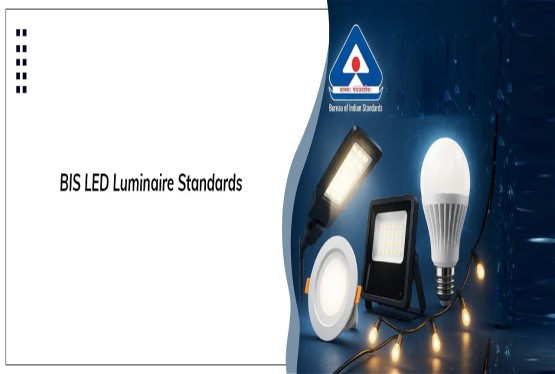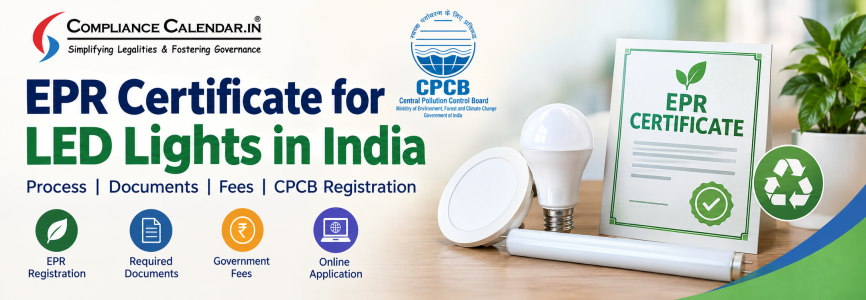



If you manufacture, import or sell LED lights under your own brand in India, you may need an EPR Certificate from the Central Pollution Control Board (CPCB). EPR stands for Extended Producer Responsibility. It means that businesses introducing covered electronic products into the market must take responsibility for the waste generated when those products are no longer useful. Under India's E-Waste (Management) Rules, 2022, producers of covered LED lighting products must complete EPR Registration and meet their recycling obligations.
This guide explains who needs an EPR Certificate for LED Lights, how to apply online, the documents required and the EPR Certificate cost in India.
What Is an EPR Certificate for LED Lights?
An EPR Certificate is commonly used to describe the registration certificate issued by CPCB to a producer under India's e-waste rules. It confirms that the business is registered for the electrical and electronic equipment covered by its registration. However, receiving this certificate does not mean the business has completed all its recycling responsibilities.
For example, imagine a company selling LED bulbs under its own brand. After several years, customers may throw away these bulbs because they no longer work. The company may have to meet recycling targets based on the quantity of covered products it has placed in the Indian market. EPR Registration helps CPCB track these responsibilities and supports the proper recycling of electronic waste.
EPR Certificate Full Form
The EPR Certificate full form is Extended Producer Responsibility Certificate. EPR is a system under which producers are responsible for meeting waste-management requirements for products they introduce into the market.
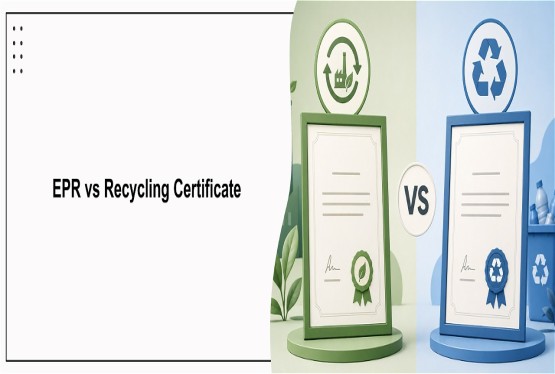
There are two important documents under the e-waste system:
- EPR Registration Certificate: Issued by CPCB to a registered producer.
- EPR Recycling Certificate: Generated by a registered recycler through the CPCB system and used by producers to meet their recycling obligations.
These documents serve different purposes and should not be confused.
Which LED Lights Require EPR Registration in India?
Not every lighting product is automatically covered in the same way. Schedule I of the E-Waste (Management) Rules, 2022 includes specified lighting equipment and related electrical products. The exact product category must be checked before applying for an EPR Certificate.
|
Lighting Product |
EPR Requirement |
|
LED bulbs |
Generally covered under the applicable lighting equipment category |
|
LED tube lights |
Generally covered, subject to product classification |
|
LED panel lights |
Check the applicable lighting equipment category |
|
LED street lights |
Check the product description and applicable category |
|
LED floodlights |
Check whether the product falls within the notified lighting category |
|
Fluorescent lamps |
Specifically covered under Schedule I |
|
Filament bulbs |
Excluded from the general lighting entry CEEW18 |
Schedule I includes CEEW18: Other lighting or equipment for the purpose of spreading or controlling light, excluding filament bulbs. The correct product classification matters because CPCB uses product categories to determine EPR obligations.
For example, a company selling LED street lights should identify the correct category before submitting its sales information. It should not assume that every lighting product has the same classification.
Who Needs an EPR Certificate for LED Lights?
EPR Registration is mainly required for businesses that qualify as producers under the e-waste rules. A producer may manufacture products under its own brand, sell products made by another factory under its brand or import covered electrical and electronic equipment for sale in India.
LED Light Manufacturers: A business manufacturing LED lights under its own brand may need producer registration. A factory manufacturing products for another brand should separately check whether it needs registration in the manufacturer category.
LED Light Importers: Businesses importing covered LED bulbs, tube lights or other lighting equipment for sale in India generally need to check their producer registration obligations.
LED Brand Owners: A company selling LED lights under its own brand may qualify as a producer even when another factory manufactures the products.
Wholesalers and Retailers: A business that only resells products from an already registered producer does not automatically need separate producer registration. Its role and business activities must be checked.
For example, if Company A manufactures LED bulbs for Company B, which sells them under its own brand, the two companies may have different registration responsibilities. This is why identifying the correct business category is important.
Documents Required for EPR Certificate for LED Lights
Before starting the EPR Certificate apply online process, businesses should prepare their company documents and product details. CPCB may ask for additional information depending on the applicant's business activities.
Common documents and information include:
- Company PAN and GST details.
- Certificate of Incorporation or business registration documents.
- Details of the authorised signatory.
- Import Export Code (IEC), where applicable.
- Product details and applicable EEE category codes.
- Financial-year-wise sales and import information.
- Product weight and quantity details.
- Required declarations relating to RoHS compliance.
- Details of the proposed consumer awareness activities.
- Other information or documents requested through the CPCB portal.
RoHS means Restriction of Hazardous Substances. It helps control certain harmful substances used in electrical and electronic products.
Businesses should check that their product details, sales records and company information are correct before submitting the application.
How to Get an EPR Certificate for LED Lights Online
Businesses can apply for an EPR Certificate online through the CPCB E-Waste EPR Portal. The application is submitted digitally, and CPCB reviews the information before granting registration.
Step 1: Check Your Product Category
Identify the LED lighting products sold by your business and confirm their Schedule I classification.
Step 2: Register on the CPCB Portal
Visit the official CPCB E-Waste EPR Portal and create an account under the correct applicant category.
Step 3: Enter Business and Product Details
Provide the company information, authorised signatory details, product categories and other required information.
Step 4: Submit Sales Information
Enter the required financial-year-wise sales or import data. CPCB uses this information to calculate the applicable recycling obligations.
Step 5: Upload Documents and Pay Fees
Upload the required documents and pay the applicable government registration fee through the available payment process.
Step 6: CPCB Reviews the Application
CPCB checks the application and may request corrections or additional information if any details are missing.
Step 7: Receive Your EPR Registration Certificate
After approval, CPCB issues the EPR Registration Certificate through the portal. The certificate contains the registration details and the covered product categories.
According to CPCB's published procedure, producer registration is valid for five years, and renewal should be applied for 120 days before expiry. Applicants should follow the latest instructions displayed on the portal.
EPR Certificate Cost for LED Lights in India
The EPR Certificate cost depends mainly on the producer's annual e-waste recycling target. CPCB has published a fee structure based on the quantity of e-waste involved.
|
Annual Recycling Target |
Published CPCB Registration Fee |
|
Below 50 MT |
2,500 |
|
50 MT to below 100 MT |
7,500 |
|
100 MT to below 1,000 MT |
1,50,000 |
|
1,000 MT to below 5,000 MT |
10,00,000 |
|
Above 5,000 MT |
15,00,000 |
Important: The published CPCB fee schedule also specifies 10,000 for producers whose sales have just started. It separately lists 5,000 annual maintenance charges for registered stakeholders. The exact fee payable should be confirmed on the CPCB portal before payment.
These are government charges. Professional assistance, if required, is charged separately. Businesses may also incur costs for meeting their recycling obligations.
What Happens After Getting an EPR Certificate?
Getting an EPR Certificate is only the beginning. Registered producers must also meet their recycling obligations and complete the required reporting.
Under the e-waste rules, producers generally fulfil their recycling obligations by obtaining EPR recycling certificates from registered recyclers through the CPCB system.
For FY 2026–27, the recycling target for established producers under Schedule III is generally 70% of the relevant historical quantity, calculated using the applicable product life. Newer producers may follow a different target calculation under Schedule IV.
For example, a company selling LED lights for the first time should not simply calculate its recycling target as 70% of its current-year sales. Its target depends on the applicable rules, product life and sales history.
Businesses must also maintain correct records and submit the required returns. Failure to meet EPR obligations may result in environmental compensation and other action under the rules.
EPR Certificate Download: How to Download Your Certificate
After CPCB approves the application, the producer can access its registration details through the official EPR portal.
The general process is simple:
- Log in to the CPCB E-Waste EPR Portal.
- Open the registration or certificate section.
- Check the approved registration details.
- Download the available EPR Registration Certificate.
- Save a copy for business and compliance records.
The exact menu names may change when CPCB updates the portal.
Businesses should also remember that an EPR Certificate for e-waste is different from BIS certification for LED lighting products. Depending on the product, separate BIS requirements may apply.
Common Mistakes to Avoid During EPR Registration
Many businesses face problems because they apply without checking their product category or preparing correct sales information.
One common mistake is selecting the wrong EEE category for LED lights. Another is providing sales figures that do not match business records. Some applicants also confuse manufacturer registration with producer registration or assume that obtaining the certificate completes all future compliance.
Before applying, check your product classification, business category, required documents and historical sales data. This can help reduce unnecessary corrections.
How Compliance Calendar LLP Can Help
If you manufacture, import or sell LED lights under your own brand, Compliance Calendar LLP can help you understand whether EPR Registration is required for your business.
Our team provides assistance with product classification, document preparation, CPCB EPR Registration, application queries and ongoing e-waste compliance.
You can also explore our EPR E-Waste Registration Service for further guidance.
Compliance Calendar LLP
Call Us: +91 9988424211
Email Us: info@ccoffice.in
Frequently Asked Questions About EPR Certificate for LED Lights
1. What is an EPR Certificate?
An EPR Certificate is commonly used to describe the registration certificate issued by the Central Pollution Control Board (CPCB) to producers covered under India's EPR rules. It confirms that the business is registered for the products listed in its certificate.
2. What is the full form of EPR Certificate?
The EPR Certificate full form is Extended Producer Responsibility Certificate. EPR means that producers must take responsibility for meeting the waste management and recycling requirements of their products.
3. Is an EPR Certificate mandatory for LED lights in India?
Yes, businesses that qualify as producers of LED lighting products covered under the E-Waste (Management) Rules, 2022, must obtain CPCB EPR Registration. The requirement depends on the product category and the business's role.
4. Who needs an EPR Certificate for LED lights?
Businesses manufacturing LED lights under their own brand, selling LED lights made by another factory under their brand, or importing covered LED lighting products may need producer registration.
5. How to get an EPR Certificate in India?
To get an EPR Certificate, visit the CPCB E-Waste EPR Portal, register your business, select the correct product category, upload the required documents and pay the applicable fees. CPCB issues the registration certificate after approving the application.
6. Can I apply for an EPR Certificate online?
Yes. You can apply for an EPR Certificate online through the official CPCB E-Waste EPR Portal. The application, document submission and fee payment are completed through the online system.
7. What is the EPR Certificate cost for LED lights?
The EPR Certificate cost depends on the applicable registration-fee category. CPCB's published fee schedule includes different charges based on recycling targets. Businesses must also consider the cost of meeting their recycling obligations.
8. Is an EPR Certificate required for importing LED lights?
Yes. Businesses importing covered LED lighting products for sale in India generally need EPR Registration if they qualify as producers under the e-waste rules. The correct registration category should be checked before importing.
9. What documents are required for an EPR Certificate?
Common documents include company PAN, GST details, business registration documents, authorised signatory details, product information, sales records and Import Export Code (IEC), where applicable. CPCB may request additional documents.
10. How can I download my EPR Certificate?
After CPCB approves your registration, log in to the official E-Waste EPR Portal. Open the registration or certificate section and download the available EPR Registration Certificate.
11. What is the validity of an EPR Certificate?
According to CPCB's published producer-registration procedure, EPR Registration is generally valid for five years. Producers should apply for renewal within the prescribed period before the certificate expires.
12. Is an EPR Certificate required for LED bulb manufacturers?
Yes, manufacturers selling covered LED bulbs under their own brand generally need producer registration. A factory manufacturing products for another brand should check its separate registration responsibilities.
13. Do LED street lights require EPR Registration?
LED street lights may fall under the lighting equipment categories covered by the e-waste rules. The manufacturer or importer should check the correct Schedule I category before applying.
14. Is EPR Registration required for LED light importers?
Importers of covered LED lighting products generally qualify as producers and must meet the applicable EPR Registration requirements. They should also check whether separate product certification requirements apply.
15. Is an EPR Certificate the same as a BIS Certificate?
No. An EPR Certificate relates to electronic waste management and recycling responsibilities. A BIS Certificate relates to applicable product quality and safety standards. Some LED lighting products may require both.
16. What is the difference between EPR Registration and an EPR Recycling Certificate?
EPR Registration allows a producer to register under the CPCB e-waste system. An EPR Recycling Certificate is generated by a registered recycler and can be used by producers to meet their recycling obligations.
17. Can a small business apply for an EPR Certificate?
Yes. Small businesses and startups can apply for EPR Registration if their activities fall under the applicable rules. Business size alone does not remove the registration requirement.
18. What happens if I sell LED lights without EPR Registration?
A business required to register under the e-waste rules may face regulatory action for operating without registration. Authorities may also impose environmental compensation or other measures under the applicable provisions.
19. Does getting an EPR Certificate complete all compliance requirements?
No. After registration, producers must continue to meet their applicable recycling targets, maintain required records and submit returns through the CPCB system.
20. Can Compliance Calendar LLP help with EPR Certificate Registration?
Yes. Compliance Calendar LLP assists businesses with EPR Certificate applications, document preparation, product classification, CPCB portal registration and ongoing e-waste compliance requirements.
Article last updated on : 23 Oct 2026.










_learn_crop10_thumb.jpg)