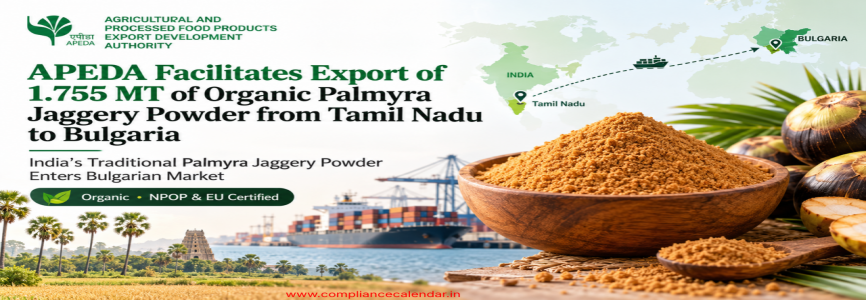



India has taken another step towards selling its traditional food products in international markets. According to the APEDA latest news 2026, the Agricultural and Processed Food Products Export Development Authority (APEDA) helped arrange the first export shipment of 1,755 kg of organic Palmyra Jaggery Powder from Tamil Nadu to Bulgaria. The shipment was flagged off on 15 October 2026, and the Government of India announced the news on 16 October 2026. The product was made in Erode, Tamil Nadu and certified under Indian and European organic standards.
This is good news for Indian farmers, food manufacturers, and people planning to start an organic food export business in India. It shows that traditional products such as jaggery can find buyers in other countries when they meet the required quality and certification standards. The announcement also highlights the importance of APEDA registration, organic certification, and proper export documents for businesses entering international markets.
What Is the Latest APEDA Update in October 2026?
On 16 October 2026, the Ministry of Commerce and Industry announced that APEDA had facilitated the first export consignment of organic Palmyra Jaggery Powder from Gobichettipalayam in Erode district, Tamil Nadu, to Varna, Bulgaria. The consignment contained 1.755 metric tonnes of jaggery powder, which is equal to 1,755 kilograms. The product was manufactured and exported by Wellbeing Foods, Erode, in collaboration with Chetty Exports Private Limited, Chennai. The shipment was planned to travel by sea through Chennai Port, while Sow Life Ltd, Bulgaria, was named as the overseas importer and distributor.
The main purpose of this initiative is to introduce traditional Indian food products to new international markets. It also aims to create better opportunities for farmers and businesses involved in organic food production. This APEDA export update 2026 is important because it shows how Indian agricultural products can reach European buyers with the right product quality, certification, and export arrangements.
Key Highlights of the APEDA Organic Jaggery Export
|
Particulars |
Details |
|
Government Authority |
APEDA |
|
Announcement Date |
16 October 2026 |
|
Product |
Organic Palmyra Jaggery Powder |
|
Export Quantity |
1.755 MT (1,755 kg) |
|
Export Location |
Erode, Tamil Nadu |
|
Destination |
Varna, Bulgaria |
|
Shipment Flag-Off Date |
15 October 2026 |
|
Organic Certification |
NPOP and EU Organic Certification |
|
Manufacturer and Exporter |
Wellbeing Foods, Erode |
|
Export Partner |
Chetty Exports Private Limited |
|
Overseas Importer |
Sow Life Ltd, Bulgaria |
|
Shipping Port |
Chennai Port |
What Is Organic Palmyra Jaggery Powder?
Palmyra Jaggery Powder is a traditional Indian sweetener made from the nectar of Palmyra palm flowers. These trees are commonly found in Tamil Nadu and some other parts of India. Farmers collect the sweet nectar from the flowers and heat it to prepare jaggery. The jaggery is then processed into powder, making it easier to pack, store, and transport. People can use this powder in tea, coffee, sweets, and other food items. Since it comes from palm nectar, it has a different taste and preparation process from ordinary white sugar.
Organic Palmyra Jaggery Powder is produced according to the applicable organic standards. This means its production and processing must meet certain requirements before it can be sold as certified organic. The product may contain small amounts of naturally occurring minerals, but it is still a sweetener and should be consumed in moderation. With growing interest in traditional food products, organic jaggery export from India may offer new business opportunities for manufacturers who can meet international food safety and certification requirements.
Why Is This APEDA Export Important for India?
India produces many traditional agricultural products, including jaggery, spices, millets, rice, and natural sweeteners. Some of these products are already popular in India but are not widely available in other countries. The export of Palmyra Jaggery Powder to Bulgaria shows that Indian businesses can introduce such products to new buyers with proper planning. For example, a small manufacturer making high-quality jaggery may be able to explore international markets if the product meets the importing country's rules and there is enough demand.
This development is also important for India's agricultural export business because it creates opportunities beyond commonly exported products. Instead of depending only on large-scale agricultural goods, exporters can explore traditional and value-added food products. APEDA supports this process by helping develop markets and encouraging quality standards. However, exporters still need to find buyers, arrange documents, and follow the applicable rules before shipping their products.
How Will Tamil Nadu Farmers Benefit from This Export?
The APEDA announcement also highlights the possible benefits for farmers involved in organic Palmyra cultivation. According to the government, the initiative covers around 137 acres of organic cultivation in Tamil Nadu. The reported price realisation is approximately 15% to 22% higher for farmers and around 17% higher for the manufacturer compared with the domestic market. This means farmers and manufacturers participating in this particular export initiative may receive better prices for their products.
For many farmers, finding reliable buyers and receiving a fair price can be difficult. International trade may provide another way to sell agricultural products, especially when farmers work with manufacturers and exporters. Better market access can encourage farmers to maintain product quality and continue organic cultivation. However, the price benefits mentioned in the announcement are specific to this initiative and do not mean every farmer or exporter will receive the same increase.
What Is APEDA and Why Is It Important for Exporters?
APEDA stands for Agricultural and Processed Food Products Export Development Authority. It is a government organisation working under the Ministry of Commerce and Industry. APEDA helps promote the export of agricultural and processed food products from India. In simple words, it supports Indian businesses that want to sell certain food and agricultural products in other countries. Its work includes promoting Indian products, supporting market development, providing export-related information, and encouraging better quality standards.
APEDA is also connected with APEDA RCMC Registration, which is relevant for exporters dealing in products covered under its scheduled categories. RCMC stands for Registration-cum-Membership Certificate. Businesses planning to export products such as processed foods, cereals, or other APEDA-scheduled goods should check whether they need this registration. APEDA RCMC is issued through the DGFT system after the exporter obtains an Import Export Code (IEC). Exporters should understand that APEDA registration, food safety licensing, and organic certification are separate requirements.
Why Were NPOP and EU Organic Certifications Important?
The organic Palmyra Jaggery Powder exported to Bulgaria had NPOP and EU organic certification. NPOP stands for National Programme for Organic Production, which is India's programme for organic production and certification. Under this system, products must follow the applicable organic standards, and certification is carried out by authorised certification bodies. Organic certification helps buyers understand that a product has been produced and handled according to the relevant organic rules. It is particularly important when a business wants to sell a product using the word “organic.”
Bulgaria is part of the European Union, so products sold there as organic must also meet the applicable EU organic requirements. This is why exporters should check the destination country's rules before shipping organic food products. A business cannot simply write “organic” on its packaging without meeting the required certification conditions. For anyone planning an organic food export from India, understanding NPOP certification and the destination country's organic rules is an important part of the preparation process.
What Documents Are Required to Export Organic Food from India?
Businesses planning to export jaggery, spices, processed foods, or other agricultural products need to prepare the documents required for their products and destination countries. One of the first requirements is usually an Import Export Code (IEC), which is issued by the Directorate General of Foreign Trade (DGFT). Exporters of APEDA-scheduled products should also check the applicable APEDA RCMC requirements. Food businesses must meet relevant FSSAI requirements, while products marketed as organic need the applicable organic certification.
Apart from registrations, exporters may need documents such as a commercial invoice, packing list, shipping documents, and product testing reports. Some countries may also require additional certificates or specific information on food labels. The exact requirements depend on the product being exported and the country receiving it. The following table explains the common documents and their purposes.
|
Document or Registration |
Purpose |
|
IEC Registration |
Generally required for importing or exporting goods from India |
|
APEDA RCMC Registration |
Relevant for exporters of APEDA-scheduled products |
|
FSSAI Licence or Registration |
Required as applicable for food businesses in India |
|
NPOP Certification |
Supports certified organic production under India's organic programme |
|
EU Organic Compliance Documents |
Required as applicable for organic products entering the EU market |
|
Commercial Invoice |
Shows the product details, buyer, seller, and value |
|
Packing List |
Provides information about the packages and quantities |
|
Shipping Documents |
Used for international transportation and customs |
|
Certificate of Origin |
May be needed to show where the product was produced |
|
Product Testing Reports |
May be required to meet food safety and quality standards |
Important: This is a general list. Not every document is required for every shipment. Exporters should confirm the current requirements before sending goods abroad.
How to Start an Organic Food Export Business in India?
Starting a food export business may look difficult, especially for someone who has never exported before. However, the process becomes easier when you understand the basic steps. Whether you want to export jaggery, spices, millets, or other processed food products, you should first check the market demand and the rules of the country where you want to sell your goods. You should also calculate your production, packaging, shipping, and certification costs before accepting an export order.
Step 1: Choose Your Export Product
Start by selecting the agricultural or food product you want to export. It could be jaggery powder, organic spices, millets, or another processed food item. Check whether buyers in other countries are interested in the product and whether your business can supply it regularly.
Step 2: Check the Export Rules
Before exporting, understand the rules of the destination country. Different countries may have different food safety, packaging, labelling, and certification requirements. For example, exporting certified organic food to Bulgaria involves meeting the applicable European Union requirements.
Step 3: Apply for IEC Registration
Apply for an Import Export Code (IEC) through the DGFT system if your business requires one. IEC is generally necessary for businesses importing or exporting goods from India. Make sure your business details and documents are correct before submitting the application.
Step 4: Check APEDA Registration Requirements
After obtaining your IEC, check whether your product falls under APEDA's scheduled categories. If applicable, you can apply for APEDA RCMC Registration through the DGFT e-RCMC system. The registration requirements depend on your product and business activities.
Step 5: Arrange Food and Organic Certification
Make sure your business follows the applicable FSSAI requirements. If you plan to export food as organic, arrange the necessary organic certification through an authorised certification body. You must also check whether the destination country requires additional certification or shipment documents.
Step 6: Find Buyers and Prepare the Shipment
Once the required preparations are complete, start looking for international buyers. Discuss the product price, quantity, packaging, delivery terms, and payment conditions. Prepare the required export documents and arrange transportation through a suitable shipping or customs service provider.
Step 7: Maintain Product Quality and Records
After your first export shipment, continue maintaining product quality and the required business records. Make sure your packaging and labelling meet the buyer's requirements. Timely delivery and consistent quality can help your business build long-term relationships with international customers.
Is APEDA Registration Mandatory for Organic Jaggery Export?
APEDA registration requirements depend on the product category and the applicable export rules. Exporters dealing in products covered under APEDA's scheduled categories should check the relevant RCMC requirements. APEDA's registration process is connected with the DGFT e-RCMC system, and businesses generally obtain their IEC before applying. However, APEDA registration does not replace food safety approvals, organic certification, or other export documents.
Businesses should also understand that the October 2026 Palmyra Jaggery Powder announcement is not a new government registration rule. It is news about an export initiative supported by APEDA. The announcement does not create a new licence or certificate for every jaggery exporter. Businesses should continue following the existing requirements applicable to their products and destination markets.
What Opportunities Does This Create for Indian Food Exporters?
The export of organic Palmyra Jaggery Powder to Bulgaria may encourage more Indian businesses to explore international markets. India has many traditional food products that could interest buyers outside the country. For example, businesses producing jaggery, natural sweeteners, spices, and other value-added agricultural products may find opportunities in markets where customers are interested in traditional or certified organic foods. However, exporters need to understand customer demand and offer products that meet the required standards.
This development is especially relevant for small manufacturers and first-time exporters. A business does not always need to manufacture a completely new product to explore international trade. Sometimes, improving packaging, maintaining quality, obtaining the required certification, and finding the right buyers can help an existing product enter a new market. The Palmyra Jaggery Powder shipment is a useful example of how these steps can work together.
How Can Compliance Calendar LLP Help with APEDA Registration?
If you are planning to start a food export business, understanding the registration process is one of the first challenges. You may need an IEC, APEDA RCMC, FSSAI licence, or other documents depending on your product and business activities. For a new exporter, knowing which registration to apply for first can be confusing. Compliance Calendar LLP helps businesses understand their applicable registration requirements and prepare the documents needed for the relevant applications.
Our team can assist with IEC Registration, APEDA RCMC Registration, FSSAI Registration and Licensing, and related business compliance requirements. Whether you are a small food manufacturer, a trader, or someone planning to enter the agricultural export business, it is important to complete the necessary preparations before exporting. You can contact Compliance Calendar LLP to understand which registrations may apply to your business.
Conclusion
The export of 1,755 kg of organic Palmyra Jaggery Powder from Tamil Nadu to Bulgaria is an important development for India's agricultural export sector. It shows that traditional Indian food products can reach international buyers when businesses maintain quality and meet the required certification standards. The initiative may also create better opportunities for farmers and manufacturers by connecting them with new markets.
For businesses planning to start organic food exports from India, this announcement offers a useful example of the importance of export preparation. Understanding IEC Registration, APEDA RCMC Registration, organic certification, and food safety requirements can help businesses avoid problems during the export process. Compliance Calendar LLP can assist businesses with applicable registration and documentation requirements so they can prepare for international trade.
Need Help with APEDA Registration or Food Export Compliance?
Planning to export jaggery, spices, organic food, or other agricultural products from India? Compliance Calendar LLP can help you understand the requirements for APEDA RCMC Registration, IEC Registration, FSSAI Licensing, and other applicable export-related compliances. Our team can guide you through the registration process and help you prepare the necessary documents.
Get in touch with Compliance Calendar LLP today!
-
Call/WhatsApp: +91 9988424211
-
Email: info@ccoffice.in
Frequently Asked Questions (FAQ's)
Q1. What is the latest APEDA news in October 2026?
Ans. On 16 October 2026, the Government of India announced that APEDA had facilitated the first export shipment of 1.755 metric tonnes of certified organic Palmyra Jaggery Powder from Tamil Nadu to Bulgaria. The shipment was flagged off on 15 October 2026 and was intended to introduce a traditional Indian sweetener to the Bulgarian market.
Q2. Which country imported organic Palmyra Jaggery Powder from India?
Ans. Bulgaria was the destination country for the organic Palmyra Jaggery Powder shipment. The consignment was arranged for Varna, Bulgaria, with Sow Life Ltd named as the overseas importer and distributor.
Q3. What is APEDA's full form?
Ans. APEDA stands for Agricultural and Processed Food Products Export Development Authority. It works under the Ministry of Commerce and Industry, Government of India, and supports the promotion of agricultural and processed food exports.
Q4. Is APEDA registration required for food exporters?
Ans. APEDA RCMC Registration is relevant for businesses exporting products covered under APEDA's scheduled categories. Exporters should check their product classification and the applicable registration requirements before applying.
Q5. What is NPOP certification?
Ans. NPOP stands for National Programme for Organic Production. It is India's organic certification programme and provides standards for organic production and certification through authorised certification bodies.
Q6. Can small businesses export jaggery from India?
Ans. Yes. Small businesses can export jaggery and other food products if they meet the applicable business, food safety, customs, and destination-country requirements. They should also check market demand, product quality, and shipping costs before starting.
Q7. Is IEC registration required for food exports?
Ans. An Import Export Code is generally required for businesses exporting goods from India, subject to applicable exemptions. IEC applications are handled through the DGFT system.
Q8. Does this APEDA update introduce a new government rule?
Ans. No. The announcement is about an export shipment of certified organic Palmyra Jaggery Powder to Bulgaria. It does not introduce a new APEDA registration rule or an additional mandatory licence for all jaggery exporters.
Article last updated on : 19 Oct 2026.














_learn_crop10_thumb.jpg)