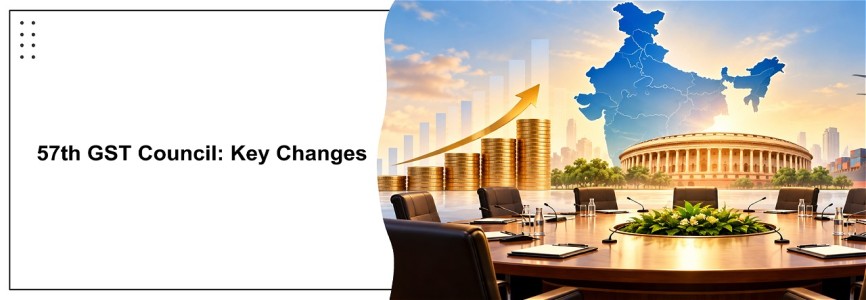



The 57th GST Council Meeting, held on 8 October 2026 in New Delhi, has brought several important recommendations that could make GST compliance easier for businesses and taxpayers across India. The meeting was chaired by Union Finance Minister Nirmala Sitharaman and focused on simplifying GST registration, reducing penalties, improving refunds and making tax procedures more business-friendly. Unlike earlier meetings that mainly focused on GST rates, this meeting paid special attention to the difficulties faced by taxpayers while following GST rules. From small shopkeepers to large companies, many businesses struggle with complicated registration procedures, delayed refunds, tax notices and compliance costs.
The Council has recommended changes to address these issues. Some of the major proposals include removing arrest provisions under GST, increasing the prosecution threshold from Rs.1 crore to Rs.5 crore, reducing the general penalty and introducing faster refund processes. These recommendations are expected to reduce unnecessary paperwork and improve the overall experience of taxpayers. However, they will become legally effective only after the required notifications, circulars or amendments are issued.
Removal of Arrest Provisions Under GST
One of the biggest recommendations of the 57th GST Council Meeting is the proposed removal of arrest powers under GST. Currently, Section 69 of the Central Goods and Services Tax Act, 2017 allows authorised officers to arrest individuals for certain GST offences, subject to prescribed conditions. The Council has recommended removing Section 69 completely. The main objective is to reduce the fear of arrest in tax-related matters and encourage businesses to follow the law voluntarily.
This does not mean that GST fraud or tax evasion will become legal. Tax authorities will still have powers to investigate offences and take action under other applicable legal provisions. The proposed change is particularly important for business owners who may face serious consequences during tax investigations.
Prosecution Threshold Increased from Rs.1 Crore to Rs.5 Crore
The GST Council has also recommended increasing the monetary threshold for prosecution from Rs.1 crore to Rs.5 crore. This means that, once implemented, criminal prosecution under the relevant GST provisions would generally apply at a higher monetary threshold, subject to the specific offence and legal exceptions.
For example, a business facing a tax dispute involving Rs.2 crore may receive different treatment under the proposed rules compared with the existing framework. The Council has also recommended changes to Section 132 of the CGST Act, 2017 to make prosecution provisions more focused on serious offences. These changes aim to reduce criminal proceedings in comparatively smaller tax matters while maintaining action against serious GST fraud.
General GST Penalty Reduced to Rs.10,000
Another important recommendation is the reduction of the maximum general penalty under Section 125 of the CGST Act, 2017. The Council has proposed reducing this penalty from Rs.25,000 to Rs.10,000. This provision generally applies to violations for which no separate penalty has been specified under the GST law.
The proposed reduction could provide relief to businesses, particularly small enterprises that sometimes make compliance mistakes due to limited resources or lack of technical knowledge. However, it is important to understand that this reduction concerns the general penalty under Section 125 and does not automatically apply to every penalty under GST.
Simplification of GST Registration and Cancellation
GST registration can sometimes become complicated because of document requirements, departmental queries and delays in application processing. To address these problems, the Council has recommended clearer registration guidelines and improvements to the GST portal. The proposed changes include better document selection options, easier application forms and more user-friendly instructions.
The Council has also recommended automatic approval of several amendments to registration details. Changes relating to the principal place of business may be treated differently depending on the registration category. Registration cancellation is also expected to become easier. In eligible cases, applications may be processed automatically once pending returns are filed and outstanding dues are paid. These changes could save considerable time for taxpayers who want to update or close their GST registrations.
Faster GST Refunds Through Automated Processing
Delayed GST refunds have been a common concern among exporters and other businesses. When a refund remains pending for a long period, the business may struggle to manage working capital and daily expenses. The Council has recommended a system-based refund process to reduce delays and unnecessary manual intervention.
Under the proposed system, eligible claims involving excess electronic cash ledger balances could be sanctioned automatically. For eligible refunds relating to zero-rated supplies and inverted duty structures, the Council has proposed automatic provisional sanction of 90% of the claimed amount, based on system risk assessment. The Council has also recommended reducing the time limit for issuing a refund acknowledgement or deficiency memo from 15 days to 10 days. These changes could help businesses receive eligible refunds faster and improve cash flow.
Changes in Input Tax Credit Rules
Input Tax Credit, commonly known as ITC, allows registered businesses to claim credit for eligible GST paid on purchases and business expenses. However, certain restrictions under Section 17(5) of the CGST Act prevent businesses from claiming ITC on specified goods and services. The Council has recommended removing some restrictions relating to outdoor catering, health and life insurance, telecommunication towers and certain other supplies.
It has also proposed expanding refund eligibility for accumulated ITC relating to capital goods and input services in specified situations. For businesses, these recommendations could reduce the amount of GST credit that remains blocked and help them manage their finances more effectively. The Council has suggested different implementation dates for some ITC-related changes, including 1 November 2026 and 1 April 2027, subject to the necessary legal changes.
Easier GST Returns and Fewer Mismatches
Many taxpayers receive GST notices because the details reported in GSTR-1, GSTR-3B and GSTR-2B do not match. Sometimes these differences arise from genuine reporting mistakes rather than deliberate tax evasion. The Council has recommended improving the return filing system to make corrections and reconciliation easier.
The proposed changes include better reporting of tax liabilities, improvements to the Invoice Management System and facilities for tracking ITC reversals and reclaims. The revised mechanism is proposed to apply from the return period of April 2027, subject to further consultation and implementation. This could help businesses correct reporting mistakes and reduce unnecessary disputes.
E-Way Bill Reforms for Transporters
Businesses transporting goods between states often face delays due to vehicle inspections and document verification. The Council has recommended changes to make the movement of goods smoother. Under the proposed framework, interception of vehicles would generally require specific intelligence and authorisation from an officer of at least Joint Commissioner rank.
The Council has also recommended restrictions on inspections in transit states, with exceptions for situations such as missing e-way bills or documents showing the origin or destination of goods. These measures could reduce transportation delays and help businesses deliver goods more efficiently.
Relief for Small Businesses and E-Commerce Sellers
The meeting also brought proposals aimed at helping small businesses and online sellers. The Council has recommended a simplified GST registration mechanism for certain small suppliers selling goods through e-commerce platforms. Eligible businesses may be able to obtain registration in another state by declaring an e-commerce operator's warehouse as their principal place of business, subject to prescribed conditions.
Another significant development is the in-principle approval of an optional Annual Return Quarterly Payment (ARQP) scheme. The proposed scheme is intended for eligible businesses with turnover up to Rs.5 crore in the preceding financial year that exclusively supply goods or services to unregistered customers. The detailed rules and implementation process will need to be finalised before businesses can use this scheme.
Better GST Notices and Dispute Resolution
The GST Council has recognised the need to improve how tax notices and disputes are handled. It has recommended introducing a minimum tax amount of Rs.10,000 for issuing show cause notices under the relevant demand provisions. The Council has also suggested clearer guidelines for tax officers regarding notices, adjudication orders and personal hearings.
In addition, reduced penalties have been proposed for certain non-fraud cases where taxpayers pay the required tax and interest within the prescribed time. These recommendations are intended to reduce unnecessary litigation and make GST proceedings more transparent.
Conclusion
The 57th GST Council Meeting represents an important effort to simplify India's GST system and make compliance less difficult for businesses. Proposals such as removing arrest provisions, reducing the general penalty, improving registration procedures and introducing faster refunds could provide meaningful relief to taxpayers. Small businesses, exporters, e-commerce sellers and other registered taxpayers may benefit from these changes once they are implemented.
However, businesses should not assume that every recommendation has already become law. The applicable GST provisions will change only through the required legal amendments, notifications or circulars. Taxpayers should continue following existing GST requirements while keeping track of official updates.
Frequently Asked Questions (FAQs)
Q1. When was the 57th GST Council Meeting held?
Ans. The 57th GST Council Meeting was held on 8 October 2026 in New Delhi. It was chaired by Union Finance Minister Nirmala Sitharaman. The meeting focused mainly on simplifying GST procedures, improving refunds, reducing penalties and making GST compliance easier for businesses.
Q2. What are the major recommendations of the 57th GST Council Meeting?
Ans. The major recommendations include removing GST arrest provisions, increasing the prosecution threshold to Rs.5 crore, reducing the maximum general penalty to Rs.10,000 and simplifying registration procedures. The Council also proposed faster automated refunds, improvements in ITC rules and easier compliance for small businesses.
Q3. Has the GST Council removed arrest provisions under GST?
Ans. The Council has recommended removing arrest powers by deleting Section 69 of the CGST Act, 2017. However, this is a recommendation and does not automatically change the existing law. The proposal must be implemented through the required legislative process before it becomes legally effective.
Q4. What is the new prosecution threshold under GST?
Ans. The Council has recommended increasing the monetary threshold for prosecution from Rs.1 crore to Rs.5 crore. The change is intended to reduce criminal proceedings in smaller tax cases. The actual application will depend on the final amended provisions, including the nature of the offence and any exceptions.
Q5. Has the GST penalty been reduced from Rs.25,000 to Rs.10,000?
Ans. The Council has recommended reducing the maximum general penalty under Section 125 of the CGST Act from Rs.25,000 to Rs.10,000. This proposal does not cover every GST offence or penalty. The revised amount will become applicable after the relevant legal amendment takes effect.
Q6. What changes have been proposed for GST registration?
Ans. The Council has proposed simpler registration forms, clearer document requirements and better guidance on the GST portal. It has also recommended automatic processing of certain registration amendments and cancellation requests. These changes are intended to reduce departmental queries and save taxpayers time.
Q7. Will GST refunds become faster after the 57th GST Council Meeting?
Ans. The Council has recommended automated processing of eligible GST refund claims. It has also proposed provisional sanction of 90% of certain refund claims based on risk assessment. These measures could reduce delays and help exporters and other eligible businesses receive refunds faster once implemented.
Q8. What is the proposed ARQP scheme under GST?
Ans. ARQP stands for Annual Return Quarterly Payment. The Council has given in-principle approval to an optional scheme for eligible businesses with turnover up to Rs.5 crore that make supplies exclusively to unregistered customers. The detailed conditions and implementation date are yet to be finalised.
Q9. What are the proposed changes in GST Input Tax Credit?
Ans. The Council has recommended relaxing certain blocked ITC restrictions and expanding refund eligibility for eligible input services and capital goods. It has also proposed improving ITC reporting and reconciliation through the GST portal. These changes could reduce blocked credits and reporting mismatches for businesses.
Q10. Are the recommendations of the 57th GST Council Meeting applicable immediately?
Ans. No. GST Council recommendations do not automatically become enforceable law. They must be implemented through the relevant amendments, rules, notifications or circulars. Businesses should continue following existing GST provisions until the applicable legal changes are officially brought into force.











_learn_crop10_thumb.jpg)