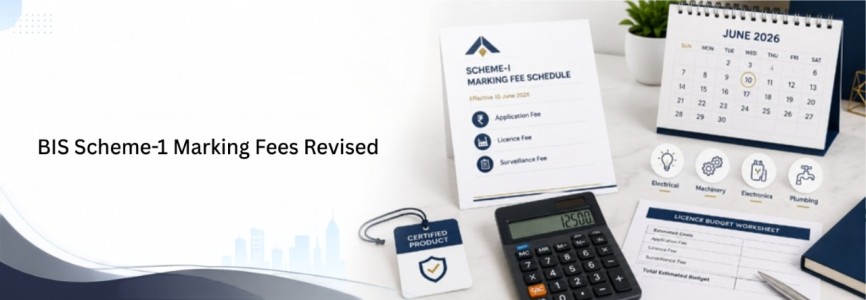



Manufacturers holding or planning a BIS Scheme-I licence should recheck the marking-fee schedule before budgeting a new application, licence operation or product launch. BIS issued notification CMD-2/G-18 dated 10 June 2026 to amend the marking-fee schedule originally notified on 5 August 2021. The amendment substitutes fee entries for several Indian Standards and inserts new entries after serial number 1759. Certain substituted rates become effective one month from notification, while inserted entries carry their own effective dates in the official table.
Marking Fee Notification at a Glance
|
Particular |
Official Detail |
|
Notification |
CMD-2/G-18 |
|
Issuing Authority |
Bureau of Indian Standards, Department of Consumer Affairs |
|
Notification Date |
10 June 2026 |
|
Gazette Publication |
15 June 2026 |
|
Certification Scheme |
Scheme-I of Schedule-II to the BIS (Conformity Assessment) Regulations, 2018 |
|
Main Change |
Substitution of specified fee entries and insertion of additional Indian Standards |
|
Rates Covered |
Annual minimum marking fee and unit-rate structure as listed in the schedule |
|
Business Relevance |
Budgeting for applicants and existing Scheme-I licensees |
What the June Amendment Actually Does
The notification does not introduce a new Quality Control Order or decide whether a product is mandatory. It changes the financial schedule used under Scheme-I. A business must therefore separate two questions: first, whether the product requires or seeks Scheme-I certification; and second, what marking fee applies once the relevant Indian Standard and enterprise category are identified.
The amendment replaces entries connected with serial numbers 229, 230, 329, 372, 399, 400, 404, 431, 432, 517, 1502, 1511, 1641 and 1765. It also inserts new serial numbers after 1759, extending the schedule through later entries. Because the notification presents many standards numerically, a business should not guess the product name from memory; the exact Indian Standard should be verified in the BIS standard and product-certification records.
Prominent Revised Entries Businesses May Notice
The substituted table includes standards such as IS 2028:2024, IS 2029:2004, IS 2997:1964, IS 3650:1981, IS 4003 (Part 1):1978, IS 4003 (Part 2):1986, IS 4123:1982, IS 4508:1992, IS 4509:1992, IS 6149:1998, IS 302 (Part 1):2024/IEC 60335-1:2020 together with IS 302-1:2008, and IS 9202:2020.
The schedule gives a unit, an annual minimum marking-fee figure for large-scale enterprises, a separate figure for micro, small and medium enterprises, unit rates and the effective-date treatment. Businesses should read the row applicable to their exact standard rather than applying a rate quoted for a similar product.
Special Treatment for the General Electrical Appliance Entry
For the combined entry relating to IS 302 (Part 1):2024/IEC 60335-1:2020 and IS 302-1:2008, the amended table uses one piece for all appliances, with a different quantity basis for electric liquid vaporizer mosquito repellents. It also distinguishes the first appliance and each subsequent appliance in the annual minimum marking-fee figures.
This structure can affect manufacturers producing several appliances under a common general safety standard. Product grouping, appliance identity and licence scope should be checked carefully before estimating the payable amount. The notification should not be read as automatically combining every model or factory into one fee.
Effective Dates Are Not Uniform Across the Entire Table
|
Compliance Event |
Relevant Date |
Business Impact |
|
Notification issued |
10 June 2026 |
Official amendment date stated in CMD-2/G-18. |
|
Gazette publication |
15 June 2026 |
Publication appears in Part III, Section 4 of the Gazette. |
|
Substituted entries |
One month from notification |
The table expressly records this effective treatment for the substituted rows. |
|
Inserted entries |
Dates stated in column 11 |
Each inserted standard carries an effective date in YYYYMMDD format. |
How to Read a Marking-Fee Row Correctly
-
Identify the exact Indian Standard number and edition that applies to the product and licence.
-
Check the unit of calculation, such as pieces, metric tonnes, litres, sets, square metres or apparatus.
-
Determine the enterprise category used by BIS for the applicable fee.
-
Read the annual minimum marking-fee figure and the unit-rate slab together.
-
Check whether all quantity falls in the first slab or whether additional slabs apply.
-
Confirm the effective date before using the row for budgeting or payment.
-
Compare the amended row with the current online marking-fee search result before filing or renewal.
Concessions Available Under a Separate March 2026 Notification
BIS separately extended Scheme-I annual minimum marking-fee concessions through 31 May 2029. The official March notification states an 80% concession for micro-scale enterprises, 50% for small-scale enterprises and 80% for start-ups, measured against the fee payable by large-scale enterprises. A women entrepreneur enterprise receives an additional 10% concession on the annual minimum marking fee applicable to its enterprise scale, whether micro, small or medium.
Eligibility should be supported with current and acceptable enterprise documents. A company should not apply a concession merely because its turnover appears small or because a founder is a woman. The enterprise classification and conditions should be checked against the official BIS requirements.
Budgeting Mistakes That Commonly Create Problems
Businesses sometimes treat the application fee, testing cost, inspection-related expenditure and marking fee as one amount. They are different cost heads. The marking-fee schedule also distinguishes annual minimum amounts and unit-based calculations. A realistic compliance budget should include all applicable official fees, laboratory charges, travel or inspection-related cost where relevant, sample logistics and professional support.
Another mistake is using an old rate sheet saved by a previous consultant or factory team. Because BIS periodically amends the schedule, the latest row for the applicable standard and effective date should be checked before payment.
Documents and Data Needed for an Accurate Fee Assessment
A fee review normally requires the exact Indian Standard, product and variety, factory and licence details, expected production quantity, enterprise classification, start-up recognition where relied upon, women-entrepreneur eligibility documents where applicable, and the planned effective period. For a multi-product or multi-appliance licence, the proposed scope and grouping should also be examined.
The marking-fee amendment does not replace the certification application checklist. Testing, factory capability, product conformity and legal documents remain separate requirements under Scheme-I.
Commercial Impact of Underestimating Marking Fee
An incorrect budget can delay application processing, licence grant, renewal or expansion of scope if the applicant is unable to pay the applicable dues. Existing licensees may also face reconciliation issues where production declarations and unit-rate calculations are incomplete.
For price-sensitive products, the annual minimum fee can affect unit economics, especially in the early period of low production. Businesses launching several products under different standards should model the fee before finalising pricing, tender quotes and import-substitution plans.
Practical Example: A Manufacturer Adds a Second Appliance
A domestic manufacturer already holds a Scheme-I licence for one appliance and plans to add another product under the general electrical appliance standard. The team should not simply multiply the old annual fee by two. The June table distinguishes the first appliance and each subsequent appliance for the relevant entry. The manufacturer should confirm whether the new product falls within the same applicable standard and licence structure, check the revised effective date, and obtain a current fee calculation before filing the inclusion request.
Scheme-I Marking Fee Checklist
-
Exact Indian Standard and edition confirmed
-
Correct serial-number row identified
-
Unit of calculation checked
-
Large/MSME annual minimum fee compared
-
Applicable unit-rate slab reviewed
-
Effective date confirmed
-
Enterprise-category evidence updated
-
Start-up or women-entrepreneur concession eligibility verified
-
Production estimate prepared
-
Other BIS and testing costs budgeted separately
How Compliance Calendar LLP Can Support Fee and Licence Planning
Compliance Calendar LLP can identify the relevant Indian Standard, review the applicable Scheme-I fee row, assess concession eligibility, prepare a licence budget, support product testing and documentation, file certification or inclusion applications, respond to BIS queries and guide post-licence production and marking-fee compliance. Final fees depend on the official BIS schedule, enterprise status, product scope and production details.
Use the Revised Schedule Before Quoting or Filing
The 10 June 2026 amendment is primarily a financial and administrative update, but it can materially affect a certification project. Applicants and licensees should identify the exact standard, read the correct unit and annual minimum fee, confirm the effective date and preserve evidence for any concession claimed. The marking fee is only one component of BIS compliance; it must be planned alongside testing, factory readiness, application fees and licence operation. Using a current calculation before filing or pricing a product can prevent unexpected dues and avoidable delays.
Frequently Asked Questions
Q1. What is the date of the latest Scheme-I marking-fee amendment?
Ans. BIS issued CMD-2/G-18 on 10 June 2026. The Gazette carrying the notification is dated 15 June 2026.
Q2. Does this notification make the listed products mandatory?
Ans.No. The notification amends the Scheme-I marking-fee schedule. Product mandatory status arises from the applicable Quality Control Order or other legal requirement.
Q3. When do the substituted rates become effective?
Ans. The substituted table records that the revised entries apply from one month of the notification. Inserted rows carry their own effective dates in the final column.
Q4. Are marking fees the same as product testing charges?
Ans. No. Marking fee, application fee, testing cost and other certification expenses are separate. A complete budget should account for each applicable cost.
Q5. What concessions are available for micro and small enterprises?
Ans. Under the separate March 2026 BIS notification, micro enterprises receive an 80% concession and small enterprises receive a 50% concession in the annual minimum marking fee payable by large-scale enterprises, up to 31 May 2029.
Q6. Do start-ups receive a concession?
Ans. The March notification provides an 80% concession for start-up enterprises in the annual minimum marking fee payable by large-scale enterprises, up to 31 May 2029, subject to eligibility.
Q7. Is there an additional concession for women entrepreneur enterprises?
Ans. Yes. BIS provides an additional 10% concession in the annual minimum marking fee payable by the applicable micro, small or medium enterprise scale, up to 31 May 2029.
Q8. How can Compliance Calendar LLP calculate the fee?
Ans.CCL can review the exact Indian Standard, unit, enterprise category, production estimate and concession documents, then prepare a current fee assessment using the official BIS schedule.


_crop10_thumb.jpg)




_for_FY_2025-26_crop10_thumb.jpg)




_learn_crop10_thumb.jpg)


_Filing_Due_Dates_for_FY_2024-25_learn_crop10_thumb.jpeg)




_of_GST_Act_learn_crop10_thumb.jpg)


_Under_GST_learn_crop10_thumb.jpg)


_crop10_thumb.jpg)


_crop10_thumb.jpg)


_learn_crop10_thumb.jpg)


_of_the_Income_Tax_Act_learn_crop10_thumb.jpg)


_learn_crop10_thumb.jpg)


_learn_crop10_thumb.jpg)


_crop10_thumb.jpg)





_in_The_Income_Tax_Act,_1961_learn_crop10_thumb.jpg)


_learn_crop10_thumb.jpg)


_of_the_Income_Tax_Act_learn_crop10_thumb.jpg)

_Of_Income_Tax_Act_learn_crop10_thumb.jpg)


_learn_crop10_thumb.jpg)


_learn_crop10_thumb.jpg)
_crop10_thumb.jpg)



_learn_crop10_thumb.jpg)
_for_Import_and_Export_learn_crop10_thumb.jpg)

















_crop10_thumb.jpg)