


Running a private security agency in India is a responsible business activity because it directly deals with protection of persons, property and business premises. For this reason, the licensing authority carefully examines every PSARA License application before granting approval. The authority does not only check whether the applicant has submitted a form; it also checks the applicant’s background, documents, business structure, training arrangement, office details and overall ability to run a security agency in a lawful manner.
Many PSARA License applications are rejected or delayed because of avoidable mistakes. In most cases, the problem is not the business itself, but the way the application is prepared. Incorrect details, missing documents, weak verification records, unsuitable office proof, poor affidavit drafting or non-compliance with state-specific requirements can create serious objections. A properly prepared application improves the chances of smooth approval and also helps the agency build a strong compliance base for future operations.
Incomplete Documentation
Incomplete documentation is one of the most common reasons for rejection of a PSARA License application. The licensing authority requires several documents to verify the applicant’s identity, business existence, office address, financial capacity, police verification details and training arrangements. If any important document is missing or unclear, the application may be objected to or rejected.
For example, if a company applies for PSARA License but does not attach proper incorporation documents, PAN, address proof, details of directors or required declarations, the authority may not process the application further. Similarly, if a document is expired, unreadable or not properly signed, it may create doubt about the authenticity of the application. To avoid this issue, the applicant should prepare a complete document checklist before filing. All documents should be valid, updated, readable and properly signed. The name, address and business details should match across all documents.
Incorrect or Mismatched Details
Another major reason for rejection is mismatch in the information submitted by the applicant. Even small mistakes in spelling, address, date of birth, PAN details, business name or director details can lead to objections during scrutiny or verification. A common example is when the registered office address mentioned in the application is different from the address mentioned in the rent agreement, electricity bill, GST certificate or incorporation records. Such mismatch may make the authority question whether the applicant has provided genuine information.
To avoid this, the applicant should cross-check all details before submission. The information in the application form must match the supporting documents. If there has been any change in address, directors, partners or business structure, the relevant records should be updated before filing the PSARA application.
Failure in Police Verification
Police verification plays an important role in the PSARA License approval process. Since private security agencies deploy guards for safety and protection, the background of the applicant, directors, partners and key persons is carefully checked. An application may face rejection if police verification gives an adverse report or remains incomplete due to wrong information. Incorrect residential address, unavailable applicant, incomplete identity details or any serious criminal background may create issues during verification.
The applicant should ensure that all personal details are correct and supported by valid identity and address proof. The applicant and key persons should also be available for verification whenever required. Any background issue should be reviewed before filing the application.
Non-Compliance with Eligibility Conditions
PSARA License can be granted only when the applicant satisfies the eligibility conditions prescribed under the law and applicable state rules. If the applicant or any key person is disqualified, the application may be refused. Eligibility issues may arise where the applicant has a serious criminal record, has been convicted for offences involving moral turpitude, has doubtful background, or has previously violated license conditions. In case of a company or LLP, the background of directors, partners and principal officers also becomes relevant.
To avoid rejection, the eligibility of the applicant and key managerial persons should be checked before filing. If any person connected with the business has a doubtful record, it should be reviewed properly because the authority may reject the application on that basis.
Improper Office Address Proof
A valid and genuine office address is required for PSARA License. The licensing authority must be satisfied that the applicant has a proper place of business from where the security agency will operate. Rejection or objection may arise where the applicant submits an expired rent agreement, incomplete address proof, utility bill with different details, or office proof without owner’s NOC. In some cases, using a residential address or shared office without proper supporting documents can also create issues depending on the state requirements.
The applicant should use a genuine business address and keep all related documents ready. The rent agreement, ownership proof, NOC and utility bill should support the address mentioned in the application. The address should also match business records wherever required.
Weak Financial Documents
The licensing authority may also examine whether the applicant has the financial capacity to run a private security agency. A security agency must bear expenses related to guard salary, training, uniforms, supervision, statutory compliance and administration. If the applicant submits incomplete financial documents or fails to show basic financial capacity, the authority may raise questions. This is especially important for newly incorporated entities because they may not have a long business history.
To avoid this problem, the applicant should maintain proper bank statements, income tax records, financial statements and capital proof, as applicable. The documents should show that the applicant can manage security agency operations responsibly.
No Proper Training Arrangement
Training is an important part of private security agency compliance. Security guards cannot be deployed without proper basic training and discipline. Depending on the state rules, the applicant may be required to show a training arrangement with a recognized or suitable training institute.
If the training agreement is missing, incomplete, not valid or not acceptable under state rules, the application may face objection. The authority may also question whether the applicant has a genuine system for training guards before deployment. To avoid this, the applicant should arrange proper training documents before filing. The training agreement, institute details and training plan should be clear and genuine. It should not look like a formality prepared only for submission.
Improper Details of Supervisors
A private security agency must have proper supervision over its guards. Supervisors are responsible for monitoring discipline, duty performance, deployment, reporting and client-site coordination. If the application does not clearly show supervisory arrangements, the authority may raise concern.
The applicant should provide proper details of supervisors, their experience and role in the agency. A clear operational structure shows that the agency is capable of managing security guards professionally.
False Declaration or Misrepresentation
False information or misrepresentation can lead to serious rejection. A PSARA application includes declarations and undertakings, and the applicant is expected to submit truthful information. If the authority finds fake documents, false address, forged training agreement, hidden criminal record or incorrect business details, the application can be rejected.
This mistake can also affect future applications because it damages the applicant’s credibility before the authority. The safest approach is to submit only genuine documents and correct information. If any fact requires clarification, it should be explained properly instead of being hidden.
Applying in the Wrong Jurisdiction
PSARA License is state-specific. The applicant must apply before the correct State Controlling Authority and select the correct area of operation. If the application is filed in the wrong state, district or jurisdiction, it may be rejected or delayed.
Businesses planning to operate in multiple states must understand that one state license does not automatically permit operations across India. Separate licensing may be required depending on the state of operation. Before filing, the applicant should decide whether the license is required for one district, multiple districts or the entire state. The application should be filed accordingly.
Ignoring State-Specific Requirements
Although PSARA is a central law, its implementation is handled by state authorities. Each state may have its own forms, government fees, affidavit formats, police verification process, training requirements and document checklist. Many applicants make the mistake of using the same checklist for every state.
This can result in missing documents or incorrect formats, leading to objection or rejection. To avoid this, the applicant should check the latest state-specific rules before filing. If applying in more than one state, separate documentation should be prepared as per each state’s requirements.
Poorly Drafted Affidavits and Undertakings
Affidavits and undertakings are important supporting documents in a PSARA application. If they are wrongly drafted, unsigned, not notarized where required, or inconsistent with the application details, they may create objections.
For example, an affidavit with an incorrect applicant name, wrong address, missing declaration or outdated format may not be accepted. Even if the rest of the application is correct, a defective affidavit can delay approval. The applicant should use updated affidavit formats as per the state requirement. The details in the affidavit should match the application form and supporting documents.
Lack of Clarity in Business Activity
The applicant’s business documents should support private security agency activity. If the object clause, business registration or GST details do not clearly align with security services, the authority may seek clarification. This issue is common where a company was incorporated for another activity and later decides to start a security agency business. If the business documents do not permit security-related services, the application may face difficulty.
Before filing, the applicant should check whether its business documents allow private security agency services. If required, the object clause or business registration details should be updated.
Failure to Respond to Objections
In many cases, the authority does not reject the application immediately. It first raises objections or asks for clarification. However, if the applicant does not respond within time or submits an incomplete reply, the application may be rejected.
Applicants often miss portal updates, emails or official communication. Some also upload the wrong revised documents or give vague replies that do not address the objection. To avoid this, the applicant should regularly track the application status after submission. Any objection should be answered clearly with the required document or explanation.
Operating Before License Approval
Starting security agency operations before receiving PSARA License can create serious problems. If an applicant begins deploying guards without license and the authority comes to know about it, it may negatively affect the application.
PSARA License should be obtained before starting private security agency services. The applicant may prepare documents, arrange training and plan operations, but actual deployment should not begin without valid approval.
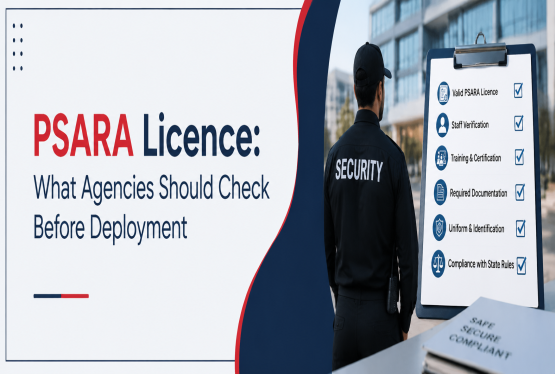
Checklist to Avoid PSARA License Rejection
Before filing a PSARA License application, the applicant should ensure that:
- All required documents are complete and updated
- Business name, address and personal details match across documents
- Applicant and key persons satisfy eligibility conditions
- Police verification details are correct
- Office address proof is valid and genuine
- Training arrangement is properly documented
- Supervisor details are clear
- Financial documents are properly arranged
Practical Tips for a Smooth PSARA Application
A PSARA License application should be handled carefully from the beginning. The applicant should not treat it as a simple online filing. Proper preparation reduces objections and improves the chances of approval. Useful practices include:
- Prepare a separate PSARA compliance file
- Review all documents before submission
- Use updated state-specific formats
- Keep scanned copies clear and readable
- Maintain proper communication records
- Track application status regularly
- Respond to objections with exact documents
- Keep training and supervisor details ready
- Avoid submitting incomplete or doubtful documents
Conclusion
PSARA License rejection usually happens because of incomplete documents, mismatched details, police verification issues, eligibility concerns, weak office proof, improper training arrangement or failure to follow state-specific rules. Most of these mistakes can be avoided with proper planning and careful documentation.
A clean and complete PSARA application gives confidence to the licensing authority that the applicant is serious, eligible and capable of running a private security agency responsibly. For any security business, PSARA compliance should not be treated as a one-time formality. It should be the foundation of lawful and professional operations.
FAQ’S
- Why is PSARA License rejected?
Ans. Due to incomplete documents, wrong details, failed verification or eligibility issues.
Q2. Can wrong details cause rejection?
Ans. Yes, mismatch in name, address or business details can cause rejection.
Q3. Is police verification important?
Ans. Yes, adverse or incomplete police verification may lead to rejection.
Q4. Can office proof affect approval?
Ans. Yes, invalid or mismatched office proof can create objections.
Q5. Are training documents required?
Ans. Yes, proper guard training arrangement is usually required.
Q6. Can criminal background lead to rejection?
Ans. Yes, serious criminal record may affect approval.
Q7. Is PSARA License state-specific?
Ans. Yes, PSARA License is generally valid for the approved state only.
Q8. Can I operate before approval?
Ans. No, security agency operations should start only after license approval.
Q9. How to avoid rejection?
Ans. Submit correct documents, proper details and follow state rules.
Q10. Can I reapply after rejection?
Ans. Yes, after correcting the rejection reasons.


_crop10_thumb.jpg)





_for_FY_2025-26_crop10_thumb.jpg)





_learn_crop10_thumb.jpg)


_Filing_Due_Dates_for_FY_2024-25_learn_crop10_thumb.jpeg)





_of_GST_Act_learn_crop10_thumb.jpg)


_Under_GST_learn_crop10_thumb.jpg)


_crop10_thumb.jpg)


_crop10_thumb.jpg)


_learn_crop10_thumb.jpg)


_of_the_Income_Tax_Act_learn_crop10_thumb.jpg)


_learn_crop10_thumb.jpg)


_learn_crop10_thumb.jpg)


_crop10_thumb.jpg)





_in_The_Income_Tax_Act,_1961_learn_crop10_thumb.jpg)


_learn_crop10_thumb.jpg)


_of_the_Income_Tax_Act_learn_crop10_thumb.jpg)

_Of_Income_Tax_Act_learn_crop10_thumb.jpg)


_learn_crop10_thumb.jpg)


_learn_crop10_thumb.jpg)
_crop10_thumb.jpg)



_learn_crop10_thumb.jpg)
_for_Import_and_Export_learn_crop10_thumb.jpg)




















_crop10_thumb.jpg)