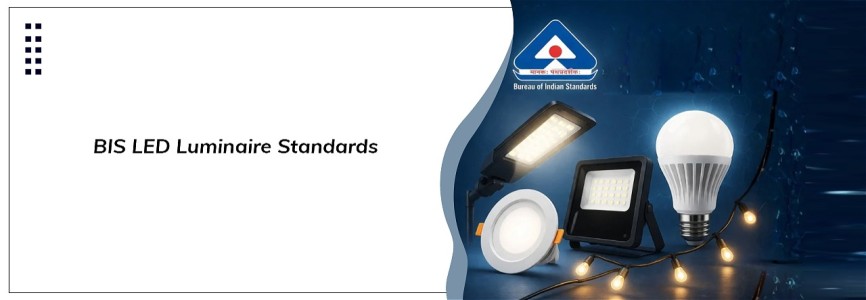



The LED lighting industry in India is growing rapidly, but with growth comes stronger regulatory responsibility. LED luminaires are no longer viewed only as electrical products used for illumination. They are now part of homes, commercial buildings, factories, public infrastructure, roads, smart cities, emergency systems, decorative lighting and large-scale government projects. Because these products directly affect electrical safety, consumer protection, fire safety, durability and public confidence, compliance with BIS standards has become a serious business requirement.
The Bureau of Indian Standards has issued guidelines for implementation of revised standards for LED luminaires under the Compulsory Registration Order. This update is important for every manufacturer, importer, brand owner, trader, OEM, testing laboratory and business dealing with LED luminaire products in India. The revised standards are not just technical changes on paper. They directly affect product testing, licence validity, model approval, market sale, tender participation, import planning, lab coordination and long-term business continuity.
For businesses already holding BIS registration, the notification creates an immediate need to review existing licences, lead models, series models and test reports. For new applicants, it changes how applications will be planned during the transition period. For importers and brand owners, it creates a need to coordinate with foreign manufacturers, Indian authorized representatives, laboratories and compliance teams well before the final deadline. In practical terms, 02 August 2026 should not be treated as a distant date. It should be treated as a compliance cut-off that requires action much earlier.
Background of the BIS Notification
BIS has revised several standards under the IS 10322 series for LED luminaires. The standards listed in the notification were earlier based on older versions and have now been revised to the 2026 versions. The notification also mentions that IS 10322 Part 1:2014 has been revised and published as IS 10322 Part 1:2026. Since the product-specific standards refer to IS 10322 Part 1, this revision becomes important for the complete compliance applicable to LED luminaires.
This revision matters because product safety standards must keep pace with technology. LED lighting products have changed significantly over the years. Modern luminaires may include electronic control gears, emergency battery systems, smart controls, lithium batteries, high ingress protection requirements, moving parts, improved thermal designs and advanced installation environments. A standard that was suitable many years ago may not fully address the risks and technical requirements of today’s products.
From a business perspective, revised standards help improve product reliability and market credibility. When a product conforms to updated BIS requirements, it gives confidence to consumers, institutional buyers, government departments and project contractors. It also protects compliant businesses from unfair competition by low-quality or unsafe products. For manufacturers and importers, timely compliance with the revised standards helps avoid disruption in sales, licence validity issues and regulatory objections.
BIS compliance is also important because LED luminaires covered under the Compulsory Registration framework cannot be handled casually. Where BIS registration is required, the product must meet applicable standards, and the business must ensure that the licence remains valid and compliant. Any gap between the old standard and the revised standard can create serious problems if corrective action is not taken within the permitted transition period.
Product Categories Covered Under the Revised Standards
The BIS notification covers several LED luminaire product categories under the IS 10322 series. The first category is Fixed General Purpose LED Luminaires, which are commonly used in residential, commercial and industrial lighting applications. This category also includes fancy lights, which are widely used in decorative lighting, interior projects, showrooms, hospitality spaces and residential applications. Because these products are sold in large volumes, compliance under the revised standards is highly important for manufacturers and brand owners.
The second category is Recessed LED Luminaires. These are usually installed inside ceilings, panels or similar surfaces and are widely used in offices, malls, hotels, homes and commercial buildings. Since recessed luminaires are installed within building structures, their safety, marking, heat resistance and installation requirements become extremely important.
The third category is LED Luminaires for Road and Street Lighting. These products are used in public infrastructure, highways, municipal projects, industrial roads, smart city projects and outdoor lighting systems. In this category, compliance is not only a private business requirement but also a public safety and infrastructure quality concern. Government tenders and large institutional procurement often require strict BIS compliance, making timely implementation of revised standards essential.
The fourth category is LED Flood Lights. Flood lights are used in outdoor lighting, stadiums, warehouses, factories, construction sites, parking areas, security lighting and industrial applications. These products often operate in challenging environments, which makes safety, durability, marking and protection requirements very important.
The fifth category is LED Hand Lamps. These are portable lighting products used in workshops, repair areas, industrial spaces and maintenance activities. Since hand lamps are often handled directly by users, electrical safety and protection against shock become especially relevant.
The sixth category is LED Lighting Chains. These products are commonly used for decorative lighting, festivals, events, temporary installations, commercial displays and residential decoration. The revised standards introduce specific provisions for certain lighting chains, making this category important for traders, importers and seasonal sellers.
The seventh category is LED Luminaires for Emergency Lighting. These products are used in emergency exits, backup lighting systems, commercial buildings, hospitals, offices, factories and public spaces. Since emergency lighting has a direct connection with safety during power failure or emergency situations, revised requirements relating to batteries, high temperature operation, rest mode, inhibiting mode and testing become particularly important.
Last Date for Concurrent Running: 02 August 2026
The notification provides 02 August 2026 as the last date of concurrent running for the revised standards. In simple words, concurrent running means a transition period during which the old standard and revised standard may operate in a controlled manner, subject to the conditions specified by BIS. This period allows businesses, laboratories and applicants to shift from the old standard to the revised standard without immediate disruption.
However, businesses should not misunderstand this period as extra time to delay compliance. The last date is not the starting point for action; it is the final point by which compliance must be ensured. Testing, documentation, model review, technical changes, label updates and application processing can take time. If businesses wait until the last few weeks, they may face lab appointment delays, sample failure, incomplete documents, revised marking issues, confusion in series model coverage and difficulties in submitting the required test reports or undertakings.
For existing licensees, the deadline is even more serious because the notification clearly states that beyond the last date of concurrent running, no licence shall remain operative where compliance with the revised standard has not been ensured. This means the risk is not limited to procedural delay. It can affect the operative status of the licence itself. For businesses selling under an existing BIS licence, this can directly affect production, import, dispatch, sales and market credibility.
Impact on Existing BIS Licensees
Existing BIS licensees must implement the applicable revised standard by 02 August 2026. This means that every business already holding BIS registration for the covered LED luminaires must review its licence scope and identify which models are affected by the revised standards. It is not enough to assume that an existing licence will automatically continue without action.
The notification requires existing licensees to ensure conformance to the revised standard by submitting complete test reports issued by BIS-recognized laboratories for all lead models covered in their scope of licence that were previously tested as per the old version of the standard. This is a major compliance action. Lead models are important because they represent the technical basis for approval of a product series. If lead models are not tested and validated as per the revised standard, the compliance status of related models may also become questionable.
In addition to test reports for lead models, licensees are also required to provide an undertaking stating that the requirements of the applicable revised standard have been implemented in other existing series models covered under the licence. This undertaking should not be treated as a mere formality. It is a compliance confirmation by the licensee and should be supported by proper internal review, technical verification and documentation.
If the licensee fails to complete all required actions by 02 August 2026, BIS may initiate cancellation of the licence or deletion of models from the scope of the licence. From a business point of view, this is a serious risk. Deletion of a model may stop the business from legally selling that model under the BIS framework. Cancellation of licence can affect the company’s entire product line, sales commitments, vendor contracts, e-commerce listings, government tenders and customer trust.
Impact on New Applicants
For new applicants, the notification provides a transition mechanism. Existing applications where samples have already been submitted to the laboratory or test reports have already been issued by the laboratory may be processed as per the applicable old version of the standard. This helps applicants whose compliance process had already started before or during the transition period.
Applications recorded after the notification may be processed as per the applicable old standard or the revised standard during the permitted transition period. However, processing under the old standard is allowed only up to 02 August 2026. In such cases, the applicant must give a declaration that they will implement the applicable revised standard by the last date of concurrent running.
This is very important for new businesses planning BIS CRS registration. Filing under the old standard may appear easier in the short term, but it can create another compliance requirement soon after approval. If a business is planning long-term manufacturing or import operations, it may be more practical to evaluate whether direct compliance with the revised standard is better. This decision should be taken after reviewing product readiness, laboratory availability, technical design, documentation and market timeline.
After 02 August 2026, no licence will be granted as per the old standard. This means that businesses planning to enter the LED luminaire market must align their products with the revised requirements. Importers should also inform their overseas manufacturers in advance because foreign production changes, testing samples and technical documents may require additional time.
Impact on Change in Scope of Licence
Many existing BIS licensees regularly apply for change in scope of licence to add new models, variants, ratings or product series. The notification states that for change in scope of licence, the relevant provisions applicable to applicants will apply. This means businesses seeking to add models during the transition period must carefully check whether the request is being made under the old standard or revised standard.
Processing of requests for change in scope under the old standard is permitted only up to the date of switchover to the applicable revised standard by the licensee or up to 02 August 2026, whichever is earlier. This creates a practical planning issue. If a licensee switches to the revised standard early, further additions under the old standard may not be permitted. If the licensee delays switchover, the final deadline still applies.
Therefore, businesses must plan change in scope applications strategically. They should identify upcoming product launches, pending models, imported variants, tender-specific models and seasonal demand products. If the business does not plan early, it may face a situation where new models cannot be added smoothly, causing commercial delays.
Major Technical Changes in the Revised Standards
The revised standards introduce several important technical changes. While the exact technical interpretation should be handled by qualified technical professionals and laboratories, business owners must understand the practical meaning of these changes. One of the important changes is the introduction of IPX9. IP ratings relate to protection against ingress of water or dust depending on the product requirement. The introduction of IPX9 indicates a higher level of protection testing for certain applications where high-pressure or high-temperature water exposure may be relevant. For businesses, this means product design, enclosure quality, sealing, material selection and testing readiness may need review.
The inclusion of EMF safety requirements is another significant update. EMF refers to electromagnetic field safety. Since LED luminaires use electronic components, drivers and control gears, safety from electromagnetic exposure becomes relevant. This update reflects the growing need to address modern electrical and electronic safety concerns. The revised standards also modify marking requirements. Marking is not only a label-related issue; it is a legal compliance requirement. Incorrect or incomplete marking can lead to objections, product rejection or market non-compliance. Businesses should review product labels, packaging, rating plates, manuals and technical documents to ensure that marking requirements under the revised standards are properly followed.
Another important change is the addition of requirements for protection against fast rotating parts, such as moving fan blades. This is relevant for products that may include moving components or integrated designs where user safety can be affected by mechanical movement. Such provisions show that the revised standards are looking beyond basic electrical safety and addressing real-use risks. The introduction of PELV, or Protective Extra-Low-Voltage system, is also important. Extra-low-voltage systems are used to reduce shock risk, but their design and protection must be properly controlled. Similarly, additional requirements for luminaires using controllable control gear providing SELV outputs indicate a stronger focus on low-voltage output safety, especially in modern LED systems.
The modification in tests to establish whether a conductive part can cause electric shock is a major safety improvement. The addition of touch voltage limits and touch current limits means products may need to be assessed more carefully from the user-contact safety point of view. For manufacturers, this may affect design review, insulation, earthing, enclosure material and component selection. The revised standards also add provisions relating to battery and EDLC-operated luminaires. EDLC means Electric Double Layer Capacitors. This is important because emergency lighting and backup lighting products may use battery or capacitor-based energy storage. Safety requirements for such systems are essential to prevent overheating, failure or unsafe operation.
Photobiological requirements have also been extended. This is relevant because LED light sources can affect human eyes and skin depending on intensity, wavelength and exposure. Extended photobiological safety requirements help ensure that LED products are safer for consumers and users. For emergency luminaires, the revised standards introduce new requirements for lithium batteries and Electric Double Layer Capacitors. This is a very important change because lithium batteries are widely used in modern emergency lighting systems. Businesses dealing in emergency luminaires must carefully review battery specifications, charging systems, thermal performance and testing requirements.
Additional marking requirements have been introduced for recessed luminaires, road and street lighting luminaires and flood lights. Recessed luminaires also include requirements relating to air-handling luminaires. Flood lights include requirements such as glass breaking tests. LED lighting chains now include specific provisions for Temporarily Installed Protected Lighting chains, along with new terms and definitions. These changes show that each category has been updated to address product-specific risks.
Why Businesses Must Act Early
Businesses should act early because compliance delays can become commercial losses. The first risk is laboratory rush. As the deadline approaches, many manufacturers and importers will approach BIS-recognized laboratories at the same time. This may increase waiting periods for testing slots, sample submission and test report issuance.
The second risk is sample failure. If a product does not meet the revised standard, the business may need design correction, component change, retesting or technical clarification. This process can take time. A company that starts early has time to correct failures. A company that starts late may not have enough time before the deadline. The third risk is documentation gaps. BIS compliance is not only about testing. It also involves product details, model series, construction data, labels, undertaking, declarations and licence scope review. Any mismatch in product details can cause delay.
The fourth risk is model deletion or licence cancellation. Existing licensees must take the notification seriously because non-compliance may lead to deletion of models from the licence scope or cancellation of the licence. This can directly affect sales and distribution. The fifth risk is supply chain disruption. Importers may need to coordinate with overseas manufacturers for samples, technical data, revised labels and product changes. If this coordination is delayed, shipments may be affected.
The sixth risk is tender disqualification. Many government and institutional buyers require valid BIS compliance. If the licence or model status is not aligned with revised standards, businesses may lose tenders or project opportunities. The seventh risk is stock and market confusion. Products manufactured or imported without proper planning may face sale restrictions, customer objections or channel partner concerns. Early compliance gives clarity to distributors, dealers and buyers.
Compliance Checklist for LED Luminaire Businesses
Businesses dealing in LED luminaires should prepare a clear action plan instead of waiting for the deadline. The following checklist can help:
-
Identify the applicable product category under the revised IS 10322 series.
-
Review the existing BIS licence scope and check which models are covered.
-
Identify lead models and series models previously tested under the old standard.
-
Arrange testing from a BIS-recognized laboratory for applicable lead models.
-
Review whether the product design meets revised technical requirements.
-
Prepare revised standard compliance documentation.
-
Submit complete test reports for lead models as required.
-
Prepare and submit undertaking for existing series models covered under the licence.
-
Plan change in scope applications early for new models or variants.
-
Update product marking, labels, rating plates and packaging wherever required.
-
Review user manuals, installation instructions and technical files.
-
Coordinate with OEMs, overseas manufacturers and component suppliers.
-
Track all communication with laboratories and BIS.
-
Maintain internal compliance records for future reference.
-
Treat 02 August 2026 as a final deadline, not as a planning date.
Why Professional Compliance Support Matters
From a consultant’s perspective, this notification is not a routine regulatory update. It is a transition exercise that requires technical understanding, documentation control and business planning. Many companies make the mistake of looking at BIS compliance only when a licence is due, a shipment is stuck, a tender is pending or a buyer raises an objection. That approach can be risky in this case.
Professional compliance support can help businesses identify the applicable standard, review the licence scope, check the affected lead models, coordinate with BIS-recognized laboratories, prepare documentation, track deadlines and avoid avoidable mistakes. A consultant can also help management understand the commercial impact of compliance delay.
For importers, the consultant’s role becomes even more important because the Indian business may depend on a foreign manufacturer for samples, product construction details, technical specifications and label changes. Without proper coordination, the Indian importer may face delays even if the intention to comply exists.
For brand owners and OEM-based businesses, the issue is equally important. Many brand owners sell products manufactured by third-party factories. In such cases, it is necessary to confirm whether the manufacturer, model, brand, construction and licence scope are properly aligned. Any mismatch can create compliance risk.
For testing laboratories, this transition may also increase workload and technical queries. Businesses should therefore maintain proper communication and submit complete documents to reduce delays. A well-prepared application or compliance file is always easier to process than a file with missing details, unclear model grouping or incorrect marking information. In today’s market, compliance is not just a legal requirement. It is also a trust-building tool. Buyers prefer products that are safe, properly certified and backed by responsible businesses. A company that handles this BIS transition professionally can use compliance as a competitive advantage.
Conclusion
The BIS revised standards for LED luminaires should be treated as a compliance priority by every manufacturer, importer, brand owner, trader, OEM and business dealing in LED lighting products. The deadline of 02 August 2026 is a clear signal that businesses must review their product portfolio, testing status, licence scope and documentation without delay.
This notification directly affects existing licensees, new applicants and businesses planning change in scope of licence. Existing licensees must ensure compliance with the revised standards, submit test reports for applicable lead models and provide undertakings for series models. New applicants must carefully decide whether to proceed under old standards during the transition period or align directly with the revised standards. After the deadline, old-standard-based licensing will not continue. The technical changes introduced in the revised standards reflect the changing nature of LED lighting products. Requirements relating to IPX9, EMF safety, marking, electric shock protection, PELV, SELV outputs, lithium batteries, EDLCs, photobiological safety and product-specific provisions show that BIS is strengthening the safety and quality framework for LED luminaires.
Businesses that act early will protect their licence validity, avoid last-minute testing pressure, reduce the risk of model deletion, maintain supply chain continuity and build stronger market credibility. Businesses that delay may face compliance gaps, commercial disruption and loss of buyer confidence. For the LED luminaire industry, this is the right time to move from reactive compliance to planned compliance. A timely and professional approach will not only ensure regulatory readiness but also strengthen product reliability, customer trust and long-term business growth.
FAQs
Q1. What is the BIS revised standard notification for LED luminaires?
Ans. The BIS notification provides guidelines for implementation of revised standards under the IS 10322 series for LED luminaires. It applies to specified LED luminaire products covered under the Compulsory Registration framework. The notification explains how existing licensees, new applicants and change in scope requests must shift to the revised standards.
Q2. What is the last date to comply with the revised standards?
Ans. The last date of concurrent running is 02 August 2026. Existing licensees must ensure compliance with the applicable revised standard by this date. After this deadline, licences or approvals based on the old standard may not continue where revised standard compliance has not been ensured.
Q3. Which LED luminaire products are covered?
Ans. The covered products include Fixed General Purpose LED Luminaires, Fancy Lights, Recessed LED Luminaires, LED Luminaires for Road and Street Lighting, LED Flood Lights, LED Hand Lamps, LED Lighting Chains and LED Luminaires for Emergency Lighting. Businesses dealing in these products should immediately review their BIS compliance status.
Q4. What happens if an existing licensee does not comply by 02 August 2026?
Ans. If an existing licensee does not complete the required compliance actions by the deadline, BIS may initiate cancellation of the licence or deletion of the model from the scope of licence. This can directly affect the business’s ability to manufacture, import, sell or supply the affected products.
Q5. Are new applicants allowed to apply under old standards?
Ans. During the transition period, certain applications may be processed under the old standard, subject to the conditions mentioned in the notification. However, processing under old standards is permitted only up to 02 August 2026. After this date, no licence will be granted as per the old standard.
Q6. Is testing required again for existing BIS licensees?
Ans. Yes, existing licensees must submit complete test reports from BIS-recognized laboratories for all lead models covered in their licence scope that were earlier tested under the old version of the standard. They must also provide an undertaking for other existing series models covered under the licence.
Q7. What is the role of BIS-recognized laboratories?
Ans. BIS-recognized laboratories are responsible for testing the products as per applicable standards and issuing test reports. These reports are essential for demonstrating compliance with the revised standard. Businesses should coordinate with laboratories early to avoid delays near the deadline.
Q8. Does the notification apply to importers?
Ans. Yes, the notification is relevant for importers dealing in covered LED luminaire products in India. Importers must coordinate with foreign manufacturers, arrange samples, ensure revised standard compliance and update documentation. Delay in compliance may affect import planning and market sale.
Q9. What are the key technical changes in IS 10322 Part 1:2026?
Ans. The key changes include introduction of IPX9, EMF safety requirements, modified marking requirements, protection against fast rotating parts, PELV system, SELV output requirements, touch voltage and touch current limits, battery/EDLC-operated luminaire requirements and extended photobiological safety requirements.
Q10. How can a compliance consultant help in this transition?
Ans. A compliance consultant can help identify applicable standards, review licence scope, coordinate testing, prepare documents, manage undertakings, track deadlines and reduce the risk of rejection or delay. Professional support helps businesses complete the transition smoothly and protect business continuity.


_crop10_thumb.jpg)





_for_FY_2025-26_crop10_thumb.jpg)




_learn_crop10_thumb.jpg)


_Filing_Due_Dates_for_FY_2024-25_learn_crop10_thumb.jpeg)




_of_GST_Act_learn_crop10_thumb.jpg)


_Under_GST_learn_crop10_thumb.jpg)


_crop10_thumb.jpg)


_crop10_thumb.jpg)


_learn_crop10_thumb.jpg)


_of_the_Income_Tax_Act_learn_crop10_thumb.jpg)


_learn_crop10_thumb.jpg)



_learn_crop10_thumb.jpg)


_crop10_thumb.jpg)





_in_The_Income_Tax_Act,_1961_learn_crop10_thumb.jpg)


_learn_crop10_thumb.jpg)


_of_the_Income_Tax_Act_learn_crop10_thumb.jpg)

_Of_Income_Tax_Act_learn_crop10_thumb.jpg)


_learn_crop10_thumb.jpg)


_learn_crop10_thumb.jpg)
_crop10_thumb.jpg)




_learn_crop10_thumb.jpg)
_for_Import_and_Export_learn_crop10_thumb.jpg)






















_crop10_thumb.jpg)