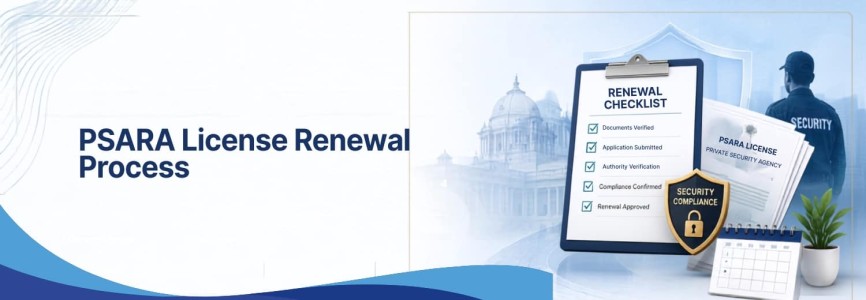



A PSARA License is required for running a private security agency in India. Any business that provides security guards, security supervisors, bodyguards, bouncers, armed guards, event security, industrial security or similar services must follow the Private Security Agencies Regulation Act, 2005. Getting a PSARA License is not enough. The agency must also renew the license before expiry. If the license expires, the agency may not be legally allowed to continue private security services. Renewal is important because it confirms that the agency is still following legal, training, police verification and operational requirements.
The PSARA License is issued by the Controlling Authority of the concerned State or Union Territory. The renewal process may slightly differ from state to state, but the basic legal requirement comes from the PSARA Act, 2005. Under the Act, the renewal application should be made to the Controlling Authority at least 45 days before the expiry of the existing license.
Meaning of PSARA License Renewal
PSARA License renewal means extending the validity of an existing private security agency license before it expires. A private security agency cannot assume that its license will continue forever. The license is granted for a fixed period. Before the validity ends, the agency must file a renewal application with the required documents, government fee and compliance proof. The renewal process helps the authority check whether the agency has properly followed the PSARA Act, maintained records, verified guards, trained staff and complied with license conditions.
Legal Requirements for PSARA License Renewal
The PSARA License renewal process is governed mainly by the Private Security Agencies Regulation Act, 2005. The Act regulates private security agencies across India and gives power to the State Government to appoint a Controlling Authority. The Controlling Authority is responsible for granting, renewing, refusing, suspending or cancelling the license. Section 8 of the PSARA Act deals with renewal of license. Section 7 deals with application for grant of license, and Section 11 covers conditions of license.
State rules also play an important role. Each state may have its own PSARA Rules, forms, fee structure, verification procedure and portal requirements. For example, Delhi has its own Private Security Agencies Regulations Rules and updated state-level materials for PSARA compliance.
Validity of PSARA License
Generally, a PSARA License is valid for five years unless it is cancelled earlier by the authority. The Act states that the license is valid for five years and renewal must be applied for not less than 45 days before expiry. However, some states may follow different validity periods under their state rules. Therefore, every agency should check the validity mentioned on its own license certificate and the rules of the concerned state.
Why PSARA License Renewal is Important
PSARA renewal is important because private security is a regulated business. Security agencies deal with guards, client premises, public safety, industrial security and sensitive locations. If the license expires, the agency may face legal issues. It may lose contracts, face penalties or be stopped from operating. Clients may also refuse to work with an agency that does not have a valid PSARA License. Renewal also protects the agency’s credibility. Many corporates, malls, hospitals, banks, residential societies, factories and institutions check PSARA validity before hiring a security vendor.
When to Apply for PSARA License Renewal
The renewal application should be filed at least 45 days before the expiry of the existing license. This is an important statutory timeline under the PSARA Act and the official PSARA portal FAQ also mentions the 45-day renewal requirement. It is better to start preparing documents 60 to 90 days before expiry. This gives enough time for document correction, compliance review, police verification, training records and portal filing.
Who Can Apply for PSARA License Renewal
Only an existing licensed private security agency can apply for renewal. The agency may be operating as a proprietorship, partnership firm, LLP, private limited company or other eligible business structure. The applicant must continue to satisfy the eligibility conditions under the PSARA Act. The promoters, directors, partners or key persons should not be disqualified under the Act. The agency must also show that it has followed license conditions during the previous license period.
Eligibility Conditions for PSARA Renewal
The agency should have a valid or soon-to-expire PSARA License. It should not have serious violations or pending cancellation orders. The applicant should be financially sound and legally eligible. The directors, partners or proprietor should have clean antecedents and should not be convicted for offences that make them ineligible under PSARA. The agency must have proper office records, guard details, supervisor details, training arrangements, police verification records and employment compliance.
Documents Required for PSARA License Renewal
The exact document list may differ from state to state, but generally the following documents are required:
- Copy of existing PSARA License
- Renewal application form
- Certificate of incorporation, LLP agreement, partnership deed or proprietorship proof
- PAN card of business entity
- GST registration, if applicable
- Shops and Establishment registration, if applicable
- Address proof of registered office
- Identity and address proof of directors, partners or proprietor
- Photographs of key persons
- Police verification or antecedent verification documents
- Character certificate, if required by the state authority
- Training certificate or training arrangement proof
- Details of security guards and supervisors
- Employee records and attendance records
- ESI and EPF registration, if applicable
- Labour law compliance proof, if applicable
- Income tax return or financial documents, if required
- Affidavit or declaration under PSARA
- Details of arms license, if armed guards are provided
- Government fee payment proof
Many professional sources also mention documents such as original license, KMP identity/address proof, office proof, affidavit, logo, Shops and Establishment certificate, EPF/ESI certificate, training affidavit, arms license and employee character certificates.
Step-by-Step PSARA License Renewal Process in India
1. Check License Expiry Date
The first step is to check the expiry date mentioned on the existing PSARA License. The agency should not wait until the last month. Ideally, the renewal work should begin at least two to three months before expiry. This helps avoid delay in police verification, document collection or portal approval.
2. Review Compliance Status
Before filing renewal, the agency should review whether all PSARA conditions have been followed. This includes guard training, supervisor appointment, employee verification, record maintenance, uniform rules, ID cards, client records and statutory registrations.
3. Prepare Required Documents
After compliance review, the agency should prepare the renewal documents. The documents should be updated and properly signed. If there is any change in directors, partners, address, branch office, training institute or business structure, the same should be reported as per state requirements.
4. Complete Police Verification
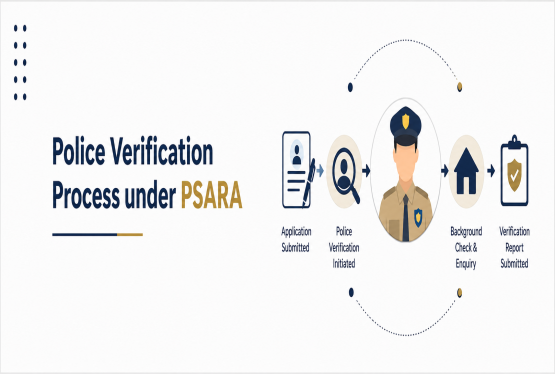
Police verification is an important part of PSARA compliance. The antecedents of the applicant and key management persons may be verified. Some states also require verification of guards and supervisors. In some cases, local police may inspect records or ask for staff details.
5. File Renewal Application
The renewal application must be filed with the Controlling Authority of the concerned state. Many states use online filing through the PSARA portal or state-specific portals. The national PSARA portal is used for private security agency licensing services. The agency should carefully fill in all details such as entity name, license number, address, districts of operation, owners/directors, staff details and compliance declarations.
6. Pay Government Fee
The prescribed renewal fee must be paid as per the state rules. The fee may depend on the area of operation, number of districts or state-level coverage. Since fee rules may differ, the agency should check the latest fee schedule of the concerned state before filing.
7. Submit Application to Controlling Authority
After uploading documents and paying the fee, the application is submitted to the Controlling Authority. The authority may examine the application, verify documents and seek additional clarification if required.
8. Respond to Defects or Queries
If the authority finds any defect, it may ask the agency to correct documents or provide additional information. The agency should respond quickly. Delay in replying may slow down the renewal process or lead to rejection.
9. Inspection or Verification
The authority may conduct verification before renewing the license. This may include checking office records, employee documents, training proof, police verification and compliance with license conditions.
10. Grant of Renewed License
If the authority is satisfied, the PSARA License is renewed. The renewed license should be downloaded or collected as per the process of the concerned state. The agency should keep a copy at its office and update clients wherever required.
Common Reasons for Delay in PSARA Renewal
PSARA renewal may get delayed if documents are incomplete or outdated. Delay may also happen due to pending police verification, mismatch in business address, expired registrations, missing training records, unpaid fee or non-compliance with previous license conditions. Another common issue is late filing. If the renewal application is not filed at least 45 days before expiry, the agency may face difficulty in continuation of services.
What Happens if PSARA License Expires?
If the PSARA License expires, the agency should not continue private security services without renewal or fresh approval. An expired license may create legal risk. Clients may terminate contracts, government departments may reject tenders and authorities may initiate action for operating without a valid license. In some cases, the agency may have to apply for a fresh license instead of renewal, depending on state rules and delay period.
Conditions to Follow After Renewal
After renewal, the agency must continue to follow PSARA rules. It must employ eligible security guards, appoint supervisors, ensure training, maintain records, issue identity cards and follow uniform rules. The agency must also maintain labour law compliance, including wage records, attendance, EPF, ESI and other applicable registrations.
Role of Training in PSARA Renewal
Training is an important part of PSARA compliance. Security guards should be trained in basic security duties, physical fitness, fire safety, emergency response, crowd control, identification of suspicious activities and basic legal awareness. The agency should maintain training records because the authority may ask for them during renewal.
Police Verification of Guards
Private security agencies must ensure proper verification of guards and staff. Police verification helps confirm that the person employed as a security guard does not have a serious criminal background. It also protects clients and the agency. Some state authorities and local police departments are strict about employee verification. For example, reports from Uttar Pradesh in 2025 noted directions for security agencies to verify employees and maintain staff records.
Records to Maintain for PSARA Renewal
A private security agency should maintain proper records for renewal and inspection. Important records include employee register, guard verification records, training certificates, client contracts, duty rosters, salary records, EPF/ESI records, ID card details, supervisor details and complaint records. Poor record maintenance can create problems during renewal.
PSARA Renewal for Multiple States
PSARA License is generally state-specific. If an agency operates in more than one state, it may need separate licenses or approvals as per the concerned state rules. During renewal, the agency should check whether the license covers one district, multiple districts or the whole state. If the agency has expanded its services, it may need modification or additional approval.
Penalty for Non-Renewal of PSARA License
Operating a private security agency without a valid PSARA License may attract legal action. The agency may face penalty, suspension, cancellation, loss of business and difficulty in future licensing. Clients may also avoid unlicensed agencies because security services involve responsibility and risk.
Practical Tips for Smooth PSARA Renewal
The agency should keep a renewal calendar and start work early. It should update documents, verify staff records, maintain training proof and check whether all statutory registrations are active. It should also keep communication records with the authority and respond quickly to any query.
Conclusion
PSARA License renewal is a necessary legal step for every private security agency in India. It is not just a formality. It confirms that the agency is still eligible, compliant and fit to provide private security services. The renewal application should be filed at least 45 days before expiry. The agency should prepare documents, complete verification, review compliance and file the application with the concerned Controlling Authority.
A valid PSARA License helps the agency continue operations legally, win client trust, avoid penalties and maintain business reputation. Every security agency should track its license validity carefully and treat renewal as a regular compliance responsibility.
FAQs
Q1. What is PSARA License renewal?
Ans. PSARA License renewal means extending the validity of an existing private security agency license before it expires. It allows the agency to continue security services legally.
Q2. When should PSARA renewal be applied?
Ans. The renewal application should be filed at least 45 days before the expiry of the existing license. Early filing helps avoid business disruption.
Q3. Who grants PSARA License renewal?
Ans. The Controlling Authority of the concerned State or Union Territory grants PSARA License renewal. The authority checks documents, eligibility and compliance.
Q4. What is the validity of a PSARA License?
Ans. Generally, a PSARA License is valid for five years unless cancelled earlier. However, some states may have different validity rules.
Q5. Can a security agency work after PSARA License expiry?
Ans. A security agency should not continue operations with an expired PSARA License. It may face legal action, penalties and loss of client contracts.
Q6. What documents are required for PSARA renewal?
Ans. Common documents include existing PSARA License, business proof, address proof, KYC of owners/directors, police verification, training proof, staff records, EPF/ESI proof and fee receipt.
Q7. Is police verification required for PSARA renewal?
Ans. Yes, police verification or antecedent verification may be required for owners, directors, partners and security staff as per state rules.
Q8. Can PSARA License renewal be rejected?
Ans. Yes, renewal may be rejected if the agency is not eligible, documents are incomplete, compliance is poor or serious violations are found.
Q9. Is PSARA License valid across India?
Ans. Generally, PSARA License is state-specific. An agency operating in multiple states may need separate approvals or licenses as per state rules.
Q10. Why is PSARA renewal important?
Ans. PSARA renewal is important to legally continue private security services, avoid penalties, maintain client trust and comply with the PSARA Act, 2005.


_crop10_thumb.jpg)





_for_FY_2025-26_crop10_thumb.jpg)





_learn_crop10_thumb.jpg)


_Filing_Due_Dates_for_FY_2024-25_learn_crop10_thumb.jpeg)




_of_GST_Act_learn_crop10_thumb.jpg)


_Under_GST_learn_crop10_thumb.jpg)


_crop10_thumb.jpg)


_crop10_thumb.jpg)


_learn_crop10_thumb.jpg)


_of_the_Income_Tax_Act_learn_crop10_thumb.jpg)


_learn_crop10_thumb.jpg)


_learn_crop10_thumb.jpg)


_crop10_thumb.jpg)





_in_The_Income_Tax_Act,_1961_learn_crop10_thumb.jpg)


_learn_crop10_thumb.jpg)


_of_the_Income_Tax_Act_learn_crop10_thumb.jpg)

_Of_Income_Tax_Act_learn_crop10_thumb.jpg)


_learn_crop10_thumb.jpg)


_learn_crop10_thumb.jpg)
_crop10_thumb.jpg)




_learn_crop10_thumb.jpg)
_for_Import_and_Export_learn_crop10_thumb.jpg)























_crop10_thumb.jpg)