


Starting a political party is an important step for a group of people who want to take part in elections. But forming a party and getting it registered are two different things. After forming the party, its members must apply to the Election Commission of India (ECI) and follow the rules given by the Commission.
Many applicants expect the registration process to move quickly. However, it may take longer if the application has mistakes, some papers are missing or the party has not followed the required steps. In some cases, the ECI may ask for more information or a correction before moving ahead.
These delays can be frustrating, especially for people who are applying for the first time. Knowing the common reasons can help a party prepare its application properly and avoid problems that could have been prevented.
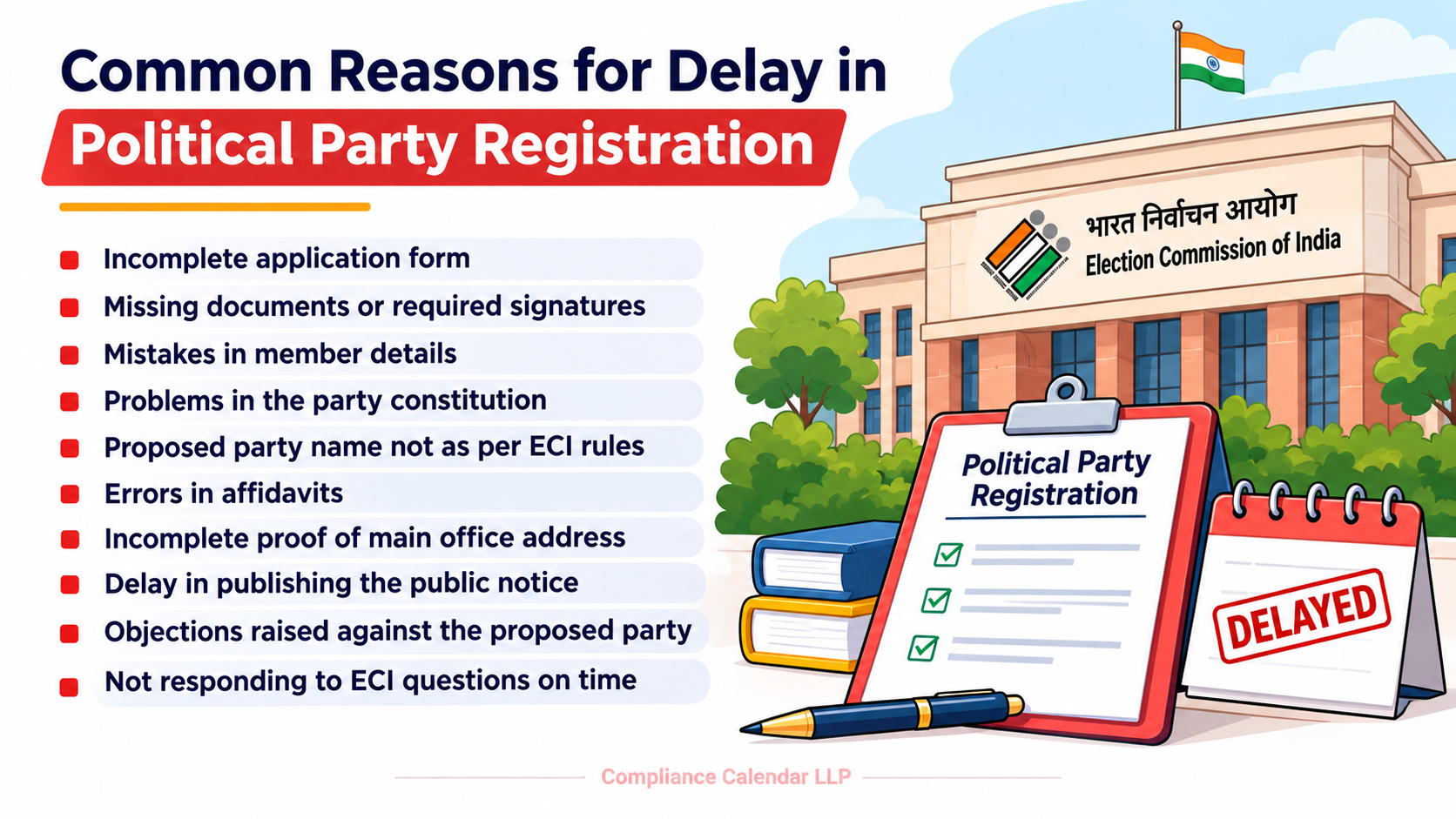
1. Incomplete Application Form
One of the first problems can happen while filling out the application form. The form asks for important details about the party, such as its name, date of formation, main office address, names of office-bearers and details of its members. If some information is missing, unclear or entered in the wrong place, the application may need further checking. For example, a party may mention its main office address but leave out some required details about its office-bearers. Even a small mistake can create questions during the checking process.
Before sending the application, the party should read the complete form once again. Check that every required field is filled in and that the information is the same across the application and supporting papers.
2. Missing Documents or Required Signatures
A political party has to submit several papers along with its application. These papers help the Election Commission check the party's details, members, office address and rules. If an important paper is missing, the application may not be ready for proper checking. For example, the party may have prepared its constitution but forgotten to attach proof that the General Body approved it. In another case, a required affidavit may be missing or a paper may not have the signature of the person concerned.
You can read our article on Documents Required for Political Party Registration in India to understand which papers need attention.
3. Mistakes in Member Details
A political party must provide details of its members as required by the ECI. These details should be correct and should match the supporting records submitted with the application. Problems can arise when the name, address or other information of a member is different in the party list and the person's voter record or affidavit. For example, a person's full name may appear in the voter record, but only a short name may be written in the party list. This difference may need to be explained.
Such mistakes become harder to correct when the party has many members. Therefore, the party should check the member list carefully before submitting it. Each person's details should be compared with the records provided by that person.
4. Problems in the Party Constitution
The party constitution is one of the important documents in the registration application. It explains how the party will work, who can become a member, how leaders will be chosen and how decisions will be made. The ECI has given rules about what a party constitution should contain. If the document misses a required declaration, does not explain internal elections or leaves out important rules about the party's working, it may need changes.
For example, the constitution must include the declaration required under Section 29A(5) of the Representation of the People Act, 1951. It must also contain the required rules about regular internal elections and other matters mentioned in the ECI guidelines.
Read our guide on Political Party Constitution: Rules, Format and Requirements for more details.
5. The Proposed Party Name Does Not Follow ECI Rules
Choosing a party name may look simple, but the name must follow the rules of the Election Commission. It should be different from the names of existing political parties. It should also not have a religious, communal or caste meaning.A problem may arise if the proposed name is too close to the name of an existing party or does not meet the ECI's naming rules. The applicant may then need to provide an explanation or make changes as required.
For example, if a new party chooses a name that is very similar to an existing registered party, it may create confusion. This is why applicants should check the proposed name before using it in the constitution, application form, letterhead and other papers.
6. Errors in Affidavits
An affidavit is a written statement in which a person confirms certain information and signs it before an authorised person, such as a Notary or Oath Commissioner. The ECI asks for affidavits from members and office-bearers as part of the registration requirements. An affidavit can create a problem if it has missing details, incorrect information or a missing signature. The issue may also arise when the information in the affidavit does not match the person's details in the party application.
For example, if the address written in an affidavit is different from the address given in the member list, the applicant may need to explain or correct it. The party should use the required affidavit format and check every statement before collecting signatures. Members should also read their affidavits before signing them.
7. Incomplete Proof of the Main Office Address
Every political party must provide details of its main office. The ECI also asks for supporting papers related to the office address. These papers help the Commission check where the party's main office is located. A problem can arise if the address is incomplete or the required proof is not attached. For example, if the party is using a rented office, it may need the owner's No Objection Certificate (NOC), along with other papers required under the guidelines.
Applicants should check the address written in the form and make sure it matches the supporting papers. They should also keep the required NOC and address proof ready before sending the application.
8. Delay in Publishing the Public Notice
Publishing a public notice is another important part of political party registration. After applying, the party has to publish its proposed name and other required details in newspapers as instructed by the ECI. The current guidelines require publication in two national daily newspapers and two local daily newspapers. The notice gives people an opportunity to raise objections against the proposed registration. The ECI also gives a period during which such objections can be submitted.
If the party does not publish the notice as required, uses the wrong details or fails to follow the instructions, it may have to complete the steps again or provide further information. This can add to the time taken by the process.
Applicants should carefully follow the latest newspaper publication instructions given by the ECI and keep copies of the published notices as proof.
9. Objections Raised Against the Proposed Party
The public notice process allows people to raise objections against a proposed political party registration. An objection may be related to the proposed party name or another matter connected with the application. For example, a person may raise an objection because the proposed name is similar to the name of an existing party. The Election Commission may then need to look at the objection and consider the applicant's reply before taking the next step.
This does not mean that every objection will stop the registration. The ECI will consider the matter according to its rules. However, the applicant may need to provide an explanation or supporting information, which can take additional time.
10. Not Responding to ECI Questions on Time
Sometimes, the Election Commission may contact the applicant to ask for more details, explain a difference or correct a problem in the application. If the party does not check its messages or reply on time, the process may take longer. This can happen when the mobile number or email address given in the application is not active. It can also happen when the person handling the application does not check for updates regularly.
The party should keep its contact details active and make sure someone is responsible for checking messages from the ECI. If the Commission asks for information, the applicant should read the request carefully and send the correct reply within the given time.
Does Applying After 30 Days Cause a Delay?
There is an important difference between a late application and an application that takes time to process. Under Section 29A of the Representation of the People Act, 1951, a political party must apply for registration within 30 days of its formation. If the party submits its application after this period, the application is time-barred under the law. This is not simply a normal processing delay. The party should therefore start preparing its documents soon after formation instead of waiting until the last few days.
Applicants should also remember that submitting an application within 30 days does not mean that registration will be completed within 30 days. The application still has to go through the required checks and other steps.
A Small Mistake That Delayed a Party's Registration
A group of people in Haryana came together to start a new political party. They had a clear name in mind, prepared their party constitution and collected the documents needed for registration. Everyone was excited to take the next step and submit the application to the Election Commission of India.But after submitting the papers, they faced a problem. The address mentioned in the application did not match the address proof they had provided. A few details of the party members also needed correction. The Election Commission asked them to provide the correct information.
The group had to check the documents again, contact the members and arrange the corrected details. What they thought would be a simple application process now needed extra work and time. This is why every detail matters when applying for Political Party Registration. Checking the application and documents carefully before submission can help avoid such problems.
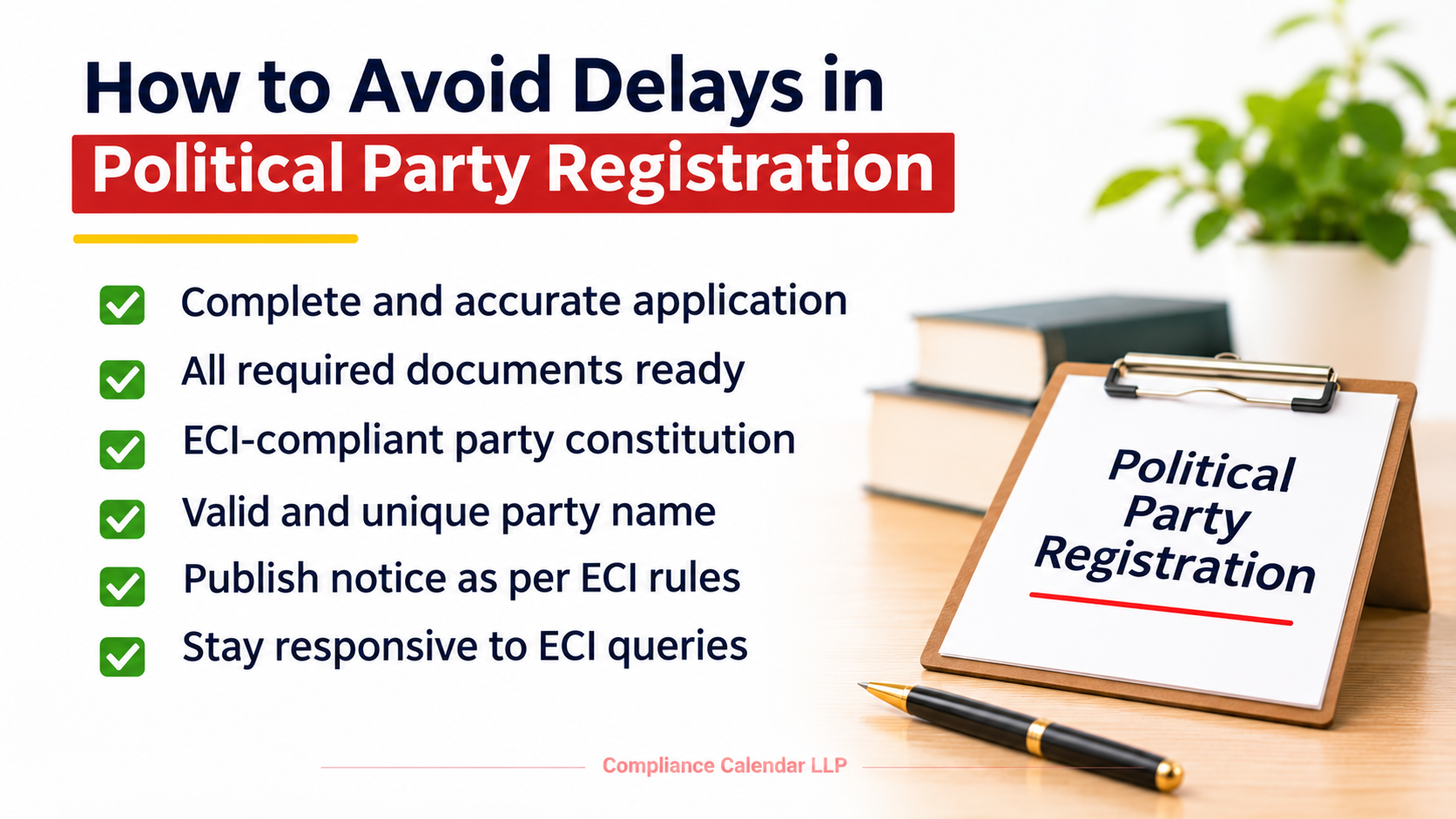
How to Avoid Delays in Political Party Registration
|
What to check |
What the party should do |
|
Application form |
Check that all required details are filled in correctly. |
|
Documents |
Keep the party constitution, member details, affidavits and office address proof ready. |
|
Member details |
Make sure the names and other details match the voter records. |
|
Party constitution |
Check that all ECI-required rules and declarations are included. |
|
Party name |
Make sure the proposed name follows the ECI guidelines. |
|
Signatures |
Check that all required documents have been signed. |
|
Newspaper notice |
Publish the notice as instructed by the ECI and keep copies. |
|
Contact details |
Keep the registered mobile number and email address active. |
|
ECI queries |
Reply to any request for information or corrections within the given time. |
The party should also keep checking its application status through the Election Commission's Political Parties Registration Tracking Management System (PPRTMS). This helps applicants follow updates and stay informed about the progress of their application.
How Compliance Calendar LLP Can Help
Political party registration involves several papers and rules. People applying for the first time may find it difficult to understand what needs to be prepared and which details should be checked before submission.
Compliance Calendar provides assistance with Political Party Registration. Our team can help applicants understand the document requirements, organise their papers, prepare the application and understand the steps involved. We can also guide them when they need help with the ECI's requirements.
If you are planning to register a political party and need assistance, contact Compliance Calendar LLP at +91 9988424211 or email info@ccoffice.in
Frequently Asked Questions (FAQs)
1. Why does political party registration take time?
It may take longer if the application has missing details, documents contain mistakes, the party constitution needs changes or an objection is raised during the public notice period.
2. Can missing documents delay political party registration?
Yes. If a required paper or signature is missing, the applicant may need to provide it later. This can add more time to the process.
3. Can a mistake in the party constitution cause a delay?
Yes. If the constitution does not contain the declarations and rules required by the ECI, the party may need to correct it.
4. Can incorrect member details affect registration?
Yes. Member details should match the supporting records. Differences in names, addresses or other information may need to be explained or corrected.
5. Can the Election Commission raise questions about a party name?
The ECI checks whether the proposed name follows its rules. A name that is too similar to an existing party or has a religious, communal or caste meaning may create a problem.
6. Does the newspaper notice process affect registration time?
Yes. The party must follow the required newspaper publication process. Objections received during the notice period may also need to be checked.
7. What is the 30-day rule for political party registration?
A party must submit its registration application within 30 days of its formation under Section 29A of the Representation of the People Act, 1951.
8. How can I check my political party registration application status?
Applicants can use the Election Commission's Political Parties Registration Tracking Management System (PPRTMS) to check their application status and updates.
9. What should I do if the ECI asks for more information?
Read the message carefully and provide the correct details or documents requested by the Election Commission within the given time.
10. Can Compliance Calendar help with political party registration?
Yes. Compliance Calendar can assist with document preparation, checking application details and organising papers for submission. The final decision on registration is made by the Election Commission of India.
Article last updated on : 11 Nov 2026.












_learn_crop10_thumb.jpg)