


Starting a political party in India requires more than choosing a name and selecting its leaders. The group must also prepare some important documents before applying to the Election Commission of India (ECI). These documents help the Commission check who started the party, who its members are, where its office is and what rules the party will follow.
Many people do not know which papers are needed to register a political party. Some documents are needed from the party, while others must be given by its members and leaders. If any paper is missing or has wrong details, the application may face delays. In this article, we explain the documents required for Political Party Registration in India in simple words so that anyone can understand what needs to be prepared.
For more Detailed Information Visit : Political Party Registration Guide
Why Are Documents Needed for Political Party Registration?
The Election Commission of India checks the details of a new political party before giving it registration. It wants to know whether the party has been formed properly, whether its members are registered voters and whether the party has written rules for its work.
For this reason, the party must submit its application along with the required papers. The main rules for this process are given under Section 29A of the Representation of the People Act, 1951. The ECI also provides its own application form and document checklist.
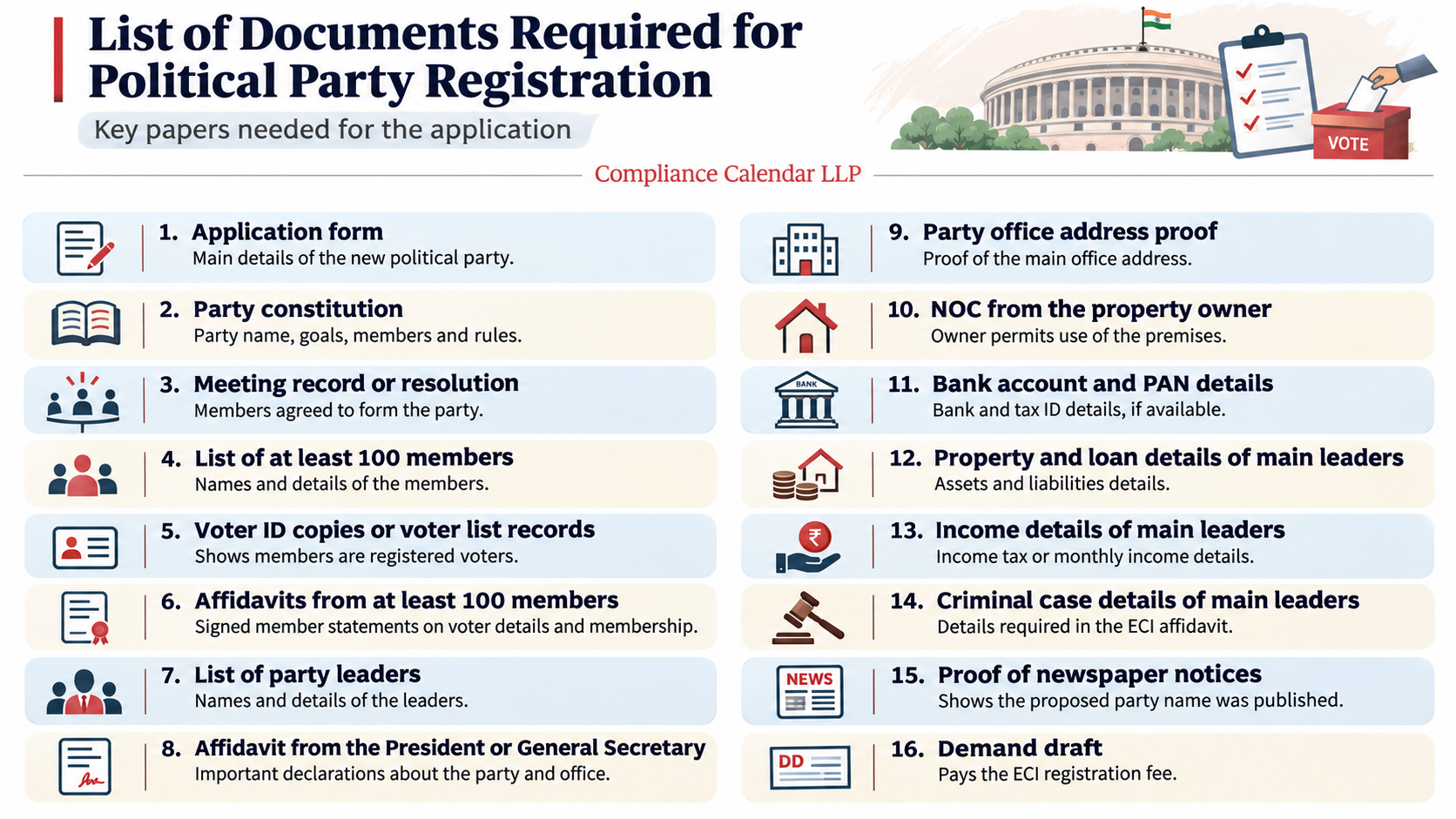
A new political party needs to prepare different papers for its application. Some papers explain how the party will work, while others prove the identity and details of its members and leaders.
|
Document |
Why Is It Needed? |
|
Application form |
Gives the main details of the new political party. |
|
Party constitution |
Explains the party's name, goals, members and working rules. |
|
Meeting record or resolution |
Shows that the members agreed to form the party and accept its rules. |
|
List of at least 100 members |
Gives the names and details of the members whose voter records are being submitted. |
|
Voter ID copies or voter list records |
Shows that these members are registered voters. |
|
Affidavits from at least 100 members |
Gives each member's signed statement about their voter details and party membership. |
|
List of party leaders |
Gives the names and details of the people who will manage the party. |
|
Affidavit from the President or General Secretary |
Gives important statements about the party and its office. |
|
Party office address proof |
Shows the address of the party's main office. |
|
NOC from the property owner |
Shows that the owner has allowed the party to use the place as its office. |
|
Bank account and PAN details |
Gives the party's bank and tax identification details, if available. |
|
Property and loan details of main leaders |
Gives details of what the leaders own and what they owe. |
|
Income details of main leaders |
Gives the required income tax or monthly income details. |
|
Criminal case details of main leaders |
Gives information asked for in the ECI affidavit. |
|
Proof of newspaper notices |
Shows that the proposed party name was published as required by the ECI. |
|
Demand draft |
Pays the ECI's registration application fee. |
The exact papers and formats should be checked against the latest ECI application form and checklist. Some papers are required from all members, while others are needed only from the party's main leaders.
1. Application Form for Political Party Registration
The first document is the application form given by the Election Commission of India. The party must fill in this form with the correct details. It should be typed clearly and signed by the person authorised to apply for the party.
The form asks for details such as:
- Name of the political party.
- Date when the party was formed.
- State where the main office is located.
- Full address of the party office.
- Names of the President, Secretary, Treasurer and other leaders.
- Total number of party members.
- Details of the party's local offices, if any.
- Other details asked for in the ECI form.
The party should check every detail before signing the application. The same name and address should appear in all supporting papers.
2. Political Party Constitution
A party constitution is a written document that explains how the political party will work. It is one of the most important papers for registration. It tells people what the party wants to do, who can join it, how leaders will be selected and how decisions will be made.
The party constitution should include the following details:
|
What to Include |
What Does It Mean? |
|
Party name |
The official name of the political party. |
|
Party goals |
What the party wants to do for the country and its people. |
|
Membership rules |
Who can join the party and how a person can become a member. |
|
Party leaders |
Who will manage the party and what work each leader will do. |
|
Internal elections |
How the party will choose its leaders. |
|
Meetings |
How meetings will be called and how decisions will be taken. |
|
Party funds |
How the party will receive, use and record money. |
|
Member discipline |
What action can be taken if a member breaks the party's rules. |
|
Changes to party rules |
How the party can change its written rules. |
|
Closing or joining another party |
What steps will be followed if the party closes or joins another party. |
The constitution must also contain a special statement required under Section 29A(5). In this statement, the party must promise to follow the Constitution of India and support socialism, secularism and democracy. It must also promise to protect the country's unity and integrity. The party should use the exact wording given in the ECI guidelines.
3. Meeting Record or Resolution Approving the Constitution
The party must show that its members have agreed to form the party and accept its written rules. For this, it should keep a copy of the meeting record or written decision passed by its General Body.
In simple words, this paper proves that the members have discussed and approved the party constitution. It should clearly show the meeting date and the decision taken. The party must submit proof, in the form accepted by the ECI, that its General Body adopted the constitution.
4. List of at Least 100 Party Members
The ECI asks for voter records and affidavits from at least 100 members of the proposed political party. The party must prepare a list of these members with their correct details.
The list should contain:
- Full name of each member.
- Father's or spouse's name, where asked.
- Age or date of birth.
- Full home address.
- Voter ID or voter list details.
- Name of the area or constituency where the person is registered to vote.
The party should check these details carefully. The names and other information must match the voter records and affidavits submitted with the application.
5. Voter ID Copies or Voter List Records
The party must prove that at least 100 of its members are registered voters. For this, the ECI guidelines allow the party to submit certified copies of the relevant voter list records. Another option is to submit copies of the members' Voter ID cards, properly attested by a Gazetted Officer or Notary, as required by the guidelines.
A voter list is an official list that contains the names of people who are registered to vote in an area. The party should make sure that the records belong to the same members whose names appear in its member list.
6. Affidavits from at Least 100 Members
An affidavit is a written statement signed by a person and officially sworn or confirmed before an authorised person. For Political Party Registration, the ECI asks for separate affidavits from at least 100 members.
Each member must give their own affidavit in the required format. It should confirm that the person is a registered voter and is not a member of another political party already registered with the Election Commission. The member's name and voter details should match the voter ID or voter list record submitted with the application.
7. List of Party Leaders
The party must also give a list of the people who will manage its work. These people are commonly called office-bearers. They may include the President, General Secretary, Secretary, Treasurer and leaders of the party's main committees.
The list should include their names, addresses, positions and other details asked for by the ECI. The party should make sure that these details match the party constitution and the meeting records.
8. Affidavit from the President or General Secretary
The President or General Secretary must give an affidavit in the format asked for by the Election Commission. This is a signed statement about important details of the party.
The ECI guidelines ask for declarations that no member of the proposed party is also a member of another political party registered with the Commission. The affidavit also includes statements about the party office, such as confirming that it is not in a government building and that its use will not cause trouble to the public. The person signing this affidavit must check all the details before submitting it.
9. Party Office Address Proof and Owner's NOC
The party must give the full address of its main office. It must also show that it has permission to use that place as its office.
If the office is in a building owned by another person, the party needs a No Objection Certificate (NOC) from the owner. An NOC is a written statement saying that the owner has no objection to the party using the premises. The ECI guidelines ask for the NOC in affidavit form, along with proof of ownership, such as property papers or a house tax receipt.
10. Party Bank Account and PAN Details
The ECI guidelines ask the party to provide its bank account and Permanent Account Number (PAN) details, if available. A PAN is a number issued by the Income Tax Department to identify a person or organisation for tax purposes.
The party should keep its bank account details and PAN information ready if these have been obtained. The name and details should match the party's other records.
11. Property and Loan Details of Main Leaders
The main leaders of the party must give separate affidavits showing their assets and liabilities. In simple words, this means they must give details of what they own and what money they owe.
For example, assets may include land, a house, a vehicle or money in a bank account. Liabilities may include a home loan, personal loan or other unpaid debt. The leaders must give the details asked for in the ECI format.
12. Income Tax Returns or Monthly Income Details
The ECI guidelines ask office-bearers to submit copies of their income tax returns for the last three years if they are income-tax payers.
If an office-bearer does not pay income tax, the guidelines ask for certified details of their monthly income and the source of that income. The party should collect these details from the concerned leaders and submit them in the required form.
13. PAN Details of Party Leaders
The party must also provide PAN details of its office-bearers. These details help the ECI identify the people who are managing the party.
The party should collect the PAN details from the concerned leaders and check that the names match their other records. If there is any difference in spelling or other details, it should be checked before the application is submitted.
14. Affidavits About Criminal Cases
The ECI asks the office-bearers of the party's main committees to give affidavits about their criminal background. These affidavits must be prepared in the format given by the Commission.
The leaders should give correct information about any criminal cases covered by the affidavit. If a leader has no case to report, the affidavit should say so in the required manner. No one should hide or give false information in these papers.
15. Newspaper Notice and Its Proof
The proposed name of the political party must be published in newspapers as part of the ECI's public notice process. This gives people a chance to raise an objection if they have a problem with the proposed name.
The ECI guidelines require the name to be published in two national daily newspapers and two local daily newspapers, on two days. The party should keep copies of the published notices as proof. Under the ECI's public notice instructions, objections can be sent to the Commission within 30 days from publication.
16. Demand Draft for the ECI Fee
The party must also pay the application processing fee. The ECI's published guidelines mention a fee of Rs 10,000. It must be paid through a demand draft in favour of the Under Secretary, Election Commission of India, New Delhi.
This fee is not returned, even if the application is not approved. The party should check the latest ECI payment instructions before preparing the demand draft and keep a copy for its own records.
Example: A Group of People Starting a New Political Party

Suppose a group of 120 people decides to start a new political party in India. They choose a party name, select a President and General Secretary, and hold a meeting to agree on the party's rules.
Before applying to the Election Commission, they need to prepare the party constitution and keep a copy of the meeting decision. They also prepare a list of their members. From these members, they arrange the voter records and separate affidavits for at least 100 people, as required by the ECI guidelines. The President and other office-bearers also collect their own required documents, such as identity, income, property and criminal case details. The group then arranges proof of its party office, newspaper notices and the application fee.
Document Checklist Before Applying
Before sending the application, the party should check whether all the required papers are ready. This table can help members and leaders check their documents one by one.
|
Document to Check |
Status |
|---|---|
|
ECI application form is filled and signed. |
Yes / No |
|
Party constitution is prepared. |
Yes / No |
|
Constitution contains the required statement under Section 29A(5). |
Yes / No |
|
Proof of General Body approval is ready. |
Yes / No |
|
List of at least 100 members is prepared. |
Yes / No |
|
Voter ID copies or certified voter list records are collected. |
Yes / No |
|
Separate affidavits from at least 100 members are ready. |
Yes / No |
|
List of party leaders is prepared. |
Yes / No |
|
President or General Secretary's affidavit is ready. |
Yes / No |
|
Party office address proof and owner's NOC are ready. |
Yes / No |
|
Party bank account and PAN details, if available, are included. |
Yes / No |
|
Property and loan details of the main leaders are ready. |
Yes / No |
|
Income tax returns or monthly income details, as applicable, are collected. |
Yes / No |
|
PAN details of office-bearers are collected. |
Yes / No |
|
Criminal case affidavits of the required leaders are ready. |
Yes / No |
|
Newspaper notice copies are kept. |
Yes / No |
|
Demand draft for the ECI fee is ready. |
Yes / No |
|
ECI checklist is filled and attached. |
Yes / No |
Note : This is a helpful working list. The party should also check the latest official ECI checklist because the Commission may update its forms or instructions.
Common Mistakes to Avoid While Preparing Documents
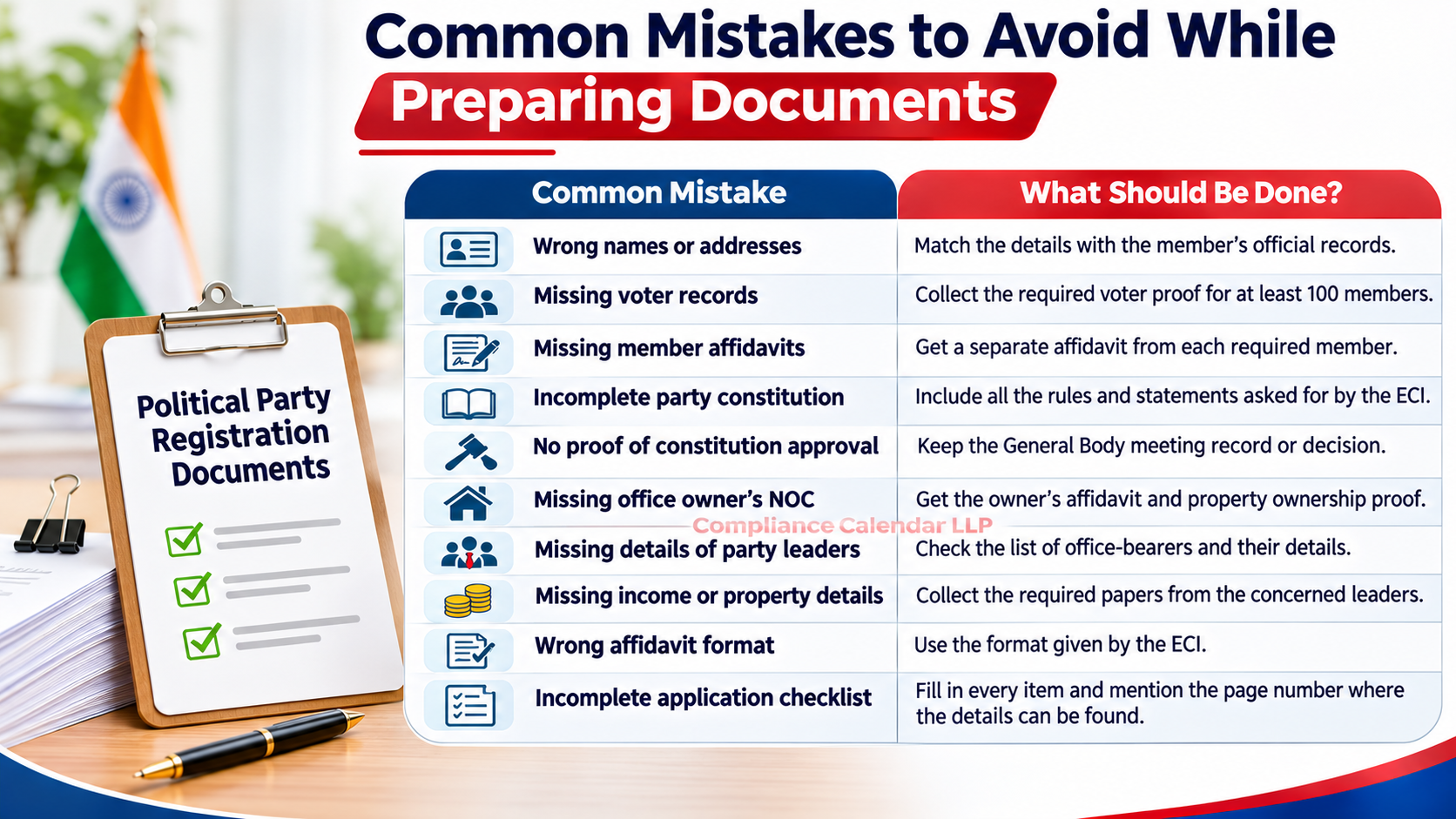
Small mistakes in the papers can create problems during the registration process. The party should check the following points before sending its application.
|
Common Mistake |
What Should Be Done? |
|
Wrong names or addresses |
Match the details with the member's official records. |
|
Missing voter records |
Collect the required voter proof for at least 100 members. |
|
Missing member affidavits |
Get a separate affidavit from each required member. |
|
Incomplete party constitution |
Include all the rules and statements asked for by the ECI. |
|
No proof of constitution approval |
Keep the General Body meeting record or decision. |
|
Missing office owner's NOC |
Get the owner's affidavit and property ownership proof. |
|
Missing details of party leaders |
Check the list of office-bearers and their details. |
|
Missing income or property details |
Collect the required papers from the concerned leaders. |
|
Wrong affidavit format |
Use the format given by the ECI. |
|
Incomplete application checklist |
Fill in every item and mention the page number where the details can be found. |
The party should keep one complete copy of the application and all supporting papers for its own records.
Important Things to Remember Before Submitting the Documents
The party must send its application and required papers to the Election Commission within 30 days from the date it was formed. The application should be complete, clearly typed and arranged in the order given in the ECI checklist. All pages and supporting papers should be numbered in order.
The ECI guidelines also mention that an acknowledgement is sent within two weeks after receiving a complete application. This does not mean that registration is approved within two weeks. The Commission will check the application and take its decision after following the required process.
How Compliance Calendar LLP Can Help with Political Party Registration
Preparing all the papers for Political Party Registration can be confusing, especially for people who are starting a political party for the first time. They may not know how to prepare the party constitution, collect member details or arrange the required affidavits.
Compliance Calendar LLP provides assistance with Political Party Registration. We can help applicants understand which documents are needed, prepare and check the party constitution, organise member and leader details, and prepare the application papers. We can also guide applicants during the submission and follow-up process with the Election Commission.
Compliance Calendar LLP provides assistance with the process. The final decision to register the political party is made by the Election Commission of India.
If you need help with Political Party Registration, contact Compliance Calendar at +91 9988424211 or info@ccoffice.in
Frequently Asked Questions (FAQs)
1. What documents are needed to register a political party in India?
The main documents include the ECI application form, party constitution, member list, voter records, member affidavits, leader details, office address proof and other papers asked for by the Election Commission.
2. Is a party constitution required for registration?
Yes. Every proposed political party must submit its written rules. The constitution explains the party's goals, membership, leaders, elections and other important matters.
3. How many members' voter records are needed?
The ECI guidelines ask for voter records for at least 100 members of the proposed party. These may be certified voter list records or properly attested copies of Voter ID cards.
4. Are affidavits needed from party members?
Yes. Separate affidavits are required from at least 100 members. These affidavits must give the statements asked for by the ECI.
5. Is proof of the party office address required?
Yes. The party must give its main office address. If the premises belong to another person, the party must also provide the owner's NOC in affidavit form and proof of ownership.
6. Are PAN and bank account details required?
The ECI guidelines ask for the party's PAN and bank account details, if available. The party should check the latest application checklist for the exact requirements.
7. Are income tax returns needed from party leaders?
Yes, the ECI guidelines ask office-bearers who pay income tax to provide their income tax returns for the last three years. Those who do not pay income tax must provide certified details of their monthly income and its source.
8. Is a criminal case affidavit required?
Yes. The office-bearers of the party's main committees must provide affidavits with the criminal case details asked for by the ECI.
9. What is the fee for Political Party Registration?
The ECI's published guidelines mention a non-refundable processing fee of Rs 10,000. It is paid through a demand draft in the prescribed manner.
10. Can Compliance Calendar help prepare the registration documents?
Yes. Compliance Calendar can assist with understanding the document list, preparing and checking the party constitution, arranging the required papers and guiding applicants through submission and follow-up with the ECI.
Article last updated on : 10 Nov 2026.












_learn_crop10_thumb.jpg)