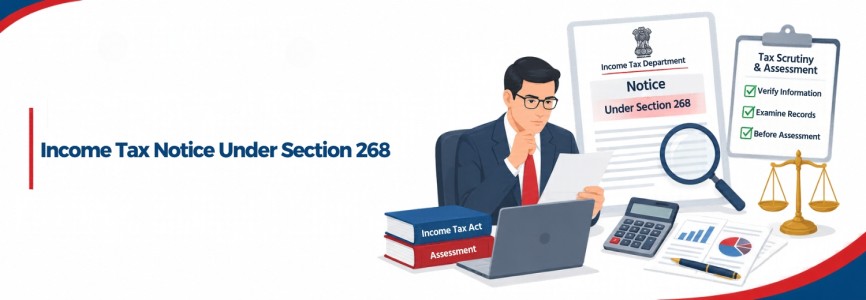



The Income-tax Department may ask taxpayers to explain their income, submit financial records, or provide additional information before completing a tax assessment. Under the Income-tax Act, 2025, this inquiry process is governed by Section 268 – Inquiry Before Assessment 268. Section 268 gives the Assessing Officer (AO) the authority to examine a taxpayer's income details, verify financial transactions, request supporting documents and investigate matters that may affect the correct assessment of taxable income. The Income-tax Act, 2025 came into effect on 1 April 2026, replacing the Income-tax Act, 1961 for tax years beginning from that date. Section 268 broadly corresponds to Section 142 of the earlier Act. However, assessments and proceedings relating to earlier years continue to be governed by the applicable provisions of the 1961 Act.
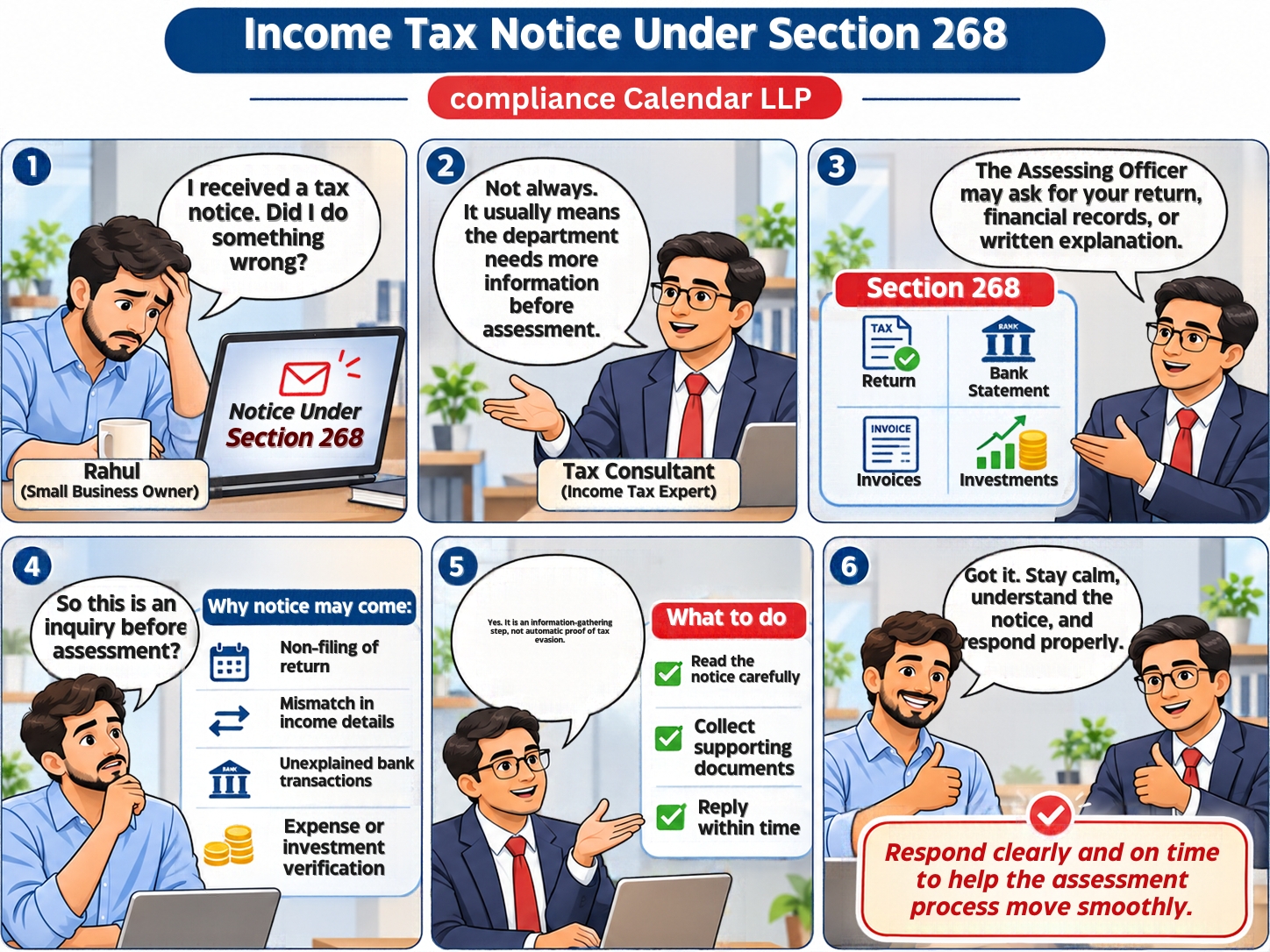
Receiving an income tax notice under Section 268 does not automatically mean that a taxpayer has concealed income or committed tax evasion. It generally means that the tax authorities require further information before completing an assessment. Understanding the purpose of this notice, the documents required, the response process and the consequences of non-compliance can help individuals and businesses handle income tax proceedings correctly.
What is Section 268 of the Income-tax Act, 2025?
Section 268 of the Income-tax Act, 2025 deals with inquiries conducted by the Assessing Officer before completing an income tax assessment. Under this provision, the Assessing Officer may issue a notice requiring a taxpayer to file an income tax return, produce financial records or provide written explanations relating to income, expenses, assets, liabilities and other relevant transactions. The main purpose of Section 268 is to help the Income-tax Department obtain accurate information about the taxpayer's financial position before determining taxable income.
For example, if a taxpayer reports business income of Rs.12 lakh but the available financial records indicate substantially higher receipts, the Assessing Officer may request bank statements, invoices and other supporting information to understand the difference. The taxpayer must respond to the specific requirements mentioned in the notice within the prescribed time.
Why is an Income Tax Notice Issued Under Section 268?
An income tax notice under Section 268 may be issued when the Assessing Officer requires additional information to verify the correctness and completeness of a taxpayer's income declaration. Such inquiries may arise because of differences between reported income and available financial information, missing records or transactions requiring further verification.
Common situations include:
-
Non-filing of Income Tax Return: The taxpayer has not filed a return despite being required to do so.
-
Mismatch in Income Details: There are differences between income reported in the return and information available with the department.
-
Unexplained Bank Transactions: Significant deposits, withdrawals or transfers require clarification.
-
Business Expense Verification: The Assessing Officer seeks evidence supporting expenses or deductions claimed.
-
Investment and Asset Verification: The department requires details of investments, assets or liabilities.
-
Incomplete Financial Records: Books of account or supporting documents are insufficient to verify certain transactions.
These are examples of situations that may lead to an inquiry, rather than an exhaustive statutory list of grounds. A Section 268 notice is an information-gathering step. It does not, by itself, establish additional tax liability.
Legal Provisions of Section 268 Under the Income-tax Act, 2025
Section 268 contains several provisions explaining the powers of the Assessing Officer, the information that can be requested and the safeguards available to taxpayers.
Power to Issue Notice – Section 268(1): Under Section 268(1), the Assessing Officer may issue a notice to a person who has filed a return under Section 263 or whose prescribed time for filing the return has expired.
The notice may require the person to:
-
Furnish an income tax return in the circumstances specified in Section 268(1)(a).
-
Produce books of account, financial statements or other documents.
-
Provide written and duly verified information relating to income or financial transactions.
-
Submit details of assets and liabilities where legally required.
The notice specifies the date by which the taxpayer must comply.
-
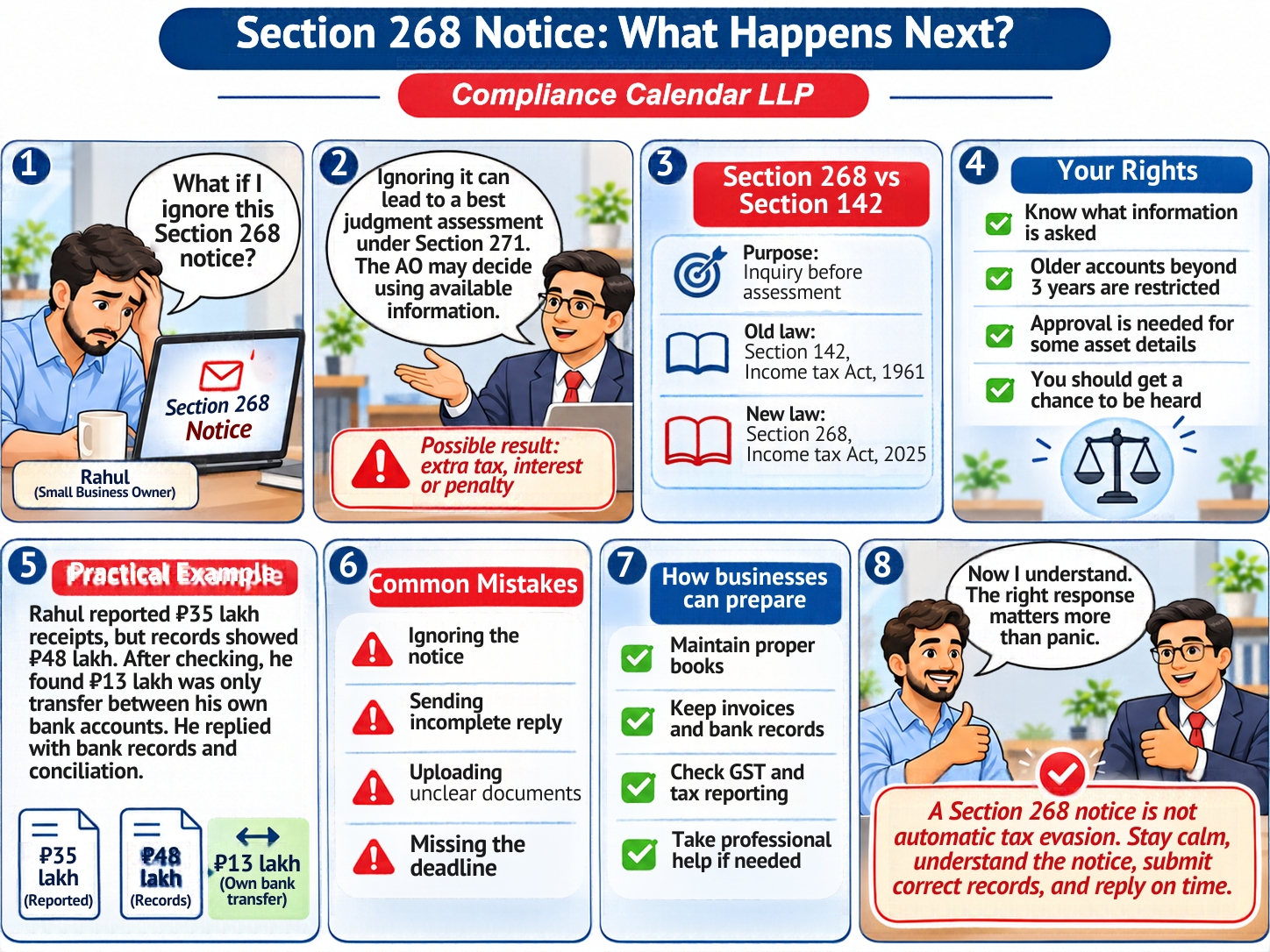
Restrictions on Information Requests – Section 268(2): Section 268(2) places important restrictions on certain information requests. The Assessing Officer must obtain prior approval from the Joint Commissioner before requiring a statement of all assets and liabilities not included in the accounts. Further, under this provision, the Assessing Officer cannot require production of accounts relating to a period more than three years before the relevant tax year. This restriction relates specifically to the production of accounts under Section 268(1).
-
Authority to Conduct Inquiry – Section 268(4): Section 268(4) allows the Assessing Officer to conduct inquiries considered necessary to obtain complete information about a person's income or loss. Such inquiries may help verify financial transactions, identify inconsistencies and establish the correct taxable income.
-
Special Audit and Inventory Valuation – Section 268(5): In certain circumstances, the Assessing Officer may direct a taxpayer to have accounts audited by an accountant or inventory valued by a cost accountant. This may be considered where accounts are complex, transactions are numerous, their correctness is doubtful or the business activities are specialised. However, the Assessing Officer must provide a reasonable opportunity of being heard and obtain prior approval from the prescribed senior income-tax authority before issuing such directions.
-
Time Limit and Expenses – Section 268(8) to 268(11): Where a special audit or inventory valuation is directed, the report must be submitted within the period specified by the Assessing Officer. Extensions may be granted for sufficient reasons, but the total period cannot exceed six months from the end of the month in which the direction is received. The expenses of the special audit or inventory valuation, including prescribed remuneration and incidental expenses, are determined by the specified authority and paid by the Central Government.
-
Opportunity of Being Heard – Section 268(12): Section 268(12) provides an opportunity to the taxpayer to be heard regarding material gathered from an inquiry, special audit or inventory valuation that is proposed to be used in the assessment. However, the provision contains an exception where assessment is made under Section 271. These requirements are set out in the official statutory text of Section 268.
Who Can Receive an Income Tax Notice Under Section 268?
A notice under Section 268 is not restricted to companies or high-income taxpayers. It can apply to persons covered by the statutory conditions. Depending on the circumstances, the following taxpayers may receive such notices:
-
Salaried Individuals: Where income, deductions or investments require verification.
-
Business Owners: Where sales, expenses, purchases or financial records need examination.
-
Professionals and Freelancers: Where professional receipts or deductions require clarification.
-
Private Limited Companies: Where business transactions, expenses or accounting records require scrutiny.
-
Limited Liability Partnerships: Where income details or books of account need verification.
-
Partnership Firms: Where declared income and financial records need examination.
-
Other Taxable Persons: Where the Assessing Officer requires information for assessment purposes.
The issuance of a notice depends on the particular facts, the relevant tax year and the legal conditions applicable to the assessment.
Documents Required to Respond to a Section 268 Notice
The documents required under a Section 268 notice depend on the information requested by the Assessing Officer. A taxpayer should not assume that every document listed below is compulsory. Only the relevant documents should be prepared and submitted according to the notice.
| Documents | Purpose |
|---|---|
| Income Tax Return and acknowledgement | Verify reported income |
| Form 16 or Form 16A | Check salary or TDS details |
| Form 26AS and AIS | Reconcile available tax information |
| Bank statements | Verify deposits and financial transactions |
| Balance sheet and profit and loss account | Examine business financial records |
| Purchase and sales invoices | Support business transactions |
| GST returns, where applicable | Reconcile turnover and sales details |
| Investment and deduction proofs | Support deductions claimed |
| Loan and property documents | Explain relevant assets and liabilities |
| Written explanations | Clarify differences or transactions questioned |
For businesses, proper reconciliation of income tax returns, GST records, bank statements and financial statements can reduce confusion during assessment proceedings.
How to Respond to an Income Tax Notice Under Section 268 Online
The Income-tax Department provides an e-Proceedings facility through its official e-Filing portal for submitting responses to notices issued by income tax authorities. The following steps explain the general process.
Step 1: Visit the Income Tax e-Filing Portal
Open the official Income Tax e-Filing Portal and log in using your registered credentials.
Step 2: Open e-Proceedings
Go to Pending Actions → e-Proceedings and identify the notice requiring your response.
Step 3: Read the Notice Carefully
Download the notice and check the relevant tax year, issuing authority, information requested and compliance deadline.
Step 4: Prepare Supporting Documents
Gather the requested financial statements, transaction details, tax records and explanations. Reconcile important figures before submitting them.
Step 5: Submit Your Response
Select the relevant notice, choose the available response option, enter your explanation and upload the supporting documents. Where supported, the portal allows partial or full responses.
Step 6: Save the Acknowledgement
After successful submission, download or save the transaction acknowledgement and keep copies of the response and documents for future reference. If more time is required, the taxpayer may use the available adjournment request facility, subject to approval. Any additional time should not be assumed until granted. The Income-tax Department's e-Proceedings guidance explains the response facility and the applicable portal steps.
What Happens If You Ignore a Section 268 Income Tax Notice?
Ignoring an income tax notice can create serious difficulties during assessment proceedings. Under Section 271 of the Income-tax Act, 2025, failure to comply with all the terms of a notice issued under Section 268(1), or a direction under Section 268(5), can lead to a best judgment assessment. In such a case, the Assessing Officer may determine the taxpayer's income or loss using the relevant information available. A best judgment assessment may result in additional tax demand if the information available supports a higher assessed income. The taxpayer may also face other consequences, including interest or penalties, where the conditions under the applicable provisions are satisfied. Section 271 contains rules concerning the opportunity of being heard and show-cause notices, including an exception to the separate show-cause requirement where a notice under Section 268(1) has already been issued. Therefore, taxpayers should neither ignore a notice nor submit incomplete or inaccurate information merely to meet the deadline.
Difference Between Section 268 and Section 142 of the Income-tax Act
The Income-tax Act, 2025 introduces a reorganised section numbering system while retaining several important concepts from the earlier law. Section 268 broadly corresponds to Section 142 of the Income-tax Act, 1961.
| Particulars | Section 142, Income-tax Act, 1961 | Section 268, Income-tax Act, 2025 |
|---|---|---|
| Main purpose | Inquiry before assessment | Inquiry before assessment |
| Return provision referenced | Section 139 | Section 263 |
| Documents and explanations | May be requested | May be requested |
| Special audit | Provided for | Provided for |
| Inventory valuation | Provided for | Provided for |
| Relevant tax periods | Governed by the 1961 Act | Tax years beginning from 1 April 2026 |
| Best judgment assessment | Section 144 | Section 271 |
The new law does not mean that Section 268 applies retrospectively to every pending income tax proceeding. For earlier tax years, the provisions of the 1961 Act continue to govern the relevant assessments and proceedings as provided under the transition arrangements.
Rights of Taxpayers During an Inquiry Under Section 268
Although Section 268 gives inquiry powers to the Assessing Officer, those powers are subject to legal requirements. A taxpayer may rely on the statutory safeguards applicable to the particular proceeding.
-
Right to know the information required: The notice should identify the information, documents or return being sought and specify the date for compliance.
-
Restriction on older accounts: Section 268(2) limits the power to require production of accounts relating to periods more than three years before the relevant tax year.
-
Approval for certain asset disclosures: Prior approval of the Joint Commissioner is required before demanding the specified statement of assets and liabilities not included in the accounts.
-
Opportunity before special audit: The taxpayer must receive a reasonable opportunity of being heard before a special audit or inventory valuation direction under Section 268(5).
-
Opportunity to address inquiry material: Section 268(12) provides an opportunity to be heard concerning specified material proposed to be used in assessment, subject to its statutory exception. Taxpayers should provide genuine explanations and supporting records while also ensuring that the information requested falls within the applicable legal provisions.
Practical Example of an Income Tax Inquiry Under Section 268
Consider a business owner who declares annual business receipts of Rs.35 lakh in the income tax return. During assessment proceedings, the Assessing Officer identifies financial information suggesting receipts of Rs.48 lakh. The difference of Rs.13 lakh requires examination. The Assessing Officer may issue a notice under Section 268 seeking details such as bank statements, sales invoices and reconciliation statements. After reviewing the records, the taxpayer discovers that certain bank credits represent transfers between the taxpayer's own accounts rather than additional business income. The taxpayer submits a reconciliation statement explaining the transactions and attaches supporting bank records. The Assessing Officer then considers the explanation and the available evidence when making the assessment. This example illustrates why properly maintained financial records are important. Not every difference between bank credits and reported turnover represents taxable income, but the taxpayer should be able to explain the nature of the transactions.
Common Mistakes to Avoid While Responding to a Section 268 Notice
Taxpayers sometimes make avoidable errors while handling income tax inquiries. One common mistake is responding without reading the complete notice. A general explanation may not answer the specific questions raised by the Assessing Officer. Another mistake is submitting financial information that does not match the income tax return or supporting records. Such differences may lead to further inquiries. Taxpayers should also avoid submitting illegible documents, unsupported claims or explanations that do not directly address the transaction under examination. Missing the response deadline can be particularly serious because non-compliance may result in assessment under Section 271. A practical approach is to prepare a point-wise response, attach relevant evidence and verify the information before submitting it through the portal.
How Can Businesses Prepare for Income Tax Assessment Inquiries?
Businesses can reduce difficulties during assessment proceedings by maintaining accurate financial information throughout the year.Maintaining proper books of account, checking income tax and GST reporting, retaining invoices and reconciling bank transactions are useful compliance practices. Companies and LLPs should also ensure that transactions involving directors, partners, related parties, loans, investments and business expenses are supported by appropriate records. Where financial transactions are complex, professional review can help identify inconsistencies before documents are submitted to the Income-tax Department. For businesses seeking support in maintaining statutory records and understanding regulatory obligations, Compliance Calendar LLP provides professional compliance-related services.
Conclusion
Section 268 of the Income-tax Act, 2025 plays an important role in ensuring that income tax assessments are based on complete and reliable information. It allows the Assessing Officer to request financial records, seek explanations, conduct inquiries and, in specified circumstances, direct special audits or inventory valuations before completing an assessment. For taxpayers, the important requirement is to understand the notice, prepare accurate supporting documents and submit a proper response within the specified deadline. A Section 268 notice should not automatically be treated as an allegation of tax evasion. However, ignoring it can lead to serious assessment consequences. Maintaining accurate financial records, responding transparently and obtaining professional assistance where required can help individuals and businesses manage income tax inquiries more effectively.
Frequently Asked Questions (FAQs)
Q1. What is Section 268 of the Income-tax Act, 2025?
Ans. Section 268 governs inquiries before income tax assessment. It allows the Assessing Officer to request returns, accounts, documents and written information required for assessment purposes.
Q2. Is receiving a Section 268 notice a serious matter?
Ans. A Section 268 notice should be taken seriously because it creates a requirement to respond. However, receiving the notice does not automatically mean that the taxpayer has committed a violation.
Q3. Is Section 268 the same as Section 142(1)?
Ans. Section 268 of the Income-tax Act, 2025 broadly corresponds to Section 142 of the Income-tax Act, 1961. Both deal with inquiries before assessment, although the applicable statutory wording and tax-year provisions must be checked.
Q4. Can the Income Tax Department ask for bank statements under Section 268?
Ans. Yes. The Assessing Officer may request relevant bank statements and supporting records where they are required for assessment purposes, subject to applicable statutory restrictions.
Q5. What is the time limit to reply to a Section 268 notice?
Ans. Section 268 does not prescribe one universal reply period for every inquiry notice. The taxpayer should follow the date specified in the particular notice and seek additional time through the available procedure where necessary.
Q6. Can the Assessing Officer order a special audit?
Ans. Yes. Under Section 268(5), a special audit or inventory valuation may be directed where the statutory conditions, prior approval requirements and opportunity of being heard are satisfied.
Q7. What happens if a taxpayer does not respond to a Section 268 notice?
Ans. Non-compliance may lead to a best judgment assessment under Section 271 of the Income-tax Act, 2025. Other statutory consequences may also apply depending on the facts.
Q8. Can a taxpayer respond to a Section 268 notice online?
Ans. Yes. Notices made available through the Income Tax e-Filing portal can generally be responded to using the e-Proceedings facility, subject to the workflow applicable to the notice.
Q9. Can a taxpayer appoint a professional to respond to the notice?
Ans. Yes. An authorised representative can assist or respond on behalf of the taxpayer in accordance with the applicable representation rules and portal authorisation procedures.
Q10. Does Section 268 apply to old income tax assessment years?
Ans. For tax years beginning before 1 April 2026, the provisions of the Income-tax Act, 1961 continue to govern the relevant proceedings. Section 268 applies under the new Act to tax years governed by that Act.
Article last updated on : 05 Nov 2026.










_learn_crop10_thumb.jpg)