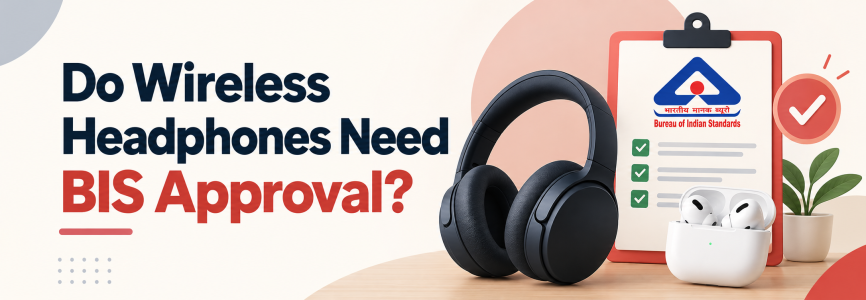



Wireless headphones have become a part of everyday life. Whether you are attending online meetings, listening to music, playing games, or watching videos, Bluetooth headphones and wireless earbuds make everything more convenient. Because of this growing demand, many businesses are planning to manufacture, import, or sell wireless headphones in India. However, before starting this business, there is one important question: Do wireless headphones need BIS approval in India?
The simple answer is yes. Wireless headphones and earphones are covered under mandatory BIS registration requirements in India. This means manufacturers must ensure that their products meet the applicable Indian safety standards before they are sold in the Indian market. If you are a manufacturer, importer, distributor, or business owner planning to launch your own headphone brand, understanding BIS certification is important. In this article, we will explain the BIS registration requirements for wireless headphones, the registration process, required documents, costs, and important rules in very simple language.
What Is BIS Certification for Wireless Headphones?
BIS stands for the Bureau of Indian Standards. It is India's national standards body, responsible for establishing product standards and operating certification schemes that help ensure product quality and safety. For wireless headphones, BIS registration helps confirm that the product meets the applicable electrical and electronic safety requirements. These requirements are important because wireless headphones generally contain batteries, charging circuits, and other electronic components.
Imagine that you are launching your own Bluetooth headphone brand in India. You have finalised the product design, packaging, and pricing. However, before selling the headphones, you must also check whether they meet the government's safety requirements. Wireless headphones fall under the BIS Compulsory Registration Scheme (CRS). Under this scheme, the manufacturer gets the product tested through a BIS-recognised laboratory and applies for registration. Once approved, the manufacturer can use the applicable BIS Standard Mark with the registration number on the registered products.
Is BIS Certification Mandatory for Wireless Headphones in India?
Yes, BIS registration is mandatory for wireless headphones and earphones covered under the notified product category.
Wireless headphones and earphones were included in the compulsory registration requirements with an implementation date of 1 April 2021. These requirements apply under the Electronics and Information Technology Goods (Requirement of Compulsory Registration) Order, 2021, as amended. This means covered products cannot legally be manufactured for sale, imported, stored for sale, sold, or distributed in India without meeting the applicable requirements.
The rules are important for businesses selling products such as:
- Bluetooth headphones
- Wireless earbuds
- True Wireless Stereo (TWS) earbuds
- Over-ear wireless headphones
- Wireless gaming headphones
- Neckband-style Bluetooth earphones
Whether the products are affordable or premium, the business must check BIS applicability before introducing them into the Indian market.
For example, if you import 1,000 Bluetooth headphones from a manufacturer in China and plan to sell them under your own brand in India, you must ensure that the manufacturer and relevant products have the necessary BIS registration. Simply purchasing the headphones from a foreign supplier does not automatically make them compliant.
Which BIS Standard Applies to Wireless Headphones in 2026?
BIS certification is based on specific Indian Standards. These standards explain the safety requirements that products must meet. Wireless headphones and earphones were originally covered under IS 616:2017, which deals with safety requirements for audio, video, and similar electronic equipment. However, the government has introduced a transition to a newer safety standard, IS/IEC 62368 (Part 1):2023. Under the notification dated 29 October 2025, the older IS 616:2017 standard and the newer standard have a permitted transition period for covered products, generally up to 1 November 2028. The older standard is scheduled to be withdrawn after this period, subject to subsequent regulatory changes. For businesses applying for BIS registration in 2026, it is important to confirm which standard and transition provisions apply to their particular product before sending samples for testing.
Why Do Wireless Headphones Need BIS Certification?
You may wonder why a small device like a wireless earphone needs government registration. The reason is simple. Wireless headphones are electronic products that may contain rechargeable batteries, electronic circuits, and charging systems. If these components are poorly designed or manufactured, they may create safety risks. BIS registration helps ensure that applicable product safety requirements are followed.
Electrical Safety
Wireless headphones use electrical components, even if they operate at low power. Proper electrical design is necessary to reduce the risk of overheating, short circuits, and other hazards. BIS testing examines applicable safety aspects to check whether the product meets the required standard.
Battery and Charging Safety
Most wireless headphones use rechargeable lithium-based batteries. These batteries need suitable protective systems and safe charging arrangements. Businesses must also consider separate BIS registration requirements for batteries and charging cases, where applicable.
Consumer Confidence
When customers purchase electronic products, they expect them to be safe and reliable. Proper BIS marking can help customers identify products that have been registered under the applicable scheme.
Legal Compliance
For businesses, BIS registration is not simply a marketing benefit. It is a legal requirement for products covered under the compulsory registration order. Selling non-compliant products may result in regulatory action under the BIS Act, 2016, and applicable orders.
Who Needs BIS Registration for Wireless Headphones?
BIS registration is generally issued to the manufacturer for the relevant product and manufacturing location. However, importers, distributors, and brand owners must also ensure that the products they handle comply with Indian requirements.
Indian Manufacturers: If your company manufactures wireless headphones in India, you generally need to obtain BIS CRS registration for the covered products before selling them.
Foreign Manufacturers: Manufacturers located outside India can also apply for BIS registration. They generally need to appoint an Authorised Indian Representative (AIR) to fulfil the applicable responsibilities in India.
Importers: If you import wireless headphones from another country, you must verify that the manufacturing unit and relevant models are covered by a valid BIS registration.
Brand Owners: If you sell headphones under your own brand but another company manufactures them, you need to coordinate with the manufacturer to ensure that the registration covers the relevant product and brand details.
Online Sellers: Businesses selling wireless headphones through Amazon, Flipkart, or their own websites must also ensure that the products comply with applicable BIS requirements.
Documents Required for BIS Certification of Wireless Headphones
Before applying for BIS Registration, businesses should keep the required documents ready. Proper documentation helps the testing and registration process move smoothly.
Commonly required documents include:
- Manufacturer's business registration and factory address details.
- Product name, model number, and technical specifications.
- Details of the manufacturing unit.
- Valid test report issued by a BIS-recognised laboratory.
- Brand or trademark details and necessary authorisation documents.
- Manufacturer's undertaking and applicable declarations.
- Authorised Indian Representative documents, where required.
- Product photographs and labelling details.
- Information about batteries, charging cases, and relevant components.
- Applicable application forms and supporting documents.
The exact documents may vary depending on whether the manufacturer is located in India or outside India, the product's design, and the application category.
BIS Registration Process for Wireless Headphones in India
The BIS certification process may appear technical, but it becomes easier when you understand the steps.
Step 1: Identify the Product Category
The first step is to identify whether your product falls under the compulsory registration category for wireless headphones and earphones. You should also review the product design, battery specifications, charging arrangement, and applicable Indian Standard.
Step 2: Arrange Product Testing
After confirming the product category, the manufacturer arranges testing through a BIS-recognised laboratory. The laboratory examines the product against the applicable safety standard and prepares a test report. The manufacturer should ensure that the tested model and components correctly represent the products intended for registration.
Step 3: Prepare the Documents
Once the relevant test report and product information are available, the manufacturer prepares the application documents. These may include factory details, brand information, declarations, and technical specifications. Foreign manufacturers must also complete the applicable Authorised Indian Representative formalities.
Step 4: Submit the BIS Application
The application is submitted through the official BIS CRS registration system with the required documents, laboratory test report, and applicable fees. All information must be accurate because differences between the application, test report, product label, and manufacturing details may result in queries or delays.
Step 5: BIS Reviews the Application
BIS reviews the submitted documents and checks whether the application meets the registration requirements. If any clarification or correction is needed, the applicant must respond and provide the necessary information.
Step 6: Receive BIS Registration
Once the application is approved, BIS issues the registration for the applicable products and manufacturing unit. The manufacturer can then use the prescribed Standard Mark with the registration number, subject to the applicable marking requirements and conditions of registration.
Do Wireless Headphones Need WPC Approval Along with BIS?
This is one of the most common questions businesses ask. BIS registration and WPC Equipment Type Approval (ETA) serve different purposes. BIS registration deals mainly with applicable product safety standards. WPC ETA deals with radio-frequency compliance for wireless communication equipment. Bluetooth headphones transmit signals using wireless frequencies. Therefore, businesses generally need to assess WPC ETA requirements in addition to BIS registration.
For eligible products operating in licence-exempt frequency bands, WPC ETA is available through a self-declaration process. Applications and relevant documentation are handled through the Department of Telecommunications' prescribed system.
For example, if you are launching a new Bluetooth headphone brand in India, obtaining BIS registration alone does not necessarily complete all your regulatory responsibilities. You should also check the WPC requirements before importing or selling the product.
Do Wireless Earbuds and Charging Cases Need Separate BIS Registration?
Yes, separate component-related registration requirements may apply. Many people assume that obtaining BIS registration for wireless earbuds automatically covers every component included in the package. However, this is not always correct.
For example, TWS earbuds generally include rechargeable batteries and a charging case. MeitY's guidance explains that battery-containing charging cases may require separate registration under the power bank category, while batteries used in wireless headphones are also subject to applicable registration requirements. This means a business launching TWS earbuds should examine the complete product arrangement rather than focusing only on the earbuds. BIS also provides a parallel testing option for eligible products and components, subject to applicable guidelines. This may help manufacturers coordinate registration where multiple regulated components are involved.
How Much Does BIS Certification for Wireless Headphones Cost?
The cost of BIS certification depends on several factors, including the applicable testing standard, laboratory charges, number of models, product components, and whether the applicant is an Indian or foreign manufacturer. The major expenses may include laboratory testing charges, BIS application and registration fees, applicable renewal expenses, and professional assistance charges if a consultant is engaged. Businesses should also consider separate testing or registration costs for batteries and charging cases where required. There is no single total price that applies to every wireless headphone model. It is better to obtain an accurate estimate after reviewing the product specifications and registration requirements.
How Long Does BIS Registration Take?
The time required for BIS registration depends on the completeness of the documents, product testing arrangements, laboratory availability, and whether BIS raises any queries during application review. If the product is ready for testing and all documents are correct, the process may move more smoothly. However, if the testing reveals safety issues or the documents contain incorrect information, the manufacturer may need to make corrections or arrange additional testing. For this reason, businesses should start planning BIS registration before finalising their commercial launch or placing large import orders.
What Happens if You Sell Wireless Headphones Without BIS Registration?
Selling wireless headphones without the required BIS registration can create serious problems for a business. Non-compliant goods may face action from the relevant authorities, including restrictions on import or sale, seizure or other enforcement action where legally applicable, and penalties under the governing law. For an importer, this may also affect shipment clearance. For a brand owner, it can disrupt inventory planning, distributor relationships, and product launches. Instead of treating BIS registration as an unnecessary expense, businesses should include compliance in their product launch planning from the beginning.
Common Mistakes Businesses Should Avoid
Many manufacturers and importers face difficulties because they start the registration process without checking the complete requirements. A common mistake is assuming that an international certificate, such as CE or FCC compliance documentation, automatically replaces BIS registration. International certifications may be relevant to other markets, but they do not by themselves substitute for mandatory BIS registration in India. Another mistake is ignoring the separate requirements for batteries and charging cases. Some businesses also assume that every model sold under the same brand is automatically covered by one registration. BIS permits series approval for eligible product models, but the models must satisfy the applicable technical conditions. Therefore, businesses should confirm whether a new model can be added to an existing registration or requires additional testing and approval.
Conclusion
Wireless headphones and Bluetooth earbuds are popular electronic products, but businesses cannot ignore the safety and regulatory requirements that apply to them. BIS CRS registration is mandatory for covered wireless headphones and earphones sold in India. Manufacturers must ensure that their products comply with the applicable Indian Standard and obtain the required registration before commercial sale.
Businesses should also check WPC ETA requirements and separate BIS registration obligations for batteries and charging cases. As India transitions toward IS/IEC 62368 (Part 1):2023, manufacturers and importers should remain aware of the applicable standard and regulatory timelines. If you are planning to manufacture, import, or launch a wireless headphone brand in India, Compliance Calendar LLP can help you understand the BIS registration process and related compliance requirements so that you can prepare for your product launch with greater confidence.
Frequently Asked Questions
Q1. Do wireless headphones need BIS approval in India?
Ans. Yes. Wireless headphones and earphones are covered under the BIS Compulsory Registration Scheme. Manufacturers must obtain the necessary registration and comply with applicable safety standards before selling covered products in India.
Q2. Is BIS certification mandatory for Bluetooth earbuds?
Ans. Yes. Bluetooth earbuds and TWS earphones generally fall under the wireless headphone and earphone product category. Manufacturers must check registration requirements before selling or importing these products for the Indian market.
Q3. Which BIS standard applies to wireless headphones?
Ans. Wireless headphones were covered under IS 616:2017. India has introduced a transition to IS/IEC 62368 (Part 1):2023. Manufacturers should confirm the applicable standard and transition conditions when applying in 2026.
Q4. Can I import wireless headphones without BIS registration?
Ans. Generally, no. If the wireless headphones fall under mandatory BIS registration, commercial imports must meet the applicable requirements. Limited exemptions may exist for specified purposes, subject to government conditions.
Q5. Do wireless headphones need both BIS and WPC approval?
Ans. Generally, wireless headphones require BIS CRS registration for applicable product safety requirements and WPC ETA for radio-frequency compliance. Both requirements should be checked separately.
Q6. Can a foreign manufacturer apply for BIS registration?
Ans. Yes. Foreign manufacturers can apply for BIS CRS registration for eligible products. They generally need to appoint an Authorised Indian Representative and meet the applicable documentation and registration requirements.
Q7. How much does BIS certification for Bluetooth headphones cost?
Ans. The cost depends on laboratory testing, applicable BIS fees, product models, and component-related requirements. Additional expenses may arise if batteries or charging cases need separate registration.
Q8. Do TWS earbuds and their charging cases need separate registration?
Ans. Separate registration may be required. Under MeitY guidance, battery-containing charging cases are covered under the applicable power bank category, and the relevant batteries also need to meet their own registration requirements.
Q9. Can I sell wireless headphones online without BIS registration?
Ans. No. Selling covered products through Amazon, Flipkart, or your own website does not remove mandatory BIS compliance requirements. Online sellers should verify that the products are properly registered and marked.
Q10. How can I check whether wireless headphones are BIS registered?
Ans. You can check the product's BIS registration details using the official BIS CRS registration search facility. Match the registration number with the manufacturer and relevant product information. A printed BIS mark alone should not be treated as sufficient proof without verification.
Article last updated on : 30 Oct 2026.













_learn_crop10_thumb.jpg)