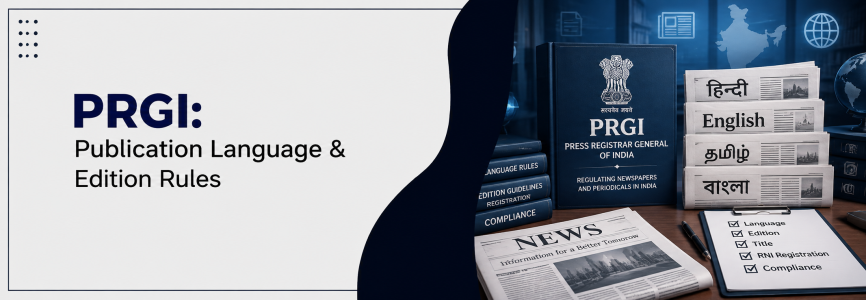



Starting a newspaper or periodical is not simply about choosing a name, printing content and distributing copies. A publisher also needs to understand the regulatory framework governing the publication, particularly when the publication is intended to operate in multiple languages, locations or editions. Since 1 March 2024, registration of newspapers and other periodicals containing public news or comments on public news is governed by the Press and Registration of Periodicals Act, 2023 (PRP Act) and the Press and Registration of Periodicals Rules, 2024.
The earlier Press and Registration of Books Act, 1867 was repealed, and the Office of the Registrar of Newspapers for India (RNI) was renamed the Press Registrar General of India (PRGI). For publishers, one of the most important areas to understand is the relationship between publication language, title, place of publication and editions. These details are not merely editorial choices. They form part of the regulatory information associated with a registered periodical.
What Is PRGI?
The Press Registrar General of India (PRGI) is the authority responsible for carrying out the functions under the PRP Act, 2023. The Act provides for registration of periodicals, including newspapers, that are published and printed at regular intervals and contain public news or comments on public news. Scientific, technical and academic journals are excluded from the definition of "periodical" under the Act.
The registration process has been shifted to an online framework through the Press Sewa Portal, making the process more streamlined than the earlier system. Publishers can submit applications and required information digitally. This digital approach is particularly relevant for publishers planning multiple editions or operating publications across different locations.
Why Publication Language Matters
Language is one of the important particulars associated with the registration of a periodical. Under Section 7 of the PRP Act, the certificate of registration issued by the Press Registrar General contains particulars including the periodicity, language, place of publication, owner details and title of the periodical. This means that language is not simply a marketing or editorial decision. It forms part of the registered particulars of the publication. For a publisher planning to launch a Hindi newspaper, for example, the proposed language should be correctly reflected during the registration process. Similarly, a publisher planning an English publication should ensure that the application accurately represents the proposed publication.
Can a Publication Be Published in Different Languages?
The language of a periodical needs to be considered carefully when planning a multilingual publishing strategy. A publisher may have a business plan involving different language audiences. However, the publisher should not assume that simply changing the language of an existing registered publication automatically creates a compliant additional edition. The registration framework requires relevant details such as language, periodicity and place of publication to be provided through the Press Sewa Portal. Therefore, publishers planning a Hindi, English, Marathi, Bengali or other regional-language publication should structure the registration and edition strategy carefully from the beginning.
Title and Language Are Closely Connected
One of the important features of the PRP Act is its approach to title availability. Section 7 provides that the proposed title should not be the same or similar to a title already held by another owner in the same language anywhere in India or in any other language in the same State, and it must comply with the guidelines issued by PRGI. This is important because publishers sometimes assume that a title is available simply because they cannot find an identical title.
That is not enough. Similarity can also matter.
For example, a proposed newspaper title may face difficulty if it is visually or phonetically similar to an existing registered title.
PRGI's Current Title Guidelines
PRGI has issued updated Guidelines for Admissibility of Titles, effective from 1 July 2025. Under these guidelines, proposed titles should preferably contain more than one word formed by combining distinct and meaningful terms. Generic or root-word titles are generally not accepted. The guidelines also require titles to be unique and not phonetically or visually similar to existing registered titles in the relevant language and geographical context.
The guidelines also address issues such as:
- Meaningfulness of titles
- Similarity with existing titles
- Offensive or inappropriate terminology
- Abbreviations and acronyms
- Compliance with statutory restrictions
Therefore, title selection should be treated as an important part of the registration strategy rather than something decided casually.
What Is an Edition?
An edition generally refers to a distinct version of a publication issued for a particular geographical area or market while operating under the broader publication identity.
For example, a newspaper may have:
- Delhi Edition
- Mumbai Edition
- Jaipur Edition
- Lucknow Edition
The practical structure of editions can vary depending on the publication model, language, place of publication and regulatory requirements. Publishers planning editions should therefore ensure that their actual publishing arrangement remains consistent with the particulars recorded with PRGI.
Why Place of Publication Matters
The place of publication is another important registration detail. The PRP Act specifically provides that the certificate of registration contains the place of publication. This becomes particularly important when a publisher expands from one city to another.
For example, if a newspaper is originally registered for publication from one location and the publisher later plans to establish another publishing operation, the publisher should review whether an update, fresh application or other PRGI process is required. The correct approach depends on the exact structure of the proposed expansion.
Expanding From One Edition to Multiple Editions
Expansion is a natural objective for many newspapers and periodicals. A publication may begin with one city edition and eventually expand into neighbouring districts or states. However, publishers should consider regulatory requirements before launching a new edition.
Important questions include:
- Is the language remaining the same?
- Is the title remaining the same?
- Is the place of publication changing?
- Is the printing press changing?
- Is the publisher remaining the same?
- Is the ownership changing?
- Is the periodicity changing?
- Does the proposed arrangement require an update or additional registration process?
A publisher should resolve these questions before the first issue of the new edition is released.
The Role of the Press Sewa Portal
The Press Sewa Portal is central to the modern PRGI registration system. PRGI describes it as the online portal developed to receive applications, intimations and documents required under the PRP Act and Rules. It also provides information concerning certificate formats, annual statements, title guidelines and other requirements. For a new periodical, the process begins with the title owner creating a profile.
The owner provides details such as:
- Language
- Periodicity
- Proposed place of publication
- Proposed title options
The appointed publisher is then invited through the portal, and the publisher completes the relevant application process and fee payment.
Publisher and Owner: Why the Distinction Matters
The PRP framework distinguishes between the owner and publisher of a periodical. The owner authorises the publisher to obtain the certificate of registration. The registration application therefore needs to reflect the correct relationship between these parties.
For businesses, this is especially important where the publication is operated through:
- Companies
- LLPs
- Partnerships
- Individuals
- Other eligible entities
Incorrectly structuring ownership or publisher details can create complications later when the publication expands.
Printing Press Compliance
Publication compliance does not stop with the owner and publisher. Printers also have responsibilities under the PRP framework. A printer of a periodical is required to provide intimation regarding the printing press through the Press Sewa Portal within the prescribed period. PRGI states that the printer is required to submit the intimation within 15 days of starting a printing press of a periodical. Changes in the particulars previously submitted must also be communicated. This becomes important when publications expand their printing arrangements.
For example, if a publisher begins using another printing facility for a new edition, the printer-side compliance should also be reviewed.
Digital Copies and Physical Copies
Modern PRGI compliance also involves digital and physical submission requirements. PRGI states that publishers must upload a scanned copy of the printed periodical on the Press Sewa Portal within 48 hours of publication. For newspapers, physical copies are also required to be delivered to the relevant Press Information Bureau office by the fifth day of every month for issues published during the preceding month. Delhi publications have a specific submission arrangement with PRGI. These obligations are important for publishers operating multiple editions because compliance needs to be managed consistently across the publication's operations.
Annual Compliance After Registration
Obtaining a Certificate of Registration is not the end of PRGI compliance. Publishers are required to furnish an annual statement by 31 May of a calendar year concerning the preceding financial year through the Press Sewa Portal.
This means publishers need an ongoing compliance system.
A publication should maintain appropriate records concerning:
- Issues published
- Publication frequency
- Editions
- Printing arrangements
- Ownership
- Publisher details
- Relevant financial and circulation information
- Copies and submission records
Good record management becomes even more important as the publication expands.
What Happens If a Publication Does Not Start?
Obtaining registration and then leaving the publication inactive can also create consequences. Under Section 7(6) of the PRP Act, after receiving the certificate of registration, the publisher is required to commence publication. If publication does not begin within 12 months from the end of the month in which the certificate was issued, the Press Registrar General may cancel the certificate and withdraw the title. Therefore, publishers should apply only when they are reasonably prepared to commence publication.
What Publishers Should Check Before Launching a New Edition
Before launching a new edition, a publisher should conduct a practical compliance review.
Check 1: Title
Confirm that the title remains compliant with PRGI requirements.
Check 2: Language
Verify that the proposed edition's language corresponds with the registered particulars and applicable PRGI requirements.
Check 3: Location
Review the place of publication and determine whether the proposed edition involves a new location.
Check 4: Printer
Ensure the relevant printer has completed the required PRGI formalities.
Check 5: Publisher and Owner
Confirm that ownership and publisher information is accurate.
Check 6: Periodicity
Ensure the actual publication frequency corresponds with the registered particulars.
Check 7: Ongoing Compliance
Plan for e-copy uploads, physical copy submissions and annual statements.
Common Mistakes Publishers Should Avoid
Choosing a Similar Title
A title that appears different at first glance may still be considered similar phonetically or visually.
Treating Language as an Editorial Detail
Language forms part of the registered particulars and should be handled accordingly.
Launching an Edition Without Reviewing PRGI Requirements
A new edition can involve changes in location, printing and other particulars.
Ignoring Printer Compliance
Printer-side obligations are an important part of the publishing ecosystem.
Forgetting Annual Compliance
Registration is an ongoing responsibility rather than a one-time certificate.
How PRGI Compliance Supports Sustainable Publishing
Regulatory compliance can actually support business growth.
A properly registered and compliant publication can establish stronger credibility with:
- Readers
- Advertisers
- Government bodies
- Business partners
- Media organisations
For publishers planning to build a long-term media business, regulatory compliance should therefore be treated as part of business planning. The objective is not simply to obtain registration but to create a publishing operation that remains compliant as it expands.
Conclusion
The PRGI has changed significantly with the introduction of the Press and Registration of Periodicals Act, 2023 and the Press and Registration of Periodicals Rules, 2024. For publishers, understanding publication language and edition requirements is particularly important when planning expansion.
Language, title, place of publication, publisher details and printing arrangements form interconnected parts of the registration framework. A change in one area can potentially affect other compliance requirements. The safest approach is to plan the publication structure before launch, verify title and language requirements, maintain accurate registration particulars and monitor ongoing PRGI obligations. For publishers, growth should not come at the cost of compliance. A well-planned PRGI strategy can provide the regulatory foundation needed to build a credible and sustainable publication.
FAQs
Q1. What is PRGI?
Ans. PRGI stands for Press Registrar General of India. It is the statutory authority responsible for carrying out functions under the Press and Registration of Periodicals Act, 2023, including registration of eligible periodicals containing public news or comments on public news.
Q2. When did the PRP Act, 2023 come into force?
Ans. The Press and Registration of Periodicals Act, 2023 came into force on 1 March 2024 and replaced the earlier Press and Registration of Books Act, 1867.
Q3. Does the registration certificate mention the publication language?
Ans. Yes. Section 7 of the PRP Act provides that the certificate of registration contains particulars including the periodicity, language, place of publication, owner details and title of the periodical.
Q4. Can a publisher start a different language edition without checking PRGI requirements?
Ans. Publishers should not assume that a different-language edition can automatically operate under an existing registration. Language is a registered particular, so the proposed structure should be reviewed against the PRP Act, Rules and applicable PRGI requirements.
Q5. Can two publications have similar titles in different languages?
Ans. The PRP Act provides that the proposed title should not be the same or similar to a title already held by another owner in the same language anywhere in India or in another language in the same State.
Q6. What is the Press Sewa Portal?
Ans. The Press Sewa Portal is PRGI's online platform for applications, intimations and documents required under the PRP Act and Rules. It also provides information regarding title guidelines, certificates and annual statements.
Q7. Does a publisher need to comply with PRGI requirements after registration?
Ans. Yes. Registration creates continuing obligations. These include annual statement filing and requirements concerning copies of publications and other information prescribed under the PRP framework.
Q8. What happens if a registered periodical does not start publication?
Ans. If publication does not commence within 12 months from the end of the month in which the certificate was issued, the Press Registrar General may cancel the certificate and withdraw the title.
Q9. Are printers also required to comply with PRGI requirements?
Ans. Yes. Printers have obligations under the PRP Rules, including providing prescribed intimation regarding the printing press through the Press Sewa Portal and informing PRGI of subsequent changes.
Q10. Why should publishers review PRGI compliance before launching a new edition?
Ans. A new edition may involve changes relating to language, place of publication, printing arrangements, publisher details or other particulars. Reviewing compliance beforehand helps publishers avoid inconsistencies and operational problems after launch.


_crop10_thumb.jpg)





_for_FY_2025-26_crop10_thumb.jpg)




_learn_crop10_thumb.jpg)


_Filing_Due_Dates_for_FY_2024-25_learn_crop10_thumb.jpeg)





_of_GST_Act_learn_crop10_thumb.jpg)


_Under_GST_learn_crop10_thumb.jpg)


_crop10_thumb.jpg)


_crop10_thumb.jpg)


_learn_crop10_thumb.jpg)


_of_the_Income_Tax_Act_learn_crop10_thumb.jpg)


_learn_crop10_thumb.jpg)



_learn_crop10_thumb.jpg)


_crop10_thumb.jpg)





_in_The_Income_Tax_Act,_1961_learn_crop10_thumb.jpg)


_learn_crop10_thumb.jpg)


_of_the_Income_Tax_Act_learn_crop10_thumb.jpg)

_Of_Income_Tax_Act_learn_crop10_thumb.jpg)


_learn_crop10_thumb.jpg)


_learn_crop10_thumb.jpg)
_crop10_thumb.jpg)



_learn_crop10_thumb.jpg)
_for_Import_and_Export_learn_crop10_thumb.jpg)


















_crop10_thumb.jpg)