


The Reverse Charge Mechanism, commonly known as RCM, is an important part of GST compliance for businesses in India. It shifts the responsibility for paying GST from the supplier to the recipient for specified transactions. Businesses receiving such supplies must correctly identify the tax liability, prepare the required documents, pay GST and assess their eligibility for input tax credit.
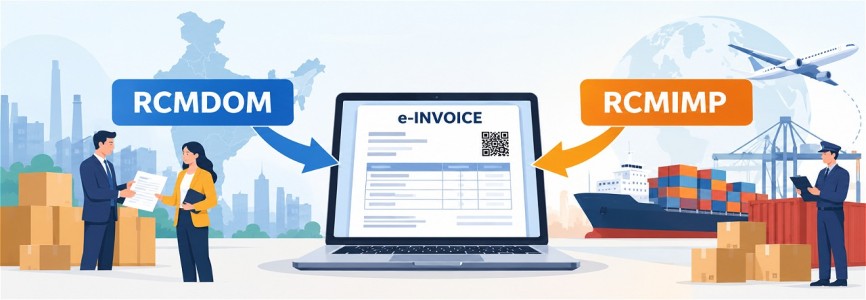
The introduction of RCMDOM and RCMIMP is intended to extend the e-invoicing to specified recipient-generated self-invoices. These supply types distinguish qualifying domestic reverse charge transactions from imports of services on which the recipient is liable to pay GST. Understanding this requires businesses to separate their existing self-invoicing obligations from the additional requirement to register those documents electronically. This article explains the meaning of RCMDOM and RCMIMP, their intended applicability, documentation requirements, tax treatment and practical compliance process.
Implementation status as of 17 October 2026: The announced functionality is available for sandbox testing and integration. The production rollout and commencement of associated reporting requirements are to be communicated separately. Businesses should prepare their systems while checking the applicable notifications and implementation announcements before treating the new reporting requirement as mandatory.
What Is the Reverse Charge Mechanism Under GST?
Under the normal GST mechanism, a supplier issues an invoice, collects GST from the customer and deposits the tax with the government. Under reverse charge, the recipient becomes responsible for paying the applicable tax directly to the government. For example, when a registered business receives a service covered by a reverse charge notification, the business must calculate and discharge the GST liability. The amount paid to the supplier and the amount paid to the government must be accounted for separately.
Reverse charge is governed primarily by Sections 9(3) and 9(4) of the Central Goods and Services Tax Act, 2017, along with the corresponding provisions of Sections 5(3) and 5(4) of the Integrated Goods and Services Tax Act, 2017. Section 9(3) covers notified categories of supplies, while Section 9(4) applies to specified supplies received from unregistered suppliers by notified classes of registered recipients. A purchase from an unregistered person does not automatically attract RCM. The business must examine the nature of the supply, the recipient’s category and the conditions of the relevant notification before determining the tax treatment.
What Is an RCM Self-Invoice?
An RCM self-invoice is a GST document prepared by the registered recipient where the law requires the recipient to issue an invoice for an inward supply. Section 31(3)(f) of the CGST Act provides for self-invoicing where a registered person liable under the relevant reverse charge provisions receives goods, services or both from a supplier who is unregistered on the date of receipt. The relevant invoicing provisions also apply to integrated tax transactions through Section 20 of the IGST Act.
The self-invoice records the transaction value, description of the supply and applicable GST. It provides a documentary connection between the underlying purchase and the recipient’s reverse charge liability. The supplier’s commercial bill should also be retained. That bill records the amount charged under the commercial arrangement, while the self-invoice supports the recipient’s GST obligations. Preparing a self-invoice does not remove the need to maintain the original supplier documentation.
Why Is Self-Invoicing Necessary?
Self-invoicing is necessary because an unregistered supplier ordinarily cannot issue a GST tax invoice in the same manner as a registered supplier. Where reverse charge applies and the statutory conditions are satisfied, the recipient must create the prescribed GST document.
For example, an overseas consultant may issue an invoice without Indian GST. If the Indian recipient receives a taxable import of services covered by reverse charge, the recipient must examine its self-invoicing obligation and account for the applicable IGST.
What Is RCM Self-Invoice e-Invoicing?
RCM self-invoice e-invoicing involves reporting prescribed details of a qualifying self-invoice to an authorised Invoice Registration Portal, commonly called an IRP. After successful validation, the system generates an Invoice Reference Number, or IRN, together with the prescribed signed information and QR code.
An invoice prepared in accounting software, printed on company letterhead or saved as a PDF is not automatically an e-invoice. Electronic registration requires submission of the prescribed information and successful processing through the applicable IRP system. The RCMDOM and RCMIMP enhancement is intended to enable eligible recipients to register specified self-invoices electronically. It adds a reporting layer to the underlying GST documentation process.
Difference Between Self-Invoicing and e-Invoicing
Self-invoicing concerns who prepares the GST document. E-invoicing concerns whether the prescribed details of that document must be reported to an IRP for registration. A business may therefore have a self-invoicing obligation even when electronic reporting does not apply. The requirement to issue the document and the requirement to obtain an IRN must be assessed separately.
What Is RCMDOM?
RCMDOM stands for Reverse Charge Mechanism on Domestic. It is intended to identify recipient-generated self-invoices for specified domestic supplies received from unregistered persons where the registered recipient is liable to pay GST under reverse charge.
Before selecting RCMDOM, the recipient should establish that the transaction is covered by the applicable domestic RCM provisions and requires a self-invoice. The supplier’s unregistered status is relevant, but it is not sufficient on its own. The recipient must also establish the correct taxable value, applicable rate and place of supply. These factors determine whether CGST and SGST or UTGST apply, or whether the liability must be discharged as IGST.
Practical Example of RCMDOM
Assume a registered company receives a domestic service from an unregistered supplier. The service and the recipient satisfy the applicable RCM notification. The taxable value is Rs.50,000 and the applicable GST rate is assumed to be 18%. The reverse charge liability would be Rs.9,000. If the transaction qualifies as an intra-State supply, this would ordinarily comprise Rs.4,500 CGST and Rs.4,500 SGST. If it qualifies as an inter-State supply, IGST would ordinarily apply.
The company should prepare the required self-invoice, pay the tax and examine input tax credit eligibility. When electronic reporting becomes legally applicable, RCMDOM would identify the qualifying self-invoice. This example assumes that reverse charge applies under the relevant notification. An ordinary purchase cannot be classified as RCMDOM merely because the supplier does not have a GST registration.
What Is RCMIMP?
RCMIMP stands for Reverse Charge Mechanism on Import of Services. It is intended to identify recipient-generated self-invoices relating to imports of services where the registered recipient is liable to pay GST under reverse charge. A service generally qualifies as an import of services when the supplier is located outside India, the recipient is located in India and the place of supply is in India.
The recipient must also examine the relevant reverse charge notification and any available exemption. Payment in foreign currency does not independently establish an import-of-services liability. The location of the parties, nature of the service and place-of-supply provisions must all be reviewed.
Practical Example of RCMIMP
Suppose an Indian company receives consulting services from an overseas consultant. The transaction qualifies as a taxable import of services subject to reverse charge. After applying the relevant currency conversion requirements, the taxable value is Rs.1,00,000.
Assuming an applicable IGST rate of 18%, the Indian company would have a reverse charge liability of Rs.18,000. It should retain the foreign consultant’s commercial invoice, prepare the required self-invoice and discharge the tax. When the electronic reporting requirement becomes applicable, RCMIMP would classify the qualifying self-invoice. The reverse charge tax is payable to the government and should not automatically be added to the amount payable to the overseas consultant.
Does RCMIMP Cover Imports of Goods?
The RCMIMP category described in the announced enhancement concerns imports of services. Businesses should not use it automatically for imports of goods. Imports of goods involve customs procedures and the applicable import documentation, including the bill of entry. Their GST treatment must be examined under the provisions governing those transactions.
How Are RCMDOM and RCMIMP Different?
The main difference lies in the nature and location of the underlying supply. RCMDOM concerns specified domestic supplies received from unregistered persons, while RCMIMP concerns imports of services subject to reverse charge. For RCMDOM, the tax may be CGST and SGST or UTGST, or IGST, depending on the transaction. For RCMIMP, the liability would ordinarily be IGST because imports of services are treated as inter-State supplies.
Documentation also differs. Domestic transactions generally involve an Indian supplier’s commercial bill, while imported services involve an overseas invoice and may require foreign currency conversion workings. Both categories require a clear connection between the original transaction, self-invoice, tax payment and any eligible credit claim.
Who Is Intended to Be Covered?
The October 2026 advisory describes the intended facility for registered taxpayers having aggregate annual turnover of Rs.5 crore and above, subject to the applicable statutory provisions and notifications. Businesses should verify the exact wording of the governing notification when determining coverage. The advisory’s threshold description should not replace the legal examination of turnover conditions, exempt categories, covered documents and the commencement date.
A business must separately determine whether the supply attracts RCM, whether a self-invoice is required and whether that self-invoice falls within the electronic reporting requirement. A taxpayer outside the e-invoicing scope may still need to issue a self-invoice and pay reverse charge tax.
What Is the Time Limit for Issuing a Self-Invoice?
Rule 47A of the CGST Rules prescribes a period of 30 days from the receipt of the supply for issuing the self-invoice covered by Section 31(3)(f). This provision took effect from 1 November 2024.
Businesses should maintain evidence of when goods or services were received. The date on which the accounts team records an expense may differ from the actual receipt date, so relying only on the accounting entry can create compliance errors.
Self-Invoice Deadline and Tax Liability
The deadline for issuing a self-invoice should be distinguished from the time-of-supply provisions that determine when GST becomes payable. Any applicable IRP reporting deadline is another separate requirement.
Businesses should therefore monitor the receipt date, self-invoice date, tax liability period and electronic reporting deadline independently. The permitted period for preparing a self-invoice should not be treated as a general extension for paying GST.
What Information Should a Self-Invoice Contain?
A self-invoice should clearly identify the recipient, supplier and underlying supply. The record should capture the document number and date, recipient’s name and GSTIN, supplier’s name and address, description, relevant HSN or SAC, taxable value, GST rate, tax amounts and place of supply, as applicable.
The document should also indicate the reverse charge treatment and connect with the supplier’s commercial invoice. For foreign currency transactions, the business should retain supporting conversion and valuation workings. For electronic reporting, the exact field mapping, supplier identifiers, mandatory values and validation requirements must follow the applicable IRP specifications. Businesses should avoid assuming that the ordinary outward B2B invoice format can be used unchanged.
Process for RCM Self-Invoice Compliance
Identify the Transaction
The process begins with reviewing the supplier’s invoice, agreement, purchase order and evidence of receipt. The business should establish what was supplied, who received it and which GST registration is responsible for the transaction. For imported services, this review should include the overseas supplier’s location and the relevant place-of-supply provision. A foreign invoice should not be processed under reverse charge without examining these conditions.
Confirm Reverse Charge Applicability
The recipient should identify the applicable statutory provision and notification. Any conditions relating to the supplier, recipient, service category or exemption must be checked. A documented explanation of the tax treatment helps maintain consistency. It also helps accounts teams avoid applying the same GST treatment to every invoice from a particular vendor when the vendor supplies different services.
Calculate the Tax
The business should determine the taxable value, classification, GST rate and correct tax head. Where the invoice is in foreign currency, the INR value should be supported by the applicable conversion working. The rate must be established for the actual supply. The 18% rate used in the examples in this article is illustrative and should not be treated as a universal RCM rate.
Prepare the Self-Invoice
The recipient should issue the self-invoice within the prescribed period and link it to the original supplier invoice. A clear numbering arrangement can help distinguish self-invoices from outward sales invoices. The accounting entry should preserve the transaction’s nature as an inward supply. The creation of a recipient-generated invoice should not cause the expense to be recorded as sales revenue.
Report Electronically When Applicable
Once production reporting is enabled and the legal requirement applies, the recipient should submit the prescribed information using the appropriate supply type. Successful registration details should be retained with the transaction record. If the submission fails, the business should identify the validation error, correct the data and complete reporting in accordance with the applicable instructions.
Pay GST and Review Credit
The recipient must separately discharge the reverse charge liability and report it in the relevant return. Input tax credit should then be assessed against the applicable conditions and restrictions. The process is complete only when the documents, liability, payment and credit treatment are reconciled. Obtaining an IRN does not complete these other obligations.
Does Generating an IRN Pay the GST?
Generating an IRN does not discharge the reverse charge tax liability. Invoice registration and tax payment are separate actions. RCM tax must be paid through the electronic cash ledger. Existing input tax credit cannot be used to settle that reverse charge liability.
For example, a company owing Rs.18,000 under RCM must arrange the required cash payment even if it has sufficient balance in its electronic credit ledger. Any eligible credit arising from the transaction must be considered separately.
Can Businesses Claim Input Tax Credit on RCM Payments?
GST paid under reverse charge may qualify for input tax credit, subject to the applicable conditions and restrictions. The business must examine the use of the supply, receipt of the goods or services, supporting documentation and payment of tax.
Credit may be restricted where the expense falls within blocked credit provisions or other limitations. Consequently, a business can have an obligation to pay reverse charge tax even where the related credit is unavailable. An IRN supports electronic registration of the document. It does not independently establish that the expense is eligible for ITC.
How Are RCM Transactions Reported in GSTR-3B?
Reverse charge liabilities are ordinarily declared in Table 3.1(d) of GSTR-3B. Eligible input tax credit on imports of services is ordinarily reported in Table 4(A)(2), while eligible credit on other inward supplies liable to reverse charge is ordinarily reported in Table 4(A)(3).
Businesses should reconcile these declarations with the purchase register, self-invoice register and tax payment records. Any differences should be explained and addressed before the return is finalised. The new reporting facility should not lead businesses to assume that every return field will populate automatically or correctly. The production guidance and actual data flow must be checked before relying on system-generated values.
Is a Payment Voucher Also Required?
Section 31(3)(g) provides for a payment voucher when a registered person liable under the relevant reverse charge provisions makes payment to the supplier. The payment voucher serves a different purpose from the self-invoice.
The self-invoice documents the inward supply for the recipient’s GST obligation, while the payment voucher records payment to the supplier under the applicable provision. Businesses should assess both requirements. Electronic registration of the self-invoice does not automatically remove a separate payment voucher obligation.
What Records Should Businesses Maintain?
A complete RCM transaction file should connect the supplier’s invoice, agreement, receipt evidence, self-invoice, valuation working, payment voucher and tax payment details. Where applicable, it should also contain the IRP response and the assessment supporting the credit claim. These records should allow a reviewer to follow the transaction from the original purchase through to the GST return.
A reliable document trail makes it easier to resolve differences, explain tax treatment and respond to verification requests. For imported services, retaining the place-of-supply analysis and currency conversion working is particularly useful. For domestic supplies, the file should support the supplier’s registration status and the relevant reverse charge classification.
Common Mistakes in RCMDOM and RCMIMP Compliance
-
Applying RCM to Every Unregistered Purchase: The absence of a supplier GSTIN does not establish reverse charge liability. Businesses must identify the applicable notification and verify its conditions before issuing an RCM self-invoice.
-
Duplicating Registered Supplier Invoices: An invoice issued by a registered supplier under reverse charge must be distinguished from a recipient-generated self-invoice under Section 31(3)(f). Creating unnecessary duplicate documents can distort the accounting records and compliance register.
-
Using the Wrong Supply Type: RCMDOM and RCMIMP should follow the nature of the underlying transaction. Incorrect classification can cause validation failures and make reconciliation more difficult.
-
Treating an IRN as Proof of Complete Compliance: An IRN does not prove that tax was paid, that the correct rate was applied or that ITC is eligible. Each of these matters requires its own review.
-
Confusing Sandbox Testing with Live Reporting: Sandbox submissions are test records. Businesses must follow the announced production process and applicable legal commencement requirements when registering actual documents.
How Should Businesses Prepare?
Preparation should begin with reviewing domestic and overseas vendor records and identifying recurring reverse charge transactions. Businesses should document the basis for RCM treatment and establish controls for receipt dates, self-invoice issuance and tax payments. Accounting teams and software providers should test the new classifications against the prescribed specifications. Testing should cover data validation, duplicate prevention, error handling and retention of successful responses.
A monthly reconciliation should connect RCM expenses, self-invoices, electronic registrations where applicable, liabilities declared, cash payments and eligible credit claims. Clear ownership of each stage will help businesses introduce RCMDOM and RCMIMP without losing control of their existing GST obligations. The immediate priority is to maintain accurate self-invoices and reconciled reverse charge records while preparing systems for the notified rollout. Once the reporting requirements take effect, businesses can build electronic registration into that established process.
Conclusion
RCMDOM and RCMIMP are intended to extend e-invoicing to specified self-invoices issued by recipients under the Reverse Charge Mechanism. RCMDOM covers qualifying domestic supplies received from unregistered persons, while RCMIMP covers qualifying imports of services where the recipient is liable to pay GST. Businesses should correctly identify RCM transactions, issue self-invoices within the prescribed period, pay the applicable tax and assess input tax credit eligibility.
Electronic invoice registration adds a reporting requirement; it does not replace tax payment, return filing or supporting documentation. As of 17 October 2026, the announced functionality is available for sandbox testing, with production rollout and commencement of reporting requirements to be communicated separately. Businesses should prepare their accounting systems and follow the applicable notifications before implementing live reporting.
Frequently Asked Questions
Q1. What is an RCM self-invoice?
Ans. An RCM self-invoice is a GST document prepared by a registered recipient where the law requires recipient invoicing for supplies received from an unregistered supplier. It records the transaction and supports the recipient’s reverse charge tax liability.
Q2. What does RCMDOM mean?
Ans. RCMDOM means Reverse Charge Mechanism on Domestic. It is intended for reporting qualifying recipient-generated self-invoices for specified domestic supplies received from unregistered persons where GST is payable by the recipient under RCM.
Q3. What does RCMIMP mean?
Ans. RCMIMP means Reverse Charge Mechanism on Import of Services. It is intended for reporting qualifying self-invoices for imported services on which the registered Indian recipient is liable to pay GST under reverse charge.
Q4. Does every purchase from an unregistered supplier attract RCM?
Ans. No. Reverse charge applies only where the transaction satisfies the relevant statutory provisions and notification. The supplier’s unregistered status alone does not make a purchase liable to RCM.
Q5. Is RCMDOM and RCMIMP e-invoicing already mandatory?
Ans. As of 17 October 2026, the announced functionality is available for sandbox testing and integration. The production rollout and commencement of associated reporting requirements are to be communicated separately. Applicability must be checked against the governing notifications.
Q6. Who is intended to be covered by the new facility?
Ans. The October 2026 advisory describes the intended facility for registered taxpayers with aggregate annual turnover of Rs.5 crore and above, subject to the applicable statutory provisions and notifications. The precise threshold conditions, exemptions and effective date must be determined from the governing legal requirements.
Q7. What is the time limit for issuing an RCM self-invoice?
Ans. Rule 47A of the CGST Rules prescribes 30 days from receipt of the supply for issuing the self-invoice covered by Section 31(3)(f). This deadline must be distinguished from the time of supply, tax payment deadline and any applicable IRP reporting deadline.
Q8. Does preparing a PDF self-invoice complete e-invoicing?
Ans. No. A PDF or an invoice generated through accounting software does not independently complete e-invoicing. Where electronic reporting applies, prescribed invoice details must be submitted to an authorised IRP and successfully registered.
Q9. Does generating an IRN pay the reverse charge tax?
Ans. No. An Invoice Reference Number confirms electronic registration of the document. The recipient must separately declare and discharge the applicable reverse charge liability.
Q10. Can existing input tax credit be used to pay RCM liability?
Ans. No. Reverse charge tax must be discharged through the electronic cash ledger. Existing input tax credit cannot be used to settle that liability.










_learn_crop10_thumb.jpg)