


Extended Producer Responsibility (EPR) has become an important environmental compliance requirement for businesses dealing with products and packaging that eventually become waste. In India, separate EPR operate for plastic packaging, e-waste, batteries, waste tyres, used oil and certain other waste streams, with online portals administered by the Central Pollution Control Board (CPCB). As of 2026, the Government has confirmed that operational EPR portals include facilities for registration, calculation of EPR obligations and generation of EPR certificates.
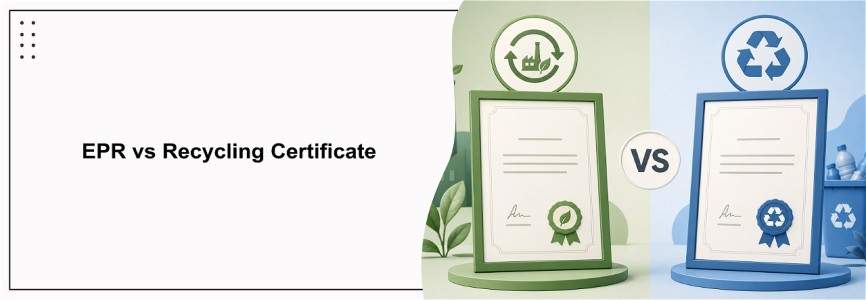
A common source of confusion for businesses is the difference between an EPR Certificate and a Recycling Certificate. These terms are sometimes used interchangeably in commercial discussions, but they can represent different stages of environmental compliance. In particular, businesses often refer to their CPCB registration document as an “EPR Certificate”, whereas the waste-management rules also use the expression EPR Certificate for certificates or credits generated on the basis of actual recycling. Therefore, understanding the context in which the term is being used is essential.
What Is Extended Producer Responsibility?
Extended Producer Responsibility is an environmental policy mechanism under which responsibility for managing a product or packaging after it reaches the end of its useful life is placed on the producer or another obligated entity. Depending on the applicable waste-management context, producers, importers, brand owners or other obligated entities may have to register on the CPCB portal, declare the quantity of covered products or packaging introduced into the market, calculate their EPR obligation and ensure that the prescribed quantity is recycled, reused or otherwise processed through authorised channels.
The Government has described India's EPR context as a market-based system that places end-of-life management responsibilities on entities introducing covered products into the market. EPR therefore involves two separate concepts: being legally registered under the EPR and actually fulfilling the recycling or waste-processing obligation generated under that registration.
What Is an EPR Registration Certificate?
In day-to-day business language, an “EPR Certificate” commonly means the registration granted to a producer, importer, brand owner or another obligated entity under the relevant waste-management rules. For example, CPCB operates a centralised EPR portal for plastic packaging for Producers, Importers and Brand Owners, while the Battery Waste Management portal provides registration facilities for producers as well as recyclers and refurbishers.
Similarly, under the E-Waste (Management) Rules, 2022, the earlier authorisation framework was replaced by portal-based registration for manufacturers, producers, refurbishers and recyclers. The Government has specifically stated that these entities are required to register on the CPCB portal and that entities covered by the rules should not operate without the applicable registration. Therefore, where businesses use the expression “EPR Certificate” to mean EPR registration, the certificate primarily establishes that the entity is registered under the applicable regulatory. It does not by itself prove that the business has fulfilled its annual recycling targets.
What Is a Recycling Certificate?
A Recycling Certificate generally refers to documentary or portal-based evidence showing that a specified quantity of waste has actually been recycled by a registered recycler or plastic waste processor. Under modern EPR contexts, such evidence is increasingly generated electronically through CPCB's centralised portals rather than relying only on private certificates issued between a producer and recycler.
For e-waste, for example, CPCB's mechanism allows EPR certificates to be generated in favour of registered recyclers based on verified recycling activity. Producers then obtain or purchase eligible EPR certificates from registered recyclers to fulfil their annual EPR obligations. Official guidance states that the certificates are generated through the portal on the basis of quantities recycled and relevant end products produced and sold. Therefore, what many businesses informally call a “recycling certificate” may legally function as an EPR certificate or recycling credit generated through the applicable portal.
Why Are the Terms Confusing?
The confusion exists because the expression “EPR Certificate” is commonly used for two very different things. The first is the EPR Registration Certificate, which represents the registration of a producer or another obligated entity. The second is an EPR compliance certificate or credit generated because waste has actually been recycled, which can be transferred or purchased in accordance with the applicable EPR and used to discharge an EPR obligation.
This distinction is particularly important in e-waste and battery compliance because the rules explicitly provide mechanisms for generation and transaction of EPR certificates. The Government confirmed in March 2026 that EPR portals for plastic packaging, e-waste, batteries, waste tyres and used oil contain functions relating to EPR certificate generation.
EPR Registration Certificate vs Recycling Certificate
|
Basis |
EPR Registration Certificate |
Recycling / EPR Compliance Certificate |
|
Purpose |
Establishes registration under the applicable EPR framework |
Demonstrates or represents eligible recycling/processing activity |
|
Main User |
Producer, importer, brand owner or other obligated entity |
Generated through activities of registered recyclers/processors |
|
Stage |
Obtained before or while commencing regulated EPR activities |
Generated after eligible waste has been processed/recycled |
|
What It Proves |
The entity is registered |
Eligible quantity of waste has been recycled/processed |
|
Annual Target Fulfilment |
Does not automatically fulfil targets |
May be used to fulfil EPR obligations according to applicable rules |
|
Portal Role |
Registration and identification of obligated entity |
Generation, transfer, purchase or adjustment of compliance credits/certificates |
|
Validity/Use |
Depends on applicable registration rules |
Depends on the specific waste-management framework |
|
Can It Replace the Other? |
No |
No |
The most important point is that registration and target fulfilment are separate compliances. A company may possess a valid EPR registration while still remaining non-compliant if it fails to fulfil its recycling obligations.
How Does the System Work for E-Waste?
The E-Waste (Management) Rules, 2022, effective from April 1, 2023, created a recycling-focused EPR regime. Producers, manufacturers, refurbishers and recyclers covered by the framework are required to register through the CPCB portal. Once registered, a producer may become subject to annual recycling obligations calculated under the applicable rules. The Government has confirmed that EPR recycling targets under the framework progressively increase, and the Rules introduced generation and transaction of EPR certificates as the mechanism through which producers can meet their obligations.
The actual EPR certificate is generated in favour of a registered recycler based on eligible quantities processed. CPCB's guidance requires information regarding waste procurement, recycling, end products and GST-linked sale details before certificate generation. The producer can then use eligible certificates obtained from registered recyclers for fulfilment of its EPR target. Therefore, under e-waste compliance:
Registration allows the producer to participate in the EPR system, while recycling-generated EPR certificates enable the producer to discharge the recycling obligation.
Example of E-Waste Compliance
Suppose an electronics producer is registered on the CPCB E-Waste EPR portal and has an annual recycling obligation of 100 metric tonnes. Possessing the producer registration certificate does not mean that the 100-MT obligation has automatically been fulfilled.
A registered recycler must process eligible e-waste and generate the appropriate EPR certificates through the portal. The producer then obtains the required eligible certificates and uses them against its obligation in accordance with the portal and regulatory mechanism. Official pollution-control-board guidance describes producer EPR fulfilment through certificates obtained from registered recyclers.
Therefore:
EPR Registration = Permission/registration under the framework
EPR Recycling Certificate = Evidence/credit used toward fulfilment of recycling responsibility
How Does It Work Under Battery Waste Management?
The Battery Waste Management Rules, 2022 also operate through an EPR-based system involving producers and registered recyclers/refurbishers. CPCB maintains a dedicated Battery Waste Management EPR portal for registration of producers and recyclers/refurbishers. The portal also provides a specific mechanism and SOP relating to generation of EPR certificates. A producer's EPR registration establishes its status within the regulatory system. The producer must then comply with the EPR obligations applicable to the quantity and category of batteries introduced into the market.
Registered recyclers process waste batteries, recover eligible materials and generate EPR certificates through the portal according to the applicable methodology. CPCB's mechanism states that EPR certificate generation is linked to recovered material from waste-battery recycling. Therefore, merely registering as a battery producer does not substitute for fulfilment of the producer's recycling obligations.
Example of Battery EPR
Suppose a battery manufacturer has obtained its CPCB producer registration and has an annual EPR obligation generated through the Battery Waste Management portal. During the compliance year, waste batteries are recycled through registered recycling facilities. Eligible recycling activity results in EPR certificates being generated through the system.
These certificates can then be used in accordance with the applicable rules to fulfil the producer's EPR obligation. The producer's registration and the recycler-generated certificate therefore perform completely different functions.
How Does the Concept Apply to Plastic Waste?
Plastic packaging EPR operates under the Plastic Waste Management Rules, 2016, as amended, including the Guidelines on Extended Producer Responsibility for Plastic Packaging introduced in Schedule II. Producers, Importers and Brand Owners covered by the framework must comply with EPR obligations for plastic packaging through CPCB's centralised portal. The portal functions as the regulatory platform for registration and implementation of EPR requirements.
Under plastic packaging obligations may include recycling, reuse requirements for specified rigid packaging, use of recycled plastic content and approved end-of-life disposal, depending on the relevant packaging category and compliance year. The EPR guidelines set different obligations for different categories of plastic packaging. Registered plastic waste processors report the quantities processed through the portal. Producers and other obligated entities must ensure that their EPR obligations are supported by legitimate portal-recorded processing and should not rely merely on an informal certificate issued by an unregistered waste processor.
Does an EPR Certificate Mean the Waste Has Already Been Recycled?
Not necessarily. If by “EPR Certificate” you mean the producer's EPR Registration Certificate, it proves registration, not recycling. A company can hold a valid registration and still have pending EPR obligations. If, however, the expression refers to an EPR certificate generated in favour of a registered recycler under a certificate-based EPR system, that certificate is linked to eligible recycling or recovery activity recorded under the applicable regulatory mechanism. For e-waste, for example, certificate generation is tied to quantities recycled and end products, with supporting invoice information entered into the portal. This is why businesses should always clarify which “EPR certificate” is being discussed.
Can a Producer Generate Recycling Certificates?
Generally, the producer does not create recycling credits merely because it has an EPR registration. Under certificate-based systems such as e-waste, eligible certificates are generated in favour of registered recyclers based on verified recycling. The producer fulfils its obligation through certificates obtained from eligible recyclers.
Similarly, the Battery EPR portal separately provides registration mechanisms for producers and recyclers and provides recycler-focused procedures for EPR certificate generation. This separation is important because it prevents producers from simply declaring that recycling has taken place without corresponding recycling activity by an eligible facility.
Can Any Recycler Issue a Valid Recycling Certificate?
Businesses should not assume that a certificate issued by any scrap dealer or waste-processing company will satisfy EPR requirements. Where the applicable rules require registration of recyclers or processors, EPR compliance should be undertaken through entities registered under that particular waste-management.
Under the E-Waste (Management) Rules, for example, registration is required for recyclers, and official guidance describes producer EPR fulfilment through certificates from registered recyclers. Using an unregistered entity can therefore create serious questions regarding the validity of the claimed recycling and the producer's EPR compliance.
Why Are EPR Certificates Linked to Actual Recycling?
The certificate mechanism is designed to connect producer obligations with actual recycling activity. Under the e-waste regime, the Government has specifically stated that recycled quantities are computed based on end products to reduce the possibility of false recycling claims. Also provides for verification, audit and environmental compensation.
CPCB guidance similarly requires recyclers to upload procurement details, production information, end-product sales data and GST-linked invoices in connection with certificate generation. This makes an official portal-generated certificate materially different from an ordinary letter issued by a recycler stating that waste was received.
Is Purchasing a Recycling Certificate Enough for EPR Compliance?
Not always. Purchasing or obtaining an eligible recycling/EPR certificate may be a major part of fulfilling an EPR obligation, but the producer may also have other compliance requirements. Depending on the relevant waste-management regime, these may include registration, filing annual or periodic returns, declaring quantities introduced into the market, meeting minimum recycling levels, meeting recycled-content obligations, maintaining records and complying with portal reporting requirements.
India's current EPR combines registration, annual targets, recycling/reuse requirements and electronic certificate mechanisms. Therefore, EPR should be treated as a continuing compliance framework rather than merely a certificate-purchase exercise.
Can EPR Certificates Be Bought and Sold?
Certain EPR provide mechanisms through which certificates generated by registered recyclers can be transferred or purchased by obligated producers. For e-waste, official guidance expressly describes producers fulfilling annual EPR obligations through purchase of certificates from registered recyclers.
The Government has also stated that the transfer of EPR certificates creates a market-based mechanism that provides financial incentives to recyclers and encourages expansion of formal recycling capacity. However, transfers must occur according to the applicable rules and CPCB portal mechanisms. An informal purchase agreement outside the recognised compliance system should not automatically be assumed to satisfy EPR obligations.
What Should Businesses Check Before Accepting a Recycling Certificate?
A business relying on recycling documentation should first verify whether the recycler or processor is properly registered for the applicable waste stream and whether the recycling transaction appears on the relevant CPCB EPR portal. The quantity, waste category, financial year and underlying transaction should correspond with the producer's actual obligation. Supporting invoices and processing records should also be maintained.
For e-waste, CPCB guidance specifically links certificate generation to procurement records, end-product production, sales and GST-linked invoices. Businesses should therefore avoid buying certificates solely on the basis of price without examining their regulatory validity and portal status.
What Happens If Fake Recycling Certificates Are Used?
The EPR framework includes verification, audit and environmental-compensation mechanisms intended to address incorrect or fraudulent compliance claims. Under the E-Waste (Management) Rules, the Government has expressly highlighted provisions relating to verification, audit and environmental compensation as part of the new EPR regime.
Portal-based tracking also enables regulatory authorities to cross-check quantities claimed by producers and recyclers. Where incorrect or unsupported recycling claims are made, the producer may face a shortfall in its recognised EPR compliance in addition to regulatory action under the applicable environmental. Therefore, businesses should carry out adequate verification before relying on third-party recycling certificates.
Why EPR Registration Alone Is Not Enough
A common compliance mistake is obtaining EPR registration and assuming that nothing further is required. Registration is merely the starting point. Once registered, a producer must determine its annual obligations, maintain accurate data regarding products or packaging introduced into the market, arrange for legitimate recycling or processing, acquire or adjust eligible EPR certificates where applicable and file the required returns.
CPCB's EPR systems are designed to connect registration, obligations, recycling activity and certificates electronically. The Government confirmed in 2026 that these functions are operational across multiple major EPR waste streams. A valid registration with zero action toward annual EPR targets can therefore still result in non-compliance.
Common Mistakes Businesses Should Avoid
Businesses frequently confuse the EPR registration number with evidence that their recycling obligation has already been completed. Another common mistake is obtaining recycling documentation from an entity that is not properly registered under the relevant waste-management rules. Companies may also purchase incorrect quantities of EPR certificates, select certificates relating to the wrong waste category or financial year, or fail to reconcile certificate quantities with portal-generated obligations.
Another risk arises when businesses depend completely on consultants, waste processors or recyclers without independently checking the CPCB portal. Since the compliance obligation ultimately rests on the regulated entity, businesses should maintain their own records and periodically review their portal status.
Which Certificate Does Your Business Actually Need?
In many situations, a business needs both forms of compliance. First, it needs an appropriate EPR registration if it falls within the definition of a producer, importer, brand owner or other regulated entity under the relevant rules.
Second, after obligations are generated, the business must fulfil those obligations using valid recycling, processing, reuse or EPR certificates and other mechanisms permitted under the applicable waste-management. Therefore, asking whether a business needs an “EPR Certificate or Recycling Certificate” can be misleading.
For many regulated businesses, the correct answer is:
You may need EPR registration first and recycling-based compliance afterward.
Practical Example
Consider a company importing electronic equipment into India. The first stage is determining whether it qualifies as a producer under the E-Waste (Management) Rules and obtaining the applicable registration on CPCB's EPR portal. The producer registration allows it to operate within the regulated EPR framework.
Based on covered equipment introduced into the market and the applicable calculation mechanism, the company may have an annual EPR recycling obligation. Registered recyclers process eligible e-waste and generate EPR certificates based on verified recycling activity. The producer obtains eligible certificates and uses them against its annual target. Accordingly, the producer's registration certificate and the recycling-generated EPR certificates form different parts of the same compliance cycle.
Importance of Portal-Based Verification
The development of centralised EPR portals has significantly changed the manner in which environmental compliance is documented. The Government confirmed in March 2026 that online EPR portals with functions for registration, EPR obligations and EPR certificate generation are operational for plastic packaging, e-waste, battery waste, waste tyres and used oil.
Businesses should therefore rely on portal-confirmed records rather than treating a privately issued PDF certificate or invoice as sufficient evidence of EPR compliance. The regulatory value of a recycling certificate ultimately depends on whether it has been generated, transferred or recognised under the applicable EPR rules and portal mechanism.
Conclusion
The key difference between an EPR Certificate and a Recycling Certificate lies in the purpose they serve. An EPR Registration Certificate generally confirms that a producer, importer, brand owner or other obligated entity is registered under the applicable EPR framework. However, registration alone does not prove that the entity has completed its annual recycling obligations. A Recycling Certificate, on the other hand, represents eligible recycling or processing activity carried out through a registered recycler or waste processor and may be used toward fulfilling EPR targets under the applicable rules.
Businesses should therefore clearly distinguish between EPR registration compliance and recycling compliance. Obtaining registration is usually only the first step, while meeting annual targets through valid portal-generated certificates, authorised recyclers, proper returns and supporting records is an ongoing responsibility. Companies dealing with plastic packaging, e-waste, batteries or other EPR-covered products should regularly verify their applicable targets and portal records to avoid compliance gaps.
Frequently Asked Questions
Q1. What is the difference between an EPR Certificate and a Recycling Certificate?
Ans. An EPR registration certificate confirms that a producer, importer, brand owner or other regulated entity is registered under the applicable EPR framework. A recycling or EPR compliance certificate, on the other hand, represents eligible waste recycling or processing that can be used toward fulfilment of an EPR obligation.
Q2. Does an EPR registration certificate prove that recycling targets are completed?
Ans. No. Obtaining EPR registration does not automatically mean that annual recycling obligations have been fulfilled. Registration and fulfilment of EPR targets are separate compliance requirements.
Q3. Who generates recycling or EPR compliance certificates?
Ans. Under certificate-based EPR systems, eligible certificates are generally generated on the basis of recycling or processing carried out by registered recyclers or waste processors. For plastic packaging, CPCB guidance provides for registered Plastic Waste Processors to issue or transfer processing certificates that can be considered for fulfilment of EPR obligations.
Q4. Can a producer generate its own recycling certificate?
Ans. Generally, a producer cannot simply create a recycling certificate to claim EPR compliance. The recycling must be undertaken through the recognised mechanism involving registered recyclers or processors and reflected through the applicable CPCB EPR portal.
Q5. Can any waste recycler issue a valid certificate?
Ans. No. Businesses should verify whether the recycler or waste processor is registered under the applicable waste-management framework. For example, CPCB's plastic EPR system requires entities carrying out specified plastic-waste-processing activities to register as Plastic Waste Processors.
Q6. Is EPR registration required before purchasing recycling certificates?
Ans. Where a business is required to register as a producer, importer, brand owner or another obligated entity, it should complete the applicable EPR registration requirements. Recycling certificates are used for fulfilling obligations and do not substitute for mandatory registration.
Q7. How are recycling certificates used for EPR compliance?
Ans. Eligible certificates corresponding to recognised recycling or processing quantities are transferred or adjusted against the EPR obligation of the producer or other obligated entity through the applicable regulatory system. The exact mechanism varies depending on whether the waste stream is plastic packaging, e-waste, batteries or another category.
Q8. Is the system the same for plastic, e-waste and batteries?
Ans. No. Each waste stream is governed by its own rules and portal mechanism. For batteries, CPCB operates a dedicated portal for registration of producers, recyclers and refurbishers under the Battery Waste Management Rules, 2022.
Q9. What is a Plastic Waste Processing Certificate?
Ans. A Plastic Waste Processing Certificate represents eligible processing carried out by a registered Plastic Waste Processor. Such certificates may be considered for meeting EPR obligations of Producers, Importers and Brand Owners under the plastic packaging EPR framework.
Q10. Can EPR certificates be transferred between recyclers and producers?
Ans. Applicable EPR frameworks may permit eligible certificates to be transferred through the relevant CPCB portal. CPCB's plastic EPR guidance specifically addresses transfer of certificates by registered Plastic Waste Processors.


_crop10_thumb.jpg)




_for_FY_2025-26_crop10_thumb.jpg)




_learn_crop10_thumb.jpg)


_Filing_Due_Dates_for_FY_2024-25_learn_crop10_thumb.jpeg)




_of_GST_Act_learn_crop10_thumb.jpg)


_Under_GST_learn_crop10_thumb.jpg)


_crop10_thumb.jpg)


_crop10_thumb.jpg)


_learn_crop10_thumb.jpg)


_of_the_Income_Tax_Act_learn_crop10_thumb.jpg)


_learn_crop10_thumb.jpg)



_learn_crop10_thumb.jpg)


_crop10_thumb.jpg)





_in_The_Income_Tax_Act,_1961_learn_crop10_thumb.jpg)


_learn_crop10_thumb.jpg)


_of_the_Income_Tax_Act_learn_crop10_thumb.jpg)

_Of_Income_Tax_Act_learn_crop10_thumb.jpg)


_learn_crop10_thumb.jpg)


_learn_crop10_thumb.jpg)
_crop10_thumb.jpg)



_learn_crop10_thumb.jpg)
_for_Import_and_Export_learn_crop10_thumb.jpg)








_crop10_thumb.jpg)