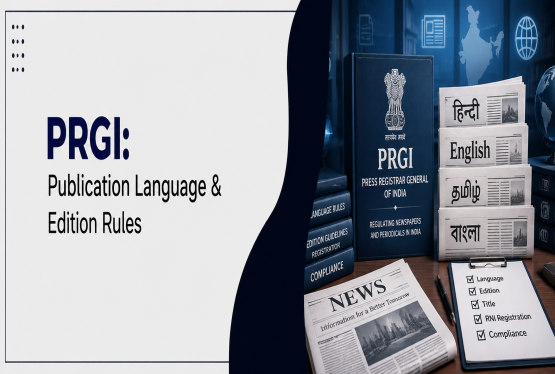




Ownership of a newspaper or periodical is not transferred merely by executing a private sale agreement between the existing owner and the proposed new owner. Since a newspaper is a registered periodical governed by a statutory registration framework, the ownership recorded with the Press Registrar General of India (PRGI) must also be formally changed. The current framework is governed primarily by the Press and Registration of Periodicals Act, 2023 and the Press and Registration of Periodicals Rules, 2024, which replaced the earlier Press and Registration of Books Act, 1867. The new law came into force on 1 March 2024 and introduced an online, substantially paperless registration system through the Press Sewa Portal.
A newspaper owner planning to sell, assign, gift or otherwise transfer the ownership of a registered publication must therefore follow the procedure prescribed under the 2023 Act, the 2024 Rules and subsequent PRGI advisories. The legal consequences are important because the registration certificate identifies the recognised owner of the publication, and an incomplete transfer may result in the official records continuing to show the previous owner.
Meaning of Newspaper, Periodical and Owner under the PRP Act, 2023
Before understanding the transfer procedure, it is important to understand the statutory terminology. Under Section 2(d) of the Press and Registration of Periodicals Act, 2023, a “newspaper” means a periodical consisting of loose-folded sheets, generally printed on newsprint, brought out daily or at least once a week and containing current events, public news or comments on public news. Section 2(g) defines a “periodical” more broadly as a publication, including a newspaper, which is printed and published at regular intervals and contains public news or comments on public news. Books and scientific, technical or academic journals are excluded from this definition. Most importantly for an ownership transfer, Section 2(f) defines an “owner” as an individual, firm or other legal entity owning a periodical. Therefore, ownership may legally vest in an individual as well as a company, society, trust or another eligible legal entity.
Who Can Own a Newspaper in India?
Section 4 of the PRP Act provides the basic eligibility requirement for bringing out a periodical. An Indian citizen or an entity incorporated and registered in India under applicable law may bring out a periodical. However, a person convicted by a court for specified terrorist or unlawful activities, or for acts against the security of the State, is prohibited from bringing out a periodical. The provision becomes relevant during ownership transfer because the proposed transferee must itself be legally eligible to become the owner of the publication. Where the proposed new owner is a company, society, trust or other organisation, its incorporation and constitutional documents, authorised representative and other organisational particulars may become relevant during portal verification. Current PRGI guidance also states that documentary requirements vary depending upon whether the transferor and transferee are individuals or non-individual entities.
Section 9: Main Legal Provision for Newspaper Ownership Transfer
The principal statutory provision governing the transfer is Section 9 of the Press and Registration of Periodicals Act, 2023.
Under Section 9(1), the ownership of every periodical registered under Section 7 must be transferred only in accordance with Section 9. This makes the statutory transfer procedure mandatory for a registered newspaper or periodical.
Section 9(2) provides that the owner must apply to the Press Registrar General for transfer of ownership by furnishing the prescribed documents and particulars and paying the prescribed fee.
Under Section 9(3), the Press Registrar General examines the application. If satisfied that the application is correct and complete, and after considering comments received from the specified authority, the Press Registrar General may permit the transfer. However, the proviso to Section 9(3) also allows the Press Registrar General to refuse permission after giving the concerned party an opportunity of being heard and recording reasons in writing.
Section 9(4) further provides that after permission for transfer has been received, the owner must forward a copy to the publisher, and the publisher must obtain the revised registration certificate in accordance with the statutory registration provisions.
Rule 7 of the Press and Registration of Periodicals Rules, 2024
The operational procedure is prescribed in Rule 7 of the Press and Registration of Periodicals Rules, 2024.
Rule 7(1) provides that where the existing owner intends to transfer ownership of the periodical to another person or entity, the transferee may apply for change of ownership through the Press Sewa Portal with the documents specified on the portal. The prescribed application fee is ?1,000, payable through Bharat Kosh using an available payment mode.
Rule 7(2) requires the application to be endorsed to the specified authority having local jurisdiction over the transferee's principal place of business. The application is transmitted online through the Press Sewa Portal.
The “specified authority” is defined under Section 2(p) of the Act as the District Magistrate, Collector or another officer notified by the State Government or Union Territory Administration.
Verification by the Specified Authority and PRGI
Rule 7(3) provides that the Press Registrar General will verify the ownership-transfer application and obtain comments from the new specified authority within a period of 60 days from receipt of the application by that authority. After considering the application and being satisfied regarding its correctness, PRGI may allow the change in ownership. This verification is important because ownership of a registered publication is a matter of public regulatory record. The authorities can verify the transferor's ownership, identity of the transferee, organisational documents, transfer agreement and related particulars before modifying the registration records.
Show-Cause Opportunity Before Refusal
An ownership-transfer application cannot simply be rejected without procedural safeguards. Under Rule 7(4), where the Press Registrar General, after considering comments of the specified authority and other relevant factors, proposes not to allow the transfer, the owner is informed online of the reasons. The owner is then provided 10 days to submit a written response. After considering that response, Rule 7(5) empowers the Press Registrar General either to permit the transfer and issue written permission through the Press Sewa Portal or to refuse the transfer. If permission is refused, PRGI must issue a reasoned order setting out the grounds for its decision. This requirement reflects the principle of natural justice and gives the owner an opportunity to correct or explain issues before an adverse order is passed.
Current Press Sewa Portal Procedure
The present operational procedure involves participation by both the existing owner and the proposed new owner.
According to the current PRGI guidance, the transferor or existing owner initiates the ownership-transfer request by logging into the Press Sewa Portal and navigating through the registration section to the Ownership Transfer module. The existing owner selects the relevant registered title, enters details of the transferor and proposed transferee, completes the required e-Sign process and submits the transfer request. The request is thereafter forwarded electronically to the transferee for further action. The portal route currently described by PRGI is broadly: Dashboard → Registration → Ownership Transfer → Ownership Transfer Request List → Add New. The new owner must then complete the transferee-side requirements, upload prescribed documents, provide the necessary particulars and complete the applicable payment and authentication process.
Ownership Transfer Agreement
One of the most important documents in the process is the Agreement for Transfer of Ownership.
PRGI issued Advisory No. 04 of 2025 after observing that several applicants were submitting transfer agreements in incorrect formats. The advisory clarified that applicants should use the prescribed standard agreement and that the format applicable to an individual transferor is different from the format applicable to organisations or other non-individual owners. PRGI has subsequently published separate updated agreement formats, including a format for transfer from an individual to another individual or non-individual entity.
The prescribed agreement records the existing ownership, details of the newspaper, its language and periodicity, the effective transfer date, details of the transferee and the consideration for the transfer. Significantly, the PRGI format provides for transfer of the entire right of ownership, including the assets and liabilities associated with the newspaper or periodical, and contains a declaration that the transferor will no longer retain a right, interest or claim in the publication after transfer.
Certificate of Registration and Loss Affidavit
Another important requirement concerns the existing registration certificate. PRGI's March 2025 advisory expressly states that uploading the original Certificate of Registration, or a Loss Affidavit where the original certificate has been lost, is mandatory when applying for ownership transfer. Applications lacking the correct certificate or loss affidavit can therefore face deficiencies or processing delays. Applicants should ensure that the title, registration number, language, periodicity, place of publication and existing owner particulars in supporting documents correspond with the PRGI record.
Revised Certificate After Ownership Transfer
Rule 7(6) distinguishes between a transaction where only ownership changes and one where additional registration particulars are also changing. If the application relates solely to change of ownership, the Press Registrar General issues a revised Certificate of Registration reflecting the new owner. However, where the transaction also involves other changes relating to the periodical, the publisher or new publisher must submit the appropriate registration application within 30 days after receipt of permission for ownership change in accordance with the prescribed registration procedure.
For example, if ownership transfer is accompanied by a change of publisher, language, periodicity, printing press or place of publication, additional revision or registration requirements may arise.
Change of Publisher Is Different from Change of Owner
The owner and publisher are legally separate concepts. Under Section 2(n), the publisher is the person responsible for publishing the periodical, whereas the owner is the person or entity that owns it. A change in ownership therefore does not automatically mean that the publisher has changed. Rule 6(4) specifically provides that where the owner intends to change the publisher, the new publisher must apply for amendment of the registration certificate, and the registration procedure under Rule 5 becomes applicable. Businesses acquiring a newspaper should therefore identify whether the transaction changes only ownership or whether the publisher, editor, printing press, address or other registration particulars will also change.
Change in Shareholding of a Newspaper Company
The Act also deals separately with corporate shareholding changes. Under Section 9(5), where the owner of the periodical is a company, any change in its shareholding pattern must be intimated within 15 days of such change being informed to the Registrar of Companies. Rule 7(7) further requires an authorised person of the company to intimate the Press Registrar General through the Press Sewa Portal about changes in the shareholding pattern, including details of new shareholders and other documents specified on the portal. Therefore, a transfer of shares in the company owning a newspaper should not automatically be treated as the same thing as transfer of the newspaper title itself. The exact transaction structure must be examined separately.
Foreign Investment Considerations
Where the proposed transferee company has foreign investment, additional regulatory scrutiny may arise. Indian print-media businesses dealing with news and current affairs are subject to sector-specific foreign-investment restrictions and Ministry of Information and Broadcasting requirements. Consequently, ownership restructuring involving a non-resident investor should be examined not only under the PRP Act but also under the applicable FDI policy, FEMA framework and MIB permissions, wherever applicable. A newspaper ownership transfer should therefore not be completed merely on the assumption that PRGI approval alone resolves every corporate or foreign-investment issue.
Transfer to Legal Heir on Death of Owner
Transfer following the death of an owner is now handled separately from an ordinary commercial ownership transfer. Current PRGI guidance provides a dedicated “Ownership Transfer to Legal Heir” facility on the Press Sewa Portal. The legal heir can initiate the appropriate application rather than following the normal voluntary transfer route between a living transferor and transferee. PRGI guidance lists documents such as the deceased owner's death certificate, legal heir or survivorship certificate, and in appropriate disputed succession cases, a succession certificate. A No Objection Certificate from other legal heirs may also be required, subject to the treatment of cases supported by a valid Will. The registration certificate or loss affidavit and identity documentation of the legal heir are also relevant.
A significant 2026 update came through PRGI's Advisory No. 15 of 2026, which provides that all titles belonging to a deceased owner may be mapped in a single legal-heir application, making succession-related transfers easier where one deceased proprietor owned multiple registered titles.
Recent Regulatory Updates
The ownership-transfer process has changed substantially since the new law became effective. The PRP Act and Rules came into force from 1 March 2024, replacing the old 1867 regime. PRGI enabled the online ownership-transfer facility on the Press Sewa Portal from 1 November 2024. In March 2025, PRGI issued Advisory No. 04 of 2025 requiring applicants to use the proper ownership-transfer agreement format and emphasising the mandatory submission of the registration certificate or loss affidavit. PRGI subsequently published updated transfer-agreement formats in December 2025, and in July 2026 it introduced or clarified the dedicated legal-heir transfer process and associated documentation. These developments mean that applicants should rely on the current Press Sewa Portal checklist and latest PRGI advisories, rather than older RNI procedures under the repealed Press and Registration of Books Act, 1867.
Consequences of Incorrect Registration Particulars
Ownership records should be updated before the new owner begins operating the periodical on the assumption that the transfer has been recognised. Section 7 requires periodicals to be published in accordance with the Act and requires a valid certificate of registration. Section 11 permits suspension or cancellation in circumstances including false representation, concealment of material facts, failure of continuous publication and false annual-statement particulars. Section 14 also authorises penalties where a periodical is published without the required certificate; the penalty may extend to ?5 lakh, together with a direction to cease publication. Accordingly, parties should ensure that commercial transfer documents and PRGI registration records remain consistent.
Appeal and Legal Remedy
Section 15 establishes the Press and Registration Appellate Board and expressly permits appeals against specified orders, including refusal of registration under Section 7(5), suspension or cancellation under Section 11 and penalties under Section 14. Such appeals are ordinarily required to be filed within 60 days, although delayed appeals may be admitted where sufficient cause is established. Notably, Section 15 does not expressly include a refusal of ownership transfer under Section 9 in its listed appealable orders. Therefore, the legal remedy against a specific ownership-transfer refusal should be examined on the facts of the case rather than assuming that the statutory appeal mechanism automatically applies.
Conclusion
The newspaper ownership transfer process in India is now a structured digital regulatory procedure governed primarily by Section 9 of the Press and Registration of Periodicals Act, 2023 and Rule 7 of the Press and Registration of Periodicals Rules, 2024. A private agreement between the buyer and seller is an important supporting document, but it does not by itself complete the regulatory change of ownership. The existing owner must initiate the appropriate transfer process, the proposed transferee must complete the required formalities through the Press Sewa Portal, the prescribed ?1,000 fee must be paid, and PRGI may seek comments from the competent specified authority before approving the transaction. The correct ownership-transfer agreement, registration certificate or loss affidavit, identity/entity documents and properly matched publication particulars are critical for smooth processing.
Particular care is required where the transaction simultaneously changes the publisher, place of publication or other registration particulars, involves transfer of corporate shareholding, contains foreign investment, or arises because of the death of the existing owner. With the introduction of updated agreement formats and the dedicated legal-heir mechanism in 2026, the regulatory system has become increasingly digital and transaction-specific. Newspaper owners should therefore check the latest PRGI requirements before executing or filing any ownership transfer.
FAQs
Q1. Which law governs newspaper ownership transfer in India?
Ans. Newspaper ownership transfer is presently governed primarily by the Press and Registration of Periodicals Act, 2023, particularly Section 9, read with Rule 7 of the Press and Registration of Periodicals Rules, 2024. The new framework came into force on 1 March 2024.
Q2. Is newspaper ownership transfer still handled by RNI?
Ans. The authority is now known as the Press Registrar General of India (PRGI), formerly the Registrar of Newspapers for India. Applications and related processes are conducted electronically through the Press Sewa Portal.
Q3. What is the government fee for newspaper ownership transfer?
Ans. The prescribed fee currently stated by PRGI for an ownership-transfer application is ?1,000, payable through Bharat Kosh while completing the online application.
Q4. Who initiates the ownership-transfer application?
Ans. Under the present Press Sewa Portal workflow, the existing owner or transferor initiates the request by entering the transferee's details. The new owner thereafter logs into the portal, completes the application, uploads documents, pays the fee, e-signs and submits it.
Q5. Can only one edition of a newspaper be transferred?
Ans. Generally, no. PRGI has clarified that all editions of a registered title are to be transferred together and splitting the ownership of different editions of the same title is not permitted.
Q6. Can ownership be transferred if annual-statement penalties are pending?
Ans. Outstanding penalties should first be cleared. PRGI specifically requires applicable pending penalties relating to the titles and editions to be paid before the ownership-transfer process is initiated.
Q7. Is a private sale agreement enough to transfer newspaper ownership?
Ans. No. A commercial agreement between the buyer and seller does not by itself update the registered ownership with PRGI. Statutory permission and the prescribed Press Sewa Portal procedure under Section 9 and Rule 7 must also be completed.
Q8. What happens if the newspaper owner dies?
Ans. A legal heir may use the separate Ownership Transfer to Legal Heir facility on the Press Sewa Portal. Documents such as the death certificate, legal-heir/succession documents, NOCs where applicable, registration certificate and identity documents are required.
Q9. Is a change in company shareholders considered newspaper ownership transfer?
Ans. Not necessarily. If the registered owner remains the same company, a change in its shareholding is dealt with separately. Section 9(5) requires changes in shareholding pattern to be intimated to PRGI within the prescribed framework, including the statutory fifteen-day requirement linked to intimation to the Registrar of Companies.
Q10. How long does the newspaper ownership-transfer process take?
Ans. The Rules provide for PRGI to obtain comments from the specified authority within 60 days from receipt of the application as part of the verification process. Actual completion may depend on the completeness of documentation, pending compliance issues, responses from authorities and whether any clarification or hearing is required.


_crop10_thumb.jpg)





_for_FY_2025-26_crop10_thumb.jpg)




_learn_crop10_thumb.jpg)


_Filing_Due_Dates_for_FY_2024-25_learn_crop10_thumb.jpeg)





_of_GST_Act_learn_crop10_thumb.jpg)


_Under_GST_learn_crop10_thumb.jpg)


_crop10_thumb.jpg)


_crop10_thumb.jpg)


_learn_crop10_thumb.jpg)


_of_the_Income_Tax_Act_learn_crop10_thumb.jpg)


_learn_crop10_thumb.jpg)



_learn_crop10_thumb.jpg)


_crop10_thumb.jpg)





_in_The_Income_Tax_Act,_1961_learn_crop10_thumb.jpg)


_learn_crop10_thumb.jpg)


_of_the_Income_Tax_Act_learn_crop10_thumb.jpg)

_Of_Income_Tax_Act_learn_crop10_thumb.jpg)


_learn_crop10_thumb.jpg)


_learn_crop10_thumb.jpg)
_crop10_thumb.jpg)




_learn_crop10_thumb.jpg)
_for_Import_and_Export_learn_crop10_thumb.jpg)




















_crop10_thumb.jpg)