


Silver jewellery and artefacts are widely purchased in India for personal use, gifting, religious ceremonies, and traditional occasions. However, the appearance of a silver article does not reveal its actual silver content. Two products can look similar while containing different proportions of silver, making purity identification important for buyers and businesses.
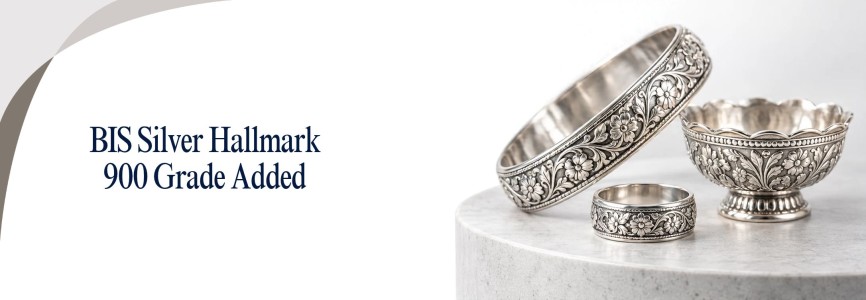
The Bureau of Indian Standards (BIS) has expanded the current silver hallmarking by including the 900 purity grade. The recognised grades now comprise 800, 835, 900, 925, 958, 970, 990, and 999. The change is reflected in IS 2112:2025, read with Amendment No. 1 published in October 2026. Understanding this update helps consumers interpret the BIS Hallmark correctly and enables jewellers to describe their products accurately.
What Is Silver Hallmarking?
Silver hallmarking is the process of determining and officially recording the silver content of an article against the applicable standard. It provides an independent basis for assessing the declared fineness of silver jewellery and artefacts. A customer purchasing a silver ornament should be able to understand the purity being represented.
Hallmarking supports this by connecting the declared grade with the prescribed testing and marking process. For example, an article offered as 925 silver represents a different silver proportion from one offered as 900 silver. The purpose of hallmarking is to establish conformity with the declared grade, rather than suggest that every silver product must have the highest possible purity.
What Is the BIS Hallmark on Silver?
The BIS Hallmark is the official marking applied under the BIS hallmarking scheme after an article satisfies the applicable requirements. For silver jewellery and artefacts under the HUID-based system, the Hallmark License comprises the BIS Standard Mark with the word “SILVER,” the purity grade, and the Hallmarking Unique Identification code.
These components serve different purposes. The BIS Standard Mark identifies participation in the hallmarking scheme, the purity grade states the fineness, and the HUID supports digital verification. A standalone number such as “900” or “925” should not be confused with the complete BIS Hallmark. A numerical stamp can represent a seller’s purity claim, but buyers should examine the full marking and verify the associated details.
What Has Changed with the Addition of 900 Grade?
The latest amendment includes 900 fineness, representing 90% silver purity, within the current silver hallmarking standard. This expands the recognised range from seven grades to eight. The 900 grade is not being recognised for the first time in India. It appeared in the earlier IS 2112:2014 standard. However, the original IS 2112:2025 revision listed seven grades without 900.
The October 2026 amendment therefore restores 900 within the current. This distinction explains why older documents can show different grade lists. A reference to six, seven, or eight grades may relate to a different version of the standard. For businesses, the practical requirement is to use the current amended standard when planning testing, product descriptions, and customer information.
Eight Recognised Silver Purity Grades
Silver fineness is expressed in parts per thousand. A grade of 900 indicates 900 parts of silver in every thousand parts of the relevant alloy. Dividing the fineness number by ten gives the equivalent percentage.
|
Silver purity grade |
Equivalent silver content |
|
800 |
80% |
|
835 |
83.5% |
|
900 |
90% |
|
925 |
92.5% |
|
958 |
95.8% |
|
970 |
97% |
|
990 |
99% |
|
999 |
99.9% |
The table helps buyers understand what each grade represents. It should not be treated as a ranking of every aspect of a finished product. Design, workmanship, construction, and intended use also influence a purchasing decision. A recognised lower grade is not automatically fake silver. The relevant issue is whether the actual article meets the fineness claimed for it.
What Does 900 Silver Purity Mean?
A homogeneous 900-grade silver alloy contains 90% silver, with the remaining proportion consisting of other alloying materials. As a simplified example, 100 grams of such an alloy corresponds to 90 grams of silver. This illustrates the relationship between fineness and silver content.
However, buyers should not apply that calculation automatically to the gross weight of finished jewellery. An ornament may include stones, decorative fittings, or other non-silver components. The relevant precious-metal weight must be understood separately. The BIS Hallmark on a 900-grade article identifies the declared fineness under the scheme. It does not mean the article is 99.9% silver or that every component included in its gross weight is silver.
Difference Between 900 and 925 Silver
The main difference is the proportion of silver in the respective alloys. A 900-grade alloy contains 90% silver, while a 925-grade alloy contains 92.5%. For equal weights of homogeneous alloy, 925 silver therefore contains more silver. For instance, 100 grams of 925 alloy corresponds to 92.5 grams of silver, compared with 90 grams in 100 grams of 900 alloy.
Nevertheless, this difference does not independently establish the final retail price. A detailed 900-grade artefact can involve more workmanship than a simpler 925-grade item. Consumers should compare equivalent weights, purity, construction, and charges. Looking only at the purity number or displayed price can produce an incomplete comparison.
Why the Update Matters for Manufacturers
The restored grade gives manufacturers another recognised fineness option within the current standard. Businesses can assess whether 900-grade production suits their intended designs and customers. Recognition does not remove the need for testing. An article described as 900 must satisfy the applicable requirements before receiving the BIS Hallmark for that grade.
Manufacturers should maintain consistent specifications across procurement, alloy preparation, production, and submission for hallmarking. A mismatch at any stage can create difficulties during assessment or customer delivery. Before committing to production schedules, businesses should confirm the relevant submission and testing arrangements with a BIS-recognised Assaying and Hallmarking Centre.
What Jewellers and Retailers Should Update
Jewellers should review product labels, catalogues, online listings, sales presentations, and internal training material. Information stating that the current standard recognises only seven grades may require correction. The declared purity should remain consistent across the entire sale. A product should not be described as 900 in the inventory record and 925 on its website listing.
Staff should also understand how to explain the BIS Hallmark, the fineness number, and HUID verification. Clear explanations reduce the possibility of customers assuming that all hallmarked silver has the same purity. The amendment does not automatically change existing stock. Each article should continue to be described according to its actual fineness and hallmarking status.
Role of Assaying and Hallmarking Centres
BIS-recognised Assaying and Hallmarking Centres assess articles submitted under the hallmarking scheme. Their role concerns testing and applying the prescribed marking to conforming articles. Jeweller registration and article hallmarking are separate matters. Registration of the business does not mean every item in its inventory automatically carries the BIS Hallmark.
Businesses should maintain a clear link between articles submitted, the declared grade, assessment records, and the products subsequently offered for sale. Consumers should likewise examine the article itself rather than rely only on the seller’s registration certificate displayed at the premises.
HUID and Digital Verification of Silver Articles
HUID stands for Hallmarking Unique Identification. It is a six-character alphanumeric code associated with a hallmarked article under the digital system. Consumers can use the Verify HUID feature in the BIS Care app to check recorded details. These can include purity, article type, the submitting jeweller, and the Assaying and Hallmarking Centre.
Verification is most useful when the customer compares the retrieved information with the actual product. A displayed record should correspond with the article being purchased. If the information appears inconsistent, the buyer should seek clarification before completing the transaction. A verbal explanation should not replace resolution of a material discrepancy.
Is Silver Hallmarking Mandatory?
The addition of 900 grade does not itself make hallmarking compulsory for every silver article. Under the reviewed, the silver hallmarking scheme remains voluntary. However, an article submitted for hallmarking under the BIS scheme must carry the prescribed HUID-based hallmark. Businesses participating in the scheme must therefore meet its applicable requirements.
This distinction is important when discussing the update. Expansion of recognised grades should not be described as a blanket compulsory-hallmarking order. A hallmarked article and an article falsely represented as BIS hallmarked are also different situations. Customers should establish exactly what the seller is claiming.
Does the BIS Hallmark Determine the Selling Price?
The BIS Hallmark concerns conformity with the declared purity or fineness. It does not prescribe the complete retail selling price. The amount charged can include the relevant silver value, making charges, additional components, taxes, and other disclosed costs. Design and workmanship can produce price differences between items of the same fineness.
Hallmarking also does not guarantee a fixed resale value. Exchange and buyback prices depend on the transaction terms and other relevant commercial factors. Consumers should ask for a clear price breakdown and understand the seller’s exchange policy before purchasing.
What Should Consumers Check Before Buying?
Buyers should begin by understanding the declared purity and relevant weight. They should inspect the complete BIS Hallmark and verify the HUID where applicable. The invoice should clearly identify the purchase and its relevant particulars. Keeping the invoice and payment record can help if a question later arises about the product or transaction.
Consumers should compare similar products on equivalent terms. A lower price can reflect lower silver content, different weight, simpler workmanship, or different charges. They should also avoid assuming that a higher fineness number automatically makes an article suitable for every purpose. The product’s intended use and construction remain relevant.
Common Misunderstandings About Silver Hallmarking
One common misunderstanding is that every silver-coloured article contains substantial silver. Appearance alone cannot establish composition. Another is that all silver carrying the BIS Hallmark has identical purity. The hallmarking recognises different fineness grades, and the number must be read carefully.
Buyers sometimes treat a “925” or “900” stamp as the complete hallmark. The full marking and HUID verification provide a stronger basis for checking the claim. Finally, the inclusion of a grade should not be interpreted as automatic approval of all products bearing that number. Conformity depends on the applicable assessment and marking process.
Conclusion
The inclusion of the 900 purity grade expands India’s current silver hallmarking to eight recognised grades, providing another standardised option for silver jewellery and artefacts. Representing 90% silver content, the restored grade helps manufacturers specify their products accurately and enables buyers to understand differences in fineness. However, the purity number alone does not establish that an article is BIS hallmarked. Consumers should examine the complete BIS Hallmark and verify its associated HUID before purchasing.
For manufacturers and retailers, the update requires consistent product specifications, appropriate testing arrangements, accurate inventory descriptions, and clear customer communication. Buyers should consider purity alongside precious-metal weight, workmanship, additional charges, and exchange conditions. Hallmarking supports purity assurance but does not guarantee a fixed selling or resale price. Understanding these distinctions can reduce confusion, encourage transparent transactions, and strengthen consumer confidence in India’s silver market, while helping businesses align their practices with the amended standard’s applicable requirements.
Need Help with BIS Hallmarking for Silver Jewellery?
Planning to sell silver jewellery or artefacts, including the 900 purity grade? Compliance Calendar LLP can help you understand applicable BIS Hallmark requirements, jeweller registration, documentation, and HUID verification. Our team can guide you through the registration process and help you prepare the necessary documents.
Get in touch with Compliance Calendar LLP today!
-
Call/WhatsApp: +91 9988424211
-
Email: info@ccoffice.in
Frequently Asked Questions (FAQ’s)
Q1. What is the latest update to silver hallmarking?
Ans. The current silver hallmarking includes the 900 purity grade under IS 2112:2025, read with its October 2026 amendment. The recognised range now comprises eight grades.
Q2. What does 900 purity mean in silver?
Ans. The 900 grade represents 900 parts of silver per thousand, equivalent to 90% silver content in the relevant alloy. It should not be confused with 99.9% purity.
Q3. What are the eight recognised silver purity grades?
Ans. The recognised grades are 800, 835, 900, 925, 958, 970, 990, and 999. Their equivalent silver content ranges from 80% to 99.9%.
Q4. Is 900 silver being recognised for the first time?
Ans. No. The 900 grade appeared in IS 2112:2014 but was absent from the original 2025 revision. The latest amendment restores it within the current.
Q5. What is the difference between 900 and 925 silver?
Ans. A 900-grade alloy contains 90% silver, while a 925-grade alloy contains 92.5%. The final product price also depends on weight, workmanship, additional materials, and other charges.
Q6. What does the BIS Hallmark on silver contain?
Ans. Under the HUID-based system, it comprises the BIS Standard Mark with the word “SILVER,” the purity grade, and a six-character alphanumeric HUID. A standalone purity stamp is not the complete hallmark.
Q7. How can consumers verify hallmarked silver?
Ans. Consumers can enter the article’s HUID in the Verify HUID feature of the BIS Care app. The retrieved information should correspond with the article being purchased.
Q8. Does the addition of 900 make silver hallmarking compulsory?
Ans. No. Adding a purity grade does not itself make hallmarking compulsory for all silver articles. However, articles hallmarked under the BIS scheme must meet the prescribed marking requirements.
Q9. Does the BIS Hallmark guarantee a fixed resale value?
Ans. No. The BIS Hallmark concerns purity assurance. Resale or exchange value depends on factors such as relevant silver weight, prevailing prices, deductions, and the buyer’s commercial terms.
Q10. What should jewellers do following this update?
Ans. Jewellers should review product descriptions, inventory records, website information, and staff guidance. They should also confirm applicable testing arrangements with a BIS-recognised Assaying and Hallmarking Centre.
Article last updated on : 22 Oct 2026.














_learn_crop10_thumb.jpg)