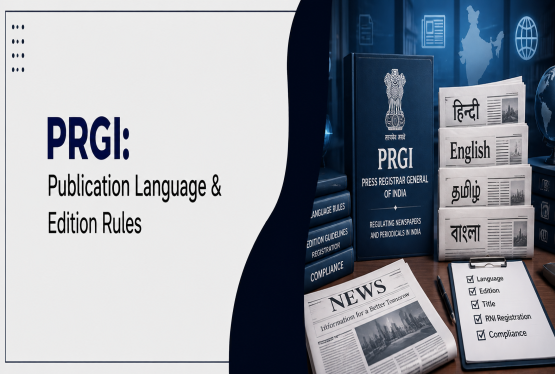



If you are planning to start a newspaper, magazine, or other publication containing public news or comments on public news in India, registration with the Press Registrar General of India (PRGI) is an important legal requirement. Many people still commonly use the term RNI Registration because the office was earlier known as the Registrar of Newspapers for India (RNI). However, after the Press and Registration of Periodicals Act, 2023 (PRP Act) came into force on 1 March 2024, the office is now known as the Press Registrar General of India (PRGI). The new law replaced the earlier Press and Registration of Books Act, 1867.
The registration process has also been changed. Under the new system, the process is primarily handled online through the Press Sewa Portal. A periodical cannot simply be printed and published without completing the applicable registration process. PRGI states that a periodical should be registered before it is printed or published in India. This article explains the PRGI/RNI registration process in simple language, including title selection, eligibility, documents, application process, printing press requirements, fees, publication requirements, common title issues and post-registration compliance.
What is PRGI Registration?
PRGI registration is the registration process for a periodical that falls within the scope of the Press and Registration of Periodicals Act, 2023. Under the Act, a periodical includes a publication, including a newspaper, which is printed and published at regular intervals and contains public news or comments on public news. Books and journals, including scientific, technical and academic journals, are excluded from this definition.
Therefore, depending on the nature of the publication, PRGI registration may be relevant for:
-
Newspapers
-
News periodicals
-
Publications containing public news
-
Publications containing comments on public news
-
Other periodicals falling within the definition of the Act
The exact applicability should be checked according to the nature and content of the proposed publication.
RNI vs PRGI – What is the Difference?
Many applicants still search online for “RNI Registration”. Earlier, newspaper registration was handled by the Registrar of Newspapers for India (RNI) under the Press and Registration of Books Act, 1867.
However, the Press and Registration of Periodicals Act, 2023 came into force on 1 March 2024. It replaced the old legislation and changed the name of the authority from RNI to Press Registrar General of India (PRGI).
So, in simple terms:
RNI Registration = commonly used old term
PRGI Registration = current terminology
Therefore, people looking to register a new newspaper or eligible periodical should now follow the current PRGI/Press Sewa Portal process.
Who Can Apply for PRGI Registration?
The PRGI allows eligible Indian citizens and entities registered in India to bring out periodicals, subject to the applicable conditions. PRGI states that any citizen of India or a person/entity registered in India under applicable law can bring out a periodical, provided the person/entity satisfies the statutory eligibility conditions.
The ownership structure may include:
-
Individual Ownership: An individual can own and publish an eligible periodical, subject to the applicable requirements.
-
Company: A company can own a periodical and appoint a publisher.
-
LLP or Partnership Firm: An eligible LLP or partnership firm may also be involved in ownership of a periodical, subject to applicable requirements.
-
Trust, Association or Organisation: Eligible organisations may also apply under the applicable ownership category.
The exact documents required will depend on the ownership structure.
What is a Periodical?
Before starting the registration process, it is important to understand what PRGI considers a periodical.
A periodical is generally a publication that:
-
Is printed and published at regular intervals; and
-
Contains public news or comments on public news.
It can include a newspaper or other publication covered by the statutory definition. However, books and journals of scientific, technical and academic nature are excluded from the definition.
Therefore, the applicant should first determine whether the proposed publication falls within the PRGI.
Title Selection is Very Important
One of the most important steps in PRGI registration is selecting a suitable title. The proposed title should be unique and should comply with the Guidelines for Admissibility of Titles for Registration of Periodicals.
The current title guidelines were issued by PRGI under the Press and Registration of Periodicals Act, 2023. The guidelines state that proposed titles should preferably contain more than one word formed by combining distinct and meaningful terms. Generic or root-word titles are not intended to be registered.
For example, applicants should be careful with titles consisting only of a generic word such as:
-
Manthan
-
Darpan
-
Inspire
-
Success
-
Khulasa
-
Rahasya
-
Katha
-
Herald
The current guidelines specifically give examples of generic/root words that may not be accepted as titles.
Title Should Be Unique
The proposed title should not be the same as or confusingly similar to an existing registered title. PRGI's guidelines consider both visual and phonetic similarity. This means that simply changing spelling may not necessarily make a title acceptable if it sounds or appears similar to an existing title.
Therefore, before submitting a title, applicants should search the existing registered titles on the PRGI website. PRGI maintains a database where registered titles can be searched by title, language, state, district and other details.
Why Title Research is Important
A common mistake is to select a title only because it sounds attractive. However, PRGI title approval is based on regulatory guidelines and availability. For example, adding a common word such as:
-
News
-
Today
-
Express
-
Times
-
Daily
-
Bulletin
to an existing title may not automatically make the new title sufficiently different. The title guidelines specifically contain restrictions concerning titles formed by adding or removing common words and other generic terms from existing titles. Therefore, applicants should prepare multiple title options and check them carefully before filing.
Current PRGI Registration Process
Under the new PRP Act, the old separate title verification and registration procedures have been replaced by a single online periodical registration process through the Press Sewa Portal.
The basic process is as follows.
Step 1: Create Owner Profile
The owner first creates a profile on the Press Sewa Portal. The owner provides the required information and creates login credentials. If the owner already has registered titles, the existing titles may also need to be mapped in the portal.
Step 2: Enter Proposed Title Details
The owner provides details such as:
-
Proposed title
-
Language
-
Periodicity
-
Proposed place of publication
The applicant must follow the applicable PRGI title guidelines while selecting title options.
Step 3: Appoint the Publisher
The owner appoints the publisher through the Press Sewa Portal. The owner provides the publisher's required contact details. If the owner and publisher are the same person, the appropriate option can be selected on the portal. The publisher then creates or uses the relevant portal profile and proceeds with the registration application.
Step 4: Publisher Completes the Application
The publisher completes the registration application by providing the required information and documents. The application may include details relating to:
-
Owner
-
Publisher
-
Proposed title
-
Language
-
Periodicity
-
Place of publication
-
Printing press
-
Other required information
The information entered in the application should match the supporting documents exactly. PRGI specifically instructs applicants to ensure that the information matches the uploaded documents.
Step 5: Printing Press Details
The printing press is an important part of the registration process. The publisher needs to designate the relevant printer/printing press through the portal. PRGI states that the selected printing press should already have an account on the Press Sewa Portal. If it does not, the owner or keeper of the printing press should create an account. The printer also has a separate role on the portal and may need to accept or reject the publisher's request to be appointed as printer.
Step 6: Upload Documents
The applicant needs to upload the applicable supporting documents. The documents vary according to the ownership structure. For an individual ownership, documents may include:
-
Proof of date of birth
-
Photo identity proof
-
Eligibility and Content Affidavit
-
Other applicable documents
For non-individual ownership such as a company, association, trust or partnership firm, documents may include:
-
Incorporation/registration document
-
PAN of the organisation/company
-
Proof of date of birth of relevant persons
-
Identity proof of owner/publisher/editor/printer/keeper
-
Authorisation letter
-
Shareholding pattern, where the owner is a company
-
Eligibility and Content Affidavit
-
GST certificate, if available
-
FDI-related documents, if applicable
PRGI has published a detailed document list for new periodical registration.
Eligibility and Content Affidavit
The Eligibility and Content Affidavit is an important document in the registration process.
The affidavit contains information relating to:
-
Owner/publisher
-
Proposed title
-
Statutory declarations
-
Nature/content of the periodical
PRGI states that the affidavit should be printed on stamp paper and notarised by a Notary Public for submission. Therefore, applicants should ensure that the affidavit is properly prepared and executed before uploading it.
Step 7: Payment of Processing Fee
The current PRGI process requires payment of a Rs.1,000 processing fee through the prescribed online payment process/BharatKosh. The payment should be completed as part of the online application process. Applicants should keep the payment details and acknowledgement safely for future reference.
Step 8: Application Reference Number
After successful submission, the Press Sewa Portal generates an acknowledgement along with a unique 10-digit Applicant Reference Number (ARN). This ARN is important because it can be used for future correspondence and reference relating to the application. Applicants should therefore maintain the ARN and other application details carefully.
Step 9: Application Review
After submission, the application goes through the applicable review process. PRGI examines the title and other application details. The application may also be sent to the Specified Authority of the concerned State Government/Union Territory for the applicable process. The Specified Authority can be a District Magistrate, Collector or another officer notified by the State Government/UT Administration.
Step 10: Queries and Clarifications
During processing, PRGI or the concerned authority may raise a query or request additional information. For example, a query may relate to:
-
Identity proof
-
Publisher details
-
Address proof
-
Printing press details
-
Affidavit
-
Title similarity
-
Place of publication
-
Other supporting documents
The applicant should carefully read the remark and submit the required clarification within the prescribed time. PRGI's current process provides a mechanism for publishers to respond to complications through the Press Sewa Portal.
Certificate of Registration
If the title and application satisfy the applicable requirements and there are no unresolved deficiencies, PRGI may issue the Certificate of Registration. The certificate is the formal registration of the periodical under the applicable law. After receiving the certificate, the publisher must comply with the applicable publication requirements.
When Can Publication Start?
A periodical should not be printed or published in India without the required registration. PRGI states that a periodical shall be printed or published only in accordance with the PRP Act, 2023. After receiving the certificate of registration, the publisher should commence publication within the applicable period.
PRGI states that if publication does not commence within 12 months from the end of the month in which the certificate was issued, the Press Registrar General may cancel the certificate, subject to the applicable law.
Annual Compliance After Registration
PRGI registration is not the end of the process. The publisher has continuing statutory responsibilities. One important requirement is filing the annual statement within the prescribed period.
PRGI has issued advisories concerning cancellation of registration due to non-compliance with annual statement filing requirements. Therefore, publishers should maintain proper records and ensure that applicable annual filings are completed on time.
Common Reasons for PRGI Queries or Rejection
Applicants should take care while preparing the application because mistakes can result in queries or rejection.
Common issues may include:
-
Similar Title: The proposed title may be visually or phonetically similar to an existing title.
-
Generic Title: A single generic or root word may not satisfy the current title guidelines.
-
Incorrect Information: Information in the application may not match the supporting documents.
-
Incomplete Documents: Required documents may be missing or unclear.
-
Identity Proof Issue: The identity document may not clearly establish the identity of the concerned person.
-
Printing Press Issue: The printing press may not have completed the required portal registration or may not have accepted the publisher's request.
-
Affidavit Issue: The affidavit may not be properly executed, stamped or notarised.
-
Address Mismatch: The place of publication or address information may not match the documents submitted.
-
Title Guideline Violation: The proposed title may contain words or combinations that are not acceptable under the applicable PRGI guidelines.
How to Select a PRGI Title?
Applicants should not select a title only on the basis of branding or personal preference.
A practical approach is to:
-
Decide the language of publication.
-
Decide the proposed place of publication.
-
Decide the periodicity.
-
Search existing registered titles.
-
Check for similar titles.
-
Avoid generic/root-word titles.
-
Avoid titles that are visually or phonetically similar.
-
Prepare multiple meaningful title options.
-
Review the current PRGI title guidelines.
-
Submit the application through the Press Sewa Portal.
PRGI's current guidelines specifically recommend that applicants check the list of existing registered titles before proposing a new title.
How Long Does PRGI Registration Take?
There is no universal guaranteed timeline for every PRGI registration application.
The processing time can depend on:
-
Completeness of the application
-
Title availability
-
Documents
-
Printing press details
-
State-level verification
-
Queries or clarifications
-
Applicant response time
-
PRGI processing
-
Other regulatory factors
Therefore, applicants should avoid promising a fixed approval date.
A properly prepared application with complete and consistent documents can help reduce avoidable delays, but final processing remains subject to the concerned authorities.
Important Point About Title Verification
Under the old RNI system, applicants commonly understood the process as two separate stages:
Title Verification → Registration
Under the current PRP Act, these separate processes have been replaced by a single online registration process through the Press Sewa Portal. This is an important change that applicants should understand when searching for information about “RNI registration” online. Older articles may still describe the previous procedure, so applicants should rely on the current PRGI portal, Act, Rules and guidelines.
Conclusion
PRGI registration is an important legal and regulatory process for anyone planning to publish a newspaper or eligible periodical containing public news or comments on public news in India. Although people commonly continue to use the term RNI Registration, the current authority is the Press Registrar General of India (PRGI), and the applicable framework is the Press and Registration of Periodicals Act, 2023. The registration process is now primarily online through the Press Sewa Portal. The applicant needs to create the owner profile, provide title and publication details, appoint the publisher, complete the registration application, provide the required documents, designate the printing press, pay the applicable processing fee and respond to any queries raised during processing.
One of the most important parts of the process is selecting a suitable title. The title should comply with the current PRGI guidelines and should not be the same as or confusingly similar to an existing registered title. Applicants should also avoid relying on old RNI information because the legal framework and registration procedure have changed after the PRP Act, 2023 came into force. After registration, the publisher must continue to follow applicable publication and compliance requirements, including the required annual filings. In simple words, PRGI registration is not only about getting approval for a newspaper or periodical title. It is a complete regulatory process that establishes the legal registration of the publication and creates continuing responsibilities for the owner and publisher. Therefore, applicants should carefully select the title, prepare accurate documents, follow the current Press Sewa Portal process and keep track of all post-registration compliance requirements.












_learn_crop10_thumb.jpg)