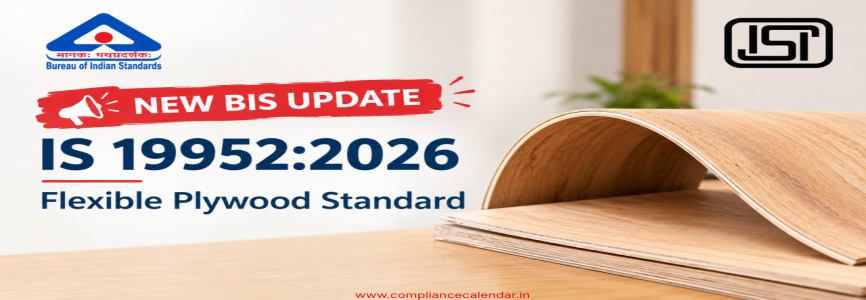



The Bureau of Indian Standards (BIS) has introduced a new Indian Standard, IS 19952:2026, for flexible plywood. The standard was announced in October 2026 and aims to improve the quality of plywood used in curved furniture, wall panels, cabinets, and interior decoration. Unlike normal plywood, flexible plywood can bend into different shapes without breaking easily. The new BIS standard explains the quality requirements manufacturers should follow, including the strength of the glue, resistance to moisture, and limits on harmful chemical emissions.
This update is important for plywood manufacturers, furniture makers, suppliers, and interior designers across India.
What Is the New BIS Standard IS 19952:2026?
IS 19952:2026 is a new Indian Standard introduced by BIS for flexible plywood. In simple words, it tells manufacturers what quality their flexible plywood should meet. Flexible plywood is different from regular plywood because it can bend and take curved shapes. It is commonly used to make rounded cabinets, curved reception desks, decorative wall panels, and modern furniture. However, if the plywood is not made properly, it may crack, lose its shape, or separate into layers. The new BIS flexible plywood standard provides common quality requirements to help manufacturers make better products and help buyers understand what they are purchasing.
Key Details of the BIS October 2026 Update
|
Particular |
Details |
|
Government Authority |
Bureau of Indian Standards (BIS) |
|
Standard Number |
IS 19952:2026 |
|
Standard Name |
Flexible Plywood – Specification |
|
Announcement |
October 2026 |
|
Main Purpose |
Improve flexible plywood quality |
|
Important Requirements |
Glue strength, moisture resistance and formaldehyde emissions |
|
Affected Businesses |
Plywood manufacturers, suppliers, furniture makers and interior designers |
|
BIS Certification |
Not automatically mandatory merely because the standard was introduced |
Why Has BIS Introduced a New Standard for Flexible Plywood?
Flexible plywood is becoming popular in homes, offices, hotels, shops, and other buildings because it allows furniture makers to create curved designs. For example, you may have seen a rounded reception counter in a hotel or a curved wooden wall behind a television. These designs are often made using flexible plywood. However, the quality of plywood available in the market may differ from one manufacturer to another. Some sheets bend easily, while others may crack or develop problems after installation. BIS introduced IS 19952:2026 to provide common quality requirements for this type of plywood.
The new standard helps manufacturers check whether the plywood layers are properly joined, whether the material has suitable bonding strength, and whether it meets the required limits for formaldehyde emissions. It also gives buyers a clearer way to discuss product quality with suppliers. The main purpose is to make flexible plywood more reliable for the uses it is designed for.
What Are the Main Requirements Under IS 19952:2026?
The new BIS standard for flexible plywood focuses on the quality of the materials used and the performance of the finished plywood. Since flexible plywood is used to make curved shapes, its layers must stay firmly joined together. It should also meet the requirements for its grade and intended use. The standard includes different glue bond strength grades and limits for formaldehyde emissions.
|
Quality Requirement |
Meaning in Simple English |
|
Glue Bond Strength |
The glue holding the plywood layers together should be strong enough |
|
Moisture Resistance |
The plywood should meet the water-resistance requirements of its grade |
|
Surface Quality |
The plywood should meet the applicable quality requirements |
|
Formaldehyde Emissions |
The release of formaldehyde must remain within the specified limits |
|
Bonding Grades |
Plywood is classified according to the strength and water resistance of its bonding |
Glue Bond Strength
Plywood is made by joining thin layers of wood using glue. In flexible plywood, these layers need to stay together when the sheet is bent into a curved shape. If the glue is weak, the layers may start separating, and the plywood may become unsuitable for use. The new BIS standard includes requirements for glue bond strength so that manufacturers can check the quality of the bonding between the layers.
Moisture Resistance
Some plywood products are used in dry rooms, while others may be exposed to moisture. For example, a decorative wall panel in a bedroom is usually exposed to less moisture than a cabinet installed near a kitchen sink. The new standard includes different bonding grades based on moisture and water resistance. Manufacturers should make sure their plywood meets the requirements of the grade they claim.
Surface Quality
Flexible plywood is often used for furniture and decoration, where appearance matters. If the surface has unwanted defects, the final furniture may not look good after painting, polishing, or applying laminate. Manufacturers should check the applicable product requirements and make sure the plywood is suitable for its intended use.
Formaldehyde Emission Limits
Formaldehyde is a chemical that can be released from some glues used in plywood manufacturing. High exposure to formaldehyde can affect human health, which is why emissions are important for wood products used indoors. IS 19952:2026 includes formaldehyde emission limits. Manufacturers should check the exact limits and testing requirements in the official standard.
What Types of Flexible Plywood Are Covered?
IS 19952:2026 includes different glue bond strength grades for flexible plywood. These grades help manufacturers and buyers understand how well the plywood bonding is expected to perform when exposed to moisture or water. The three classifications mentioned in the official government announcement are moisture-resistant (MR), boiling-water-resistant (BWR), and boiling-water-proof (BWP). Choosing the correct grade matters because not every plywood sheet is suitable for the same conditions.
|
Flexible Plywood Grade |
Full Form |
Simple Explanation |
Common Uses |
|
MR Grade |
Moisture Resistant |
Suitable for applications with limited moisture exposure |
Bedroom cabinets, decorative panels and indoor furniture |
|
BWR Grade |
Boiling Water Resistant |
Has stronger water-resistant bonding than MR grade |
Kitchen furniture and interior areas with occasional moisture |
|
BWP Grade |
Boiling Water Proof |
Has bonding designed to meet higher water-resistance requirements |
Applications requiring stronger water-resistant bonding |
For example, a furniture maker building a curved cupboard for a bedroom may choose a different grade from someone making curved furniture for an area exposed to more moisture. However, even BWP-grade plywood should not automatically be considered suitable for permanent contact with water. Buyers should check the product's actual specifications before purchasing it.
Who Will Be Affected by the New BIS Flexible Plywood Standard?
The new BIS standard is useful for businesses that manufacture, sell, or use flexible plywood. Manufacturers can use it to understand the quality requirements their products should meet. Furniture makers and interior designers can use it when choosing plywood for curved designs. Suppliers can also use the standard to explain product quality to their customers. Although the standard is mainly technical, it can help different businesses make better decisions about the materials they buy and sell.
The businesses most likely to find this update useful include:
-
Plywood manufacturers: Businesses producing flexible plywood sheets.
-
Furniture manufacturers: Companies making curved tables, cabinets, counters, and other furniture.
-
Plywood suppliers: Businesses selling flexible plywood to furniture makers and contractors.
-
Interior designers: Professionals designing curved walls, decorative panels, and furniture.
-
Architects and contractors: Professionals selecting building and interior materials.
Is BIS Certification Mandatory for Flexible Plywood Under IS 19952:2026?
One common question is whether manufacturers must immediately obtain BIS certification for flexible plywood after the introduction of IS 19952:2026. The answer is that introducing a new Indian Standard does not automatically make BIS certification compulsory. BIS develops standards to explain the quality and safety requirements for different products. However, certification becomes mandatory when an applicable law or government order requires it.
For example, the government may issue a Quality Control Order (QCO) requiring certain products to meet a particular Indian Standard and obtain BIS certification. A QCO is simply a government order that makes specified quality requirements compulsory for the products it covers. Manufacturers should check whether any such order applies to their flexible plywood before deciding what certification they need.
Businesses should also understand that following a BIS standard and using the ISI Mark are not the same thing. A manufacturer cannot place the ISI Mark on its product simply because it claims to follow IS 19952:2026. The mark can only be used when the manufacturer has the required BIS licence.
How Can Flexible Plywood Manufacturers Prepare for IS 19952:2026?
Manufacturers should begin by understanding what the new standard requires. They can obtain the official document, check their existing products, and compare their manufacturing methods with the quality requirements. This does not mean every manufacturer must immediately change its entire production process. The first step is to find out whether the current product already meets the relevant requirements and whether any improvements are needed.
Here are some practical steps manufacturers can follow:
-
Get the official standard: Obtain IS 19952:2026 through BIS.
-
Check your products: Identify which flexible plywood products are covered.
-
Review the glue and raw materials: Check whether the materials are suitable for the required bonding grade.
-
Arrange product testing: Check the applicable tests for bonding, emissions, and other specified properties.
-
Compare the results: Find out whether the products meet the standard.
-
Check BIS certification rules: Confirm whether certification is legally required.
-
Keep proper records: Maintain relevant product details and test reports.
These steps can help manufacturers understand the new requirements and prepare their products without unnecessary confusion.
What Is the Difference Between a BIS Standard and BIS Certification?
Many people think that a BIS standard, BIS registration, and BIS certification all mean the same thing. However, there are important differences. A BIS standard is a document explaining how a product should be made or tested. BIS certification is a separate process in which a product or manufacturer is assessed under an applicable certification scheme. The ISI Mark is a mark that can be used on products covered by a valid BIS licence.
|
Term |
Meaning |
|
BIS Standard |
A document explaining product quality and testing requirements |
|
BIS Certification |
Official assessment and certification under a BIS scheme |
|
A mark used on products under the relevant BIS licence |
|
|
Quality Control Order (QCO) |
A government order that can make certification compulsory for specified products |
For flexible plywood manufacturers, the important point is that IS 19952:2026 is a product standard. Whether BIS certification is mandatory must be checked separately.
How Will IS 19952:2026 Help the Plywood and Furniture Industry?
The new BIS flexible plywood standard can help manufacturers improve the consistency of their products. When businesses follow common quality requirements, it becomes easier for buyers to compare products from different suppliers. Furniture manufacturers can also ask for plywood that meets particular specifications instead of depending only on general claims about quality.
For example, a company making curved reception desks may purchase flexible plywood from several suppliers. Without a common standard, comparing the quality of these products can be difficult. IS 19952:2026 provides a recognised reference that can help the company discuss bonding grades and other product requirements with suppliers. It can also encourage manufacturers to pay closer attention to the materials and production methods they use.
How Compliance Calendar Can Help with BIS Certification
Understanding a new BIS standard can be difficult, especially for small manufacturers who are not familiar with technical requirements, testing procedures, or certification rules. Compliance Calendar helps businesses understand BIS-related compliance requirements and the steps involved in applicable certification processes.
If your business manufactures or supplies flexible plywood, Compliance Calendar can assist you in understanding whether BIS certification is required for your products, what documents may be needed, and how the applicable certification process works. Businesses should first confirm their legal requirements before applying for any certification.
Need help understanding BIS certification requirements? Contact Compliance Calendar for professional assistance.
Conclusion
The introduction of IS 19952:2026 for flexible plywood is an important update for plywood manufacturers, furniture makers, and interior designers in India. The new BIS standard provides common quality requirements for flexible plywood, including glue bonding grades and formaldehyde emission limits. These requirements can help businesses understand product quality and choose suitable materials for curved furniture and interior designs.
However, manufacturers should remember that a new BIS standard does not automatically mean mandatory BIS certification. Businesses should read the official standard, check their products, and confirm whether any applicable government order requires certification. This will help them understand their responsibilities and avoid unnecessary confusion.
Frequently Asked Questions (FAQ's)
Q1. What is IS 19952:2026?
Ans. IS 19952:2026 is a new Indian Standard for flexible plywood. It explains quality requirements, including glue bond strength grades and formaldehyde emission limits.
Q2. When was IS 19952:2026 introduced?
Ans. BIS announced IS 19952:2026 in October 2026 as part of its new Indian Standards.
Q3. What is flexible plywood?
Ans. Flexible plywood is a type of plywood that can bend into curved shapes. It is commonly used for furniture, cabinets, wall panels, and decorative interiors.
Q4. Is BIS certification mandatory for flexible plywood?
Ans. The introduction of IS 19952:2026 does not automatically make certification mandatory. Manufacturers should check whether an applicable Quality Control Order requires certification.
Q5. What are MR, BWR, and BWP grades?
Ans. MR means Moisture Resistant, BWR means Boiling Water Resistant, and BWP means Boiling Water Proof. These grades describe different levels of glue bonding performance and water resistance.
Q6. What are the main requirements of IS 19952:2026?
Ans. The standard includes requirements relating to glue bond strength grades and formaldehyde emissions. Manufacturers should refer to the complete standard for the exact technical requirements.
Q7. Can manufacturers use the ISI Mark after following the new standard?
Ans. No. Manufacturers need the appropriate BIS licence before using the ISI Mark on their products.
Q8. Where can I find IS 19952:2026?
Ans. You can search for the standard using the official BIS Know Your Standard service.
Article last updated on : 19 Oct 2026.











_learn_crop10_thumb.jpg)