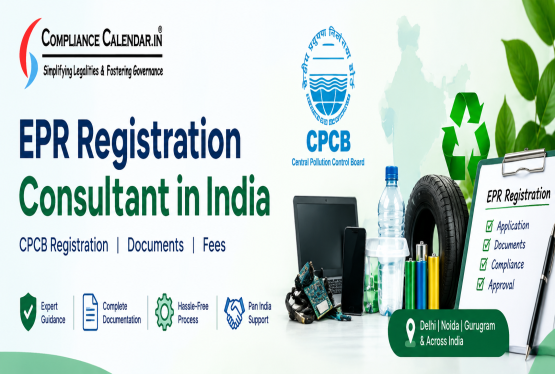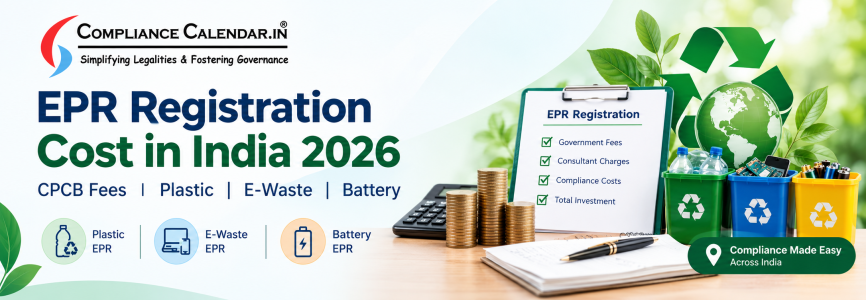



The EPR Registration Cost in India 2026 depends on the type of waste, business category and amount of waste your company handles. For plastic packaging, the published government registration fee ranges from 10,000 to 50,000 for producers, importers and brand owners. For battery EPR registration, the published fee ranges from 10,000 to 40,000, depending on annual turnover. E-waste registration has a different fee structure based on the applicant’s category and, for producers, the annual recycling target.
Apart from government fees, businesses may also need to pay EPR consultant charges and expenses for meeting recycling requirements. This guide explains the CPCB EPR registration fees in 2026, including plastic waste, e-waste and battery registration costs.Fees for waste tyre, used oil and end-of-life vehicle registration are not covered in this guide.
How Much Does EPR Registration Cost in India in 2026?
There is no single government fee for all EPR registrations in India. The Central Pollution Control Board (CPCB) operates different registration systems for plastic packaging, e-waste, batteries and other covered waste categories. The fee depends on which rules apply to your business. For example, a cosmetics company selling products in plastic bottles may pay a different registration fee from a company importing electronic equipment.
The table below compares the published CPCB fee structures for three common EPR categories.
|
EPR Registration Type |
Published Government Fee |
Fee Depends On |
|
Plastic Waste EPR Registration (PIBO) |
10,000–50,000 |
Annual plastic waste generation |
|
E-Waste EPR Registration (Producer) |
2,500–15,00,000 |
Annual e-waste recycling target |
|
Battery EPR Registration (Producer) |
10,000–40,000 |
Annual business turnover |
Important: These are published CPCB fee schedules, not a guarantee of the amount payable by every applicant in October 2026. The current portal-generated fee should be checked before payment. The e-waste figures apply specifically to producers, while other registered entities may have different fees. These are the published application fees, so check on the portal whether GST or any other charge is added to the amount payable. The fee tables in this article were checked against CPCB fee documents on 26 October 2026.
EPR Plastic Waste Registration Cost in India 2026
The EPR Plastic Registration Cost depends mainly on the amount of plastic packaging waste generated by the business. Producers, Importers and Brand Owners (PIBOs) covered by the Plastic Waste Management Rules must register through the applicable EPR system. The government fee is calculated according to the plastic waste generation category.
Plastic EPR Registration Government Fees
|
Annual Plastic Waste Generation |
Published Registration Fee |
|
Less than 1,000 tonnes |
10,000 |
|
1,000–10,000 tonnes |
20,000 |
|
More than 10,000 tonnes |
50,000 |
TPA means tonnes per annum, or tonnes in one year.
For example, suppose a cosmetics company sells shampoo and face cream in plastic packaging. If its applicable plastic waste generation is below 1,000 tonnes per year, the published government registration fee for that category is ?10,000. This amount does not include consultant charges or expenses for meeting recycling obligations.
CPCB’s published plastic EPR FAQ also lists an annual processing fee equal to 25% of the application fee. For the 10,000 category in the example above, that would be 2,500. However, registration validity and renewal provisions have changed over time. A CPCB plastic EPR document states that registration granted to PIBOs under the Rules does not require renewal. Businesses should check the current portal instructions before assuming that an old renewal-fee schedule still applies.
Plastic Waste Processor Registration Fees
Businesses registering as Plastic Waste Processors (PWPs) have a different published fee structure.
|
Processing Capacity |
Published Registration Fee |
|
Less than 200 tonnes per year |
5,000 |
|
200–2,000 tonnes per year |
20,000 |
|
More than 2,000 tonnes per year |
50,000 |
These charges apply to the relevant processor category, not automatically to every company dealing with plastic products.
EPR E-Waste Registration Cost in India 2026
The EPR E-Waste Registration Cost depends on the applicant’s category. Under the E-Waste (Management) Rules, 2022, covered producers must register and meet applicable recycling obligations. CPCB’s published producer fee schedule uses the annual e-waste recycling target to determine the registration charge.
E-Waste EPR Registration Fees for Producers
|
Annual E-Waste Recycling Target |
Published Government Fee |
|
Less than 50 MT |
2,500 |
|
50 MT to less than 100 MT |
7,500 |
|
100 MT to less than 1,000 MT |
1,50,000 |
|
1,000 MT to less than 5,000 MT |
10,00,000 |
|
More than 5,000 MT |
15,00,000 |
MT means metric tonnes.
These figures come from CPCB’s published e-waste producer registration FAQ. They show why the cost of e-waste registration can differ greatly between businesses. For example, a producer with a recycling target below 50 MT falls into a much lower fee category than a large producer with a target above 1,000 MT.
Manufacturers, recyclers and refurbishers have separate registration requirements and fee schedules. A business should not use the producer fee table if it is applying under another category.
Other E-Waste Registration Charges
CPCB’s fee document for the E-Waste (Management) Rules, 2022 also lists other charges:
|
Particulars |
Published Fee |
|
Producers whose sales have just started |
10,000 |
|
Amendment to an existing producer registration (for example, adding EEE items or revising the recycling target) |
10,000 |
|
New recycler registration (valid for five years) |
15,000 |
|
Recycler renewal after five years |
7,500 |
The document also provides for annual maintenance charges for all stakeholders registered on the EPR portal. Check the portal for the amount that applies to you.
The EPR E-Waste Certificate Cost may also be confused with the cost of buying EPR recycling certificates. These are different expenses. Registration allows a covered producer to enter the EPR system, while recycling certificates are used to meet applicable recycling obligations.
EPR Battery Registration Cost in India 2026
The EPR Battery Registration Fees are based on annual business turnover under CPCB’s published producer registration guidance. Businesses covered by the Battery Waste Management Rules, 2022, may need registration when they manufacture, import or place batteries on the market.
Battery EPR Registration Government Fees
|
Annual Turnover |
Published Registration Fee |
|
Below ?5 crore |
10,000 |
|
?5 crore to ?50 crore |
20,000 |
|
Above ?50 crore |
40,000 |
For example, if a company imports batteries and its annual turnover is ?3 crore, the published application fee for the below-?5-crore category is ?10,000. If another battery producer has annual turnover above ?50 crore, the published fee is ?40,000. The actual amount payable should be confirmed through the current registration system.
CPCB’s guidance also provides for registration-related processing and renewal charges. Businesses should check the current rules and portal instructions for the applicable payment requirements.
EPR Consultant Fees in India
Government fees are not the only expense a business may have when applying for EPR registration. Some businesses hire an EPR Registration Consultant to help with documents, online applications and compliance requirements. Consultant fees are professional service charges, not government charges.
There is no fixed government-approved consultant fee for every EPR application. The amount depends on the work required and the service provider. For example, a company needing help with a simple application may pay less than a company that needs support for multiple registrations and annual compliance.
What Do EPR Consultant Charges Usually Cover?
An EPR consultant may charge for:
- Checking which EPR registration applies to the business.
- Preparing and reviewing documents.
- Completing the CPCB EPR online application.
- Checking product, packaging or battery details.
- Responding to application queries.
- Assisting with corrections or amendments.
- Helping with EPR annual return filing.
- Providing ongoing EPR compliance support.
Before hiring a consultant, ask whether the quotation includes government fees, application support and services after registration.
Tip: Do not compare consultant quotations by price alone. Check what work is included and whether additional charges may apply.
Additional Costs After EPR Registration
Many businesses think the total EPR Certificate Cost is only the amount paid during registration. However, registration and meeting EPR obligations are different things. Depending on the waste category, a business may have to meet recycling targets, obtain valid EPR recycling certificates, maintain records and file returns.
These expenses may continue after registration. For some businesses, the cost of meeting recycling obligations can be higher than the original government application fee.
Common Additional EPR Compliance Costs
|
Expense |
Why It May Be Required |
|
EPR recycling certificates |
To meet applicable recycling obligations |
|
Annual return filing |
To submit required compliance information |
|
Record maintenance |
To keep product, packaging and recycling details |
|
Registration amendments |
To update information when required |
|
Consultant assistance |
To obtain professional support for ongoing compliance |
|
Other applicable charges |
To meet requirements under the relevant rules |
Not every expense applies to every business. The actual cost depends on the EPR category and the company’s obligations.
What Happens If You Do Not Comply?
Not meeting EPR obligations can also cost money. For example, CPCB’s e-waste registration certificate states that environmental compensation can be imposed for failing to meet the recycling target or for any other violation under the E-Waste Rules. CPCB can also suspend or cancel a registration. Check the penalty provisions of the rules that apply to your category.
What Affects the Total EPR Registration Cost?
Two businesses applying for EPR registration may pay different amounts even when they sell similar products. This happens because registration fees and compliance costs depend on the business’s activities, size and waste-related obligations.
The main factors affecting the total cost are:
- Type of EPR registration: Plastic, e-waste and battery EPR have different fee structures.
- Business category: A producer, importer, brand owner or recycler may have different requirements.
- Annual turnover: Turnover affects the published battery producer registration fee.
- Waste quantity: Plastic waste generation and e-waste recycling targets can affect applicable fees.
- Number of registrations: A business covered by more than one EPR framework may need separate registrations.
- Consultant services: Professional charges depend on the work required.
- Recycling obligations: Businesses may have additional expenses to meet their EPR targets.
For example, a company selling electronic products with batteries may need to check both e-waste and battery EPR requirements. It should calculate the cost of each applicable registration separately rather than assuming that one fee covers everything.
How to Calculate Your Total EPR Registration Cost
Before applying, it is useful to prepare a simple cost estimate. Start by identifying the correct EPR category and checking the official registration fee. Then add any consultant charges and the expected expenses for meeting ongoing compliance requirements.
Simple EPR Cost Calculation
Total EPR Cost = Government Registration Fee + Consultant Fee + Applicable Compliance Expenses
Suppose a plastic packaging business falls under the published 10,000 government fee category. If it hires a consultant, the professional fee will be added separately. The company may also need to budget for the annual processing fee (25% of the application fee, or 2,500 in this example), recycling obligations and other compliance expenses.
The 10,000 in this example is the published registration fee for the stated category, not the total cost of EPR compliance.
Before Paying, Check These Details
- Which EPR category applies to your business?
- What is the current government fee?
- Are there any annual processing charges?
- Does the consultant quotation include government fees?
- Will you need to meet recycling targets?
- Are annual return services included?
- Could your business need more than one registration?
Checking these points can help you prepare a realistic budget.
How to Reduce EPR Registration Expenses
Businesses can avoid unnecessary expenses by preparing the correct documents and understanding their registration requirements before applying. Mistakes in product details, business information or registration categories may lead to additional work and delays.
Here are some practical ways to manage EPR registration costs:
- Choose the correct category: Check whether you need plastic, e-waste, battery or another registration.
- Prepare accurate documents: Make sure your PAN, GST and business details match.
- Check the official fee: Use the current government portal instead of relying only on old fee lists.
- Compare consultant quotations: Understand which services are included.
- Keep proper records: Accurate product and waste information can make future compliance work easier.
- Plan for annual compliance: Budget for applicable recycling targets and return filing.
- Avoid misleading offers: Be careful of anyone promising guaranteed approval or unusually low total compliance costs.
The aim should be to complete the correct registration and meet the required rules, not simply to find the cheapest application service.
How Compliance Calendar Helps with EPR Registration Costs
Compliance Calendar LLP provides EPR registration and compliance assistance to businesses across India. If you are unsure how much EPR registration will cost, our team can help you understand the applicable registration category, required documents and government fee structure.
We provide assistance with:
- EPR Plastic Waste Registration.
- EPR E-Waste Registration.
- EPR Battery Registration.
- CPCB EPR online applications.
- Document preparation and application queries.
- EPR Annual Return Filing.
- Related EPR compliance requirements.
Whether you are a manufacturer, importer or brand owner, understanding the correct registration cost before applying can help you plan your expenses.
Need Help with EPR Registration Fees?
If you want to know the EPR Registration Cost for your business, contact Compliance Calendar LLP. Share your business activity, product details and registration requirements so our team can help you identify the applicable process and fee category.
Compliance Calendar LLP
Phone: +91 9988424211
Email: info@ccoffice.in
Frequently Asked Questions About EPR Registration Cost in India
1. What is the EPR Registration Cost in India in 2026?
The cost depends on the type of EPR registration. Published CPCB fees for plastic packaging PIBOs range from 10,000 to 50,000, while battery producer fees range from 10,000 to 40,000. E-waste producer fees follow a separate recycling-target-based schedule. Check the current portal for the payable amount.
2. What is the minimum EPR registration fee in India?
There is no single minimum fee for every EPR category. For example, CPCB's published e-waste producer fee schedule starts at 2,500 for the lowest recycling-target category, while the lowest published plastic fee for producers, importers and brand owners is 10,000.
3. How much does EPR Plastic Waste Registration cost?
CPCB's published plastic packaging registration fees for producers, importers and brand owners are 10,000, 20,000 or 50,000, depending on annual plastic waste generation.
4. What are the CPCB EPR Registration Fees for e-waste?
The published e-waste producer registration fee depends on the annual recycling target. The listed fees range from 2,500 to 15,00,000 across different target categories.
5. What is the Battery EPR Registration Cost in India?
The published battery producer registration fee is 10,000 for annual turnover below 5 crore, 20,000 for 5 crore to 50 crore and 40,000 for turnover above 50 crore.
6. Are EPR registration government fees and consultant fees the same?
No. Government registration fees are official charges, while consultant fees are professional charges for application and compliance assistance.
7. Is EPR registration free in India?
EPR registration generally involves an application fee under the relevant registration system. The amount depends on the category and applicable rules.
8. How much does an EPR consultant charge?
There is no single fixed consultant fee. Charges depend on the type of registration, documents, application work and other services required.
9. Does the EPR certificate cost include recycling expenses?
No. Government registration fees and expenses for meeting recycling obligations are separate. The total cost depends on the business's applicable EPR responsibilities.
10. Is EPR registration cheaper for small businesses?
Some fee schedules use turnover, waste quantity or recycling targets, so businesses in lower categories may pay lower fees. However, small-business status alone does not guarantee a lower fee or exemption.
11. Are EPR registration fees the same for plastic, batteries and e-waste?
No. Each waste category has its own registration fee structure and compliance requirements.
12. Do importers need to pay EPR registration fees?
Importers covered by the applicable EPR rules generally need to pay the relevant registration charges. The fee depends on the category and business details.
13. Is there an annual EPR registration fee?
Some EPR systems have annual processing or other recurring charges. These should be checked under the current rules for the applicable category.
14. Does EPR registration require renewal fees?
Renewal requirements are not identical across all EPR categories. Check the current registration validity and renewal provisions before paying any renewal charge.
15. Can I pay EPR registration fees online?
Yes. The relevant EPR registration systems generally provide online payment facilities for applicable government charges.
16. Can one business pay for more than one EPR registration?
Yes. If a business falls under more than one EPR framework, it may need separate registrations and payments.
17. What happens if my EPR application is rejected?
The next steps depend on the registration system and reason for rejection. You may need to correct information, submit a fresh application or follow another permitted process. Additional fees may apply.
18. Does EPR registration cost depend on company turnover?
For some categories, yes. For example, CPCB's published battery producer registration fees are based on annual turnover. Other categories use different factors.
19. What is the cost of an EPR recycling certificate?
There is no single fixed price for all EPR recycling certificates. The cost depends on the waste category, applicable rules and the relevant certificate market or transaction.
20. Can Compliance Calendar help calculate my EPR registration cost?
Yes. Compliance Calendar LLP can help businesses understand the applicable EPR category, government registration fees, document requirements and professional service charges.
Article last updated on : 26 Oct 2026.










_learn_crop10_thumb.jpg)