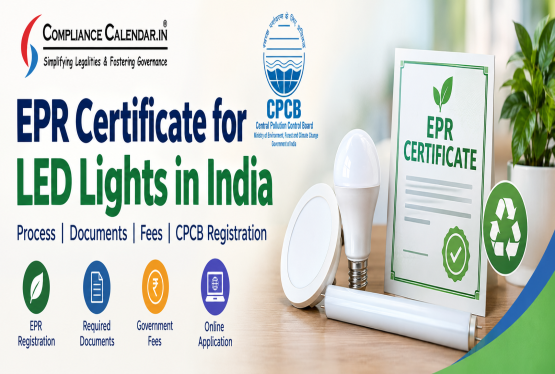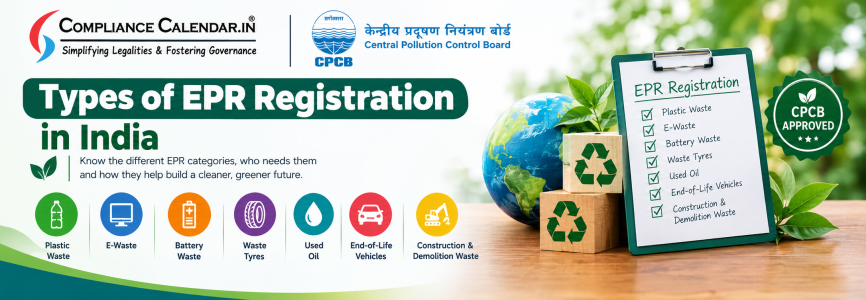



There are seven main types of EPR registration and compliance frameworks in India covering plastic packaging, e-waste, battery waste, waste tyres, used oil, end-of-life vehicles, and construction and demolition waste. EPR stands for Extended Producer Responsibility. It means that businesses covered by these rules must take responsibility for managing waste linked to their products or activities. The type of EPR registration you need depends on what your business manufactures, imports or sells.
For example, a company selling shampoo in plastic bottles may need plastic EPR registration, while a business importing electronic products may need e-waste EPR registration. This guide explains the different types of EPR registration in India, who needs them, how they work and how to choose the correct registration for your business.
What Is EPR Registration?
EPR Registration is a process through which businesses register under the applicable Extended Producer Responsibility rules. These rules help ensure that waste from products, packaging and certain business activities is collected, recycled or managed properly. The Central Pollution Control Board (CPCB) operates online systems for several EPR categories.
Getting an EPR registration certificate is often the first step towards meeting these rules. After registration, businesses may also need to meet recycling targets, keep records and submit returns. EPR registration does not mean that all waste management responsibilities are complete.
How Many Types of EPR Registration Are There in India?
India has several EPR systems for different waste categories. The most common are plastic packaging, e-waste and battery waste. Other frameworks cover waste tyres, used oil, end-of-life vehicles, and construction and demolition waste.
Types of EPR Registration – Comparison Table
|
EPR Type |
Products or Waste Covered |
Businesses That May Need Registration |
|
Plastic Waste EPR |
Plastic bottles, wrappers and packaging |
Producers, importers and brand owners |
|
E-Waste EPR |
Covered electrical and electronic equipment |
Producers and other regulated stakeholders |
|
Battery Waste EPR |
Covered batteries |
Battery producers, including certain importers |
|
Waste Tyre EPR |
New tyres and imported waste tyres |
Tyre producers and other covered entities |
|
Used Oil EPR |
Base oil, lubricating oil and used oil |
Covered producers, importers and other entities |
|
End-of-Life Vehicle EPR |
Vehicles reaching the end of their useful life |
Covered vehicle producers and other stakeholders |
|
Construction and Demolition Waste EPR |
Waste from covered building and demolition projects |
Covered producers, developers and other entities |
Important: These categories do not all use the same registration process. The exact requirements depend on the rules for each waste type.
1. EPR Registration for Plastic Waste
Plastic EPR Registration applies to covered producers, importers and brand owners dealing with plastic packaging in India. It is regulated under the Plastic Waste Management Rules, 2016, and the applicable EPR guidelines and amendments. Businesses covered by these rules must register with the relevant authority and meet their plastic waste management responsibilities.
For example, a cosmetics company selling shampoo in plastic bottles may need plastic EPR registration. The company must report the plastic packaging it introduces into the market and meet the applicable collection, recycling or other EPR targets. The rules also cover different types of plastic packaging, including rigid plastic packaging and flexible plastic packaging.
Who Needs Plastic EPR Registration?
- Producers of covered plastic packaging.
- Importers of plastic packaging or goods with plastic packaging.
- Brand owners using plastic packaging.
- Other covered entities, including plastic waste processors, according to their registration requirements.
Businesses should check their exact role before applying. A packaging manufacturer and a brand owner may have different responsibilities.
2. EPR Registration for E-Waste
E-Waste EPR Registration applies to producers of electrical and electronic equipment covered by the E-Waste (Management) Rules, 2022, along with applicable amendments. These rules help ensure that electronic waste is recycled through registered recyclers.
For example, a company selling covered electronic products under its own brand may need e-waste EPR registration. The producer must meet its recycling obligations using the process set out in the rules. Manufacturers, recyclers and refurbishers also have registration requirements according to their roles.
Who Needs E-Waste EPR Registration?
- Producers of covered electrical and electronic equipment.
- Importers who fall under the definition of a producer.
- Manufacturers covered by the rules.
- Registered recyclers and refurbishers.
The requirements depend on the products listed under the rules. Not every electrical item is automatically covered in the same way.
Example: An electronics company importing covered products for sale in India should check whether it must register as a producer under the e-waste rules.
3. EPR Registration for Battery Waste
Battery EPR Registration is required for covered producers under the Battery Waste Management Rules, 2022, and applicable amendments. These rules cover different battery types, including portable, automotive, industrial and electric vehicle batteries.
A producer may include a business that manufactures or imports batteries, including certain products containing batteries. Covered producers must register and meet the recycling or refurbishment obligations that apply to their battery category.
Who Needs Battery EPR Registration?
- Battery manufacturers covered by the rules.
- Businesses importing batteries.
- Businesses importing equipment containing batteries, where covered.
- Other regulated entities according to their role.
Example: A business importing rechargeable batteries for sale in India may need battery EPR registration. It must also follow the applicable waste battery management requirements after registration.
4. EPR Registration for Waste Tyres
Waste Tyre EPR was introduced through amendments to the Hazardous and Other Wastes (Management and Transboundary Movement) Rules. It applies to covered tyre producers and other regulated businesses.
The system aims to ensure that waste tyres are recycled or processed through registered facilities. Producers must meet their EPR obligations through the applicable certificate system.
Who Needs Waste Tyre EPR Registration?
Covered businesses may include:
- Manufacturers of new tyres.
- Importers of new tyres.
- Importers of vehicles fitted with new tyres.
- Importers of waste tyres.
- Other entities covered by the waste tyre rules.
For example, a company importing new tyres into India may need waste tyre EPR registration. The exact obligation depends on the business activity and quantities covered by the rules.
5. EPR Registration for Used Oil
Used Oil EPR Registration applies under the Hazardous and Other Wastes rules and the amendments dealing with used oil. The framework came into effect on 1 April 2024.
Used oil includes oil that has already been used in activities such as vehicle servicing or industrial operations and is no longer suitable for its original purpose. The rules aim to support proper collection, recycling and re-refining of used oil.
Who Needs Used Oil EPR Registration?
The framework covers relevant entities such as:
- Producers of base oil or lubricating oil.
- Importers covered by the used oil rules.
- Used oil recyclers.
- Collection agents, where applicable.
Example: A business producing lubricating oil for the Indian market may have EPR obligations. It may need to meet these obligations through eligible certificates generated by registered recyclers.
6. EPR for End-of-Life Vehicles
End-of-Life Vehicle EPR is covered by the Environment Protection (End-of-Life Vehicles) Rules, 2025, and applicable amendments. These rules deal with vehicles that have reached the end of their useful life and need to be scrapped or recycled.
The framework places EPR responsibilities on covered vehicle producers. It also involves registered vehicle scrapping facilities and other regulated stakeholders. The aim is to support proper recycling and recovery of materials from old vehicles.
For example, a vehicle manufacturer may need to meet EPR targets linked to the vehicles it has introduced into the Indian market. The rules also address responsibilities relating to materials such as steel and other waste categories.
Important: Vehicle EPR is not the same as battery or tyre EPR. A vehicle business may have responsibilities under more than one set of rules.
7. EPR for Construction and Demolition Waste
The Environment (Construction and Demolition) Waste Management Rules, 2025, introduced an EPR-based framework for covered construction, demolition and related activities.
Construction and demolition waste includes materials such as concrete, bricks and other waste generated when buildings are constructed, repaired or demolished. The rules aim to increase recycling and the use of recycled materials.
Who May Be Covered?
Depending on the project and applicable requirements, covered entities may include:
- Construction project developers.
- Builders and other responsible project entities.
- Businesses carrying out covered demolition work.
- Other entities identified under the rules.
For example, a large redevelopment project may need to meet waste recycling requirements and use recycled construction materials according to the applicable rules.
This framework is different from the EPR systems used for plastic packaging, batteries and electronic products.
Which Type of EPR Registration Does Your Business Need?
The easiest way to identify the correct EPR registration is to check what your business manufactures, imports or sells. You should also consider the packaging used for your products and whether your business deals with any other regulated waste category.
EPR Registration Examples
|
Your Business |
EPR Registration to Check |
|
Cosmetics brand using plastic bottles |
Plastic Waste EPR |
|
Electronics importer |
E-Waste EPR |
|
Battery manufacturer |
Battery Waste EPR |
|
Tyre importer |
Waste Tyre EPR |
|
Lubricating oil producer |
Used Oil EPR |
|
Vehicle manufacturer |
End-of-Life Vehicle EPR and other applicable categories |
|
Large construction project |
Construction and Demolition Waste EPR |
Can One Business Need More Than One EPR Registration?
Yes. A business may need to comply with more than one EPR framework.
For example, a company importing electronic products containing batteries and packed in plastic may have responsibilities under the e-waste, battery waste and plastic packaging rules. The exact requirements depend on the products, the business's role and any applicable exemptions.
One EPR registration certificate does not automatically cover every waste category.
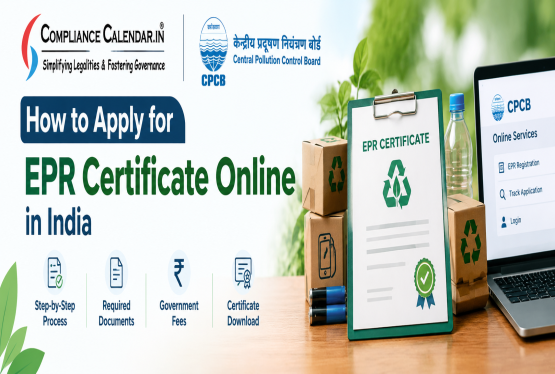
How to Apply for EPR Registration Online in India
The EPR registration process depends on the waste category. CPCB provides online registration systems for several EPR frameworks, while the responsible authority and application requirements may differ for other categories.
General EPR Registration Process
- Identify the EPR category: Check which waste management rules apply to your business.
- Check eligibility: Confirm your business's legal role under those rules.
- Prepare documents: Collect the required business and product information.
- Open the correct portal: Use the current official registration system.
- Complete the application: Enter the required business and waste-related details.
- Pay applicable fees: Follow the official payment instructions.
- Submit the application: Respond to any query raised by the authority.
- Download the certificate: Access the registration certificate after approval, where the relevant system provides one.
The exact process may be different for vehicle and construction waste frameworks. Always follow the instructions for your category.
Documents Required for EPR Registration
The documents required depend on the type of EPR registration and the applicant's role. However, businesses commonly need basic registration information and records showing the products or materials they place on the market.
|
Document |
Why It May Be Required |
|
PAN |
Business identification |
|
GSTIN, where applicable |
GST registration details |
|
Company registration documents |
Proof of business registration |
|
IEC, where applicable |
Importer details |
|
Business address |
Registered business information |
|
Product details |
Information about covered products |
|
Sales or import records |
Helps determine EPR obligations |
|
Packaging or material details |
Relevant for certain EPR categories |
|
Authorised person details |
Identifies the application representative |
Additional technical, environmental or facility documents may be needed for certain categories. This table is a general guide, not a complete checklist for every EPR application.
Is EPR Registration Mandatory in India?
Yes, EPR registration is mandatory for businesses covered by the applicable registration rules. However, not every manufacturer, importer, trader or service provider needs EPR registration.
The requirement depends on the products, business activity and relevant waste management rules. Some businesses may be exempt from specific requirements, while others may need more than one registration.
Businesses that fail to meet applicable EPR requirements may face regulatory action, environmental compensation or other consequences under the relevant rules.
EPR Registration Fees and Validity
EPR registration fees are not the same for every waste category. Charges depend on the relevant rules, applicant type and applicable government fee schedule. Some frameworks also require periodic payments, returns or other compliance activities.
Similarly, certificate validity and renewal requirements differ between EPR categories. Businesses should check the official conditions for their registration rather than assuming that every EPR certificate has the same validity period.
Government registration charges are also separate from recycling costs and professional consultancy fees.
Conclusion
Understanding the types of EPR registration in India is important for businesses that manufacture, import or sell products covered by waste management rules. Plastic packaging, electronic products, batteries, tyres, used oil, vehicles and construction waste have different requirements.
Before applying, identify the correct EPR category and check your business's responsibilities. This can help you avoid applying under the wrong rules and make future compliance easier.
Compliance Calendar LLP provides assistance with EPR registration for e-waste, plastic packaging and battery waste. If you need help understanding the correct registration for your business, contact our team.
Phone: +91 9988424211
Email: info@ccoffice.in
Frequently Asked Questions About Types of EPR Registration
1. How many types of EPR registration are there in India?
India has seven major EPR waste management frameworks covering plastic packaging, e-waste, batteries, waste tyres, used oil, end-of-life vehicles, and construction and demolition waste. Each category has different registration and compliance requirements.
2. What are the main types of EPR registration in India?
The main types include EPR for plastic waste, e-waste, battery waste, waste tyres, used oil, end-of-life vehicles, and construction and demolition waste. Businesses must follow the rules that apply to their products or activities.
3. What is EPR registration, and why is it required?
EPR stands for Extended Producer Responsibility. It requires covered businesses to take responsibility for managing waste linked to their products or packaging. Registration helps authorities monitor these responsibilities.
4. Which EPR registration is required for plastic packaging?
Businesses covered by the plastic waste rules may need Plastic EPR Registration. These include producers, importers and brand owners dealing with plastic packaging such as bottles, wrappers and containers.
5. Who needs EPR registration for e-waste in India?
Producers of covered electrical and electronic equipment need EPR registration. Manufacturers, recyclers and refurbishers also have registration duties under the e-waste rules, depending on their activities.
6. Is battery EPR registration different from e-waste EPR registration?
Yes. Battery EPR and e-waste EPR follow different rules. Battery EPR covers waste batteries, while e-waste EPR covers electrical and electronic equipment listed under the applicable rules.
7. Can one company need more than one EPR registration?
Yes. A company may need multiple EPR registrations if it deals with different regulated products or packaging. For example, an electronics importer selling battery-powered products in plastic packaging may have more than one EPR obligation.
8. Is EPR registration mandatory for all manufacturers in India?
No. EPR registration is mandatory only for businesses covered by the relevant rules. The requirement depends on the products manufactured, the business activity and any applicable exemptions.
9. Is EPR registration required for importers in India?
Yes, importers covered by EPR rules must meet the applicable registration requirements. For example, importing certain electronics, batteries, tyres or plastic-packaged goods may create EPR obligations.
10. Which EPR registration is required for a cosmetics company?
A cosmetics company selling products in plastic bottles, tubes or wrappers may need Plastic EPR Registration. The requirement depends on its role as a producer, importer or brand owner and the packaging it uses.
11. Which EPR registration is required for tyre manufacturers?
Tyre manufacturers covered by the waste tyre rules need Waste Tyre EPR Registration. Certain tyre importers and other regulated businesses also have registration duties. The rules aim to ensure proper recycling of waste tyres.
12. Who needs EPR registration for used oil?
Covered producers and importers of base oil or lubricating oil need to follow used oil EPR requirements. Recyclers and collection agents also have registration duties under the applicable rules. Central Pollution Control Board
13. Is EPR registration required for vehicle manufacturers?
Yes. Covered vehicle producers must follow the End-of-Life Vehicle EPR rules. These rules help ensure that old vehicles are properly scrapped and recycled. Vehicle producers may also have responsibilities under other waste management rules. Ministry of Environment and Forests
14. Is EPR registration required for construction companies?
EPR requirements may apply to construction companies, developers and other entities covered by the Construction and Demolition Waste Management Rules, 2025. The requirements depend on the project and applicable conditions. Ministry of Environment and Forests
15. What documents are required for different types of EPR registration?
Common documents include PAN, GST details, business registration records, IEC for applicable importers, product information and sales or import records. Additional documents depend on the EPR category and business activity.
16. How can I apply for EPR registration online in India?
First, identify the correct EPR category. Then visit the applicable government portal, enter your business details, upload the required documents and pay the prescribed fees. After approval, you can access your registration certificate through the relevant system.
17. What is the difference between EPR registration and an EPR certificate?
EPR registration is the process of registering a business under the applicable waste management rules. An EPR registration certificate is the document issued after approval. It is different from an EPR recycling certificate used to meet recycling obligations.
18. What happens if a business does not get EPR registration?
A business that is required to register but fails to do so may face regulatory action, environmental compensation or other penalties. The consequences depend on the waste category and the applicable rules.
19. Where can I get EPR registration assistance in Delhi NCR?
Businesses in Delhi, Noida, Gurugram and other parts of Delhi NCR can seek professional EPR registration assistance. Compliance Calendar LLP, based in Mayur Vihar, New Delhi, helps eligible businesses with plastic waste, e-waste and battery EPR applications.
20. Can I get EPR registration assistance online from anywhere in India?
Yes. Many EPR registration steps can be completed through government online portals. Compliance Calendar LLP provides assistance to businesses across India with eligibility checks, documents, online applications and applicable compliance requirements.
Article last updated on : 27 Oct 2026.











_learn_crop10_thumb.jpg)