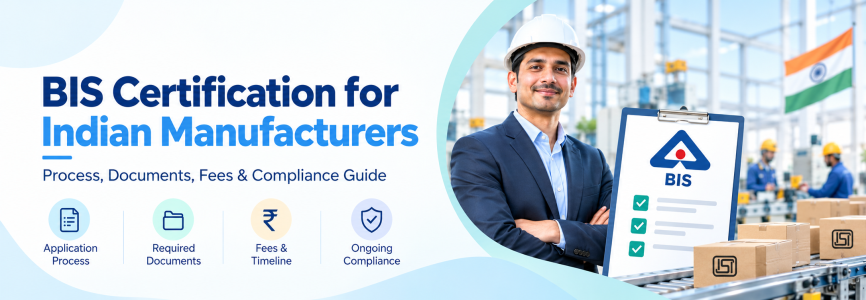



BIS Certification for Indian Manufacturers is an important requirement for businesses that manufacture products in India. The Bureau of Indian Standards (BIS) checks whether products meet the required Indian quality and safety standards. For certain products, BIS Certification is mandatory before they can be manufactured or sold in India. These include specific electrical appliances, electronics, cement, steel and other regulated products. Getting BIS Certification helps manufacturers meet legal requirements, improve product quality and build customer trust.
What Is BIS Certification?
BIS Certification is an approval issued by the Bureau of Indian Standards to manufacturers whose products meet the applicable Indian Standards (IS). It helps ensure that products are safe, reliable and meet quality requirements. Manufacturers can use the relevant BIS Standard Mark after receiving the necessary licence or registration. However, not every product requires BIS Certification. The requirement depends on the product category and government notifications.
Is BIS Certification Mandatory for Indian Manufacturers?
BIS Certification is mandatory for products covered under applicable Quality Control Orders (QCOs). Under Section 16 of the BIS Act, 2016, the Central Government can make BIS Certification compulsory for certain products.
Manufacturers must check whether their products require certification before starting production or selling them in India.
Types of BIS Certfication for Indian Manufacturers
1. ISI Mark Certification (Scheme I)
ISI Mark Certification applies to many products, including cement, electrical equipment and industrial goods. Manufacturers must meet the relevant Indian Standards and obtain a BIS licence.
2. Compulsory Registration Scheme (Scheme II)
The Compulsory Registration Scheme (CRS) applies to specified electronic and IT products. Manufacturers must obtain registration after completing the required product testing and documentation.
3. Certificate of Conformity (Scheme IV)
This scheme applies to certain products that require a BIS Certificate of Conformity under applicable rules and notifications.
4. Scheme X Certification
Scheme X covers specified machinery and electrical equipment. Manufacturers must follow the relevant safety, testing and certification requirements.
Documents Required for BIS Certification
Manufacturers may need the following documents:
-
Company registration certificate
-
PAN and GST details
-
Factory address proof
-
Manufacturing process details
-
List of machinery and equipment
-
Product specifications
-
Testing equipment details
-
Product test reports
-
Quality-control records
-
Authorisation letter
The exact documents depend on the product and certification scheme.
BIS Certification Process for Indian Manufacturers
Step 1: Identify the Product Standard
Check which Indian Standard applies to your product and whether BIS Certification is mandatory.
Step 2: Select the Certification Scheme
Choose the applicable BIS scheme based on your product category.
Step 3: Prepare Documents
Collect the required business, factory, product and testing documents.
Step 4: Submit the Application
Apply through the relevant BIS online portal and pay the prescribed application fees.
Step 5: Product Testing and Inspection
Complete the required product testing and factory inspection, where applicable.
Step 6: Obtain BIS Certification
After successful verification and approval, BIS issues the relevant licence, registration or certificate.
BIS Certification Fees in India
BIS Certification fees depend on the product category, certification scheme, inspection requirements and testing charges.
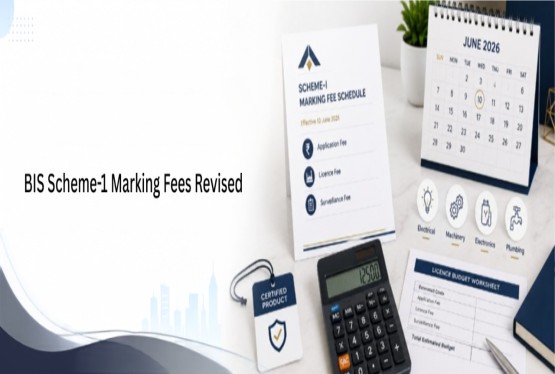
For Scheme I, common fees include:
|
Fee Type |
Amount |
|---|---|
|
Application Fee |
Rs 1,000 |
|
Inspection Fee |
Rs 7,000 per man-day |
|
Annual Licence Fee |
Rs 1,000 |
|
Testing Charges |
Depends on product |
|
Marking Fee |
Product-specific |
These are indicative Scheme I fees. Manufacturers should verify the latest BIS fee schedule before applying.
How Long Does BIS Certification Take?
The time required depends on the product and certification scheme.
Under Scheme I, the average processing time indicated by BIS is approximately one month under the simplified procedure and four months under the normal procedure.
Incomplete documents, product testing failures or factory inspection issues may delay certification.
Benefits of BIS Certification for Manufacturers
BIS Certification offers several benefits:
-
Legal Compliance: Helps meet mandatory product certification requirements.
-
Product Quality: Encourages consistent quality and safety standards.
-
Customer Trust: Builds confidence in certified products.
-
Business Opportunities: Supports access to markets and tenders requiring certified products.
-
Brand Reputation: Helps manufacturers demonstrate product conformity.
BIS Certification Validity and Renewal
The validity of BIS Certification depends on the applicable scheme.
Under Scheme I, a BIS licence may initially be granted for up to two years and renewed for up to five years, subject to applicable conditions. Manufacturers must renew their licences on time and maintain product quality throughout the certification period.
Common Reasons for BIS Certification Rejection
BIS applications may be delayed or rejected due to:
-
Incomplete or incorrect documents
-
Failure to meet Indian Standards
-
Unsuccessful product testing
-
Inadequate manufacturing facilities
-
Missing testing equipment
-
Incorrect product classification
Checking documents and product requirements before applying can help prevent these problems.
Why Choose Compliance Calendar LLP for BIS Certification?
Compliance Calendar LLP provides professional assistance to Indian manufacturers applying for BIS Certification. Our services include product classification guidance, documentation support, application assistance and help with BIS compliance requirements. For professional assistance with BIS Certification, contact Compliance Calendar LLP at 9988442411
Frequently Asked Questions (FAQs)
Q1. What is BIS Certification for Indian Manufacturers?
Ans. BIS Certification confirms that a product meets the applicable Indian Standards. It helps manufacturers demonstrate product quality and comply with relevant regulations.
Q2. Is BIS Certification mandatory in India?
Ans. BIS Certification is mandatory for products covered under applicable government notifications and Quality Control Orders. It is not compulsory for every product.
Q3. How can I apply for BIS Certification online?
Ans. Manufacturers can apply through the relevant BIS online portal. They must submit the required documents, pay applicable fees and complete the certification process.
Q4. What documents are required for BIS Certification?
Ans. Common documents include company registration, factory address proof, product details, machinery information and test reports. Requirements vary by product.
Q5. What is the cost of BIS Certification in India?
Ans. The cost depends on the certification scheme, product testing, inspection and licence fees. Different products may have different certification charges.
Q6. How long does BIS Certification take?
Ans. Under Scheme I, the average processing time is approximately one month for the simplified procedure and four months for the normal procedure. Actual timelines may vary.
Q7. What is the difference between BIS and ISI Certification?
Ans. BIS Certification covers several product certification schemes. ISI Mark Certification is a specific BIS certification scheme used for eligible products.
Q8. Can MSMEs apply for BIS Certification?
Ans. Yes. MSMEs can apply for BIS Certification if their products and manufacturing facilities meet the applicable requirements.
Q9. Is BIS Certification required for every factory?
Ans. Under Scheme I, separate manufacturing locations generally require separate BIS licences, even when they manufacture the same product.
Q10. What happens if a manufacturer does not obtain mandatory BIS Certification?
Ans. Manufacturing or selling covered products without required certification may result in penalties or other legal action under applicable BIS regulations.
Article last updated on : 28 Oct 2026.










_learn_crop10_thumb.jpg)