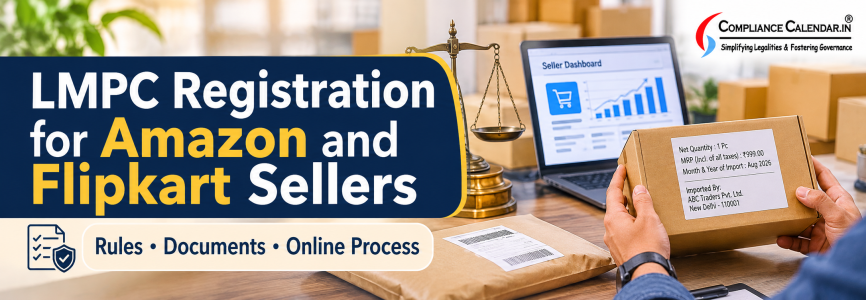



If you sell products on Amazon or Flipkart, you may need to follow the Legal Metrology (Packaged Commodities) Rules, 2011. LMPC Registration is required for certain businesses that import, manufacture or pack pre-packaged goods for sale in India. However, not every online seller needs a separate LMPC certificate. If you only buy properly labelled products from an authorised supplier and resell them, your position may be different from that of an importer or manufacturer.
For example, a seller importing packaged kitchen appliances from China may need LMPC Registration as an importer. A seller manufacturing and packing products under their own brand may need to check the requirements for manufacturers or packers. This guide explains when Amazon and Flipkart sellers need LMPC Registration, which product labels must show, what documents are required, how to apply and what to check before listing products online.
What Is LMPC Registration?
LMPC stands for Legal Metrology Packaged Commodities. It refers to the rules that control how pre-packaged products must be labelled and sold in India. These rules are made under the Legal Metrology Act, 2009 and the Legal Metrology (Packaged Commodities) Rules, 2011. A pre-packaged commodity is a product packed before the customer buys it, where the quantity cannot be changed without opening the package. Common examples include packaged cosmetics, toys, clothes sold in retail packs, kitchen products, electronics, food items and household goods.
LMPC Registration is a registration requirement under Rule 27 for covered manufacturers, packers and importers. It is important to understand that LMPC Registration and product labelling are related but different responsibilities. Having a registration certificate does not automatically make an incorrect product label legal. Businesses must follow the applicable labelling rules as well.
For a wider explanation, read our guide on LMPC Registration: Legal Metrology Compliance Guide.
Do Amazon and Flipkart Sellers Need LMPC Registration?
The answer depends on what your business does. Selling through Amazon or Flipkart does not, by itself, decide whether you need Rule 27 registration. Your role in the supply chain matters.
Sellers who import products
If you import pre-packaged goods into India and sell them through Amazon or Flipkart, you generally need to check and obtain the required importer registration under Rule 27. You must also ensure that imported packages carry the declarations required under Indian law.
For example, if you import Bluetooth speakers, watches, toys or kitchen appliances from another country and sell them in India, you should check the LMPC requirements before importing and selling those products.
Sellers who manufacture or pack products
If you manufacture products and pack them for retail sale, you may need registration as a manufacturer or packer, depending on your activity. The same applies if you buy goods in bulk and pack them into smaller retail packages for sale.
For example, a business that buys loose spices, packs them into 500-gram pouches and sells them on Amazon should check the packer registration requirements. A brand owner using another factory to manufacture products should also check who is legally responsible for manufacturing, packing and the declarations on the package.
Sellers who only resell products
If you purchase already packaged products from an Indian manufacturer or authorised distributor and resell them without changing the package, you are not automatically required to obtain a separate Rule 27 registration merely because you sell online.
However, you should still check that the products are legally labelled and that the required information is available on the online listing. Keep purchase invoices and supplier details as supporting records.
Quick comparison
|
Seller's activity |
Is Rule 27 LMPC Registration generally required? |
|
Importing pre-packaged goods for sale in India |
Yes, subject to applicable rules and exemptions |
|
Manufacturing and packing retail products |
Yes, where covered by Rule 27 |
|
Packing or repacking products for retail sale |
Registration may be required as a packer |
|
Buying properly labelled products in India and reselling them unchanged |
Not automatically |
|
Selling products under your own brand |
Depends on who manufactures, packs and imports them and how the business is presented |
|
Selling unpackaged goods by weight at the time of purchase |
Different requirements may apply |
Important: Do not assume that an Amazon or Flipkart seller account is a substitute for LMPC Registration. Equally, do not assume that every seller needs the same certificate. First identify whether you are an importer, manufacturer, packer or reseller.
Which Products Sold on Amazon and Flipkart Come Under LMPC Rules?
The rules cover many types of pre-packaged commodities. The product category alone does not decide the registration requirement; the way the product is packed and the seller's role also matter.
Common examples include:
|
Product category |
Examples |
|
Electronics |
Headphones, chargers, speakers and packaged accessories |
|
Home and kitchen products |
Cookware, storage containers and kitchen tools |
|
Cosmetics and personal care |
Shampoo, face wash, creams and soaps |
|
Clothing and accessories |
Retail-packed garments, socks and accessories |
|
Toys and games |
Packaged toys, board games and children's products |
|
Food products |
Packaged snacks, spices, pulses and dry fruits |
|
Household goods |
Detergents, cleaning products and packaged utility items |
|
Stationery |
Pens, notebooks, art supplies and office products |
Certain packages and commodities are excluded or treated differently under the rules. For example, specific industrial or institutional packages and certain larger packages may fall under exemptions, subject to the exact conditions. Check the applicable exemption before deciding that a product is outside the rules.
What Details Must Appear on Product Packaging?
A product sold on Amazon or Flipkart must carry the declarations required under the applicable Legal Metrology rules. The exact declarations depend on the product and the type of package.
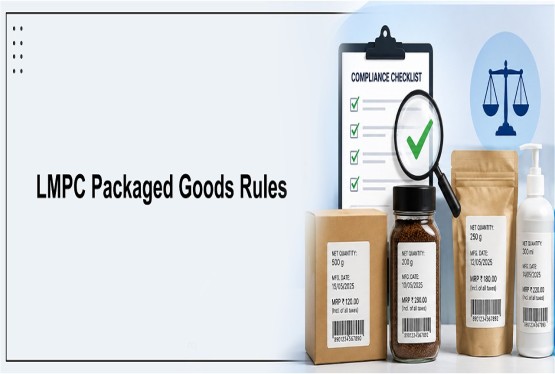
For many retail pre-packaged commodities, the label generally needs to show:
| Name and address of the manufacturer | Details of the business that manufactures the product |
| Name and address of the packer | Required where a separate packer is involved |
| Name and address of the importer | Required for imported products |
| Country of origin | Required for imported products |
| Common or generic product name | The name should help customers understand what the product is |
| Net quantity | Weight, volume, length or number of units, as applicable |
| Maximum Retail Price (MRP) | The retail sale price inclusive of all taxes |
| Consumer care details | The required contact details for customer complaints |
| Month and year of manufacture, packing or import | As applicable under the rules |
Some products have additional requirements under other laws. For example, packaged food products must also follow applicable FSSAI labelling requirements. A seller should not treat Legal Metrology declarations as a replacement for food, drug, electronics or other product-specific rules.
For a detailed explanation of label information, read LMPC Labelling Rules: Mandatory Declarations on Packaged Goods.
Do these details also need to appear on Amazon and Flipkart listings?
Yes, the e-commerce rules require the online display of applicable packaged commodity declarations. Rule 6(10) of the Packaged Commodities Rules places a responsibility on the e-commerce entity to ensure that the required declarations are displayed on its digital network, subject to the exception stated in that rule for the month and year of manufacture or packing.
This means sellers should provide correct product information to the marketplace and check that the listing displays the required details. Uploading a product image alone may not be enough if mandatory information is missing from the listing.
A further amendment dated 13 February 2026 requires e-commerce entities selling imported products to provide a searchable and sortable filter specifying the country of origin. This provision came into force on 1 July 2026. Sellers of imported goods should therefore ensure that their country-of-origin information is accurate and available to the marketplace.
Documents Required for LMPC Registration for Amazon and Flipkart Sellers
The document checklist depends on whether you are applying as an importer, manufacturer or packer. The authority may also ask for additional information based on your business and the state in which you apply.
Commonly required documents and details include:
|
Document |
Why it may be required |
|
PAN card |
To identify the applicant or business |
|
Aadhaar or identity proof |
To verify the proprietor, partner or authorised person |
|
To verify applicable business and tax details |
|
|
Business registration proof |
Such as incorporation certificate, partnership deed or proprietorship proof |
|
Business address proof |
To confirm the registered or operating premises |
|
Import Export Code (IEC) |
For businesses importing covered products |
|
Product list |
To identify the packaged goods handled by the business |
|
Sample product label |
To check the required package declarations |
|
Authorisation letter or board resolution |
Where someone applies on behalf of the business |
|
Contact details |
For application communication and verification |
An importer should pay particular attention to the IEC, product list and proposed labels. A manufacturer or packer should prepare details of the premises and the products being packed or manufactured.
Do not use one general checklist for every application. Check the latest requirements of the relevant Legal Metrology authority before submitting your documents.
How to Apply for LMPC Registration Online
The application process depends on the applicant's business activity and the procedure followed by the relevant state or central authority. The following steps explain the general process.
Step 1: Identify your business category
First, decide whether you are applying as an importer, manufacturer or packer. If you only resell products purchased from an Indian supplier, check whether Rule 27 registration applies to your actual activity.
Step 2: Check your products
Prepare a list of the pre-packaged commodities you import, manufacture or pack. Check whether any specific exemption applies to your products.
Step 3: Prepare the documents
Keep your PAN, GST details, business proof, address proof, IEC (where applicable), product list and proposed label samples ready.
Step 4: Review the product labels
Check that the package carries all declarations required under the rules. Correct missing or inaccurate information before the products are sold.
Step 5: Submit the application
Apply to the appropriate Legal Metrology authority using the prescribed form and procedure. The application route may differ depending on the state and the applicant category. The National Single Window System may provide access to the relevant service where it is available.
Step 6: Respond to any queries
The authority may ask for clarification or additional documents. Reply with correct information and supporting records.
Step 7: Receive the registration certificate
If the application meets the requirements, the authority may issue the LMPC registration certificate. Keep a copy with your business records and follow the applicable compliance requirements after registration.
You can also visit our LMPC Registration service page for assistance with the registration process.
LMPC Registration Fees, Time and Validity
The government fee and processing time should be checked with the authority handling your application. The fee may depend on the applicable state rules and the type of registration. Professional consultancy charges, if you choose to use a consultant, are separate from government fees.
Do not rely on a single fee or processing-time estimate for every state. Before applying, confirm the current fee, payment method and document checklist with the relevant Legal Metrology Department.
Is LMPC Registration valid for a lifetime?
The 2026 amendments to Rule 27 changed the validity position for LMPC registration. Under the amended framework, registration is intended to remain valid until it is cancelled, subject to the applicable requirements, including updating information as prescribed.
Businesses should check the latest version of Rule 27 and the instructions of the authority before relying on an older certificate-validity or renewal statement. Do not confuse LMPC registration with other Legal Metrology licences, which may have different validity and renewal conditions.
What Happens If an Amazon or Flipkart Seller Does Not Follow LMPC Rules?
A seller who ignores applicable Legal Metrology requirements may face regulatory action. Depending on the violation, this can include monetary penalties, seizure or detention of goods, and directions from the authority to correct the non-compliance. Online marketplaces may also ask sellers to correct product information or provide supporting documents. If a seller cannot establish that the products meet applicable requirements, the listing or sale may be affected under the marketplace's own policies.
For example, an importer selling packaged kitchen appliances without the required importer declarations may face problems even if the product listing is active. A seller should therefore check both the physical package and the online product information before starting sales.
How Can Compliance Calendar Help with LMPC Registration?
Understanding whether you need LMPC Registration can be confusing, especially when you sell through Amazon or Flipkart. The first step is to identify your role in the business: importer, manufacturer, packer or reseller. The next step is to check your products, labels and documents against the applicable rules.
Compliance Calendar LLP can assist with understanding LMPC applicability, preparing the required documents, reviewing product-label information and guiding you through the application process. If you import products or sell goods under your own brand, our team can help you understand which requirements may apply to your business.
Need help with LMPC Registration?
Contact Compliance Calendar LLP:
Phone: +91 9988424211Email: info@ccoffice.in
Frequently Asked Questions
1. Is LMPC Registration mandatory for Amazon sellers?
It is mandatory for Amazon sellers who fall within the covered importer, manufacturer or packer categories under Rule 27. A seller who only resells properly labelled goods bought in India is not automatically required to obtain a separate Rule 27 registration.
2. Is LMPC Registration required for Flipkart sellers?
The same Legal Metrology rules apply to Flipkart sellers. The requirement depends on whether the seller imports, manufactures or packs pre-packaged goods, not simply on the marketplace used.
3. Can I sell on Amazon without an LMPC certificate?
You may be able to sell without your own Rule 27 certificate if you are only reselling products that are already legally packaged and labelled by the responsible manufacturer, packer or importer. However, you must still follow the applicable product and online listing requirements.
4. Do resellers need LMPC Registration?
Not automatically. A reseller who buys finished, correctly labelled products from an Indian supplier and sells them without changing the package is generally different from an importer, manufacturer or packer. Check the actual business arrangement before deciding.
5. Do private-label sellers need LMPC Registration?
They may need it, depending on who imports, manufactures and packs the products and whose details appear on the package. A private-label business should identify the responsible legal entity before applying.
6. Is LMPC Registration required for imported products?
Importers of covered pre-packaged commodities generally need to comply with Rule 27 and the applicable labelling requirements, subject to specific exemptions.
7. What documents are required for LMPC Registration?
Common documents include PAN, GST details, business registration proof, address proof, product details and sample labels. Importers also generally need an Import Export Code.
8. Does every product sold on Amazon need LMPC Registration?
No. The rules apply to covered pre-packaged commodities and the businesses responsible for importing, manufacturing or packing them. The product type, package and business activity must be checked.
9. Do I need to display MRP on Amazon and Flipkart?
The applicable MRP and other mandatory declarations must be shown on the package and the required information must be displayed online under the e-commerce provisions. Sellers should ensure that the marketplace listing contains accurate information.
10. Is country of origin required for imported products?
Yes. Imported products must carry the applicable country-of-origin declaration. From 1 July 2026, the 2026 amendment also requires e-commerce entities selling imported products to provide a searchable and sortable country-of-origin filter.
11. Can I use my supplier's LMPC certificate?
A supplier's certificate does not automatically cover every other business in the supply chain. You should identify who is legally responsible for importing, manufacturing or packing the product and whether your own activity requires registration.
12. Is LMPC Registration different from GST registration?
Yes. GST registration relates to tax requirements. LMPC Registration relates to Legal Metrology requirements for covered pre-packaged commodities. One does not replace the other.
13. Does LMPC Registration need renewal?
The 2026 amendments changed the Rule 27 validity framework. Registration is intended to remain valid until cancelled, subject to applicable requirements and prescribed updates. Check the latest rules and your certificate conditions.
14. Can I apply for LMPC Registration online?
The application route depends on the relevant authority and the service available for your state and applicant category. Check the current government portal instructions before submitting your application.
15. What should I do if Amazon or Flipkart asks for LMPC documents?
First identify why the marketplace is asking for the documents. Check whether you are an importer, manufacturer, packer or reseller. Keep your applicable registration, supplier invoices, product labels and business documents ready, and provide accurate information.
Article last updated on : 03 Nov 2026.










_learn_crop10_thumb.jpg)