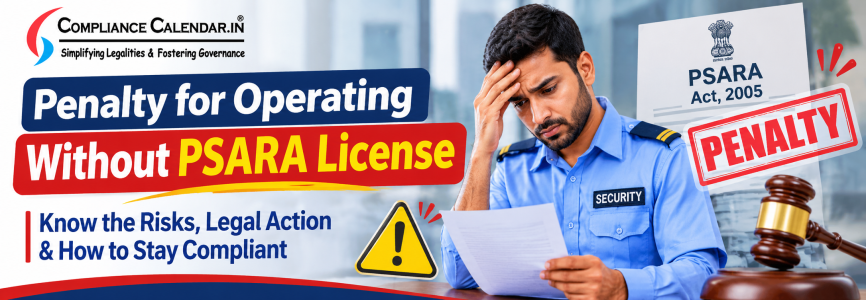



What happens if you run a security agency without a PSARA License? Under Indian law, operating a private security agency without the required licence is illegal. Section 20(1) of the Private Security Agencies (Regulation) Act, 2005 provides for imprisonment of up to one year, a fine of up to Rs. 25,000, or both. Apart from legal action, an unlicensed agency may lose clients, face contract problems and miss business opportunities.
For example, suppose you start supplying security guards to offices, factories or residential societies without obtaining a PSARA License. Even if your company has GST registration and a valid incorporation certificate, you are still required to obtain the applicable security agency licence.
This article explains the legal penalties, business risks and steps you should take if you are already operating without PSARA approval.
Is It Illegal to Run a Security Agency Without a PSARA License?
Yes. Section 4 of the Private Security Agencies (Regulation) Act, 2005 states that no person can start or operate a private security agency without obtaining the required licence. This law applies to businesses providing private security services, including supplying guards to offices, factories, shopping malls, hospitals, hotels and residential societies. The licence is issued by the Controlling Authority of the concerned state or union territory.
For example, a company registered in Delhi may start supplying guards to warehouses in Noida. Although the company has PAN, GST registration and other business documents, these do not replace the PSARA License. The business must obtain the required approval for its operating area before providing security services.
If you are unsure whether your business needs this licence, read our detailed guide on Is PSARA License Mandatory in India? to understand which security agencies require registration and when the licence becomes compulsory.
Common businesses that need to check PSARA requirements include:
- Agencies supplying security guards to offices and corporate buildings.
- Businesses providing guards to factories and warehouses.
- Agencies offering security services to residential societies.
- Companies supplying guards to hospitals, hotels and shopping malls.
- Businesses providing private security personnel for commercial establishments.
To understand the registration requirements, visit our PSARA License Registration service page.
What Is the Penalty for Operating Without a PSARA License?
Under Section 20(1) of the PSARA Act, anyone violating the licensing requirement under Section 4 may face imprisonment, a fine or both. The punishment depends on the facts of the case and the outcome of legal proceedings.
|
Violation |
Possible Punishment |
|
Operating without the required PSARA License |
Imprisonment of up to one year |
|
Operating without the required PSARA License |
Fine of up to Rs. 25,000 |
|
Operating without the required PSARA License |
Both imprisonment and fine |
The fine of Rs. 25,000 is the maximum amount provided under this section, not a fixed penalty imposed automatically. Similarly, imprisonment is a possible legal consequence, but it does not occur automatically whenever an agency is found operating without a licence.
The PSARA Act also contains separate provisions for certain other violations, including requirements relating to security guards, supervisors and uniforms.
What Happens If Authorities Find an Unlicensed Security Agency?
If authorities discover that a business is providing private security services without the required licence, they may examine its operations and take action under the applicable law. They may seek information about the agency, its guards, customers, deployment locations and licensing status. Where a violation is established, legal proceedings may follow.
For example, suppose an agency supplies 20 security guards to a factory in Gurugram without obtaining the required Haryana PSARA License. During a compliance check, the factory management asks the agency to provide its licence. If the agency cannot produce one, the matter may be reported to the relevant authorities.
An unlicensed agency may face several problems:
- Legal proceedings for violating the PSARA Act.
- Possible imprisonment, fine or both.
- Loss of existing security service contracts.
- Rejection from tenders requiring a valid PSARA License.
- Difficulty gaining the trust of new customers.
- Business disruption while resolving licensing issues.
These consequences do not all happen automatically. Legal penalties depend on the law and proceedings, while contract-related problems depend on the agreement between the agency and its customers.
Can You Lose Clients and Security Contracts Without PSARA?
Yes. Many companies, factories, residential societies and government organisations require security agencies to provide a valid PSARA License before signing a contract. Some clients also ask for the licence during annual audits or vendor verification. If the agency cannot provide the required documents, the customer may refuse to appoint it or take action under the contract.
For example, suppose your agency provides 30 guards to a shopping mall. During an internal audit, the management discovers that your agency does not have a valid PSARA License. The mall may decide to terminate the contract and appoint another licensed agency, depending on its agreement. Similarly, government tenders and corporate security contracts often include licensing conditions that an unlicensed business cannot satisfy.
A PSARA License is therefore important not only for legal compliance but also for building trust with customers.
Can the Owner or Directors Face Legal Action?
Yes. Under Section 22 of the PSARA Act, when an offence is committed by a company, the company and persons responsible for conducting its business may face legal proceedings, subject to the conditions and defences provided in the law.
For example, if a private limited company operates a security agency without the required licence, the fact that contracts are signed in the company's name does not automatically protect the people responsible for running the business. However, every director or employee is not automatically guilty. Liability depends on their role, knowledge, involvement and the circumstances of the offence.
This is why business owners and directors should verify licensing requirements before accepting security service contracts.
Can You Operate With a PSARA License From Another State?
A PSARA License issued in one state does not automatically authorise operations in another state. Security agencies must obtain the required licence for the state or union territory where they provide services.
For example, an agency holding a Delhi PSARA License cannot assume that it can supply security guards to a factory in Noida using the same licence. It must check and meet the licensing requirements applicable in Uttar Pradesh.
Before expanding your security agency, check:
- Whether the existing licence covers the proposed operating area.
- Whether a separate state licence is required.
- Whether the licence is valid for the relevant districts.
- Whether additional documents or approvals are necessary.
A business should also check the authorised area mentioned in its existing licence before expanding within the same state.
Can You Start Operations While Your PSARA Application Is Pending?
No. Submitting a PSARA application does not automatically give you permission to start providing regulated security services. An application acknowledgement, payment receipt or verification notice is not the same as an approved licence.
For example, suppose you submit your PSARA application in November and expect approval in December. You may complete permitted business preparations, arrange your office and prepare the required documents. However, you should not begin deploying security guards to customers until the necessary licence has been granted.
The same concern applies when a PSARA License expires. A pending renewal application does not automatically extend an expired licence unless the applicable legal provisions or authority allow continued validity.
What Should You Do If You Are Already Running Without PSARA?
If your agency is already providing security services without the required licence, you should address the situation immediately. Applying for a licence is important, but obtaining approval later does not automatically remove liability for earlier violations.
Follow these steps to address the problem:
- Stop unauthorised operations: Do not continue providing regulated security services without the required approval. Manage any transition responsibly.
- Check your operating locations: Identify the states and districts where your agency provides guards.
- Review your business documents: Prepare company registration details, PAN, address proof and ownership information.
- Check PSARA eligibility: Review the applicable requirements for owners, directors, guards, supervisors and training arrangements.
- Apply for the correct licence: Submit your application to the concerned Controlling Authority.
- Complete verification: Follow the prescribed police verification, training and documentation requirements.
- Wait for approval: Begin or resume regulated security agency operations only after obtaining the necessary valid licence.
- Maintain compliance: Follow licence conditions, keep required records and renew the licence on time.
For example, if an agency has been supplying guards in Delhi and Haryana without the required approvals, it should examine the licensing requirements for both states rather than assuming that one application will cover all operations.
If your agency has already received a legal notice, consult a qualified lawyer about your specific situation.
Does Every Business Hiring Security Guards Need PSARA?
No. There is a difference between a business directly employing guards for its own premises and a private security agency supplying guards to customers.
For example, a factory that directly employs people to protect its own premises is not automatically operating a private security agency merely because it has security staff. However, a company whose business involves supplying security guards to other factories, offices or residential societies generally falls within the PSARA framework.
Similarly, a company that only sells CCTV cameras or installs alarm systems does not automatically require PSARA registration for those activities alone. The requirement depends on whether it provides regulated private security services.
How Compliance Calendar Can Help With PSARA Registration
Starting a security agency involves more than registering a company and hiring guards. You must understand the licensing requirements, identify the correct authority, prepare documents and complete the applicable verification and training procedures. Mistakes during the application process may delay approval and create unnecessary difficulties.
Compliance Calendar LLP helps eligible business owners understand PSARA requirements, prepare documents and complete the applicable registration process. Our team also provides assistance with licence renewal and related compliance requirements.
Need assistance with PSARA License Registration?
Contact Compliance Calendar LLP for professional guidance.
Phone: +91 9988424211
Email: info@ccoffice.in
Frequently Asked Questions (FAQs)
1. What is the penalty for operating a security agency without a PSARA License?
Under Section 20(1) of the Private Security Agencies (Regulation) Act, 2005, operating a security agency without the required licence can result in imprisonment of up to one year, a fine of up to Rs. 25,000, or both. The actual punishment depends on the legal proceedings and circumstances of the case.
2. Is a PSARA License mandatory for all security agencies in India?
Yes. Under Section 4 of the PSARA Act, businesses providing regulated private security agency services must obtain the required licence before starting operations. The licence is issued by the concerned state or union territory's Controlling Authority.
3. Can a security agency owner go to jail for operating without PSARA?
Yes. The PSARA Act provides for imprisonment of up to one year for operating a private security agency without the required licence. However, imprisonment is not automatic. The punishment depends on the facts of the case and the court's decision.
4. Can the government shut down a security agency operating without a PSARA License?
An agency cannot lawfully continue regulated security services without the required licence. Authorities may take action against an unlicensed agency under the applicable law. The exact enforcement measures depend on the circumstances and relevant state procedures.
5. Is the Rs. 25,000 PSARA penalty fixed for every violation?
No. Rs. 25,000 is the maximum fine provided under Section 20(1) for violating the licensing requirement. It is not a fixed penalty automatically imposed in every case. Other violations may attract separate penalties under the Act.
6. Can I start a security agency while my PSARA application is pending?
No. Submitting a PSARA application does not authorise you to begin providing regulated private security services. You must receive the required licence before deploying guards to customers.
7. What happens if my PSARA License expires but I continue operating?
Continuing regulated security agency operations without valid authorisation can create legal risks. You should check the applicable renewal provisions and directions of the concerned Controlling Authority. A pending renewal application does not automatically extend an expired licence.
8. Can I operate a security agency in another state using my existing PSARA License?
No. A PSARA License issued in one state does not automatically permit operations in another state. For example, a Delhi PSARA License does not authorise security agency operations in Haryana or Uttar Pradesh. You must obtain the required approval for the relevant state.
9. Is GST registration enough to operate a private security agency?
No. GST registration, company incorporation and a PAN card do not replace a PSARA License. These documents serve different purposes. A business providing regulated private security services must obtain the required PSARA approval.
10. Can a company director be punished for operating a security agency without PSARA?
Yes. Under Section 22 of the PSARA Act, directors, managers or other persons responsible for the company's business may face legal liability when the conditions stated in the law are met. Liability depends on their involvement and the circumstances of the offence.
11. Can a security agency lose its clients for not having a PSARA License?
Yes. Many factories, offices, hospitals, housing societies and government organisations require a valid PSARA License before appointing a security agency. An unlicensed agency may lose contracts or become ineligible for tenders, depending on the customer's requirements and contract terms.
12. What should I do if I am already running a security agency without PSARA?
You should stop unauthorised regulated operations, review your existing contracts and apply for the required licence through the concerned Controlling Authority. If you have already received a legal notice, seek advice from a qualified lawyer. Obtaining a licence later does not automatically remove liability for past violations.
13. Can I get a PSARA License after starting my security agency?
You can apply for a PSARA License after establishing your business, provided you meet the applicable eligibility requirements. However, you must not carry on regulated security agency operations without the required approval. A licence issued later does not automatically legalise earlier unlicensed operations.
14. Does a company hiring security guards for its own office need a PSARA License?
Not automatically. A company directly employing guards to protect its own premises is different from a private security agency supplying guards to customers. The requirement depends on the nature of the business and the services provided.
15. How can I avoid penalties under the PSARA Act?
The best way to avoid penalties is to obtain the required PSARA License before starting regulated security agency operations and follow its conditions. Keep your licence valid, comply with applicable guard verification and training requirements, maintain required records and apply for renewal on time. For professional assistance, visit PSARA License Registration.
Article last updated on : 31 Oct 2026.














_learn_crop10_thumb.jpg)