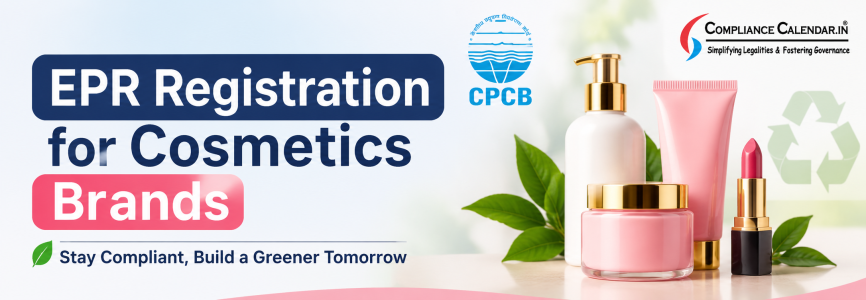



If you sell shampoo, face wash, lipstick, perfume, skincare products or other beauty products in plastic packaging, your business may need EPR Registration. EPR stands for Extended Producer Responsibility. It means that businesses covered by the Plastic Waste Management Rules must take responsibility for the plastic packaging waste created by their products. This requirement can apply to cosmetics manufacturers, importers and brand owners, including businesses that get their products manufactured by another company.
For example, suppose you start a skincare brand and sell face wash in plastic tubes, shampoo in plastic bottles and moisturiser in plastic jars. After customers finish using these products, the empty packaging becomes waste. Under India's plastic waste rules, your business may have to register, report how much plastic packaging it uses and meet the applicable recycling responsibilities. This article explains which beauty businesses need EPR Registration, what packaging is covered, how to apply and what happens after registration.
What Is EPR Registration for Cosmetics?
EPR Registration for cosmetics is generally registration under India's Plastic Waste Management Rules for businesses dealing in covered plastic packaging. It is not a separate licence issued only for the cosmetics industry. The rules apply to different businesses, including food companies, personal care brands, household product manufacturers and beauty brands.
For example, a company selling shampoo in plastic bottles and another company selling face cream in plastic jars may both have EPR responsibilities. The products are different, but both businesses place plastic packaging on the market. Under EPR, eligible businesses must register with the relevant authority and meet their waste management responsibilities.
The main law is the Plastic Waste Management Rules, 2016, along with later amendments and the EPR Guidelines for Plastic Packaging introduced in 2022.
If you want to understand the general requirements first, read Compliance Calendar's guide to EPR Plastic Waste Registration.
Which Cosmetics and Beauty Products Come Under EPR?
One of the biggest questions for beauty brands is whether EPR applies to their products. The important thing to understand is that plastic EPR mainly concerns the packaging, not the cosmetic product inside it.
For example, face cream itself is not plastic packaging. However, the plastic jar, cap, wrapper or other plastic packaging used to sell it may be covered by EPR requirements.
Here are some common examples.
|
Beauty Product |
Packaging Example |
EPR Requirement to Check |
|
Shampoo |
Plastic bottle and cap |
Rigid plastic packaging |
|
Conditioner |
Plastic bottle or refill pouch |
Rigid or flexible plastic packaging |
|
Face wash |
Plastic tube |
Plastic packaging category based on its material |
|
Moisturiser |
Plastic jar and lid |
Rigid plastic packaging |
|
Body lotion |
Plastic pump bottle |
Plastic packaging and its components |
|
Sunscreen |
Plastic tube or bottle |
Plastic packaging |
|
Lipstick |
Plastic lipstick case |
Whether the component qualifies as covered packaging |
|
Lip balm |
Plastic container |
Rigid plastic packaging |
|
Face serum |
Glass bottle with plastic dropper or cap |
Plastic packaging components |
|
Perfume |
Glass bottle with plastic cap or wrapping |
Plastic packaging components |
|
Hair oil |
Plastic bottle |
Rigid plastic packaging |
|
Hair colour |
Plastic sachet, tube or bottle |
Flexible or rigid packaging |
|
Face mask |
Plastic sachet |
Flexible plastic packaging |
|
Makeup remover |
Plastic bottle |
Rigid plastic packaging |
|
Wet wipes |
Plastic packet |
Flexible plastic packaging |
|
Beauty gift set |
Plastic tray, wrap or outer packaging |
Applicable plastic packaging categories |
These examples are useful for identifying packaging that needs to be checked. The exact category depends on the material and construction of the packaging.
Example: Shampoo Brand
Suppose your company sells 50,000 shampoo bottles in a year. Each bottle has a plastic body, plastic cap and plastic label. You should identify the packaging materials, calculate the relevant plastic quantities and determine which EPR requirements apply to your business.
You cannot decide your EPR responsibility only by counting the bottles. The weight and category of the plastic packaging also matter.
Example: Skincare Brand
Imagine that your brand sells face wash in plastic tubes, face cream in plastic jars and face masks in plastic sachets. These products may use different types of packaging. You should not automatically place all of them in the same EPR category.
Maintaining product-wise packaging records makes it easier to prepare your registration details and calculate applicable EPR obligations.
Who Needs EPR Registration in the Cosmetics Industry?
Not every person selling cosmetics needs EPR Registration. The requirement depends on the business's role and the packaging it places on the Indian market.
The Plastic Waste Management Rules identify different regulated businesses, including producers, importers and brand owners. These are often called PIBOs.
1. Cosmetics Brand Owners
A brand owner sells products under its own brand or label. The company may manufacture the products itself or get them manufactured by another business.
For example, suppose you launch a skincare brand called GlowCare. You do not own a factory. Instead, a third-party manufacturer produces your face wash and moisturiser, and the products are sold under the GlowCare name. You may still have EPR responsibilities as a brand owner because the products are sold under your brand.
Outsourcing manufacturing does not automatically remove a brand owner's EPR responsibilities.
2. Cosmetics Importers
Businesses importing cosmetics in plastic packaging may also fall under EPR requirements.
For example, a company imports Korean skincare products, Japanese face masks or European hair care products and sells them in India. If the imported products arrive in covered plastic packaging, the importer should check its registration and reporting responsibilities.
Other examples include importing makeup kits in plastic boxes, shampoo bottles, skincare tubes, beauty gift sets with plastic trays and cosmetic products wrapped in plastic film.
3. Plastic Packaging Producers
A company manufacturing plastic packaging for cosmetics may have separate responsibilities as a plastic packaging producer.
For example, a factory manufacturing plastic shampoo bottles, cosmetic jars or flexible packaging pouches should check the producer requirements under the Plastic Waste Management Rules.
4. Online Beauty Brands
Many beauty businesses sell through their own websites or online marketplaces. Selling online does not automatically remove EPR responsibilities.
For example, a skincare startup may sell its products through its own website, Amazon, Flipkart or Nykaa. If the startup is a covered brand owner placing plastic-packaged products on the Indian market, it should check its EPR obligations.
However, a retailer that simply resells another company's products is not automatically treated in the same way as the brand owner. Its exact role must be considered.
What About Small Cosmetics Businesses?
The rules contain special provisions and exclusions for certain micro and small enterprises. These should be checked carefully because registration duties and EPR obligations are not always identical.
For example, a small homegrown beauty brand should not assume that it needs every registration required of a large cosmetics company. Equally, it should not assume that being small automatically removes every responsibility.
The correct answer depends on its business classification, activities and the applicable legal provisions.
Types of Plastic Packaging Used by Beauty Brands
The EPR rules divide plastic packaging into categories. Understanding these categories is important because different packaging types can have different recycling and reporting requirements.
|
Packaging Category |
General Meaning |
Cosmetics Example |
|
Category I |
Rigid plastic packaging |
Shampoo bottles, plastic jars and rigid containers |
|
Category II |
Flexible plastic packaging made of plastic layers |
Certain refill pouches, plastic wrappers and sachets |
|
Category III |
Multilayer packaging containing plastic and at least one non-plastic material |
Certain laminated cosmetic sachets |
|
Category IV |
Compostable plastic packaging covered by the rules |
Qualifying certified compostable plastic packaging |
The category cannot always be identified just by looking at the product. For example, two face mask sachets may look similar but use different materials. One may contain only plastic layers, while another may combine plastic with aluminium foil or another non-plastic material.
Beauty brands should ask their packaging suppliers for accurate material details rather than guessing.
Does EPR Apply to Glass Cosmetic Bottles?
A glass bottle is not plastic packaging simply because it contains a cosmetic product. However, the same product may have a plastic cap, pump, dropper, sleeve or other plastic packaging components.
For example, a perfume bottle may be made of glass but use a plastic cap and plastic outer wrapping. A face serum may come in a glass bottle with a plastic dropper assembly. These components should be examined separately.
Businesses should also check whether other packaging-specific waste management rules apply to their materials.
Is EPR Registration Required for Private Label Cosmetics?
Yes, a private label cosmetics business may need EPR Registration if it falls within the applicable brand owner requirements. Private label manufacturing is common in the beauty industry. A business chooses products, packaging and branding, while another company manufactures the cosmetics.
For example, suppose a company in Delhi gets its sunscreen, face wash and body lotion manufactured by a factory in Haryana. The products are sold under the Delhi company's brand name. The brand owner should check its EPR responsibilities even though it does not manufacture the cosmetics itself.
The manufacturer and brand owner may have different legal roles. They should identify who is responsible for the plastic packaging introduced into the market and maintain proper records.
Documents Required for EPR Registration for Cosmetics Brands
The documents required depend on whether the applicant is a producer, importer or brand owner. Businesses should prepare their registration details and packaging records before starting the application.
|
Document or Information |
Purpose |
|
Business PAN |
Business identification |
|
Verification of business details |
|
|
Incorporation Certificate or business registration proof |
Proof of business structure |
|
Registered Address |
Business address verification |
|
Authorised Person Details |
Person responsible for the application |
|
Brand Details |
Identification of the cosmetics brand |
|
Product List |
Details of cosmetics sold or imported |
|
Plastic Packaging Details |
Packaging type and category |
|
Packaging Weight and Quantity Records |
Calculation of relevant plastic quantities |
|
Sales or Import Records |
Supporting information for EPR obligations |
|
Import Export Code, where applicable |
Importer information |
|
Declarations and other supporting documents |
As required by the portal |
The exact document list may differ depending on the applicant category and current portal requirements.
Example: What Records Should a Beauty Brand Maintain?
Suppose your brand sells five products: shampoo, conditioner, face wash, body lotion and sunscreen. Each product comes in different packaging.
You should maintain records showing the product name, packaging material, packaging category, weight of relevant plastic packaging and quantities placed on the market. If the same product comes in different sizes, such as 100 ml and 250 ml bottles, you should account for the packaging differences.
This information can help with registration, EPR calculations and annual reporting.
For a broader document checklist, see EPR Plastic Registration for Importers & Brands.
How to Apply for EPR Registration for Cosmetics Online
EPR Registration for covered plastic packaging is completed through the applicable government online system.
Step 1: Identify Your Business Category
First, decide whether your business is a producer, importer or brand owner under the applicable rules.
For example, a company selling its own skincare products under its brand may be a brand owner. A company importing packaged cosmetics may fall under the importer category.
Step 2: Identify Your Plastic Packaging
Prepare details of the plastic bottles, tubes, jars, sachets, wrappers and other covered packaging used by your business.
Check the packaging material and category carefully.
Step 3: Open the Government EPR Portal
Use the current CPCB EPR system and follow the registration instructions for plastic packaging.
Official portal: CPCB Common EPR Portal.
Step 4: Enter Business and Product Details
Provide the required business information, authorised person details, brand information and packaging quantities.
Step 5: Upload Documents
Upload the required documents and declarations in the prescribed format.
Step 6: Pay the Applicable Government Fee
Pay the government registration fee according to the current fee schedule and your applicant category.
Step 7: Complete Verification
The authority may review your application and ask for corrections or additional information.
Step 8: Receive Your EPR Registration Certificate
After approval, the registration certificate is made available through the applicable government system.
Remember that receiving the certificate does not mean all your EPR responsibilities have been completed.
EPR Registration Fees for Cosmetics Brands
There is no separate universal government fee simply because a company sells cosmetics. Plastic EPR registration fees depend on the applicant category and the applicable government fee schedule. A beauty brand should distinguish between the government registration fee and the cost of meeting its EPR responsibilities.
For example, a company may pay the prescribed fee to register as a brand owner. Later, it may also need to meet recycling obligations, maintain packaging records and complete applicable annual filings.
Professional consultancy fees, if any, are separate from government charges. For an estimate based on your business, you should identify whether you are a manufacturer, importer or brand owner, the packaging categories involved and the quantities of plastic packaging placed on the market.
Latest EPR Rules for Cosmetics Brands in 2026
Cosmetics businesses should be aware of changes to India's plastic waste management system.
1. CPCB Common EPR Portal
The earlier Plastic EPR Portal was discontinued for regular operations from 28 June 2026. CPCB migrated existing user data to the new Common EPR Portal.
Businesses that already had accounts on the previous portal should check their migrated information and follow the new login instructions.
Official website: CPCB Common EPR Portal.
2. Plastic Waste Management Amendments
The Plastic Waste Management Rules have been amended several times, including in 2024, 2025 and 2026.
Beauty brands should check the current rules for requirements relating to packaging categories, recycled plastic content, reuse, labelling and EPR reporting, wherever applicable.
Not every requirement applies to every packaging category or every business.
3. EPR Is More Than Registration
Plastic EPR is not limited to obtaining a certificate. Covered businesses must also follow the relevant waste management responsibilities, including applicable recycling targets, record keeping and reporting.
For example, a cosmetics brand may have to calculate how much plastic packaging it introduces into the market and fulfil the obligations assigned under the rules.
Businesses should use the current government rules and portal notices rather than relying only on older registration guides.
What Happens After EPR Registration?
After receiving an EPR Registration Certificate, a cosmetics brand may need to meet annual waste management targets, maintain accurate packaging records and submit returns.
Example: A Beauty Brand With Multiple Products
Suppose your business sells shampoo, conditioner, face wash, body lotion and moisturiser. Each product has different plastic packaging.
You should keep records of the packaging used for each product and the quantities introduced into the market. These records help determine the applicable EPR responsibilities.
A registered brand owner may fulfil recycling-related obligations through the mechanisms allowed under the rules, including the use of eligible EPR certificates generated by registered plastic waste processors.
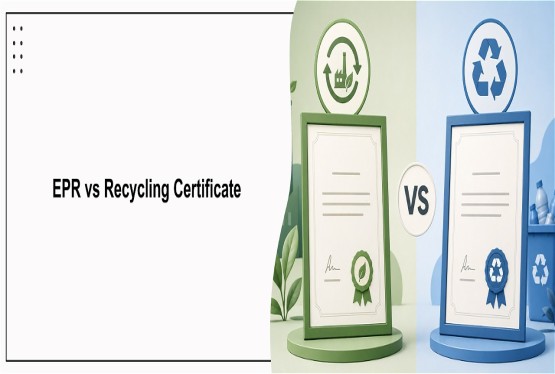
What Are EPR Recycling Certificates?
An EPR recycling certificate is different from the registration certificate issued to a business. Registered plastic waste processors can generate eligible EPR certificates for qualifying waste processing activities. Covered businesses may use the applicable certificates to meet their EPR obligations according to the government rules.
Buying or transferring certificates does not replace the need to maintain accurate records and complete other applicable compliance requirements.
Common EPR Mistakes Made by Cosmetics Brands
Many new beauty businesses make mistakes because they do not understand how plastic EPR applies to their products.
Some common problems include:
- Assuming that only the cosmetics manufacturer needs EPR Registration.
- Ignoring plastic packaging because the main product is made of another material.
- Forgetting to account for plastic caps, wrappers or other relevant packaging components.
- Treating all flexible packaging as the same category.
- Estimating packaging quantities without checking actual weights.
- Assuming that selling through an online marketplace removes EPR responsibilities.
- Believing that EPR compliance ends after receiving the registration certificate.
- Using outdated portal instructions or old government notices.
For example, a skincare brand may correctly record its plastic bottles but forget about the plastic packaging used for refill products. Another company may classify laminated cosmetic sachets without checking their material composition.
Keeping accurate packaging records from the beginning can help avoid these problems.
How Compliance Calendar Helps Cosmetics and Beauty Brands
EPR Registration can be confusing for a new cosmetics business, especially when it sells several products in different packaging materials. A company may understand how to manufacture and market skincare products but still be unsure about plastic packaging categories, registration requirements or annual EPR responsibilities.
Compliance Calendar LLP assists cosmetics manufacturers, importers, private label businesses and beauty brand owners with understanding their applicable EPR requirements, preparing documents and completing the relevant registration process.
Our team can also assist with applicable EPR compliance and annual return requirements.
If you are planning to launch a cosmetics brand or already sell beauty products in plastic packaging, you can contact us for guidance.
Compliance Calendar LLP
Phone: +91 9988424211
Email: info@ccoffice.in
Frequently Asked Questions
1. Is EPR Registration mandatory for cosmetics brands in India?
EPR Registration may be mandatory for cosmetics businesses covered by the Plastic Waste Management Rules. The requirement depends on whether the business is a producer, importer or brand owner, the packaging it uses and any applicable exclusions.
2. Does a shampoo manufacturer need EPR Registration?
A shampoo manufacturer should check whether it falls under the applicable producer or brand owner requirements. Plastic shampoo bottles, caps and other covered packaging may create EPR responsibilities.
3. Is EPR required for skincare brands?
Skincare brands selling products in plastic packaging may need EPR Registration. Examples include face wash tubes, moisturiser jars, sunscreen bottles and face mask sachets.
4. Do private label cosmetics brands need EPR Registration?
Private label cosmetics businesses may need registration as brand owners if they are covered by the rules. Getting products manufactured by another company does not automatically remove their responsibilities.
5. Is EPR required for imported cosmetics?
Importers bringing cosmetics into India in covered plastic packaging should check the applicable plastic EPR registration requirements.
6. Do small beauty brands need EPR Registration?
The answer depends on the business's legal classification, activities and applicable exemptions or special provisions. Small businesses should check the current rules rather than assuming that every requirement applies to them.
7. Is EPR Registration required for glass perfume bottles?
Plastic EPR does not apply to a glass bottle merely because it contains perfume. However, plastic caps, wrappers and other plastic packaging components may need to be considered.
8. Does a cosmetics brand need EPR Registration if it sells on Amazon or Nykaa?
Selling through an online marketplace does not automatically remove a brand owner's EPR responsibilities. The requirement depends on the business's role and packaging.
9. How can cosmetics brands apply for an EPR Certificate online?
Eligible businesses can apply through the applicable government EPR portal by submitting their business details, packaging information, documents and prescribed fee.
10. What happens after receiving an EPR Registration Certificate?
Covered businesses must continue meeting their applicable EPR obligations. These may include recycling targets, packaging records, EPR certificate transactions and annual returns.
Article last updated on : 31 Oct 2026.














_learn_crop10_thumb.jpg)