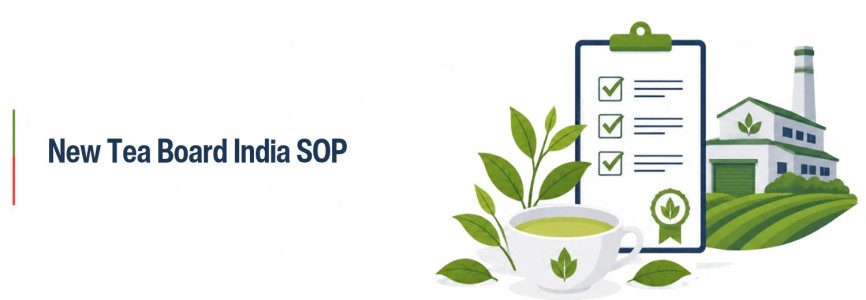



India’s tea industry includes growers, manufacturers, warehouses, importers, exporters and sellers. Each business handles different responsibilities, but accurate records and product quality remain important throughout the supply chain. Tea Board India’s Standard Operating Procedures, commonly called SOPs, explain how specific processes should be completed and help businesses organise their compliance work.
The expression “New Tea Board India SOP” refers to several separate procedures rather than one combined official manual for every tea business. These procedures cover activities such as tea sampling, import testing, manufacturer reporting, voluntary certification and auction operations. Businesses must identify the documents relevant to their activities and read them together with subsequent amendments.
This article explains these procedures in simple English and describes how businesses can turn applicable requirements into everyday working practices.
What Is a Tea Board India SOP?
A Tea Board India SOP is a written procedure that explains how a particular regulatory or administrative activity should be carried out. Depending on its purpose, it may identify the responsible parties, necessary documents, verification process, reporting requirements and possible action for non-compliance.
For example, the tea sampling SOP explains how samples should be collected and handled for food safety assessment. The Form E SOP addresses monthly information submitted by manufacturers. The Tea Mark SOP deals with a separate voluntary certification process. Understanding these differences helps a business avoid applying the wrong procedure to its operations.
Why Tea Board Compliance Matters
A tea business needs reliable information about the products it produces, purchases, stores and sells. When invoices, warehouse records and reporting figures do not match, employees may struggle to explain transactions during an inspection or review. Clear compliance procedures make it easier to identify differences and resolve them promptly.
Organised compliance also supports daily business operations. Warehouse employees can locate the correct stock, accounts teams can prepare accurate returns, and management can track outstanding approvals. These activities work best when responsibilities are clearly assigned and information moves between departments on time.
Which Businesses Should Review Tea Board SOPs?
Businesses should review Tea Board procedures according to the activities they actually perform. A manufacturer may need to focus on production records, monthly returns and sampling arrangements. An importer must examine the current import directions, while an eligible business seeking Tea Mark certification must follow the certification and batch permission process.
A business carrying out several activities may need more than one internal checklist. For example, a manufacturer that also imports tea should review the requirements applicable to both activities. Holding one registration or certificate should not be assumed to satisfy every separate reporting, testing or operational requirement.
Tea Sampling SOP and Food Safety Assessment
Tea Board’s sampling procedure establishes a consistent method for collecting representative samples to assess conformity with food safety standards. It addresses bulk and packet teas at different locations in the supply chain, including factories, warehouses, buyer premises and auction centres.
The purpose of a controlled sampling process is to connect the tested sample with the relevant tea lot or batch. Proper identification, handling and documentation help preserve the reliability of laboratory assessment. Businesses should therefore ensure that employees can locate the relevant stock and produce the records connected with it.
Regulatory Samples
Regulatory samples are collected for compliance monitoring. Where analysis produces an adverse result, action may be initiated under the applicable legal provisions. Businesses should carefully retain the sampling documents and understand any instructions issued during the inspection.
For regulatory bulk sampling, the relevant lot is placed under seizure under the stated procedure. The stock must be stored separately and cannot be moved, released or tampered with without prior written permission from the competent authority. The warehouse and dispatch teams should receive clear instructions so affected goods are not accidentally released.
Surveillance Samples
Surveillance samples are collected for monitoring, research or information gathering. Under the stated sampling SOP, their results are not to be used to initiate legal or regulatory action. The purpose of sampling therefore matters when understanding how the results may be used.
Businesses should retain the inspection paperwork and check the classification recorded for the sample. This helps employees distinguish surveillance activity from regulatory sampling and respond appropriately to subsequent communication.
Sample Collection and Documentation
The sampling procedure contains requirements concerning sample quantities, packaging, sealing and identification. Businesses should cooperate with authorised officials and retain the relevant acknowledgements and documents.
As an internal preparation measure, the business can appoint an employee who understands its stock records and warehouse layout. This person should be able to identify the selected lot, retrieve supporting invoices and communicate operational instructions to the relevant teams.
Tea Import Testing and Clearance
Tea Board’s February 2026 directive introduced mandatory testing of tea import consignments from 1 May 2026. Subsequent import directions were also published, so importers should examine the latest operative requirements before planning a shipment.
Import compliance should be considered before the goods arrive. Purchasing, finance and logistics teams should work from the same verified information about the consignment. Delivery commitments should also allow for the applicable inspection, testing and clearance arrangements.
Preparation of Import Documents
A practical shipment file should bring together the commercial invoice, packing information, transport records, applicable authorisations and clearance correspondence. Keeping these records together makes it easier to respond to requests for clarification.
Before submission, employees should compare important details across documents. Differences in product descriptions, quantities, business names or shipment references can create avoidable queries. An internal document review can help identify these problems early.
Coordination During Clearance
Import transactions may involve several parties, including the importer, logistics provider, customs representative and warehouse operator. Clear communication helps ensure that everyone understands the status of the shipment and any outstanding requirements.
A useful internal approach is to appoint one coordinator to maintain the shipment file and track unresolved queries. Other teams can continue handling their specialist responsibilities while relying on the same current information.
Form E Monthly Return for Tea Manufacturers
Form E is a monthly reporting requirement for registered tea manufacturers. The relevant notification requires submission on or before the seventh day of the following month through the Board’s designated online system. For example, the ordinary deadline for reporting April’s information is 7 May.
The return captures manufacturing and related business information. Timely filing is important, but businesses must also ensure that the figures are accurate and the relevant fields are completed. A return should be prepared from supporting records rather than estimates made at the last moment.
Information Reported in Form E
Form E includes information about production, sales, tea waste, green leaf payments to small tea growers and private sales. Preparing these details requires cooperation between factory staff and the accounts team because different departments may maintain different parts of the information.
A month-end review should bring these records together before filing. Where figures differ, employees should investigate the reason and document any correction. This process can also reveal weaknesses in the way transactions are recorded during the month.
Verification Before Filing
The employee preparing the return should compare the figures with the relevant operational and financial records. The notification specifically refers to private sale information being supported by sales registers and corroborated with GST returns.
A review by another authorised employee can help identify missing information or inconsistent figures. After submission, the acknowledgement and working records should be retained together so the business can explain how the reported information was prepared.
Consequences of Reporting Failures
The Form E notification warns that non-submission, late submission or incomplete submission may lead to suspension or cancellation of the manufacturer’s licence. Monthly reporting should therefore have a clearly assigned owner and an established review process.
An internal deadline before the official due date gives employees time to resolve discrepancies. A backup employee should also understand the filing process so that absence or staff changes do not interrupt compliance.
Tea Mark Certification
Tea Mark is a voluntary certification process for eligible Indian teas. It addresses quality verification, traceability and authorised use of the certification mark. Businesses considering the scheme should review its eligibility conditions and any subsequent notifications before applying.
The published SOP initially covers registered Mini Tea Units and Bought Leaf Factories. Expansion to other categories is subject to further notifications. Applicants should therefore confirm current eligibility rather than assuming that every manufacturer, packer or exporter is automatically covered.
Certification and Batch Permission
The Tea Mark process separates the certificate from permission for a particular batch. Businesses should understand both stages before planning packaging or sales involving the mark.
An internal register can connect the certificate, batch details and relevant permissions. This helps the packaging and sales teams check that the product concerned has completed the applicable process before it is offered for sale using the mark.
Documents Required for Application
The published instructions require a properly signed application and supporting documents such as the TMCO certificate, relevant QR code cards, GST registration certificate and FSSAI registration certificate.
Applicants should check that the documents are current and show consistent business details. Differences in the entity name, address or authorised signatory information should be resolved before submission where necessary.
Published Application Fees
The published fee is ?1,000 plus GST for a new or renewed Tea Mark certificate. The separately published batch permission fee is ?5,400 plus GST.
Businesses should check for revisions before making payment. For internal budgeting, certification and batch permission should be treated as separate application stages rather than assuming that payment for the certificate covers every subsequent batch.
Validity, Renewal and Logo Use
The published SOP provides a three-year certificate validity and requires renewal applications at least 30 days before expiry. Businesses should record the expiry date and begin preparing the renewal application early enough to address missing documents.
Logo use also requires internal control. Employees approving packaging should check the applicable permission and guidelines. The SOP provides for suspension or cancellation in cases involving misuse of the logo or failure of a retail sample test.
Revised Dust Tea Auction Procedures
Tea Board has published revised procedures and compliance directions concerning dust tea auctions, including an October 2026 circular. Businesses handling affected transactions should review the relevant revised document before continuing with an older checklist.
Version control is particularly important where procedures have changed more than once. Employees may continue following familiar instructions unless management clearly communicates the revision. The business should record which circular its internal auction procedure follows and update the instructions when relevant changes are issued.
How to Prepare an Internal Tea Compliance Manual
An internal compliance manual should connect applicable requirements with the people and records involved in daily work. It should explain who prepares information, who reviews it, where documents are stored and how problems are escalated.
The following measures are practical management suggestions. The precise legal obligations remain those contained in the applicable official documents.
Assign Clear Responsibilities
Each compliance activity should have a named owner. The accounts team may prepare reporting information, warehouse staff may maintain stock identification, and a senior employee may oversee regulatory correspondence.
Responsibility should cover both preparation and review. Employees should know who checks their work and whom to contact when records are incomplete or an instruction is unclear.
Maintain a Document Register
A document register should identify the relevant SOPs, circulars and permissions, together with their issue dates and internal reviewers. When a document is replaced, the previous version should be clearly marked to prevent further use.
This makes it easier to identify the source behind an internal procedure. It also helps management review whether employees are working from current instructions.
Connect Stock and Transaction Records
Consistent lot references should be used across purchase documents, production records, warehouse entries and sales invoices wherever practical. Employees should be able to explain where a lot came from, where it is stored and which transactions relate to it.
Periodic internal checks can show whether those connections work. If a selected lot takes considerable time to trace, the business may need to improve its recordkeeping or stock identification process.
Maintain a Compliance Calendar
A compliance calendar should capture applicable filing dates, certificate expiries and internal review deadlines. Reminders should reach both the person responsible for preparation and the reviewer.
The calendar should also allow preparation time. Starting document collection only on the official due date increases the risk that missing information will delay completion.
Establish an Inspection Response Process
Employees should know who will receive inspecting officials, retrieve documents and communicate instructions to operational teams. Inspection records and acknowledgements should be stored together.
A clear response process helps the business provide consistent information. It also reduces the risk of an operational mistake, such as dispatching stock that is subject to a recorded restriction.
Correct Errors and Review Their Cause
When an error is discovered, the business should correct it and examine why it happened. The cause may be inconsistent stock descriptions, delayed information sharing or unclear responsibility.
Recording the corrective action helps prevent repetition. Over time, this makes the manual more useful because it reflects actual operational problems and the measures introduced to resolve them.
Common Compliance Mistakes to Avoid
A frequent mistake is assuming that every Tea Board procedure applies to every business. Another is relying on an old circular without checking whether a later direction has changed the process. Both can lead employees to follow an incomplete or unsuitable checklist.
Businesses should also avoid preparing returns without checking supporting records or approving certification claims without reviewing the relevant permission. Clear ownership, consistent records and dated source documents make these mistakes easier to prevent.
Conclusion
Tea Board India’s SOPs address different activities across the tea industry, including sampling, imports, monthly reporting, voluntary certification and auction operations. Businesses should identify the procedures that apply to them and ensure that their internal instructions reflect the current requirements.
A useful compliance manual gives employees clear responsibilities and connects filings, permissions and inspections with reliable supporting records. Regular review, timely reporting and effective coordination between departments help businesses manage these obligations more accurately.
Frequently Asked Questions (FAQ's)
Q1. What is the new Tea Board India SOP?
Ans. The expression generally refers to separate Standard Operating Procedures issued by Tea Board India for particular activities. These include tea sampling, manufacturer reporting, import-related processes and Tea Mark certification. There is no single combined SOP that automatically covers every tea business.
Q2. Do all Tea Board SOPs apply to every tea business?
Ans. No. Applicability depends on the business’s activities and the scope of the relevant document. A manufacturer, importer, warehouse operator and certification applicant may have different responsibilities. Businesses carrying out several activities may need to follow more than one procedure.
Q3. What is the purpose of the tea sampling SOP?
Ans. The sampling SOP establishes a consistent procedure for collecting and handling representative tea samples for food safety assessment. It helps connect a sample with the relevant lot or batch and supports reliable laboratory analysis through identification, sealing and documentation controls.
Q4. What is the difference between regulatory and surveillance samples?
Ans. Regulatory samples are collected for compliance monitoring, and adverse results may support action under applicable provisions. Surveillance samples are collected for monitoring, research or information gathering. Under the stated SOP, surveillance results are not to be used to initiate legal or regulatory action.
Q5. Can a business sell stock placed under seizure during regulatory sampling?
Ans. Under the stated bulk sampling procedure, the affected lot must be kept separately and cannot be moved, released or tampered with without prior written permission from the competent authority. Businesses should communicate the restriction clearly to warehouse and dispatch employees.
Q6. What is the due date for the Form E monthly return?
Ans. The relevant notification requires registered manufacturers to submit Form E on or before the seventh day of the following month. For example, April’s information is ordinarily due by 7 May. Businesses should also check any applicable official directions affecting a particular reporting period.
Q7. What information is included in Form E?
Ans. Form E includes information relating to production, sales, tea waste, green leaf payments to small tea growers and private sales. The figures should be supported by the relevant operational and financial records and checked before submission.
Q8. What can happen if Form E is filed late or remains incomplete?
Ans. The notification warns that non-submission, late submission or incomplete submission may lead to suspension or cancellation of the manufacturer’s licence. Businesses should assign responsibility for preparation and review and retain the filing acknowledgement.
Q9. Is Tea Mark certification mandatory?
Ans. Tea Mark is described in the published SOP as a voluntary certification process. Businesses choosing to participate must satisfy the applicable eligibility conditions and follow the certification, batch permission and logo-use requirements.
Q10. Who is initially eligible for Tea Mark certification?
Ans. The published SOP initially covers Mini Tea Units and Bought Leaf Factories registered under the Tea (Marketing) Control Order, 2003. Expansion to other stakeholder categories is subject to further notifications, so current eligibility should be checked before applying.
Article last updated on : 31 Oct 2026.










_learn_crop10_thumb.jpg)