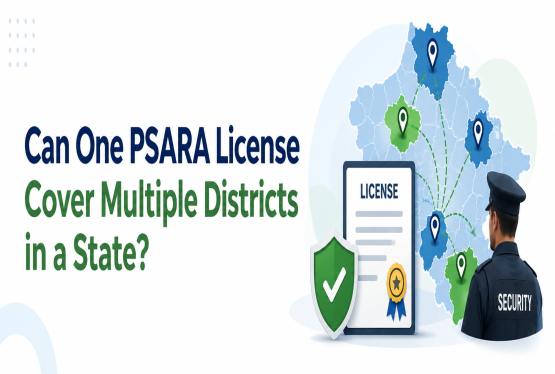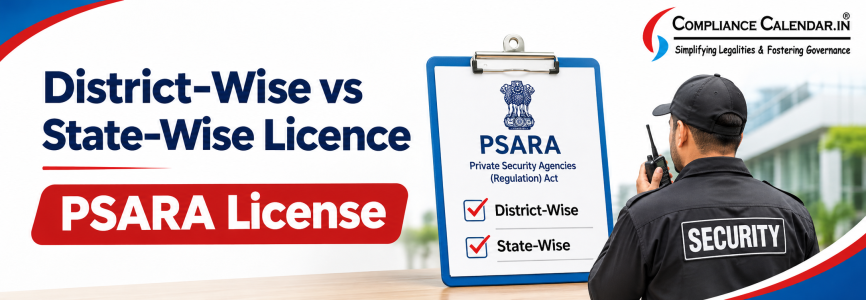



Planning to start a private security agency in India? One of the first decisions you need to make is where you want to provide security services. Do you plan to work in one district, serve clients in several districts or operate across an entire state? Your answer will help you choose the right PSARA License.
Under the Private Security Agencies (Regulation) Act, 2005, a PSARA License can be obtained for one district, more than one district or the whole state. The government application fee also depends on the selected area. For one district, the fee is Rs 5,000; for more than one and up to five districts, it is Rs 10,000; and for the whole state, it is Rs 25,000.
The main difference between district-wise and state-wise PSARA licensing is the area in which your agency is allowed to operate. This guide explains both options, their fees, documents, application requirements and what you should consider before choosing one.
What Is a PSARA License?
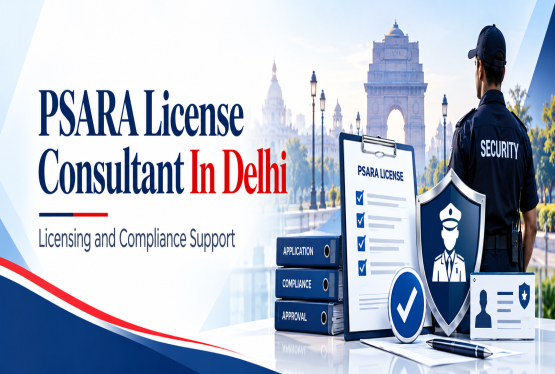
A PSARA License is the legal permission required to run a private security agency in India. It is issued under the Private Security Agencies (Regulation) Act, 2005, which is commonly called the PSARA Act. The law regulates businesses that provide private security services, such as security guards and supervisors for offices, factories, residential societies, hospitals, shopping centres, warehouses and other establishments.
One important feature of PSARA licensing is that the applicant must select the area where the agency plans to operate. This can be one district, multiple districts within the same state or the entire state.
What Is the Difference Between District-Wise and State-Wise PSARA License?
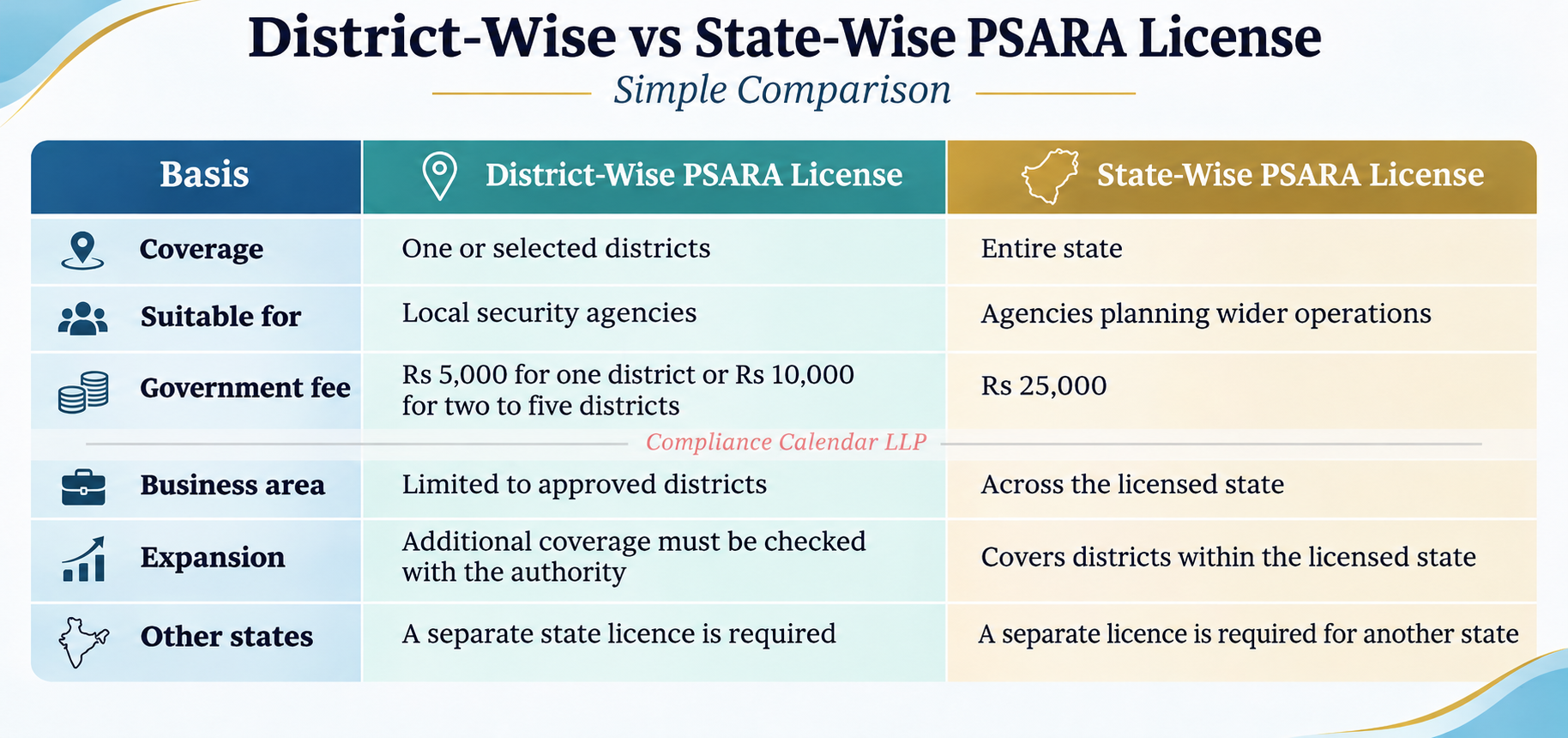
The main difference is the geographical coverage of the licence.
A district-wise PSARA License covers the district or districts approved under the licence. It is generally suitable for an agency that plans to serve clients in a limited area.
A state-wise PSARA License covers the entire state for which the licence is granted. It is generally suitable for an agency planning to provide security services in different districts across that state.
The Ministry of Home Affairs confirms that a licence can be obtained for one district, a number of districts or the whole state.
Here is a simple comparison:
|
Basis |
District-Wise PSARA License |
State-Wise PSARA License |
|
Coverage |
One or selected districts |
Entire state |
|
Suitable for |
Local security agencies |
Agencies planning wider operations |
|
Government fee |
Rs 5,000 for one district or Rs 10,000 for two to five districts |
Rs 25,000 |
|
Business area |
Limited to approved districts |
Across the licensed state |
|
Expansion |
Additional coverage must be checked with the authority |
Covers districts within the licensed state |
|
Other states |
A separate state licence is required |
A separate licence is required for another state |
Both options fall under the same PSARA Act. The difference is not the type of security service an agency can provide, but the area in which it is permitted to operate.
A Real Client Journey: Expanding a Security Agency in Gurugram, Haryana
One of our clients from Gurugram, Haryana, approached us to start a private security agency. Initially, he planned to provide security guards only in Gurugram, so he needed a one-district PSARA License, for which the government fee was Rs 5,000. As his business grew, he started receiving enquiries from clients in Faridabad and Sonipat. He then wanted to expand his services to all three districts and needed to check the process for extending his licence. For two to five districts, the government fee is Rs 10,000.
Later, as he received more business opportunities from different parts of Haryana, he decided to expand across the state. He then considered applying for a whole-state PSARA License, for which the government fee is Rs 25,000. This journey shows why choosing the right PSARA License is important. Your licence should cover the area where you plan to provide security services, and you should obtain the required approval before expanding into additional districts.
What Is a District-Wise PSARA License and Who Should Apply?
A district-wise PSARA License is meant for an agency that wants to provide security services in one district or a limited number of districts within a state.
For example, suppose you want to start a security agency in Jaipur and your initial clients are offices, residential societies and commercial buildings located only in Jaipur district. You may consider applying for a one-district licence. If your agency plans to serve clients in two to five districts within the same state, the applicable fee category under Section 7(3) of the Act is different.
A district-wise licence may be suitable for:
- New security agencies starting with a limited service area.
- Small businesses working with local offices and residential societies.
- Agencies that have contracts in only one or a few districts.
- Business owners who want to expand gradually.
Example: A security agency based in Lucknow has contracts with three clients located within Lucknow district. If it plans to operate only in that district, a one-district licence may meet its planned coverage, subject to approval by the concerned authority.
However, if the agency later receives a contract in Kanpur, it should not assume that its Lucknow licence automatically covers Kanpur. It must first check the procedure for extending or changing the licensed area.
What Is a State-Wise PSARA License and Who Should Apply?
A state-wise PSARA License, also called a whole-state licence, allows an agency to operate across the state covered by the licence, subject to its conditions and applicable rules. This option may be more suitable for an established security company or a business planning to serve clients in different districts from the beginning.
For example, a security agency planning to provide guards in Gurugram, Faridabad, Sonipat, Panipat and other districts of Haryana may consider whole-state coverage.
A whole-state licence may be suitable for:
- Agencies planning to work with clients across the state.
- Companies expecting contracts in several districts.
- Security businesses with the staff and resources to manage wider operations.
- Agencies planning to build a larger service network.
The statutory government application fee for a whole-state licence is Rs 25,000.
However, choosing a whole-state licence does not mean that the agency is free from other PSARA conditions. It must still meet the requirements relating to guards, training, records, supervisors and other applicable compliance obligations.
Also, a whole-state licence is not an all-India licence. It covers only the state for which it is granted.
What Are the Government Fees for District-Wise and State-Wise PSARA License?
The application fee is one of the main differences between the two options. Section 7(3) of the PSARA Act, 2005, sets out the following statutory fee categories:
|
Selected area of operation |
Government application fee |
|
One district |
Rs 5,000 |
|
More than one and up to five districts |
Rs 10,000 |
|
Whole state |
Rs 25,000 |
For example:
- If your agency plans to operate in one district, the fee is Rs 5,000.
- If it plans to operate in three districts, the fee is Rs 10,000.
- If it plans to operate across the entire state, the fee is Rs 25,000.
Important: The Act specifically mentions the fee categories for one district, more than one and up to five districts, and the whole state. If you plan to cover six or more selected districts without choosing whole-state coverage, confirm the applicable licensing category and fee with the concerned Controlling Authority. Do not assume that the Rs 10,000 category applies.
These amounts are statutory government application fees. They do not include professional or consultancy charges, business setup expenses, staff salaries, training expenses or other operating costs.
For detailed information about fee you can learn : PSARA License Fee Guide
What Documents Are Required for a PSARA License?
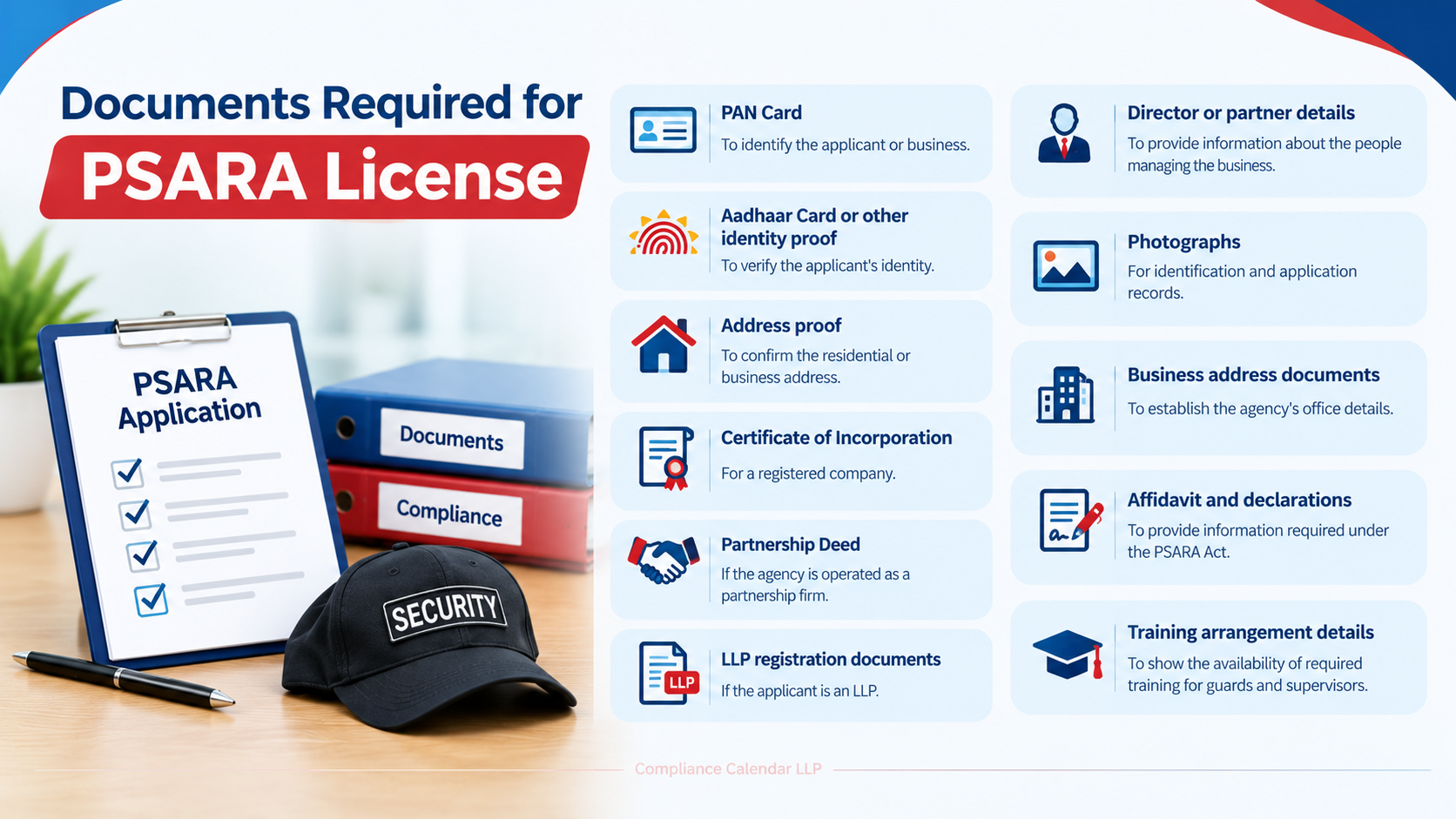
The documents required for a PSARA License may vary depending on the applicant's business structure and the rules of the concerned state. However, applicants should generally prepare the following documents and information.
|
Document or information |
Why it may be required |
|
PAN Card |
To identify the applicant or business |
|
Aadhaar Card or other identity proof |
To verify the applicant's identity |
|
Address proof |
To confirm the residential or business address |
|
Certificate of Incorporation |
For a registered company |
|
Partnership Deed |
If the agency is operated as a partnership firm |
|
LLP registration documents |
If the applicant is an LLP |
|
Director or partner details |
To provide information about the people managing the business |
|
Photographs |
For identification and application records |
|
Business address documents |
To establish the agency's office details |
|
Affidavit and declarations |
To provide information required under the PSARA Act |
|
Training arrangement details |
To show the availability of required training for guards and supervisors |
Section 7 of the PSARA Act also requires the applicant to submit an affidavit covering relevant eligibility and compliance details, including information about cases registered with the police or pending before a court, as applicable.
Here is the detailed information about Documentation : PSARA License Checklist
How to Choose the Right PSARA License for Your Business?
Choosing the right licence becomes easier when you first decide where you want to provide security services.
Consider these situations:
Situation 1: You want to work in only one district.
If your agency has clients in one district and does not plan to serve other districts at present, a one-district licence may be suitable. The statutory application fee is Rs 5,000.
Situation 2: You want to serve clients in two to five districts.
If your business plan covers more than one and up to five districts within the same state, the statutory fee category is Rs 10,000. Make sure the selected districts and licence coverage are correctly reflected in the application.
Situation 3: You want to operate across the entire state.
If you plan to provide services throughout the state, a whole-state licence may be more appropriate. The statutory application fee is Rs 25,000.
Before making a decision, consider your expected clients, staff availability, business budget and expansion plans. A licence should match your actual area of operation, not just the lowest application fee.
Can You Expand Your PSARA License to Other Districts or States?
Yes, a security agency can plan to expand its operations, but it must follow the applicable licensing procedure.
Expansion within the same state
Suppose your agency has a PSARA License for Jaipur district and later receives a contract in Jodhpur. Your existing licence should not be treated as automatic permission to operate in Jodhpur.
You should contact the concerned Controlling Authority and ask about the procedure for adding districts or changing the area of operation. Complete the required process and obtain the necessary approval before providing services outside the existing licence coverage.
Expansion into another state
The process is different when you want to enter another state.
For example, an agency holding a Rajasthan PSARA License wants to provide security guards in Delhi or Haryana. Its Rajasthan licence does not automatically permit it to operate in those places. The agency must check the applicable requirements and obtain the required licence from the concerned authority in the new state.
Planning expansion in advance can help avoid problems when a new client contract comes in.
What Are the Validity and Compliance Requirements for a PSARA License?
Whether you choose district-wise or state-wise coverage, the general licence validity is five years, unless it is cancelled earlier under the Act.
An application for renewal should be submitted to the Controlling Authority at least 45 days before the licence expires.
A licensed agency must also follow the applicable PSARA conditions. These may include:
- Employing eligible security guards and supervisors.
- Making the required training arrangements.
- Issuing identity cards to security guards.
- Maintaining the prescribed agency and employee records.
- Following the conditions mentioned in the licence.
- Cooperating with inspections by authorised officials.
- Renewing the licence within the prescribed time.
The area of operation is also an important compliance requirement. An agency should not provide services outside its approved coverage simply because it has received a new client contract.
For more information about renewal , you can visit : PSARA License Renewal Guide
How Compliance Calendar LLP Can Help with PSARA License Registration
Choosing between district-wise and state-wise coverage is an important step for any private security agency. The decision affects the area in which your business can operate and the government application fee.
Compliance Calendar helps businesses understand the PSARA License registration requirements and prepare for the application process. Our team can assist with understanding the applicable licence category, reviewing documents, preparing application details and guiding you through the relevant requirements.
Whether you are starting a new agency in one district or planning to operate across an entire state, getting the right guidance before applying can help you make a better decision.
Need help with PSARA License registration? Contact Compliance Calendar at +91 9988424211 or email info@ccoffice.in for expert assistance with your application.
FAQs About District-Wise and State-Wise PSARA License
1. Can I get a PSARA License for only one district?
Yes. The PSARA Act allows an agency to apply for a licence covering one district. The statutory government application fee for this category is Rs 5,000.
2. Can one PSARA License cover multiple districts?
Yes. A licence can cover more than one district within the same state. The statutory fee for more than one and up to five districts is Rs 10,000.
3. What is the fee for a state-wise PSARA License?
The statutory application fee for a whole-state PSARA License is Rs 25,000.
4. Is a state-wise PSARA License better than a district-wise licence?
Neither option is automatically better. A district-wise licence may suit an agency serving local clients, while a whole-state licence may suit a business planning to operate across the state. The right option depends on the agency's service area and expansion plans.
5. Can I operate in another district with a one-district PSARA License?
You should not assume that you can. A one-district licence covers the approved area. If you want to operate in another district, confirm the required procedure with the concerned Controlling Authority and obtain the necessary approval.
6. Can I use my PSARA License in two different states?
No. A licence granted for one state does not automatically cover another state. You must check and obtain the applicable licence for the other state.
7. What documents are needed for a PSARA License?
Common documents include PAN, identity proof, address proof, business registration documents, director or partner details, affidavits and training arrangement details. The final checklist depends on the business structure and state requirements.
8. How long is a PSARA License valid?
A PSARA License is generally valid for five years, unless cancelled earlier under the Act. Renewal should be applied for at least 45 days before expiry.
9. Who issues a district-wise or state-wise PSARA License?
The Controlling Authority appointed by the respective State or Union Territory Government issues the licence. The authority examines the application and conducts the required verification.
10. Can I change my district-wise licence to a whole-state licence?
You may be able to change or extend the area of operation, but the procedure must be confirmed with the concerned Controlling Authority. Do not assume that the existing licence automatically changes to whole-state coverage.
Article last updated on : 05 Nov 2026.











_learn_crop10_thumb.jpg)