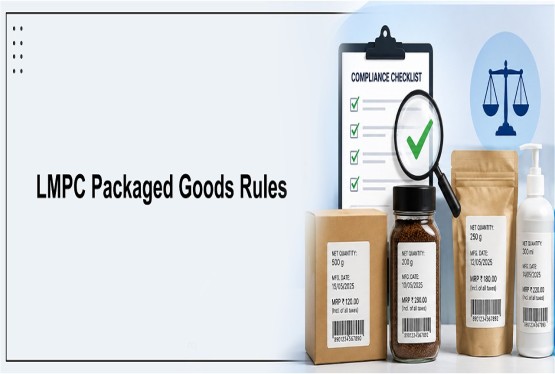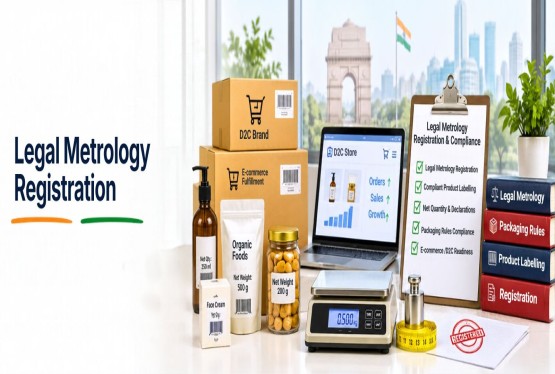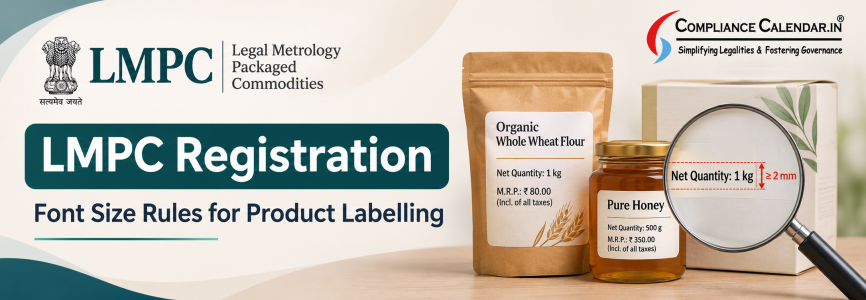



A product label does more than show the brand name and design. It tells customers important details such as the product quantity, price, manufacturer, importer and customer care information. These details must be easy to read. If the letters or numbers are too small, unclear or poorly placed, the package may not meet Legal Metrology requirements.
Many importers and manufacturers focus on getting their LMPC Registration but forget to check the font size of the product label. This can create problems when goods arrive in India or before products are sold in the market. In this guide, we explain the font size rules in simple English, how to calculate the display panel area, what details need attention and how businesses can check their labels before printing.
What Is LMPC Registration?
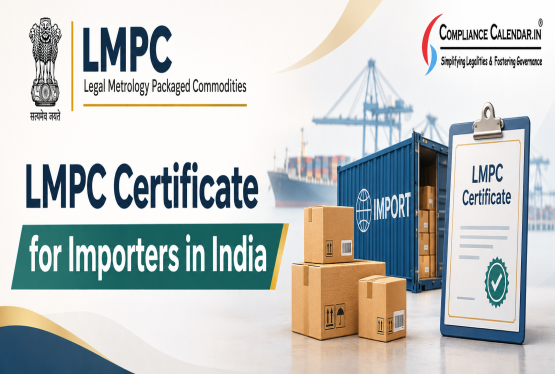
LMPC stands for Legal Metrology Packaged Commodities. It refers to the requirements under the Legal Metrology Act, 2009 and the Legal Metrology (Packaged Commodities) Rules, 2011.
These rules help make sure that customers receive correct information about packaged products. For example, when someone buys a shampoo bottle, a packet of dry fruits or an imported electronic accessory, the package should clearly show important details such as its net quantity, retail sale price and the name and address of the responsible business.
LMPC Registration under Rule 27 is relevant to manufacturers, packers and importers covered by the rules. An importer bringing pre-packaged goods into India for sale should check the registration requirement before starting business. Registration and correct product labelling are two separate parts of compliance. Having an LMPC certificate does not automatically mean that every product label is correct.
For detailed information Kindly Visit : LMPC Registration Guide
Why Is Font Size Important in LMPC Labelling?
Imagine buying a 500 ml bottle of shampoo. The MRP is printed in very small letters, the importer’s address is difficult to read and the net quantity is hidden near the edge of the label. The information may be present, but a customer cannot easily understand it.
This is the reason font size matters. The rules aim to make important declarations clear and readable instead of allowing businesses to hide them in tiny print.
Correct font size helps businesses:
- Make product information easier for customers to read.
- Show the MRP and net quantity clearly.
- Reduce mistakes during label design and printing.
- Avoid problems caused by unclear or poorly placed declarations.
- Give customers better information before they purchase a product.
Rule 9 also requires declarations to be legible and prominent. The numbers used for retail sale price and net quantity must have a clear contrast with the label background, subject to the rule's stated exceptions.
What Is the Minimum Font Size Under Rule 7?
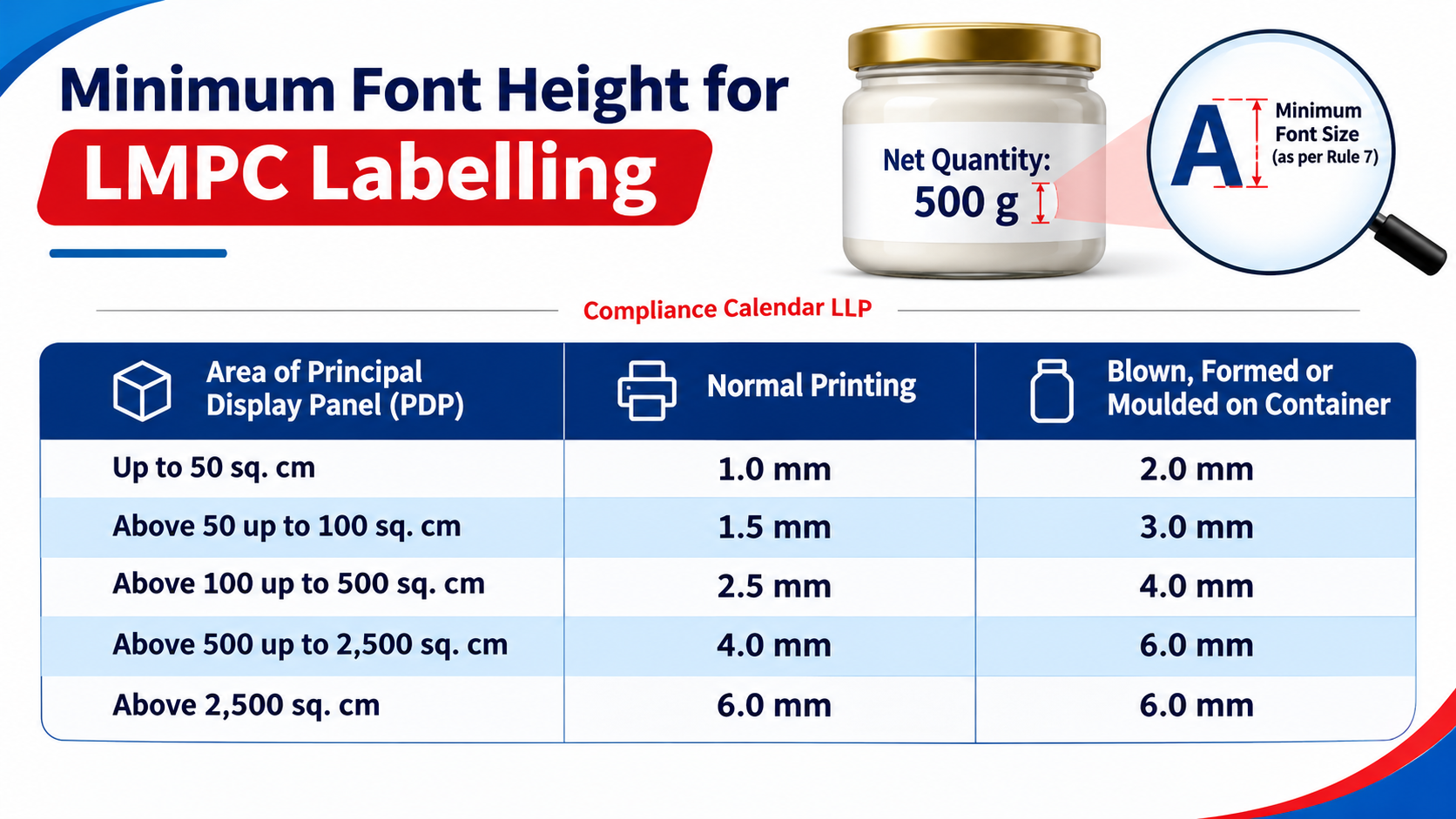
Rule 7 of the Legal Metrology (Packaged Commodities) Rules, 2011 sets the minimum height of letters and numbers according to the area of the Principal Display Panel (PDP).
The important point is that the general table is based on the PDP area in square centimetres, not simply on whether a product contains 100 g, 500 g or 1 litre.
Minimum Font Height for LMPC Labelling
|
Area of Principal Display Panel |
Normal Printing |
Blown, Formed or Moulded on Container |
|
Up to 50 sq. cm |
1.0 mm |
2.0 mm |
|
Above 50 up to 100 sq. cm |
1.5 mm |
3.0 mm |
|
Above 100 up to 500 sq. cm |
2.5 mm |
4.0 mm |
|
Above 500 up to 2,500 sq. cm |
4.0 mm |
6.0 mm |
|
Above 2,500 sq. cm |
6.0 mm |
6.0 mm |
These are minimum heights under the Rule 7 table. A business can use larger letters and numbers. It should not reduce the size just to fit more information into a small space.
Example: If the PDP area of a normal printed package is 150 sq. cm, the minimum height under this table is 2.5 mm. If the relevant information is blown, formed or moulded on the container, the minimum is 4 mm.
Note : Do not select the font size only by looking at the product's net quantity. First identify the correct PDP area and the type of printing or marking used.
What Is a Principal Display Panel (PDP)?
The Principal Display Panel is the area of a package where the declarations required under the rules are displayed. In simple words, it is the main area used to show the important product information.
For example, on a rectangular cardboard box, the front side may be used as the main display panel. On a bottle, the label area around the body may be used for the required declarations.
The rules explain how to calculate the area for different package shapes.
How to Calculate PDP Area
|
Package Shape |
How the Area Is Calculated |
|
Rectangular package |
Height × width of the side treated as the PDP |
|
Cylindrical or nearly cylindrical package |
40% × height × circumference |
|
Other shaped packages |
40% of total surface area, or an area considered to be the PDP |
The top and bottom of the package are not included. The rules also exclude can flanges and the shoulders and neck of bottles and jars while calculating the area.
Example: Suppose a rectangular box has a front display side measuring 15 cm in height and 10 cm in width. Its PDP area is:
15 × 10 = 150 sq. cm
This places it in the above 100 up to 500 sq. cm category. The normal minimum letter and numeral height is therefore 2.5 mm.
For unusual packaging shapes, it is better to check the calculation before finalising the artwork. A wrong PDP calculation can lead to the wrong font size being selected.
Does Font Size Depend on Net Quantity or Package Area?
This is one of the most common points of confusion in LMPC labelling. Net quantity means the amount of product inside the package, without counting the packaging material. For example, a bottle may contain 250 ml of shampoo, while a box may contain 500 g of dry fruits. PDP area means the display area of the package where the required declarations are shown.
These are two different things. Under the current Rule 7 table, the general height of letters and numbers is linked to PDP area. Therefore, two products containing the same quantity may have different minimum font heights if their display panel areas are different.
For example, two 500 ml bottles may have different shapes and label areas. Their font-size requirements should be checked using the applicable PDP calculation, not by assuming that both need the same size because they contain 500 ml. This is why businesses should check the actual packaging design before approving labels for printing.
Other Important Rules for Letters, Numbers and Spacing
Selecting the correct font height is only one part of label compliance. Rule 7 and the related provisions also cover letter width, placement and readability.
Letter and Number Width
Rule 7(3) says that the width of a letter or numeral should not be less than one-third of its height. This requirement has exceptions for the numeral "1" and the letters "i", "I" and "l".
This means businesses should not use extremely narrow or compressed letters simply to fit more text into a small space.
Space Around Net Quantity
Rule 8 requires the area around the quantity declaration to remain free from printed information. The minimum space is:
- Above and below the quantity declaration: at least the height of the numeral.
- On the left and right: at least twice the height of the numeral.
For example, if the numeral height is 2 mm, the space above and below should be at least 2 mm, while the space on each side should be at least 4 mm.
Colour and Readability
Rule 9 requires declarations to be clear and prominent. The numbers used for MRP and net quantity should stand out from the background colour.
For example, dark text on a light background is generally easier to read than light grey text printed on a white background. Businesses should also avoid placing important information where it is hidden by folds, curved edges or other packaging details.
Can Importers Use Stickers for LMPC Declarations?
Importers sometimes receive products from foreign manufacturers with labels that do not contain all the declarations required in India. They may need to add information such as the Indian importer's name and address or other required declarations.
Rule 6(9) allows labels to be affixed to imported packages for making declarations required under the rules. However, this should not be treated as permission to place any sticker anywhere or cover existing information.
Rule 6(3) generally restricts individual stickers used to alter or make declarations, with a specific exception for reducing the MRP, provided the original MRP is not covered. The separate provision for imported packages must be read carefully.
Before using a sticker, an importer should check:
- Whether the product is an imported package covered by the relevant provision.
- Whether all required Indian declarations are included.
- Whether the sticker is firmly attached and easy to read.
- Whether the sticker hides the original MRP or other required information.
- Whether the font size, placement and contrast meet the applicable rules.
A label that is technically present but difficult to read may still create a compliance problem.
For more information about Importers kindly visit : LMPC Certificate for Importers
Small Packages and Special Product Requirements
Some products come in very small containers, where it may not be practical to print all required information directly on the package.
Rule 7(1) provides a specific option for packages with a capacity of 10 cubic centimetres or less. In such cases, the Principal Display Panel may be a card or tape firmly attached to the package, carrying the required information. Businesses should not assume that every small product is automatically exempt from labelling requirements. They should check the applicable rule and make sure the required information is available in the permitted manner.
There may also be product-specific rules under other laws. For example, packages containing medical devices have a specific provision referring to the Medical Devices Rules, 2017 for the height and width of letters and numbers. Businesses dealing with regulated products should check the rules that apply to their product instead of relying only on a general packaging guide.
Common LMPC Labelling Mistakes Businesses Should Avoid
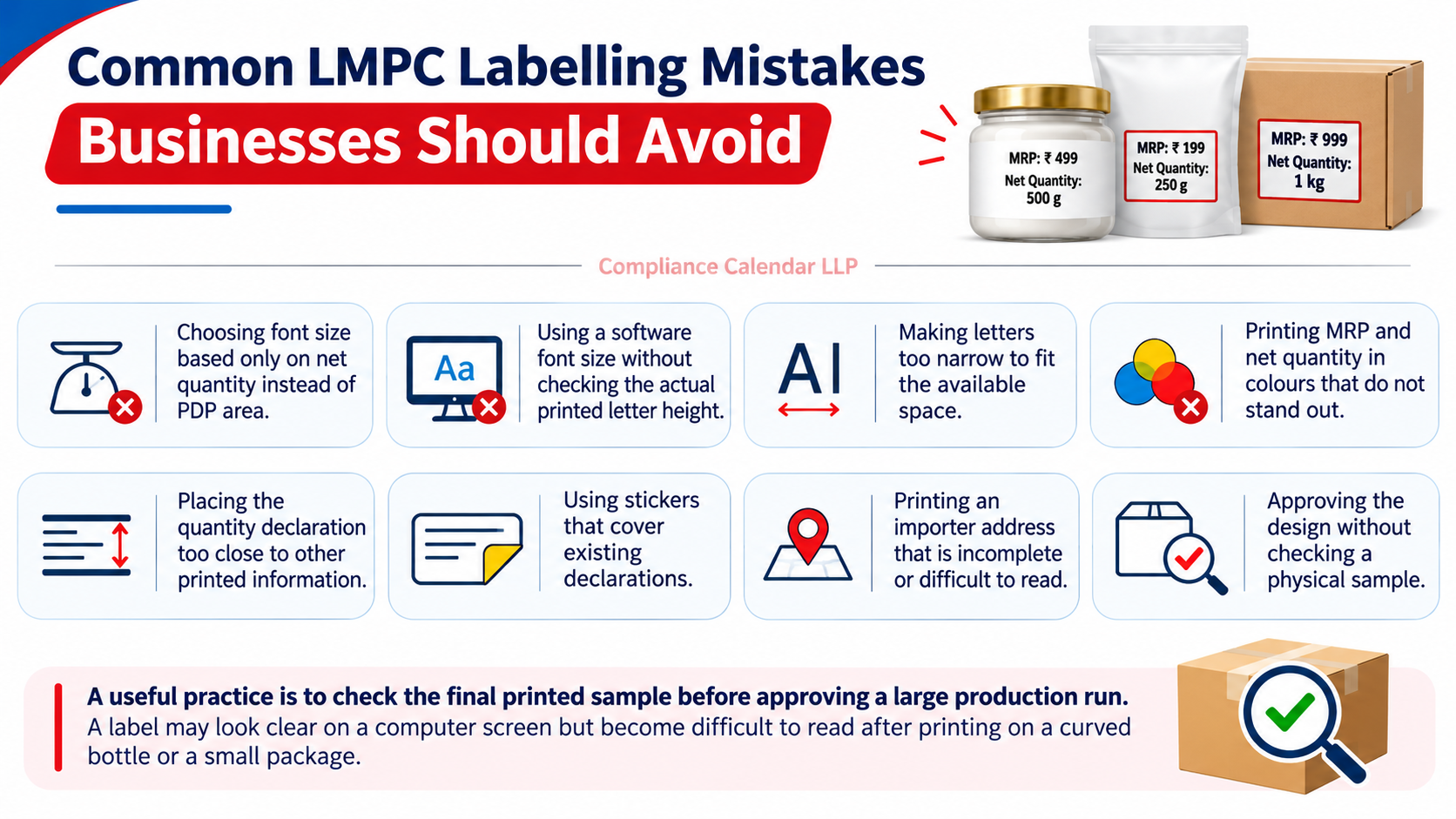
Small label mistakes can become expensive when thousands of packages have already been printed. Some common mistakes include:
- Choosing font size based only on net quantity instead of checking the PDP area.
- Using a software font size without checking the actual printed letter height.
- Making letters too narrow to fit the available space.
- Printing MRP and net quantity in colours that do not stand out.
- Placing the quantity declaration too close to other printed information.
- Using stickers that cover existing declarations.
- Printing an importer address that is incomplete or difficult to read.
- Approving the design without checking a physical sample.
A useful practice is to check the final printed sample before approving a large production run. A label may look clear on a computer screen but become difficult to read after printing on a curved bottle or a small package.
For more detailed information kindly visit : Declaration on Packaged Goods
Practical Example: Checking an Imported Product Label
Consider an Indian business importing personal-care products in bottles. The foreign supplier sends the label design for approval. The importer checks the product name, quantity and MRP but does not calculate the Principal Display Panel area. Later, the importer finds that the label uses very small letters and that the quantity declaration has almost no space around it. The business may need to revise the label or add a compliant declaration before the goods are sold.
The better approach would have been to check the package dimensions, calculate the PDP area, select the correct minimum letter height and review the printed sample before placing the bulk order.
LMPC Labelling Checklist Before Printing
Before approving your product label, use this simple checklist:
- Confirm whether LMPC Registration is required for your business.
- Check the declarations required for your product.
- Measure the package and calculate the PDP area.
- Select the minimum letter and numeral height under the applicable rule.
- Check the width of letters and numbers.
- Keep the required space around the net quantity declaration.
- Use colours that make MRP and net quantity easy to read.
- Check the manufacturer, packer or importer details.
- Review any sticker used on imported packages.
- Check a physical printed sample before bulk printing.
Completing these checks early can help avoid reprinting labels and making last-minute changes.
Need help with LMPC Registration or packaged commodity labelling?
Connect us at 9988424211 or info@ccoffice.in
Frequently Asked Questions (FAQs)
1. What is the minimum font size for LMPC labelling?
The minimum font height ranges from 1 mm to 6 mm, depending on the package's display area.
2. What is LMPC Registration?
LMPC Registration is a Legal Metrology registration required for applicable manufacturers, packers and importers of pre-packaged commodities.
3. What is the Principal Display Panel (PDP)?
PDP is the main area of a package where important product declarations are displayed.
4. Is font size the same for all product packages?
No. The required font height depends on the area of the Principal Display Panel.
5. Can I use a font size larger than the prescribed limit?
Yes. Businesses can use a larger font size than the minimum required under the rules.
6. Can imported products use stickers for LMPC declarations?
Yes. Imported packages can use labels for required declarations, subject to applicable Legal Metrology rules.
7. Is MRP compulsory on packaged products?
Yes. Retail packages generally need to display MRP inclusive of all taxes, subject to applicable exemptions.
8. Is LMPC Registration compulsory for importers?
Generally, yes, for importers bringing pre-packaged commodities into India for sale, distribution or delivery, subject to applicable exemptions.
9. What happens if the product label has a very small font size?
Incorrect labelling can lead to regulatory action, penalties and a requirement to correct the packaging.
10. When should businesses check LMPC font size requirements?
Businesses should check font size and other label declarations before printing packaging or importing products.
Article last updated on : 05 Nov 2026.











_learn_crop10_thumb.jpg)