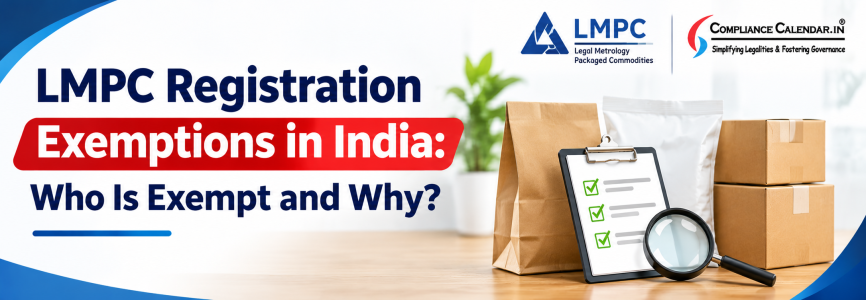



Not every packaged product sold in India has to follow the same Legal Metrology labelling requirements. The government has provided exemptions for certain products, package sizes and types of sales under the Legal Metrology (Packaged Commodities) Rules, 2011. However, these exemptions apply only when the conditions mentioned in the rules are satisfied.
This is important for manufacturers, importers, packers and sellers. For example, a business selling products in bulk may believe that it does not need to follow LMPC requirements. But package size alone does not always decide whether an exemption applies. this article, we explain the main LMPC Registration exemptions, the conditions businesses must follow and what they should check before claiming an exemption.
What Is LMPC Registration?
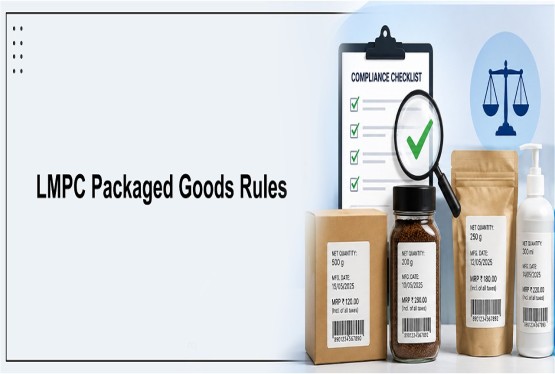
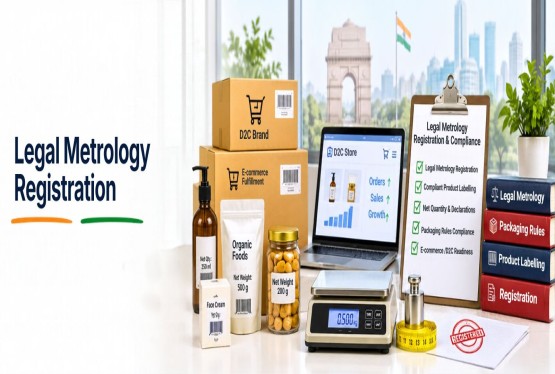
LMPC stands for Legal Metrology (Packaged Commodities) in the context of packaged goods. The Legal Metrology (Packaged Commodities) Rules, 2011 require certain details to be printed on packages sold in India. These details help customers understand what they are buying and how much they are paying.
Depending on the product and the applicable rule, package declarations may include:
- Name and address of the manufacturer, packer or importer.
- Common or generic name of the product.
- Net quantity or number of items.
- Maximum Retail Price (MRP), inclusive of all taxes.
- Country of origin for imported products.
- Consumer care details.
Businesses that pre-pack or import commodities for sale, distribution or delivery should also check the registration requirement under Rule 27.
When Are Products Exempt from LMPC Requirements?
The main exemptions under the Packaged Commodities Rules are covered under Rule 3 and Rule 26. Although both rules provide exemptions, they do not work in the same way.
- Rule 3: Certain packages are excluded from the application of Chapter II of the Packaged Commodities Rules.
- Rule 26: Certain packages containing specified commodities are exempt from the rules, subject to the conditions mentioned in that rule.
A business should identify the correct category before claiming an exemption. An exemption from particular labelling provisions does not automatically mean that every Legal Metrology requirement or Rule 27 registration obligation is removed.
Exemptions Under Rule 3 of the LMPC Rules
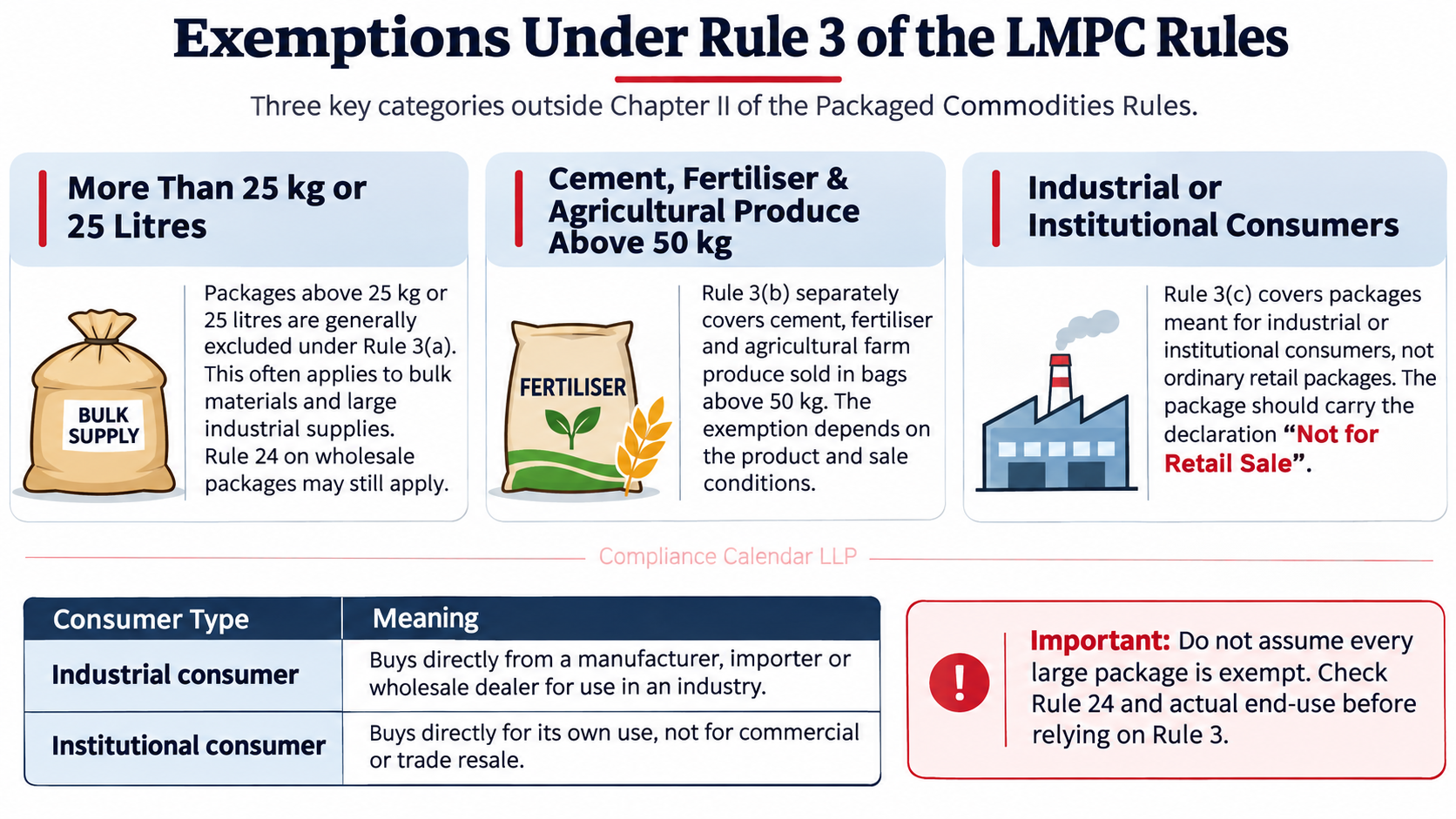
Rule 3 covers certain packages that are outside the application of Chapter II of the Packaged Commodities Rules. The three main categories are explained below.
1. Packages Containing More Than 25 kg or 25 Litres
Packages containing more than 25 kg or 25 litres are generally excluded from Chapter II under Rule 3(a). This provision is relevant to businesses selling large packages, bulk materials and certain industrial supplies.
For example, a business selling a 30 kg package of an eligible commodity may fall within this category. However, this exclusion does not automatically remove every requirement under the Packaged Commodities Rules. Provisions relating to wholesale packages under Rule 24 may still apply.
You can also read our guide on mandatory declarations under LMPC labelling rules to understand what information must appear on packaged products.
2. Cement, Fertiliser and Agricultural Farm Produce Above 50 kg
Rule 3(b) separately covers cement, fertiliser and agricultural farm produce sold in bags above 50 kg. These products have a specific package-size condition.
For example, a supplier selling fertiliser in 60 kg bags may qualify under this provision if the product and sale meet the rule's requirements. A business should not assume that every product weighing more than 50 kg receives this exemption.
3. Packages Meant for Industrial or Institutional Consumers
Rule 3(c) covers packages meant for industrial consumers or institutional consumers. These are not ordinary retail packages. The buyer must meet the relevant definition under the rules, and the package must carry the declaration "Not for Retail Sale".
|
Consumer type |
Meaning |
|
Industrial consumer |
Buys directly from a manufacturer, importer or wholesale dealer for use in an industry. |
|
Institutional consumer |
Buys directly from a manufacturer, importer or wholesale dealer for its own use, not for commercial or trade purposes. |
For example, a manufacturer supplying cleaning chemicals directly to a factory for use in its operations may fall within this category, provided all applicable conditions are met. The exemption should not be used for products actually meant for retail sale.
Exemptions Under Rule 26 of the LMPC Rules
Rule 26 provides exemptions for certain types of packages and commodities. However, businesses must check the exact conditions because some exemptions apply only to specific products or sales.
1. Small Packages of 10 Grams or 10 Millilitres or Less
Rule 26(a) generally exempts packages containing 10 grams or 10 millilitres or less, where the commodity is sold by weight or measure. However, this exemption does not cover tobacco and tobacco products. Pan masala was also specifically excluded through an amendment effective from 1 February 2026.
For example, a 5-gram sachet of an eligible commodity may qualify for this exemption. However, a business cannot claim the same exemption for a small tobacco or pan masala package simply because its weight is below 10 grams.
2. Fast Food Packed by Restaurants and Hotels
Fast food items packed by restaurants, hotels and similar businesses are covered by an exemption under Rule 26(b). This is relevant to food businesses packing items for customers as part of their food service.
For example, a restaurant packing a burger, sandwich or similar fast food item for takeaway may fall within this category. However, a company manufacturing packaged food products for sale through retail stores should check its requirements separately. Other applicable food safety and labelling rules must also be considered.
You can also read our article on : LMPC Registration for Flipkart and Amazon Sellers
3. Certain Pharmaceutical Formulations
Rule 26(c) provides an exemption for scheduled and non-scheduled formulations covered under the Drugs (Prices Control) Order, 2013. This exemption applies to the specified pharmaceutical category and should not be treated as a general exemption for all medicines or healthcare products.
Medical devices declared as drugs are not covered by this exemption. Businesses dealing in medicines or medical devices should check the legal classification of each product before relying on this provision.
4. Thread Sold in Coils to Handloom Weavers
Thread sold in coils to handloom weavers is another category covered under Rule 26. This exemption is intended for the specified type of sale and should not be treated as a general exemption for all thread or textile products.
For example, a supplier selling thread coils to handloom weavers for weaving work may qualify, provided the transaction meets the conditions of the rule.
5. Garments and Hosiery Sold Loose or Open
Rule 26(f) provides an exemption for certain garments and hosiery products sold loose or in an open condition at the point of sale, where customers can inspect the products before buying them. However, businesses must still provide specific information.
The required details include:
- Name and address of the manufacturer, marketer, brand owner or importer.
- Country of origin or manufacture for imported products.
- Consumer care email address and telephone number.
- Size details, such as S, M, L and XL, along with the required metric details.
- MRP, inclusive of all taxes.
For example, a clothing shop selling an open T-shirt that customers can inspect before purchase may qualify if all conditions are met. This exemption applies to finished products, and the required information must also be displayed on the e-commerce website when such products are sold online.
6. Loose Commodities Ordered Through E-commerce
Rule 26(g) covers certain loose commodities ordered through e-commerce platforms where the customer is aware of the commodity, its type and the quantity being ordered. However, this does not mean that the seller can send the product without any package information.
The package must carry the details specified under the rule:
- Name and address of the manufacturer, marketer, brand owner, importer or seller, as applicable.
- Country of origin or manufacture for imported products.
- Consumer care email address and telephone number.
- Retail sale price, inclusive of all taxes.
- Net quantity or number of the commodity.
For example, a customer ordering a known quantity of a loose commodity through an online platform may fall within this provision. The seller must still provide the required information on the package.
Quick Comparison of LMPC Exemptions
The following table helps businesses understand the main exemption categories at a glance.
|
Rule |
Exemption category |
Main condition |
|
Rule 3(a) |
Large packages |
More than 25 kg or 25 litres |
|
Rule 3(b) |
Cement, fertiliser and agricultural farm produce |
Bags above 50 kg |
|
Rule 3(c) |
Industrial or institutional packages |
Must meet the relevant consumer definition and conditions |
|
Rule 26(a) |
Small packages |
10 g or 10 ml or less, subject to exclusions |
|
Rule 26(b) |
Fast food |
Packed by restaurants, hotels and similar businesses |
|
Rule 26(c) |
Certain pharmaceutical formulations |
Covered under the Drugs (Prices Control) Order, 2013 |
|
Rule 26(e) |
Thread coils |
Sold to handloom weavers |
|
Rule 26(f) |
Garments and hosiery |
Sold loose or open with specified information |
|
Rule 26(g) |
Loose e-commerce commodities |
Customer knows the commodity, type and quantity; specified details must be provided |
Important: Rule 3 exclusions apply to Chapter II, while Rule 26 contains specific package exemptions. Businesses should check the complete provision before deciding that their products are exempt.
Does an LMPC Exemption Mean Registration Is Not Required?
No business should assume that an exemption from particular labelling provisions automatically removes its registration obligation. Rule 27 deals separately with registration of individuals and businesses that pre-pack or import commodities for sale, distribution or delivery.
For example, an importer may deal in two different product categories. One product may qualify for a specific exemption, while the other may require the usual package declarations and compliance. The importer should therefore review each product and business activity separately instead of treating the exemption as a blanket approval for the entire business.
Common Mistakes Businesses Make While Claiming LMPC Exemptions
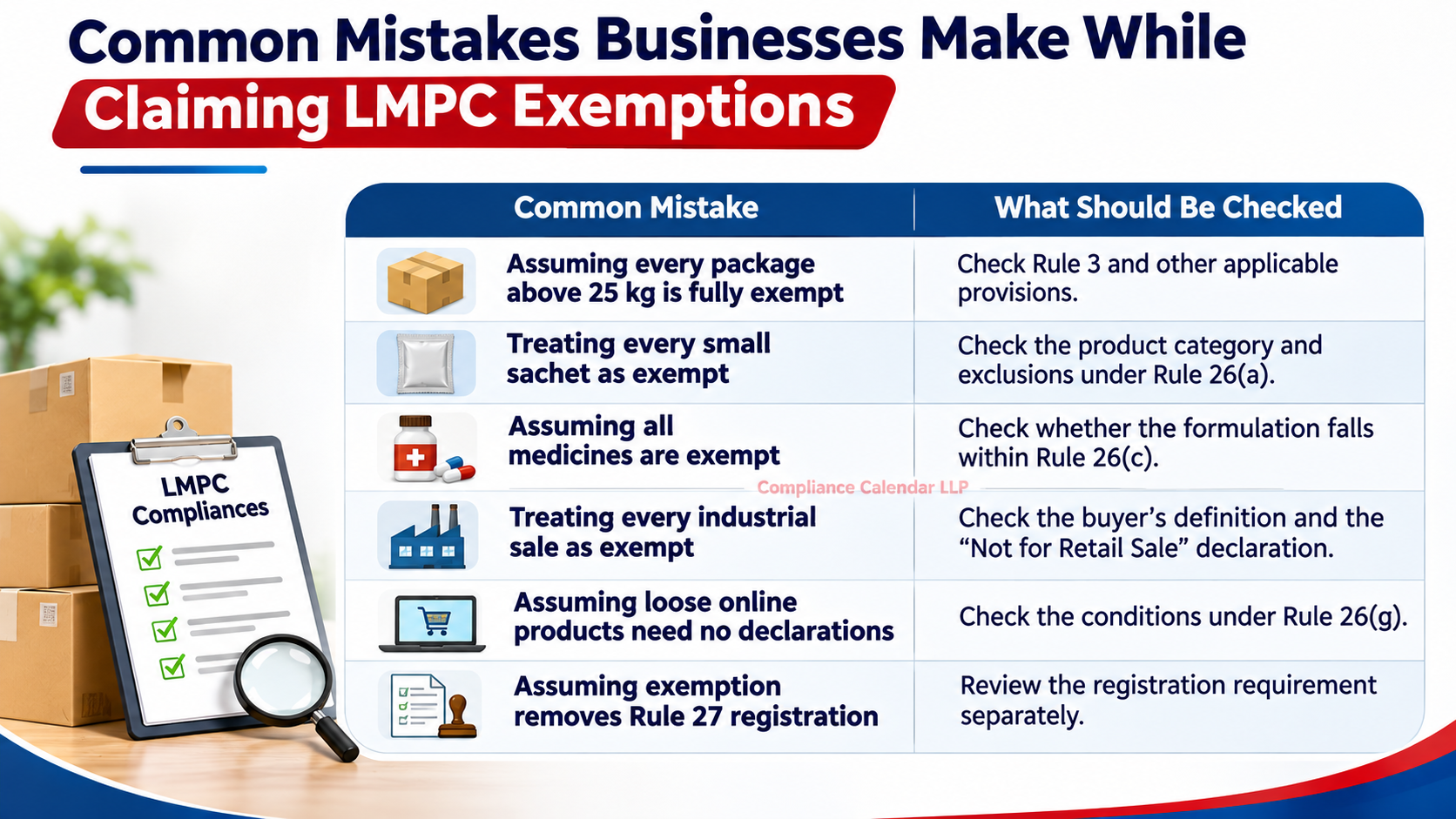
Businesses sometimes rely on only one detail, such as package weight or product type, without checking the full conditions. The following mistakes should be avoided:
|
Common mistake |
What should be checked |
|
Assuming every package above 25 kg is fully exempt |
Check Rule 3 and other applicable provisions. |
|
Treating every small sachet as exempt |
Check the product category and exclusions under Rule 26(a). |
|
Assuming all medicines are exempt |
Check whether the formulation falls within Rule 26(c). |
|
Treating every industrial sale as exempt |
Check the buyer's definition and the "Not for Retail Sale" declaration. |
|
Assuming loose online products need no declarations |
Check the conditions under Rule 26(g). |
|
Assuming exemption removes Rule 27 registration |
Review the registration requirement separately. |
What Should Businesses Check Before Claiming an LMPC Exemption?
Before claiming an LMPC exemption, manufacturers, importers and sellers should check the following details to make sure the exemption applies to their product and business activity.
|
What to Check |
What Does It Mean? |
|---|---|
|
Product Category |
Identify the exact product being manufactured, packed, imported or sold. |
|
Package Size |
Check the net weight or volume of the package to see whether it falls within an exemption limit. |
|
Nature of Sale |
Confirm whether the product is sold in retail, wholesale, bulk or directly to an industrial or institutional consumer. |
|
Buyer Details |
Check whether the buyer meets the definition of an industrial or institutional consumer under the rules. |
|
Required Declarations |
Confirm whether the exemption still requires certain details on the package or e-commerce website. |
|
Other Applicable Laws |
Check whether other laws, such as food safety or drug-related rules, also apply to the product. |
|
Registration Requirement |
Check Rule 27 separately. A labelling exemption does not automatically remove the LMPC registration requirement. |
Note : Businesses should also keep relevant records, such as product specifications, package photographs, invoices and buyer details. These records can help explain why a particular exemption is being claimed.
Important LMPC Rule Changes Businesses Should Know
The Legal Metrology (Packaged Commodities) Rules, 2011 have been amended over time. Businesses should not rely only on old articles or outdated registration information. The Department of Consumer Affairs publishes the rules and amendments on its official website.
Two recent changes are particularly important:
Pan masala exemption: From 1 February 2026, the small-package exemption under Rule 26(a) does not apply to pan masala. Businesses dealing in small pan masala packages should not rely on the general 10 g or 10 ml exemption.
Rule 27 changes in 2026: The Third Amendment Rules, 2026 introduced changes to registration information. Companies must provide the name of the director responsible for violations under the Act and rules. Companies and firms must also update specified details annually through the online portal, including their address, products and the numbers manufactured, packed or imported during the previous year, and country of origin. Registration certificates remain valid until cancelled.
How Compliance Calendar Can Help With LMPC Registration
Understanding LMPC exemptions can be difficult when a business deals with different products, package sizes and sales channels. A product may qualify for one exemption but still need to meet other Legal Metrology requirements. Checking the correct rule before selling the product can help businesses avoid unnecessary compliance problems.
Compliance Calendar assists manufacturers, importers and packers with understanding LMPC requirements, checking registration needs and preparing the necessary documents. If you are unsure whether your product qualifies for an exemption, professional guidance can help you take the right steps.
Need help with LMPC Registration or checking whether your product qualifies for an exemption? Contact Compliance Calendar at +91 9988424211 or info@ccoffice.in .
Frequently Asked Questions (FAQs)
1. Is LMPC Registration compulsory for every importer in India?
Not every imported product is subject to the same requirements. Importers should check the product, package and applicable exemptions. The Rule 27 registration requirement must also be examined separately.
2. What is the small-package exemption under LMPC Rules?
Rule 26(a) generally provides an exemption for packages containing 10 grams or 10 millilitres or less, where the commodity is sold by weight or measure. Tobacco, tobacco products and pan masala are excluded.
3. Are packages above 25 kg exempt from LMPC rules?
Packages containing more than 25 kg or 25 litres are excluded from Chapter II under Rule 3(a). However, other applicable provisions, including relevant wholesale package requirements, should still be checked.
4. Are industrial packages exempt from LMPC labelling?
Certain packages meant for industrial consumers are covered under Rule 3(c). The buyer and transaction must meet the relevant definition, and the package must carry the required "Not for Retail Sale" declaration.
5. Are medicines exempt from LMPC Registration?
Certain scheduled and non-scheduled formulations covered under the Drugs (Prices Control) Order, 2013 are covered under Rule 26(c). This exemption does not apply to every medicine or medical device.
6. Are garments sold loose exempt from LMPC rules?
Certain garments and hosiery products sold loose or open at the point of sale may qualify under Rule 26(f). The specified information, including size, MRP and consumer care details, must still be provided.
7. Is LMPC Registration required for products sold online?
Selling through an e-commerce platform does not automatically remove LMPC requirements. Certain loose commodities ordered online may qualify under Rule 26(g), but the required package information must still be provided.
8. Does the LMPC exemption apply to manufacturers and importers?
The exemption depends on the product, package and conditions mentioned in the relevant rule. Both manufacturers and importers should check their activities and obligations separately.
9. Can a business claim an LMPC exemption for all its products?
No. An exemption may apply only to specific products or packages that meet the stated conditions. Businesses dealing in multiple products should check each category separately.
10. Where can I check the latest LMPC exemption rules?
You can visit the Department of Consumer Affairs website and check the Legal Metrology section for the Packaged Commodities Rules, 2011 and their latest amendments.
Article last updated on : 09 Nov 2026.










_learn_crop10_thumb.jpg)