


E waste registration is an important requirement for businesses that repair used electronic products and sell them again after making them usable. For example, a business that purchases old laptops, replaces damaged parts, tests them and sells them as refurbished laptops may need registration under the E-Waste (Management) Rules, 2022.
Many businesses enter the refurbishment market because customers want working electronic products at a lower price. However, repairing and reselling used electronics also creates waste, such as damaged screens, batteries, circuit boards and other parts. These items need proper handling.
In India, the Central Pollution Control Board (CPCB) manages the online registration system for e-waste refurbishers. This guide explains who needs registration, which documents are required, how to apply online, the government fees and the responsibilities that continue after registration.
What Is E-Waste Refurbisher Registration?
E-Waste Refurbisher Registration is the registration required for businesses that repair or assemble used electrical and electronic equipment to extend its working life and sell it again for the same purpose for which it was originally made.
Consider a business that purchases used desktop computers from offices. It checks each computer, replaces damaged parts, installs the required software and tests whether the computer is working properly. After these repairs, the business sells the computers again. If the products and activities fall under Schedule I of the E-Waste (Management) Rules, 2022, the business may be treated as a refurbisher and must obtain the required registration.
The rules came into effect on 1 April 2023 and replaced the earlier E-Waste (Management) Rules, 2016. They require covered refurbishers to register on the CPCB portal before carrying out their regulated business.
Who Needs E-Waste Refurbisher Registration in India?
Not every business dealing in old electronic products needs refurbisher registration. The main point is to understand what the business actually does with the products.
A business may need registration if it purchases used electronic equipment, repairs or assembles it to extend its working life and sells it again for its original use. This may include businesses refurbishing computers, laptops, televisions and other equipment listed in Schedule I.
For example, a shop that only purchases and resells second-hand laptops without repairing or assembling them is not automatically a refurbisher under the rules. However, if the same shop starts repairing damaged laptops and selling them after refurbishment, its activities may bring it within the definition.
Businesses should check these points before applying:
- Does the business repair or assemble used electronic equipment?
- Is the equipment covered under Schedule I of the rules?
- Is the purpose of the repair to extend the product's working life?
- Is the refurbished product sold for the same purpose for which it was originally made?
The rules also provide an exemption for micro enterprises as defined under the Micro, Small and Medium Enterprises Development Act, 2006. A business should check its official classification and the exact applicability of this exemption before deciding that registration is not required.
Which Electronic Products Are Covered Under the Rules?
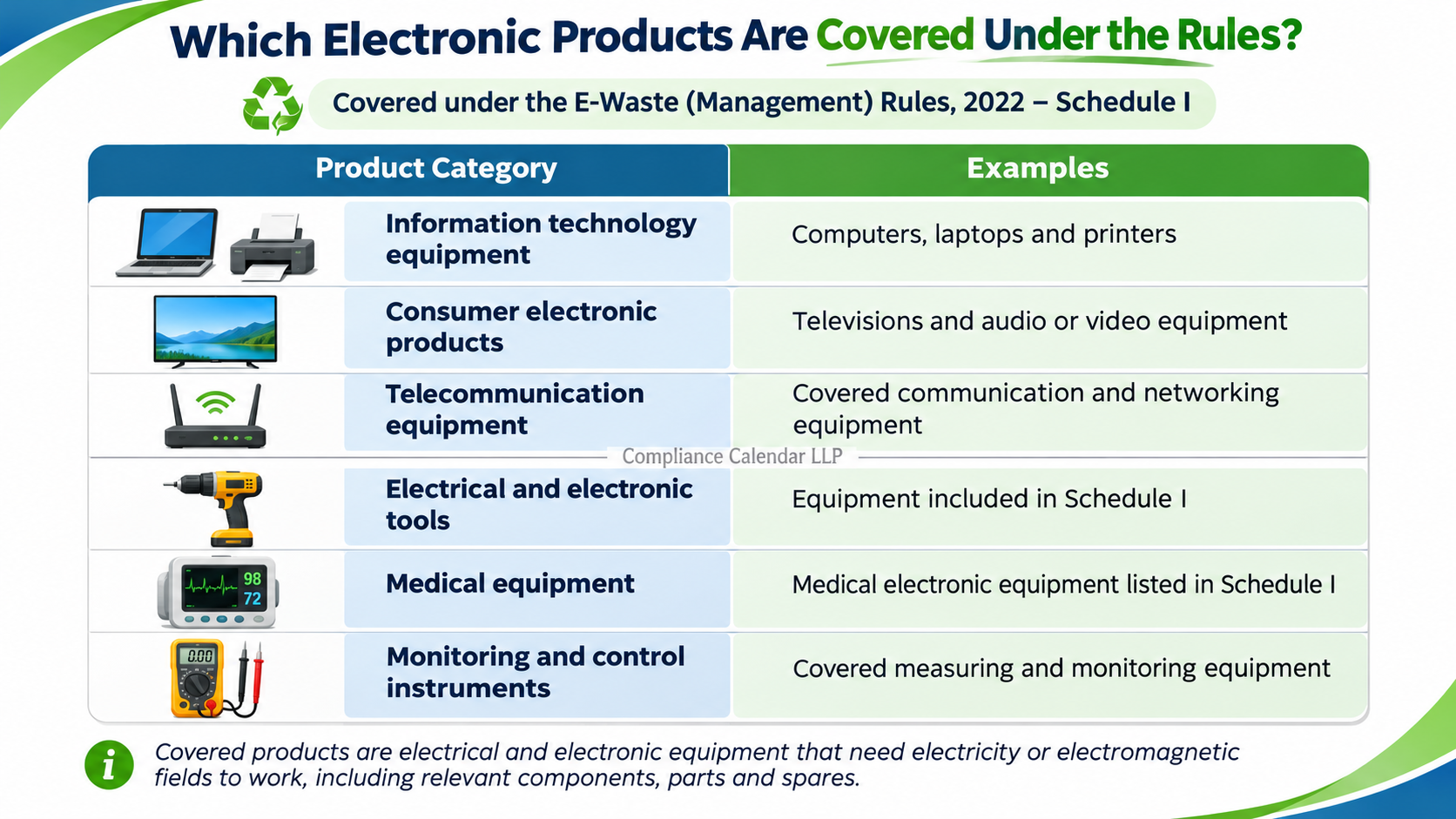
The E-Waste (Management) Rules, 2022 cover electrical and electronic equipment listed in Schedule I. These are products that need electricity or electromagnetic fields to work. Their covered components, parts and spares are also included where they make the product operational.
Some common product groups include:
|
Product category |
Examples |
|
Information technology equipment |
Computers, laptops and printers |
|
Consumer electronic products |
Televisions and audio or video equipment |
|
Telecommunication equipment |
Covered communication and networking equipment |
|
Electrical and electronic tools |
Equipment included in Schedule I |
|
Medical equipment |
Medical electronic equipment listed in Schedule I |
|
Monitoring and control instruments |
Covered measuring and monitoring equipment |
Note : This table gives only a general idea of the products covered. It is not the complete list. A refurbisher should check the exact product category in Schedule I before selecting equipment in the CPCB application. Not every electronic item is automatically covered by these rules.
Businesses dealing in used laptops and computers should also understand the EPR registration requirements for laptops and computers in India.
Why Is E-Waste Registration Important for Refurbishers?
A refurbishment business does more than repair old products. During the repair process, some parts may become unusable and turn into e-waste. If these parts are mixed with ordinary waste or sent to an unregistered handler, they may not be managed properly.
Registration brings the business into the formal e-waste management system. It also allows CPCB to track the refurbishment activity and the waste generated from it. Under the rules, registered refurbishers must hand over the e-waste generated during refurbishment to registered recyclers and submit the required information on the portal.
There is another important benefit. The rules provide for the generation of refurbishing certificates for registered refurbishers. Producers can purchase these certificates to defer the corresponding part of their EPR obligation for the period allowed under the rules. This is different from an ordinary recycling certificate.
For more detailed information you can read our article : E-waste Registration Requirements
Documents Required for E-Waste Refurbisher Registration
Before applying, a business should arrange its company documents and details of the actual refurbishment facility. The CPCB Standard Operating Procedure (SOP) asks for information about the business, facility, equipment and refurbishment capacity.
The following table covers the main documents and information mentioned in the CPCB SOP.
|
Document or information |
Why is it needed? |
|
PAN card of the business |
To identify the applicant business |
|
To verify the business and facility address |
|
|
Consent to Establish (CTE) |
Consent issued by the concerned SPCB/PCC under applicable pollution control laws |
|
Consent to Operate (CTO) |
Permission to operate the facility under applicable pollution control laws |
|
Company incorporation certificate, if available |
To support the legal identity of the company |
|
Facility address and geo-coordinates |
To identify the location of the refurbishment unit |
|
Authorised person's details |
Name, designation, email address and contact number |
|
List of electronic equipment |
To identify the products the business plans to refurbish |
|
Annual refurbishment capacity |
To show the capacity mentioned in the CTO |
|
Geo-tagged facility video |
To show the actual facility, plant and machinery |
|
Self-declaration |
To confirm that the submitted information is correct and required safety measures are in place |
The CPCB SOP also lists an Aadhaar card of the authorised person and authorisation under the earlier Hazardous and Other Wastes Rules, 2016 as optional documents. The incorporation certificate is also marked optional in the SOP. Applicants should check the latest portal requirements before submission.
One point deserves special attention: the address of the refurbishment facility must be consistent across the application and supporting documents. The CPCB SOP specifically asks applicants to ensure that the address in the GST certificate and pollution control consents matches the facility address entered on the portal. A mismatch may lead to questions from the authorities.
E-Waste Refurbisher Registration Process in India
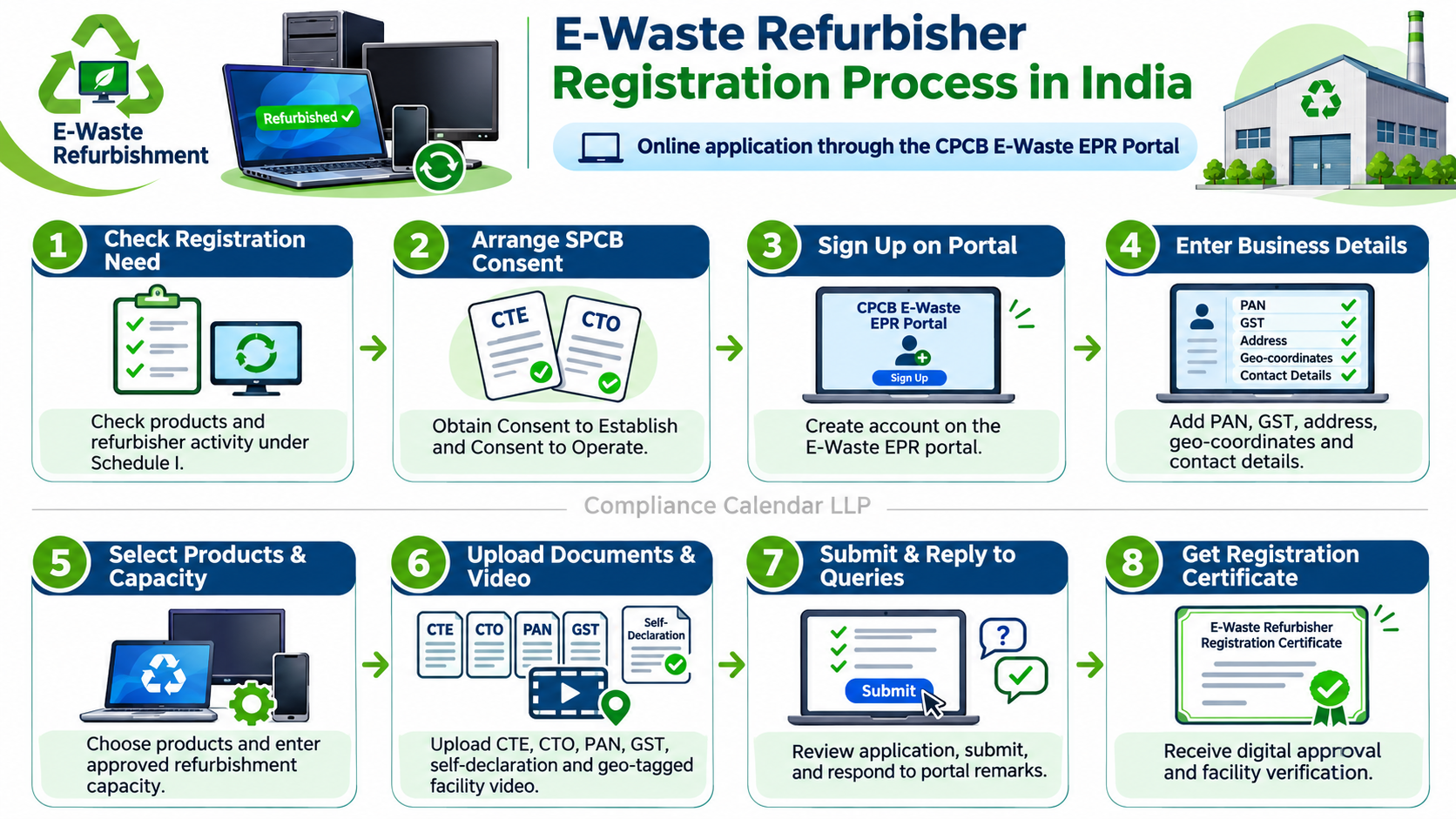
The application is made online through the CPCB E-Waste EPR Portal. The business should first prepare its documents and facility information so that it can complete the application without unnecessary delays.
Step 1: Check Whether Your Business Needs Registration
Start by checking the type of electronic products your business repairs or assembles. Compare them with Schedule I of the E-Waste (Management) Rules, 2022. Also check whether your activity meets the definition of a refurbisher.
This step is important because a business that only trades in used electronics may have different requirements from a business that repairs and resells them.
Step 2: Arrange Consent from the State Pollution Control Board
Before submitting the CPCB application, check the pollution control consent requirements for your facility. The CPCB refurbisher SOP asks for Consent to Establish and Consent to Operate issued by the concerned State Pollution Control Board (SPCB) or Pollution Control Committee (PCC) under the applicable Air and Water Acts.
The business should make sure that the consents relate to the actual refurbishment facility and its activities.
Step 3: Sign Up on the CPCB E-Waste Portal
Visit the official CPCB E-Waste EPR Portal and complete the sign-up process. Select the appropriate stakeholder category for refurbishment and provide the required contact details.
Use an active email address and mobile number. CPCB may send application updates and requests for additional information to the authorised person.
Step 4: Enter Business and Facility Details
After creating the account, enter the business name, PAN, GST details, facility address and contact information. You will also need to provide the geo-coordinates of the refurbishment unit and details of the authorised person.
Check the address carefully before moving ahead. It should match the supporting documents and identify the place where the actual refurbishment work takes place.
Step 5: Select Products and Enter Refurbishment Capacity
Select the electronic equipment that your business plans to refurbish. Enter the annual refurbishment capacity in line with the capacity mentioned in the Consent to Operate.
For example, if your CTO mentions a particular annual capacity, do not enter a higher figure without proper supporting approval. The information should reflect the actual approved capacity of the facility.
Step 6: Upload Documents and Facility Video
Upload the required documents, including CTE, CTO, PAN, GST certificate and self-declaration. The CPCB SOP also asks for a geo-tagged video of the refurbishment unit showing the plant and machinery.
The self-declaration should be prepared on the company's letterhead and signed by the authorised person with the company seal. It must confirm that the information submitted is correct and that suitable occupational health, safety and fire safety measures are in place.
Step 7: Submit the Application and Check for Queries
After uploading the documents, review the application and submit it through the portal. Do not assume that the process is complete just because the application has been submitted.
CPCB may send a digital checklist if any information or document is missing. The applicant should log in regularly, read the remarks and submit the required clarification within the given time.
Step 8: Receive the Registration Certificate
Once the application is complete and approved, the registration certificate is issued digitally through the portal. CPCB's SOP also provides for verification of the refurbishment facility after registration. This verification may take place through a physical inspection or video conferencing.
You can visit our detailed article on : E-waste Registration Process
Government Fees for E-Waste Refurbisher Registration
The CPCB fee schedule lists a registration fee for new refurbishers, along with charges for renewal, amendments and annual maintenance.
|
Particulars |
Fee |
|
New registration (valid for five years) |
Rs 15,000 |
|
Renewal after five years |
Rs 7,500 plus Rs 0.625 per MT of refurbishing certificate transactions during the previous five years |
|
Amendment or addendum |
Rs 3,000 |
|
Annual maintenance charges |
Rs 5,000 |
These amounts are based on the fee schedule published with the CPCB refurbisher SOP. Applicants should check the latest fee notice and the amount shown on the portal before making payment, as charges may be revised.
How Much Time Does E-Waste Refurbisher Registration Take?
The CPCB SOP provides a timeline for checking and processing applications. If an application is incomplete, CPCB may communicate the shortcomings through the portal within 30 working days of receiving it. The applicant is required to reply to the shortcomings within seven working days.
For a complete application, the SOP provides for registration within 30 working days after the application is found complete. It also provides for verification of the refurbishment facility within 120 working days after registration.
These are the timelines mentioned in the SOP, not a guarantee that every application will be completed in the same number of days. Missing documents, incorrect details and delayed replies can affect the process.
What Should a Refurbisher Do After Getting Registration?
Receiving the registration certificate does not mean that the business has completed all its responsibilities. A refurbisher must continue to follow the rules while repairing and selling electronic products.
For example, if a laptop is repaired and sold again, its working life may be extended. But if its damaged motherboard or screen cannot be used, those parts become e-waste and need to be handled separately. A refurbisher cannot simply throw such parts away with ordinary garbage.
Under Rule 7 of the E-Waste (Management) Rules, 2022, refurbishers have the following responsibilities:
- Send generated e-waste to registered recyclers: Waste created during refurbishment must be handed over to a registered recycler.
- Update information on the CPCB portal: Required details about the e-waste generated and handed over must be uploaded.
- Follow product standards: Refurbished equipment must meet the applicable requirements under the Compulsory Registration Scheme of the Ministry of Electronics and Information Technology and relevant BIS standards.
- File quarterly and annual returns: Submit the prescribed returns on the portal within the applicable deadlines.
These responsibilities help ensure that the products are refurbished properly and that the waste generated during the process is not left unmanaged.
Practical Example: A Refurbishment Business in Noida
One of our client in Noida runs a business that purchases used laptops from offices and individual customers. The business checks the laptops, replaces damaged parts, tests their performance and sells the working devices again.
The business may initially think that it only needs a GST registration because it is buying and selling electronic products. However, its activity is not limited to trading. It is also repairing used electronic equipment to extend its working life. If the laptops fall under Schedule I and the activity meets the definition of a refurbisher, the business needs to check the E-Waste (Management) Rules, 2022 and obtain the required CPCB registration.
Before applying, the business should arrange its pollution control consents, check that the facility address matches its supporting documents, prepare its equipment list and declare its approved refurbishment capacity. It should also make arrangements to send unusable electronic parts to a registered recycler.
Common Mistakes to Avoid During E-Waste Refurbisher Registration
Some businesses face application queries because they do not check their documents or facility details before submission. A simple review can help avoid many of these problems.
|
Common mistake |
What should the business do? |
|
Selecting the wrong category |
Check whether the activity is refurbishment, recycling or only trading. |
|
Entering a different facility address |
Match the address with the GST certificate and CTE/CTO. |
|
Uploading incomplete documents |
Follow the latest CPCB document checklist. |
|
Giving incorrect refurbishment capacity |
Use the capacity mentioned in the CTO. |
|
Selecting the wrong electronic products |
Select only the equipment the facility actually refurbishes and that is covered by the rules. |
|
Uploading an unclear facility video |
Provide an active geo-tagged video showing the unit and machinery. |
|
Ignoring CPCB queries |
Check the portal regularly and reply within the stated time. |
|
Forgetting returns after registration |
Maintain records and submit the required quarterly and annual returns. |
A business should also avoid submitting incorrect information just to complete the application quickly. CPCB's SOP provides for action, including revocation of registration, where false information or concealment is found.
How Compliance Calendar LLP Can Help with E-Waste Registration
For a business applying for the first time, understanding the CPCB requirements and preparing the documents can take time. It may also be difficult to identify the correct equipment category, check the facility details and complete the online application.
Compliance Calendar can assist businesses with understanding the registration requirements, preparing the required information, organising supporting documents and completing the CPCB application process. The team can also help businesses understand the responsibilities they need to follow after registration.
If you are planning to start a refurbishment business or already repair and resell used electronic equipment, checking the registration requirement at the beginning can help you avoid compliance problems later.
Need help with E waste registration for your refurbishment business?
Contact Compliance Calendar at +91 9988424211 or info@ccoffice.in for expert assistance.
Frequently Asked Questions (FAQs)
1. What is E-Waste Refurbisher Registration?
It is the registration required for eligible businesses that repair or assemble used electronic equipment covered under Schedule I to extend its working life and sell it again for its original use.
2. Who needs E waste registration in India?
Businesses that refurbish electronic equipment listed in Schedule I generally need to register in the refurbisher category on the CPCB portal, subject to the exemptions under the rules.
3. Is CPCB registration compulsory for e-waste refurbishers?
Yes. Businesses covered by the E-Waste (Management) Rules, 2022 must register on the CPCB portal before carrying out the regulated refurbishment activity.
4. Which portal is used for E-Waste Refurbisher Registration?
Applications are submitted through the official CPCB E-waste EPR Portal.
5. What documents are required for E-Waste Refurbisher Registration?
Common requirements include PAN, GST certificate, applicable CTE and CTO, facility details, geo-coordinates, equipment details, annual refurbishment capacity, a geo-tagged facility video and a signed self-declaration.
6. What is the government fee for E-Waste Refurbisher Registration?
The CPCB fee schedule lists Rs 15,000 for new registration valid for five years and Rs 5,000 as annual maintenance charges. Check the portal for the current payable amount.
7. How long does E-Waste Refurbisher Registration take?
The CPCB SOP provides for registration within 30 working days after the application is found complete. The actual time may vary if documents are missing or further clarification is needed.
8. Is registration required for a business that only sells second-hand electronics?
Not automatically. A business that only buys and resells used electronics without repairing or assembling them may not meet the definition of a refurbisher. Its actual activities should be checked.
9. Can a refurbisher send generated e-waste to an ordinary scrap dealer?
No. E-waste generated during refurbishment must be handed over to a registered recycler, and the required information must be uploaded on the CPCB portal.
10. Does an e-waste refurbisher need to file returns after registration?
Yes. Refurbishers must file the prescribed quarterly and annual returns on the CPCB portal within the applicable deadlines.
Article last updated on : 09 Nov 2026.










_learn_crop10_thumb.jpg)