


When people talk about political parties in India, they often hear the words registered political party and recognised political party. Many people think both mean the same thing, but there is a clear difference between them. A party can register with the Election Commission of India (ECI) without becoming a recognised party.
Registration is the first step for a new political party. Recognition comes later, when the party meets certain conditions based on its performance in elections. This means a party does not need to win an election to get registered, but it must meet the required vote or seat conditions to become a recognised State Party or National Party. Let us understand how both work and what benefits a recognised party gets.
What Is a Registered Political Party?
A registered political party is a group that has completed the registration process with the Election Commission of India under Section 29A of the Representation of the People Act, 1951. In simple words, when a group of people comes together to form a political party, it can apply to the ECI for registration by submitting its party constitution, details of its members and office-bearers, office address and other required documents.
After checking the application, the Election Commission decides whether the party meets the registration requirements. If the application is approved, the party gets registered. It can then take part in elections by following the applicable election rules. However, registration does not mean that the party has already gained enough public support to become a State Party or National Party. Until it meets the recognition conditions, it remains a registered unrecognised political party.
For more detailed information kindly visit : Political Party Registration Guide
What Is a Recognised Political Party?
A recognised political party is a registered party that has also gained the required public support in elections. The Election Commission checks how many votes the party's candidates received and how many seats they won. Based on this performance, the party may get recognition as a State Party or a National Party.
For example, a party may be registered with the ECI and contest an Assembly election in one state. If it receives the required number of votes or wins the required seats, it may qualify for State Party status in that state. A party that meets the national-level conditions can become a National Party. Recognition gives the party certain benefits, including a reserved election symbol, which helps voters identify its candidates during elections.
Difference Between Registered and Recognised Political Parties
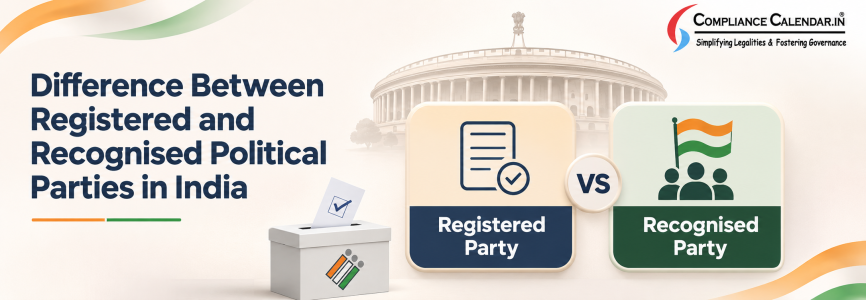
The biggest difference is that registration is based on the application submitted to the Election Commission, while recognition depends on the party's performance in elections. A newly formed party can get registered without winning any seats, but it cannot become a recognised party unless it meets the conditions set by the ECI.
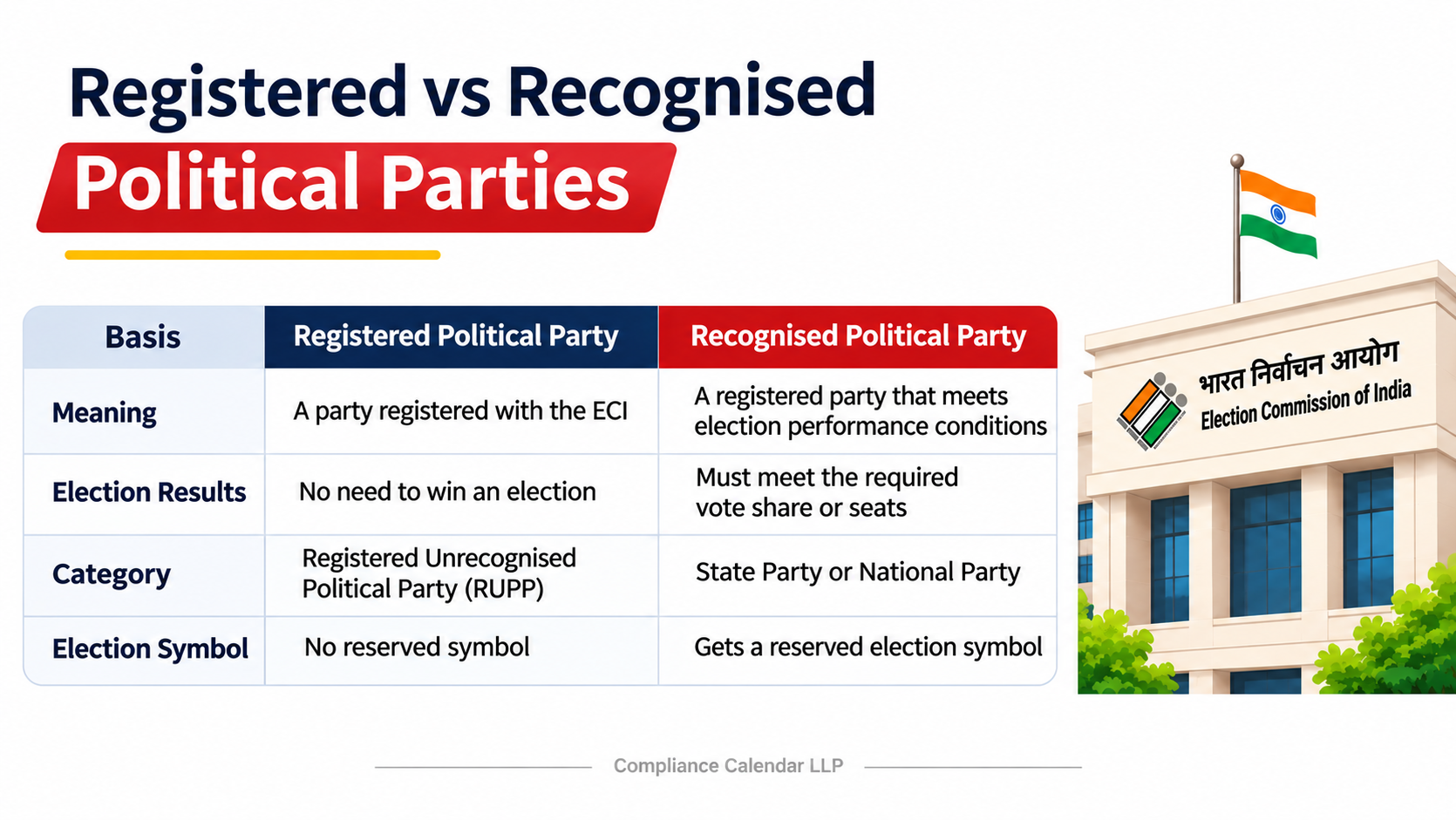
Here is a simple comparison to understand both categories:
|
Basis |
Registered Political Party |
Recognised Political Party |
|
Meaning |
A party registered with the ECI |
A registered party that meets the election performance conditions |
|
Main requirement |
Approval of the registration application |
Required vote share or number of seats in elections |
|
Election results |
Does not need to win an election to get registered |
Must meet at least one recognition condition |
|
Category |
Registered Unrecognised Political Party (RUPP), if not recognised |
State Party or National Party |
|
Election symbol |
Does not have a reserved symbol as a recognised party |
Gets a reserved election symbol under ECI rules |
|
Recognition area |
Registration is with the ECI |
May be recognised in one or more states or at the national level |
|
Main advantage |
Can take part in elections by following the applicable rules |
Gets additional election-related benefits and facilities |
Note:One important point is that a registered party is not the same as an unregistered group. It has already completed the registration process with the Election Commission. It simply has not yet met the conditions required for State Party or National Party status.
For any fee related information kindly read our article : Political Party Registration Fee Timeline
How Does a Political Party Get State Party Status?
A political party can become a recognised State Party when it meets any one of the conditions set by the Election Commission in a particular state. These conditions are mainly based on the votes received by its candidates or the number of seats won in Lok Sabha or State Assembly elections.
The party does not have to fulfil all the conditions. Meeting even one of them can make it eligible for State Party recognition in that state.
|
Condition |
What the party needs to achieve |
|
6% votes in State Assembly election |
Get at least 6% of the valid votes in the state and win at least 2 seats in its Legislative Assembly. |
|
6% votes in Lok Sabha election |
Get at least 6% of the valid votes in the state and win at least 1 Lok Sabha seat from that state. |
|
Assembly seats |
Win at least 3% of the total Assembly seats or 3 seats, whichever number is higher. |
|
Lok Sabha seats |
Win at least 1 Lok Sabha seat for every 25 seats, or any fraction of 25 seats, allotted to that state. |
|
8% votes |
Get at least 8% of the total valid votes in the state in either a Lok Sabha or State Assembly general election. |
For example, a political party contesting an Assembly election in Rajasthan may receive 8% of the total valid votes in the state. Even if it does not win a seat, it can still qualify for State Party recognition under the 8% vote-share condition. This is why election performance is important even when a party does not win many seats.
For more information about Document Checklist Visit : Documents required for Political Party Registration
How Does a Political Party Become a National Party?
Becoming a National Party requires support across different states or a strong presence in the Lok Sabha. A party cannot get this status simply by opening offices in different parts of India or contesting elections in many states. It must meet at least one of the conditions laid down by the Election Commission.
The three conditions are:
|
Condition |
What the party needs to achieve |
|
6% votes in four states |
Get at least 6% of the valid votes in each of at least four states in the relevant Lok Sabha or State Assembly general elections and win at least 4 Lok Sabha seats in total. |
|
Lok Sabha seats |
Win at least 2% of the total Lok Sabha seats, with its elected candidates coming from at least 3 different states. |
|
State Party status |
Become a recognised State Party in at least 4 states. |
A party only needs to meet one of these three conditions to qualify. For example, if a political party becomes a recognised State Party in four different states, it can meet the condition for National Party recognition. It does not have to win a large number of seats across the entire country if it has already met this particular requirement.
What Benefits Do Recognised Political Parties Get?
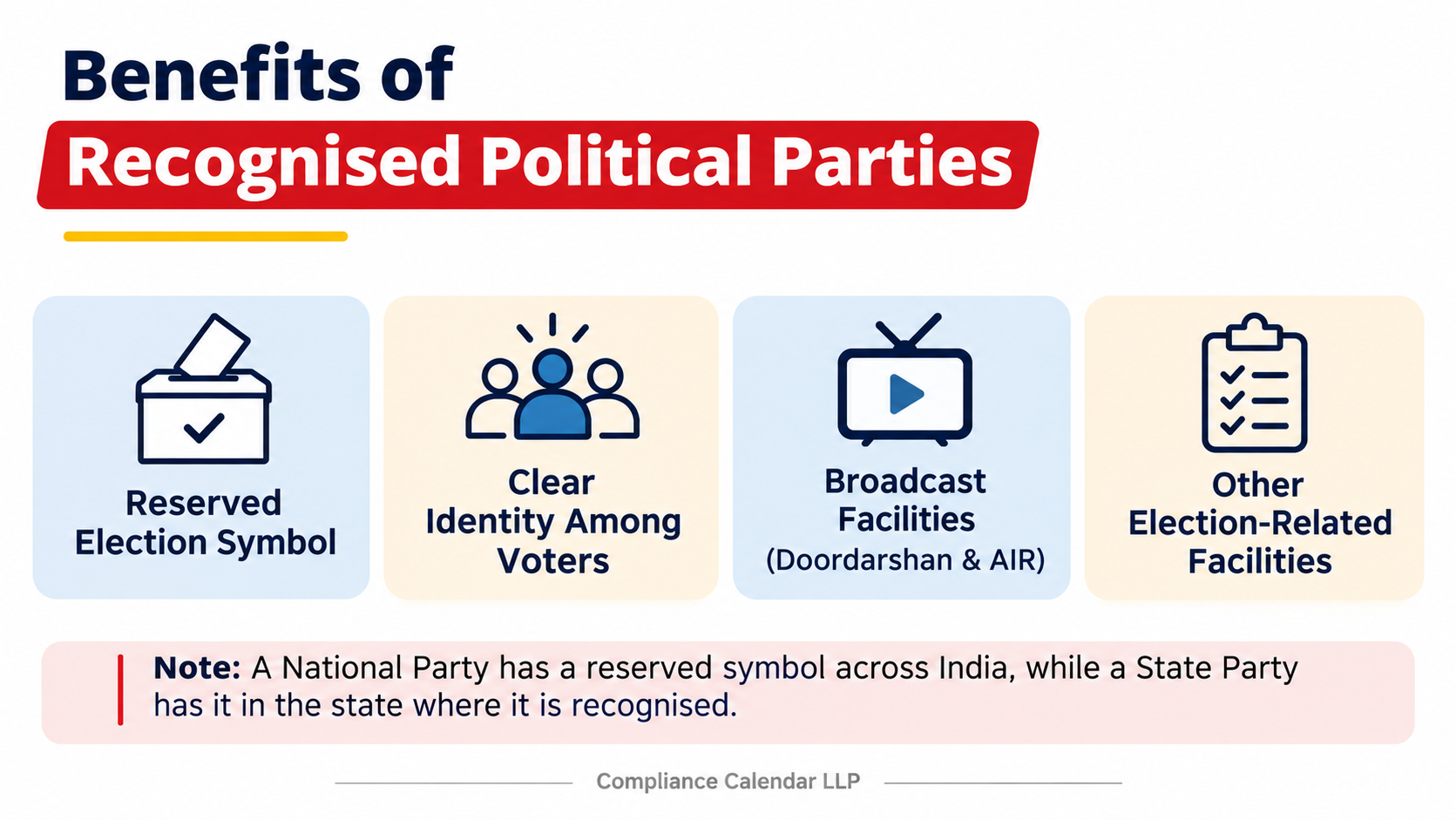
Getting recognised by the Election Commission gives a political party some advantages during elections. One of the biggest benefits is a reserved election symbol, which helps voters identify the party and its candidates when they go to vote. Recognised parties also get certain facilities that are not available to every registered unrecognised party.
|
Benefit |
How it helps the political party |
|
Reserved election symbol |
The party gets its own reserved symbol, which its candidates can use under ECI rules. |
|
Easy identification |
Voters can recognise the party through its symbol on the ballot or EVM. |
|
Broadcast time |
Recognised parties get time on Doordarshan and All India Radio during elections, as per ECI rules. |
|
Election-related facilities |
They receive certain additional facilities under election rules. |
There is also a difference between the symbol rights of State and National Parties. A National Party has its reserved symbol across India, while a State Party has its symbol reserved in the state where it is recognised. If it contests elections in other states, different symbol rules may apply.
Can a Registered Party Contest Elections Without Recognition?
Yes. A registered unrecognised political party can contest Lok Sabha and State Assembly elections if it follows the election rules and completes the required formalities for its candidates. It does not have to become a State Party or National Party before taking part in an election.
The main difference is that it does not automatically get a reserved election symbol. Its candidates generally have to choose from the free symbols available for that election. In certain cases, a registered unrecognised party may also apply for a common symbol under the Election Commission's rules, but this is subject to the conditions and approval process.
For example, a newly registered party in Haryana may decide to contest the next Assembly election. It can put forward its candidates by completing the required nomination and party authorisation formalities. However, it cannot assume that it will automatically get a reserved symbol just because the ECI has registered the party.
Can a Political Party Lose Its Recognition?
Yes. A political party can lose its State Party or National Party status if it does not continue to meet the required conditions after later elections. The Election Commission checks the party's performance under the rules for continued recognition. However, the rules also provide for continuation of recognition for a following general election in certain circumstances, so losing the required vote share or seats does not always mean that recognition ends immediately.
It is also important to understand that losing recognition does not automatically cancel the party's registration. The party may continue as a registered unrecognised political party and contest elections by following the applicable rules. In other words, registration and recognition are separate matters, and losing one does not automatically cancel the other.
Example: How a Political Party Moves from Registration to Recognition
A group of people in Rajasthan decides to form a political party because they want to work on issues affecting farmers, young people and local communities. They prepare a party constitution, collect the required member details and submit their application to the Election Commission of India. After the application is approved, their party becomes a registered political party.
After registration, the members start building their organisation and decide to contest the next State Assembly election. Their candidates receive votes from different parts of Rajasthan, and the party manages to secure 8% of the total valid votes in the state. Under the ECI recognition rules, this vote share can make the party eligible for State Party status, even if it has not won any Assembly seat.
The party first became registered by completing the application process. It became eligible for recognition later because of the votes it received in the election. Registration helped it enter the election process, while its performance helped it move towards recognised party status.
For avoid any legal issues later kindly read : Political Party Constitution Rules & Format
How Compliance Calendar Can Help with Political Party Registration
Starting a political party involves more than choosing a name and bringing a group of people together. The founders also need to prepare a proper party constitution, arrange member details, collect the required documents and follow the Election Commission's registration guidelines. Missing information or mistakes in the application can create problems during the registration process.
Compliance Calendar helps applicants understand these requirements and organise their documents before submission. Our team can assist with preparing the paperwork, checking the application details and guiding applicants through the registration process. The final decision to register a political party rests with the Election Commission of India.
If you are planning to start a political party and need assistance with the registration process, you can contact Compliance Calendar on +91 9988424211 or info@ccoffice.in
Frequently Asked Questions (FAQs)
1. What is the difference between a registered and a recognised political party?
A registered political party is one that has completed registration with the Election Commission under Section 29A. A recognised political party is a registered party that has also met the required vote-share or seat conditions in elections.
2. Can a registered political party contest elections in India?
Yes. A registered unrecognised political party can contest Lok Sabha and State Assembly elections by following the applicable election rules and completing the required formalities for its candidates.
3. Does every registered political party get a reserved election symbol?
No. A registered unrecognised party does not automatically get a reserved symbol. Its candidates generally use free symbols, although the party may apply for a common symbol under the relevant ECI rules.
4. How can a political party become a State Party?
A political party can become a State Party by meeting any one of the conditions set by the Election Commission. These conditions include getting the required vote share or winning a certain number of seats in that state.
5. How can a political party become a National Party?
A party can become a National Party by meeting any one of three conditions: getting at least 6% of valid votes in four states along with four Lok Sabha seats, winning at least 2% of Lok Sabha seats from at least three states, or becoming a recognised State Party in at least four states.
6. Can a new political party become a National Party immediately after registration?
No. Registration alone does not give a party National Party status. It must first take part in elections and meet at least one of the national recognition conditions.
7. Can a political party be recognised in one state but not in another?
Yes. A party may become a recognised State Party in one state because of its election performance there, while remaining unrecognised in other states where it has not met the required conditions.
8. Can a recognised political party lose its status?
Yes. A party can lose its recognition if it does not meet the required conditions under the rules for continued recognition. However, the ECI rules provide for continuation of recognition for a following general election in certain circumstances.
9. Who decides whether a political party is recognised?
The Election Commission of India decides whether a party qualifies for State Party or National Party status. It checks the party's election performance under the Election Symbols (Reservation and Allotment) Order, 1968.
10. Is political party registration compulsory before seeking recognition?
Yes. A political party must first register with the Election Commission under Section 29A of the Representation of the People Act, 1951. Recognition is a separate status that a registered party may receive after meeting the required election conditions.
Article last updated on : 11 Nov 2026.













_learn_crop10_thumb.jpg)