


Do you want to start your own political party in India? You may have a group of people who share the same ideas and want to work together for the public. But before your group can become a registered political party, you need to complete a registration process with the Election Commission of India (ECI).
This process is known as Political Party Registration. It is done under Section 29A of the Representation of the People Act, 1951. You need to choose a party name, prepare its rules, collect member details and submit an application with the required documents. In this guide, we explain how to register a political party in India, what documents you need, how much the process costs and how Compliance Calendar LLP can assist you.
What Is Political Party Registration?
Political Party Registration is the process of getting a group officially registered as a political party with the Election Commission of India. A group of Indian citizens who want to form a political party can apply under Section 29A of the Representation of the People Act, 1951.
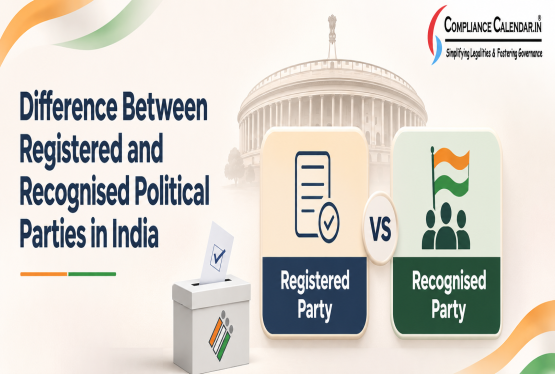
After the ECI approves the application, the group becomes a Registered Political Party. This registration gives the party a formal place in the election system. However, registration does not automatically make it a State Party or National Party. These are separate statuses that depend on the party's performance in elections and the rules set by the Election Commission.
Who Can Register a Political Party in India?
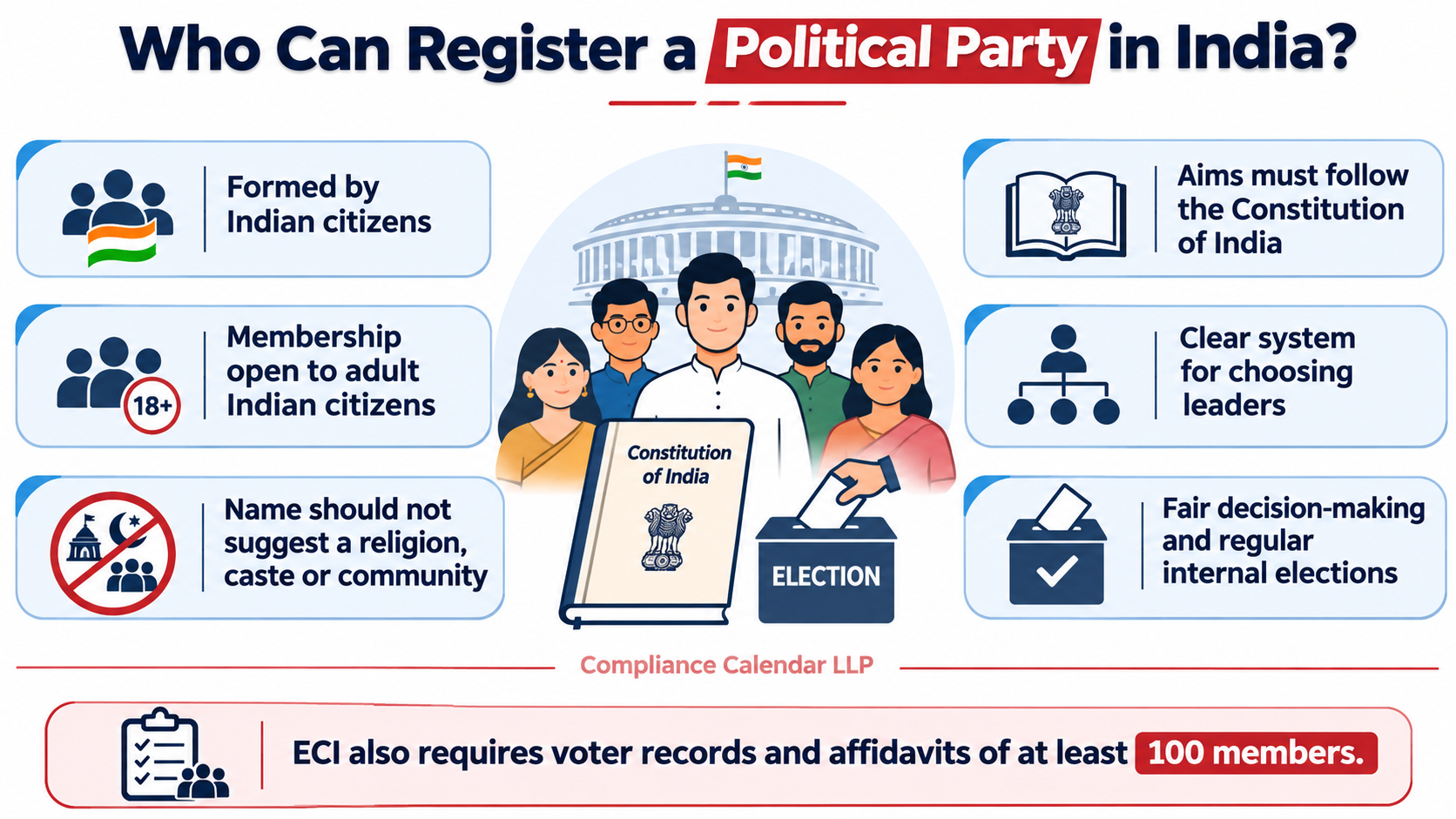
A group or association of Indian citizens can apply for Political Party Registration. The group should have a clear purpose, members, leaders and written rules for running the party.
Before applying, keep these basic conditions in mind:
- The party must be formed by individual Indian citizens.
- Its membership must be open to adult Indian citizens.
- Its name should not suggest a particular religion, caste or community.
- Its aims must follow the Constitution of India.
- It must have a clear system for choosing its leaders.
- Its rules must support fair decision-making and regular internal elections.
Note : The Election Commission also asks for voter records and affidavits for at least 100 members of the proposed party. These members must meet the conditions mentioned in the ECI guidelines.
Which Law Covers Political Party Registration?
Political Party Registration in India is covered by Section 29A of the Representation of the People Act, 1951. This section explains how an association or group of Indian citizens can apply to the Election Commission to become a registered political party.
The Election Commission has also issued guidelines and an application format. These explain how to prepare the party constitution, which member details to provide, what documents to attach and where to send the application. Applicants should follow the latest instructions available on the ECI website.
How to Register a Political Party in India?
The registration process includes choosing a party name, forming the party, preparing its rules and submitting an application to the Election Commission. It is better to arrange all the important details before filing the application.
Step 1: Choose a Name for Your Political Party
The first step is to select a name for your political party. The name should be clear and different from the names of existing political parties. It should not contain words that suggest a particular religion, caste or community.
Before finalising the name, check the list of registered political parties on the Election Commission website. This will help you avoid choosing a name that is already in use or is too similar to another party's name. The final decision on the proposed name rests with the Election Commission.
Step 2: Form the Party and Select Its Leaders
Once the name is decided, the group should formally form the political party. Its members should decide who will manage the party and take care of its daily work.
The party should select its main office-bearers, such as:
- President
- General Secretary
- Secretary
- Treasurer
- Members of the main committees
The group should also record the date on which the party was formed. This date is important because the application must be submitted within 30 days of the party's formation.
Step 3: Prepare the Political Party Constitution
A party constitution is a written document that explains how the political party will work. You can think of it as a rulebook for the party. It tells members how leaders are selected, how decisions are made and how the party's money is managed.
The constitution should cover:
- Name and main aims of the party.
- Rules for joining and leaving the party.
- Rights and duties of members.
- Names and roles of the main leaders and committees.
- How internal elections will be held.
- How meetings and important decisions will take place.
- How party funds and accounts will be managed.
- Rules for discipline and solving disputes.
- How the constitution can be changed.
- Rules for merger, split or closure of the party.
It must also include the declaration required under Section 29A(5) of the Act. This declaration states that the party will follow the Constitution of India and the principles of socialism, secularism and democracy, and protect the sovereignty, unity and integrity of India.
Step 4: Collect Details of at Least 100 Members
The Election Commission asks the proposed party to provide records for at least 100 members. These records help show that the members are registered voters in India.
For these members, the party must arrange voter details through certified electoral roll extracts or attested copies of their Voter ID cards (EPICs). Individual affidavits are also required to confirm that each person is a registered voter and is not a member of another political party registered with the ECI.
Make sure that the names and other details match across the member list, voter records and affidavits. Incorrect or missing details can create problems during the application review.
Step 5: Arrange an Office Address for the Party
The party must provide the address of its main office. This is the address where the Election Commission can send letters and other official communication.
The ECI guidelines also require a No Objection Certificate (NOC) in the form of an affidavit from the owner of the premises, along with proof of ownership, such as property papers or a house tax receipt. The proposed party office should not be located in a government building. The party must also provide the required undertaking about the use of the premises and any disturbance to the public.
Step 6: Prepare the Application and Pay the Registration Fee
After arranging the party details and documents, fill in the application format given by the Election Commission. The application should include the party name, formation date, office address, member details, names of leaders and other information asked for by the ECI.
The current published ECI guidelines mention a non-refundable processing fee of Rs 10,000. This amount must be paid through a demand draft in favour of the Under Secretary, Election Commission of India, New Delhi. Check the latest ECI instructions for the correct payment details before preparing the demand draft.
Step 7: Publish a Notice About the Proposed Party Name
The proposed party name must also be made public through newspaper notices. Under the ECI's published instructions, the name is advertised in two national daily newspapers and two local daily newspapers, on two days.
This gives people an opportunity to raise objections if they have a valid reason to do so. The ECI's 2024 clarification states that objections can be submitted within 30 days from the publication of the notice. The party should keep copies of the newspaper notices as proof of publication.
Step 8: Submit the Application to the Election Commission
Once the application and supporting documents are ready, submit them to the Secretary of the Election Commission of India. The ECI guidelines allow the application to be presented personally or sent by registered post.
Important: The application must reach the Election Commission within 30 days from the date the party was formed. If the application is submitted after this period, it may be treated as time-barred under Section 29A of the Representation of the People Act, 1951.
Step 9: Track the Application and Reply to ECI Questions
After submitting the application, the party can check its progress through the Political Parties Registration Tracking Management System (PPRTMS). The applicant should provide the correct mobile number and email address to receive updates.
The Election Commission may check the documents or ask for more details. The party should read these requests carefully and send the required information within the given time. The ECI will make the final decision after reviewing the application and other relevant details.
Documents Required for Political Party Registration
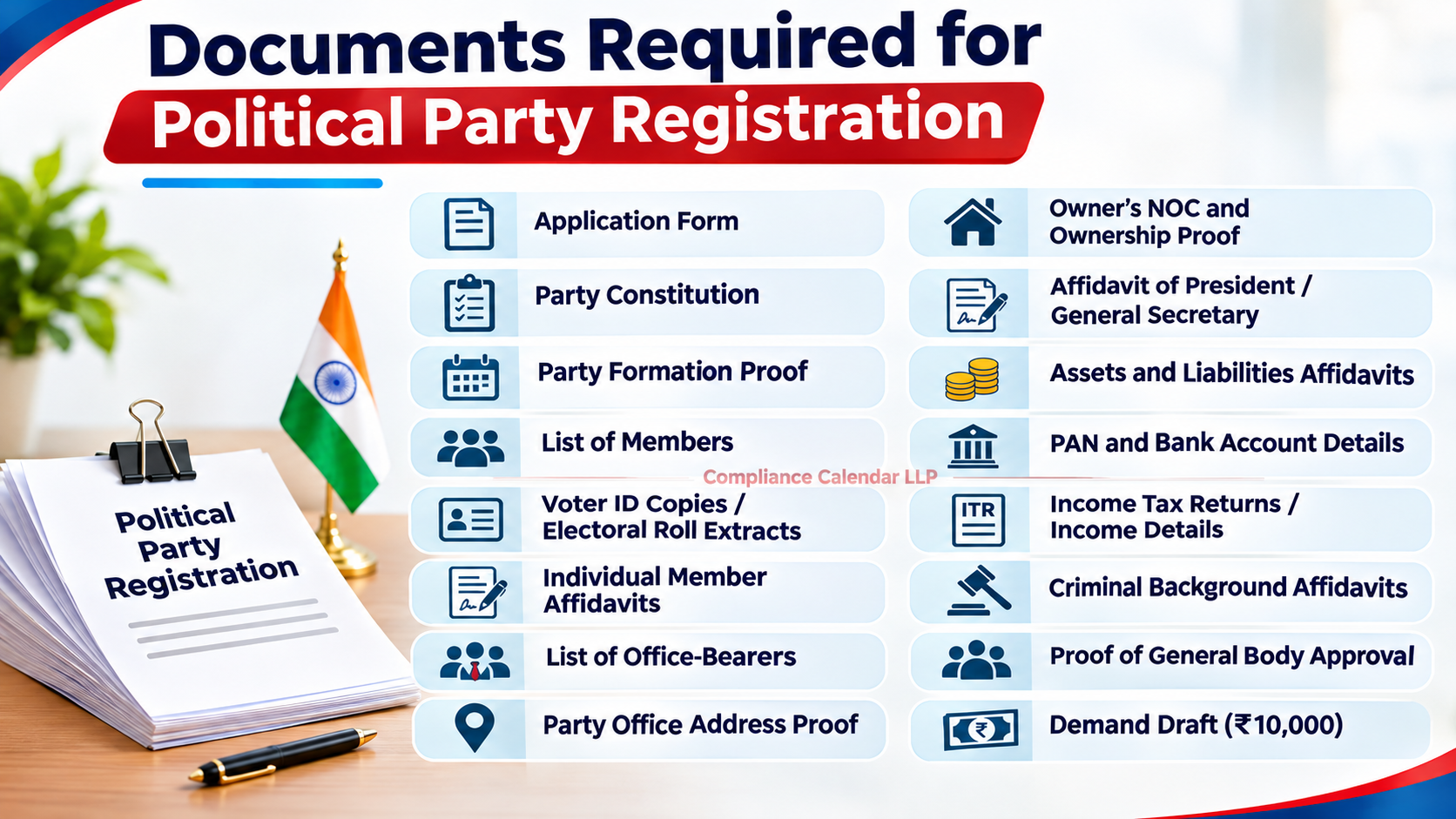
Before applying, the party should arrange all the required documents. Keeping them ready can make the application process easier and help avoid delays caused by missing information.
|
Document |
Why Is It Required? |
|
Application form |
Gives the main details of the proposed political party. |
|
Party constitution |
Explains the party's aims, rules, members and working system. |
|
Party formation proof |
Shows the date on which the party was formed. |
|
List of members |
Provides the names and details of party members. |
|
Voter ID copies or electoral roll extracts |
Shows that at least 100 members are registered voters. |
|
Individual member affidavits |
Confirms the voter status and party membership details of the required members. |
|
List of office-bearers |
Gives the details of the President, Secretary, Treasurer and other leaders. |
|
Party office address proof |
Shows the address of the party's main office. |
|
Owner's NOC and ownership proof |
Gives permission to use the premises as the party office. |
|
Affidavit of the President or General Secretary |
Covers declarations required by the ECI, including details about party members and the office premises. |
|
Assets and liabilities affidavits |
Gives the financial details of the main office-bearers. |
|
PAN and bank account details, if available |
Provides the party's financial information. |
|
Income tax returns or income details of office-bearers |
Provides the information asked for under the ECI guidelines. |
|
Criminal background affidavits of office-bearers |
Gives the background details required by the ECI. |
|
Proof of General Body approval |
Shows that the party constitution was approved by its General Body. |
|
Demand draft |
Pays the prescribed processing fee of Rs 10,000. |
The Election Commission may ask for other information or supporting records as part of its review. Therefore, use the latest ECI checklist before submitting the application.
What Is the Fee for Political Party Registration?
The processing fee mentioned in the Election Commission's published guidelines is Rs 10,000. It is paid through a demand draft in favour of the Under Secretary, Election Commission of India, New Delhi. This fee is non-refundable.
Apart from this fee, the party may have other expenses for preparing affidavits, getting documents attested, publishing newspaper notices and arranging its office. These expenses are separate from the ECI processing fee.
How Much Time Does Political Party Registration Take?
The party must submit its application within 30 days from the date it is formed. This is the deadline for filing the application, not the time taken by the Election Commission to approve it.
The ECI guidelines state that an acknowledgement is sent within two weeks after receiving a complete application. However, final registration may take longer because the Commission has to check the documents, complete the public notice process and consider any objections or further information. There is no need to treat the two-week acknowledgement period as a promise of final approval.
What Happens After a Political Party Is Registered?
Getting registered is only the first step. After registration, a political party must follow the Election Commission of India's (ECI) guidelines and manage its work properly.
|
Responsibility |
What Does the Party Need to Do? |
|
Hold Internal Elections |
Hold regular elections for party leaders and main committees. As per ECI guidelines, these elections should take place at least once every four years. |
|
Maintain Proper Accounts |
Keep clear records of all money received and spent by the party. |
|
Submit Audited Accounts |
Get the party's accounts audited every year and submit them to the ECI within six months after the financial year ends. |
|
Inform the ECI About Changes |
Inform the ECI about important changes, such as a change in the party's name, office address or office-bearers. |
|
Take Part in Elections |
A newly registered party must contest an election conducted by the ECI within five years of registration. |
|
Avoid Removal from the ECI List |
A party that does not contest any election continuously for six years may be removed from the list of registered political parties. |
Important: Political parties should continue to follow ECI guidelines even after receiving registration. Registration does not mean that the party has no further responsibilities.
Does Political Party Registration Make a Party a National Party?
No. Registration and recognition are two different things. When the Election Commission approves an application, the party becomes a Registered Political Party. It does not automatically become a State Party or National Party.
A party gets State or National Party recognition only when it meets the election performance conditions set by the Election Commission under the Election Symbols (Reservation and Allotment) Order, 1968. Registration alone also does not guarantee a reserved election symbol.
Common Mistakes to Avoid During Political Party Registration
Some parties face problems because their application is incomplete or the details do not match. Checking the documents before submission can help avoid these common mistakes.
|
Common Mistake |
What Should Be Done? |
|
Choosing a name similar to an existing party |
Check the ECI list and choose a clearly different name. |
|
Using a name linked to religion or caste |
Select a name that follows ECI guidelines. |
|
Preparing an incomplete party constitution |
Include all required rules about members, leaders and internal elections. |
|
Missing the 30-day application deadline |
Start preparing documents soon after forming the party. |
|
Providing incorrect member details |
Match member names with voter records and affidavits. |
|
Missing the newspaper notice |
Follow the ECI's publication instructions carefully. |
|
Forgetting the processing fee |
Attach the required demand draft with the application. |
|
Ignoring ECI requests |
Check application updates and reply within the given time. |
How Compliance LLP Calendar Can Assist with Political Party Registration
Starting a political party involves several documents and steps. For someone doing this for the first time, understanding the ECI requirements and preparing the application can be difficult.
Compliance Calendar LLP provides professional assistance with Political Party Registration. Our team can help you understand the requirements, prepare and organise the documents, draft or review the party constitution, arrange the application details and guide you through the submission and follow-up process.
Our role is to assist you with the paperwork and registration process. The Election Commission of India is the authority that checks the application and makes the final decision on registration. Compliance Calendar does not issue the registration certificate or guarantee approval.
Planning to start a political party in India? Contact Compliance Calendar LLP at +91 9988424211 or info@ccoffice.in for assistance with Political Party Registration.
Frequently Asked Questions (FAQs)
1. How can I register a political party in India?
You need to form a group of Indian citizens, choose a party name, prepare its constitution, collect member details and submit an application to the Election Commission under Section 29A of the Representation of the People Act, 1951.
2. Who can start a political party in India?
A group or association of individual Indian citizens can form a political party. The party must follow the Constitution of India and the registration conditions set by the Election Commission.
3. How many members are required for Political Party Registration?
The ECI guidelines ask for voter records and individual affidavits for at least 100 members of the proposed political party.
4. What is the fee for Political Party Registration?
The processing fee mentioned in the ECI guidelines is Rs 10,000. It is paid through a demand draft and is non-refundable.
5. What is the time limit for applying for political party registration?
The application must be submitted within 30 days from the date the political party is formed.
6. Is a party constitution compulsory?
Yes. The party must submit a written constitution. It should explain the party's aims, membership rules, leadership, internal elections and working system.
7. Where should I submit the political party registration application?
The application must be submitted to the Secretary of the Election Commission of India in New Delhi, either personally or through registered post, as allowed by the ECI guidelines.
8. Can a registered political party contest elections?
Yes. A registered political party can take part in elections, subject to applicable election laws and rules. Registration does not automatically give the party State or National Party recognition.
9. Can I check the status of my registration application?
Yes. Applicants can use the Political Parties Registration Tracking Management System (PPRTMS) to check the progress of their application.
10. Can Compliance Calendar help with Political Party Registration?
Yes. Compliance Calendar can assist with understanding the requirements, preparing the party constitution, organising documents and guiding applicants through the application and follow-up process. The final registration decision is made by the Election Commission of India.
Article last updated on : 10 Nov 2026.











_learn_crop10_thumb.jpg)