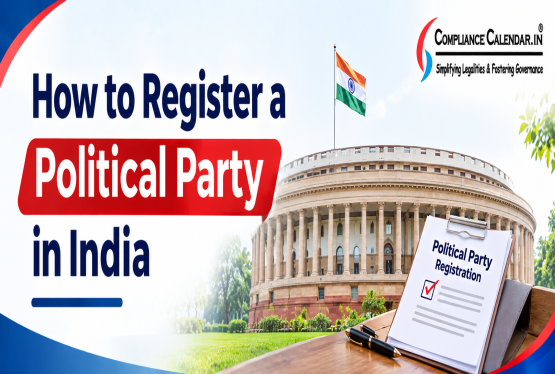



Starting a political party involves more than choosing a name and bringing people together. The party also needs a written constitution that explains how it will work, who can join, how leaders will be selected and what rules members must follow. This document is important because the Election Commission of India (ECI) asks every new political party to submit its constitution when applying for registration. It must contain certain rules and declarations required by the Commission.
If you are planning to form a political party, you should understand these requirements before preparing the document. In this article, we explain the political party constitution format, the rules it should contain and the common mistakes you should avoid.
What Is a Political Party Constitution?
A political party constitution is a written set of rules for running a political party. It explains the party's name, goals, membership rules, leadership and working system. Think of it as a rulebook for the party. It helps every member understand how the party will work and what they are expected to follow.
For example, if a party has a President, General Secretary and Treasurer, its constitution should explain how these people will be selected and what work each person will do. It should also explain how the party will choose new leaders in the future.
Why Does a Political Party Need a Constitution?
The Election Commission of India requires a political party to submit its constitution when applying for registration under Section 29A of the Representation of the People Act, 1951. The document helps the Commission understand how the party is organised and whether it has clear rules for its work. It also shows how the party will follow democratic methods while choosing leaders and making decisions.
A clear constitution also helps the party avoid confusion later. Members can refer to the same rules when there is a question about membership, elections, meetings or leadership.
If you want to understand the complete registration process, read our guide on How to Register a Political Party in India.
What Should a Political Party Constitution Include?
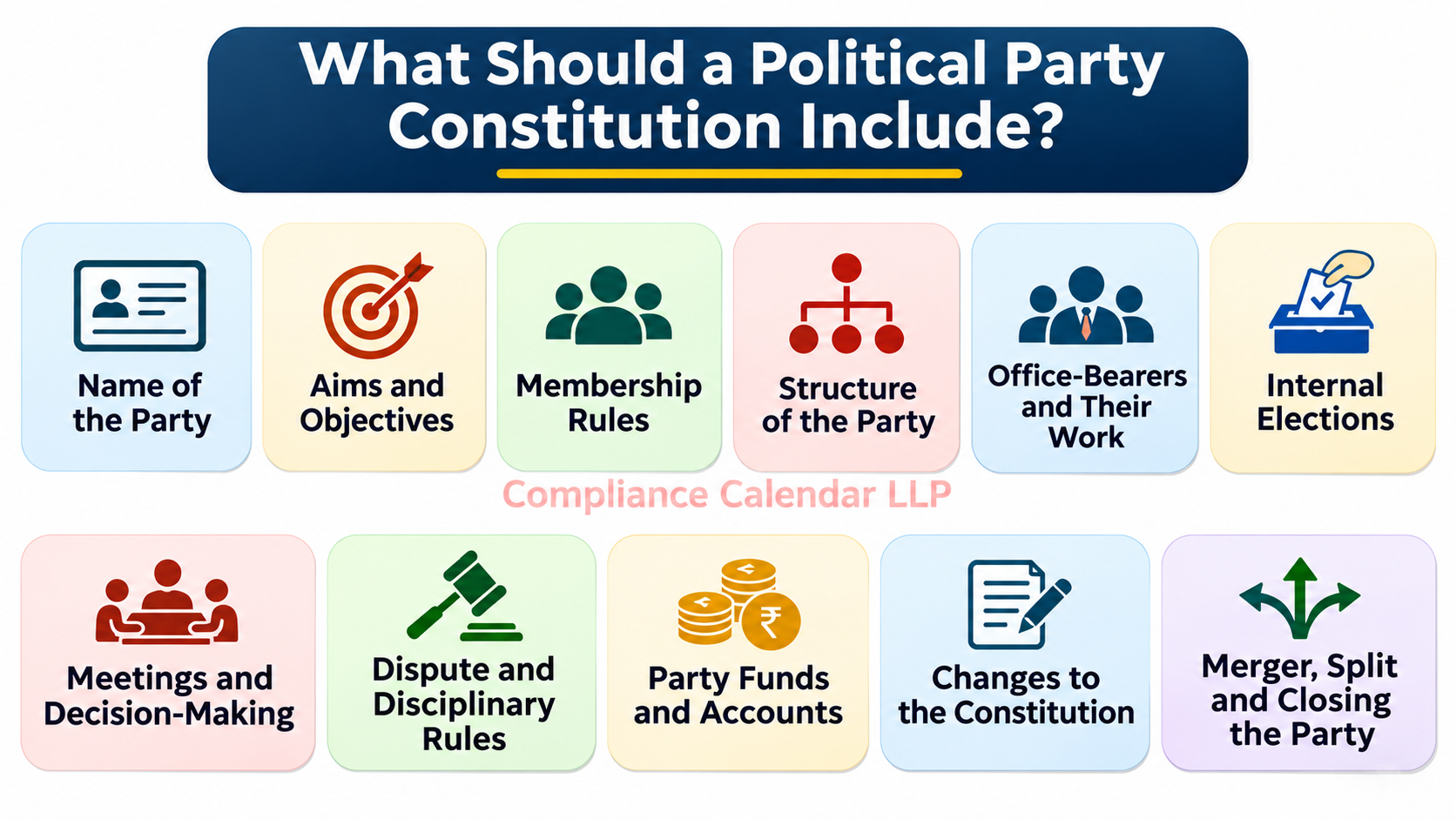
The ECI has given a list of main articles that should be covered in a party constitution. A party can arrange these points in its own document, but it should not leave out the required rules.
Here are the main sections explained in simple words.
1. Name of the Party
The constitution should begin with the full name of the political party. The name should be clearly different from the names of existing political parties. It should not contain religious, communal or caste references.
Before finalising the name, check the names of existing parties so that your proposed name does not create confusion.
2. Aims and Objectives
This section explains why the party has been formed and what it wants to work towards. For example, the party may mention its goals related to education, employment, public welfare, development or better public services. These goals must be in line with the Constitution of India.
The objectives should be written clearly so that members and the public can understand the party's purpose.
3. Membership Rules
The constitution should explain who can join the party and how a person can become a member.
The ECI guidelines state that membership should be open to all adult Indian citizens without discrimination. The constitution should also make it clear that a person must be at least 18 years old to become a member.
This section should cover:
- How a person can apply for membership.
- Whether any membership fee will be charged.
- What rights and duties members will have.
- How membership records will be kept.
- When and how membership can end.
The party should keep these rules clear so that people know how they can join and what is expected from them.
4. Structure of the Party
A political party may have committees and groups at different levels to manage its work. The constitution should name these groups and explain what each one will do. For example, a party may have a National Executive Committee, State Committees and District Committees. It should explain who will be part of each committee and what decisions that committee can take.
The rules should also explain how committee members will be selected and how long they can hold their positions. The ECI guidelines say that decision-making should follow democratic rules. One person should not have special veto power over the decisions of the party.
5. Office-Bearers and Their Work
Office-bearers are the people who handle the main work of the party. The constitution should mention their positions, duties and powers.
Some common positions may include:
|
Position |
Main Work |
|
President |
Leads the party and looks after its main activities. |
|
Vice-President |
Helps the President with party work. |
|
General Secretary |
Handles records, meetings and official communication. |
|
Treasurer |
Looks after party funds and accounts. |
|
Other Secretaries |
Handle work given to them by the party. |
The constitution should explain how office-bearers will be selected, how long they can remain in their positions and how they can be replaced. The ECI guidelines also set rules for elections, nominations and the term of office. For example, not more than one-third of the members of an organisational body or office-bearer group can be nominated. The fixed term should not be more than five years, and the party must provide for regular elections at least once every four years.
6. Internal Elections
A political party must have clear rules for choosing its leaders. These are called internal elections because they take place within the party. The constitution should explain who can vote, who can contest and how the results will be announced. It should also mention how elections will take place at different levels of the party.
The ECI guidelines require the party to hold regular elections for all office-bearer positions and party bodies at least once every four years. The constitution should clearly mention this rule.
7. Meetings and Decision-Making
The constitution should explain how party meetings will take place and how important decisions will be made.
It should cover:
- Who can call a meeting.
- How members will be informed.
- How many members must be present.
- How decisions will be approved.
- How meeting records will be maintained.
The minimum number of members needed to hold a valid meeting is called a quorum. The party should explain this rule clearly in its constitution.
8. Dispute and Disciplinary Rules
Disagreements may happen between party members. The constitution should explain how the party will handle such problems. For example, if a member breaks party rules or behaves against the party's code of conduct, the constitution should explain how a complaint will be checked and what action may be taken.
It should also give members a fair chance to explain their side before action is taken.
9. Party Funds and Accounts
A political party needs money to manage its office and carry out its activities. The constitution should explain how this money will be received, used and recorded. It should also mention who will look after the accounts and who can approve expenses.
The ECI guidelines require the party to:
- Use party funds for political activities.
- Maintain accounts on an accrual basis.
- Get its accounts audited every financial year by an auditor from the CAG panel.
- Submit its audited annual accounts to the ECI within six months after the financial year ends.
These rules help the party keep proper records of its money.
10. Changes to the Constitution
A party may need to change some of its rules in the future. The constitution should explain how these changes can be made. It should mention who can suggest a change and how it will be approved. The ECI guidelines require any amendment to the party constitution to be approved by its General Body.
The party should also keep a record of the changes made.
11. Merger, Split and Closing the Party
The constitution should explain what will happen if the party joins another party, splits into different groups or decides to close its operations. It should mention who can take these decisions and what approval is needed. It should also explain how the party's records and remaining funds will be handled.
These rules are important because they help avoid confusion if the party's structure changes later.
Important Declaration Required Under Section 29A(5)
There is one important declaration that every political party must include in its constitution. It is required under Section 29A(5) of the Representation of the People Act, 1951. The ECI requires the declaration to be included in the constitution in the exact wording given below:
"(Name of the party) shall bear true faith and allegiance to the Constitution of India as by law established, and to the principles of socialism, secularism and democracy and would uphold the sovereignty, unity and integrity of India."
The party must replace "(Name of the party)" with its actual name. It should not change the wording of the declaration.
Leaving out this declaration or changing its required wording can create a problem with the registration application.
Other Rules the ECI Requires in the Constitution
Apart from the main sections, the ECI guidelines also require some specific promises to be written in the constitution.
|
Rule |
What the Party Must Include |
|
No violence |
The party will not promote, encourage or take part in violence. |
|
Regular elections |
The party will hold elections for all office-bearer positions and party bodies at least once every four years. |
|
General Body approval |
Any change to the constitution must be approved by the General Body. |
|
Annual accounts |
The party will submit its audited annual accounts to the ECI within six months after the financial year ends. |
|
Contesting elections |
The party will contest an election conducted by the ECI within five years of its registration. |
The ECI guidelines also state that if a party does not contest elections continuously for six years, it will be taken off the list of registered parties. These requirements should be written clearly in the constitution itself.
Common Mistakes to Avoid
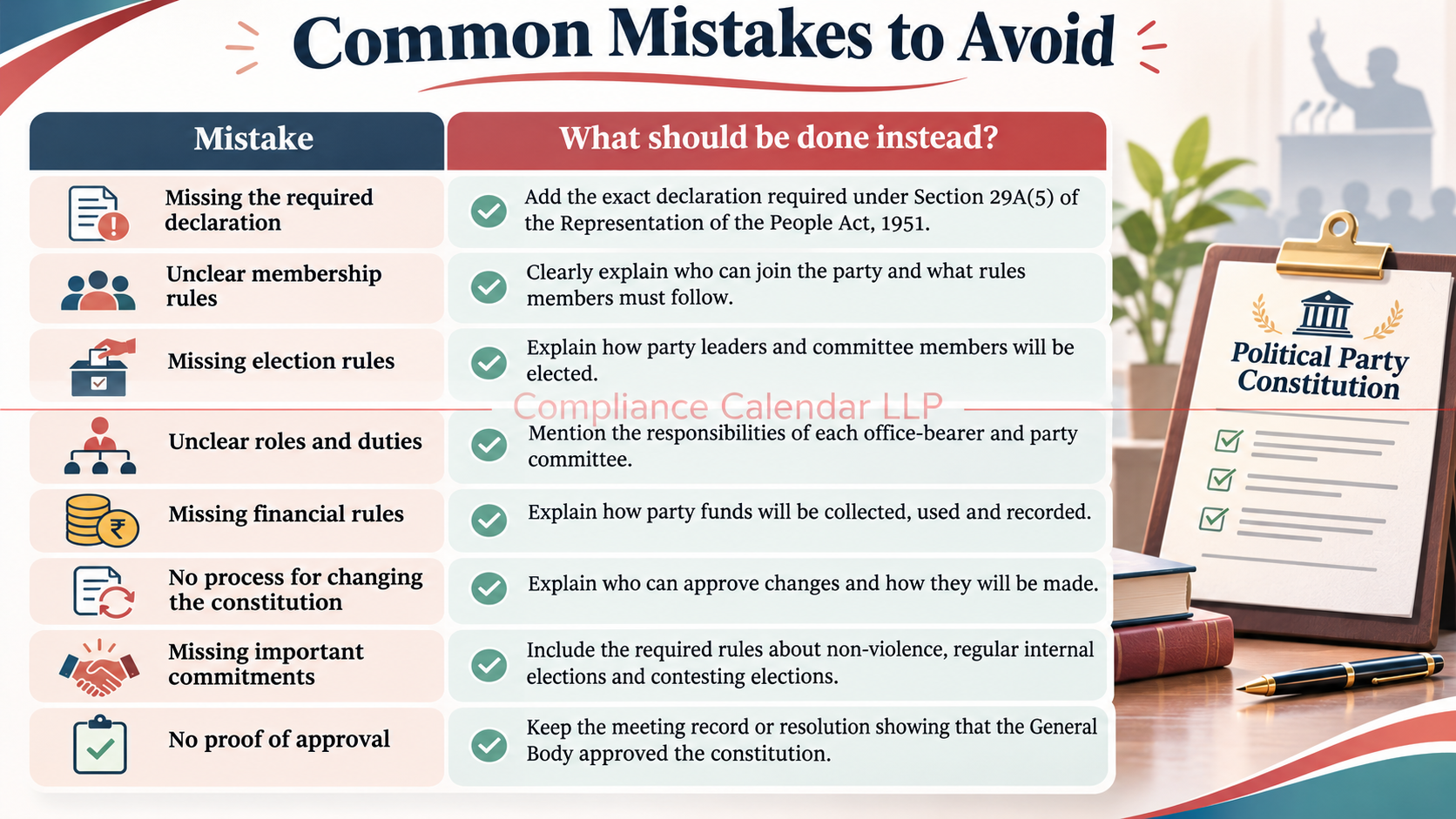
A party constitution should be checked properly before it is submitted to the Election Commission. Missing information or unclear rules can lead to questions from the Commission.
|
Mistake |
What should be done instead? |
|
Missing the required declaration |
Add the exact declaration required under Section 29A(5) of the Representation of the People Act, 1951. |
|
Unclear membership rules |
Clearly explain who can join the party and what rules members must follow. |
|
Missing election rules |
Explain how party leaders and committee members will be elected. |
|
Unclear roles and duties |
Mention the responsibilities of each office-bearer and party committee. |
|
Missing financial rules |
Explain how party funds will be collected, used and recorded. |
|
No process for changing the constitution |
Explain who can approve changes and how they will be made. |
|
Missing important commitments |
Include the required rules about non-violence, regular internal elections and contesting elections. |
|
No proof of approval |
Keep the meeting record or resolution showing that the General Body approved the constitution. |
Note : Before submitting the application, check every clause against the latest ECI guidelines.
For a separate list of documents needed for the registration application, read our article on Documents Required for Political Party Registration in India.
How to Prepare a Political Party Constitution
Preparing the constitution becomes easier when the party first decides how it will work. Do not simply copy another party's constitution because its structure and rules may be different.
Step 1: Decide the Party's Name and Goals
First, choose a name for the party and write down its main goals. The name should follow the Election Commission of India's rules, and the goals should be in line with the Constitution of India.
Step 2: Make Rules for Party Members
Decide who can become a member, how a person can join and what rules members must follow. The membership rules should be clear and fair.
Step 3: Decide Who Will Run the Party
List the main positions, such as President, Secretary and Treasurer. Also explain what each person will do and which committees will help run the party.
Step 4: Set Rules for Internal Elections
Explain how party leaders and committee members will be chosen. Mention how often elections will take place and how members can take part in them.
Step 5: Add Rules for Money and Discipline
Explain how the party will collect and use its money and maintain its accounts. Also include rules for handling complaints and taking action if a member breaks party rules.
Step 6: Include All Required ECI Declarations
Check that the constitution contains the exact declaration required under Section 29A(5) and all other required commitments. Do not change the wording of the mandatory declaration.
Step 7: Get Approval from the General Body
Once the constitution is ready, the party's General Body should approve it. Keep the meeting minutes or resolution as proof that members have adopted the constitution.
Step 8: Check the Constitution Before Submission
Read the full document and compare it with the Election Commission of India's guidelines. Make sure no important rule or declaration is missing.
The constitution should be clear enough for members to understand and detailed enough to explain how the party will work.
How Compliance Calendar LLP Can Help
Preparing a political party constitution can take time because it must cover many rules and requirements. Missing an important clause may lead to questions from the Election Commission.
Compliance Calendar can assist with understanding the ECI requirements, preparing the constitution and arranging the documents needed for the registration application.
The team can also help applicants check whether the required details have been included before the application is submitted. The final decision on registration rests with the Election Commission of India.
For assistance, contact Compliance Calendar LLP at +91 9988424211 or email info@ccoffice.in
Frequently Asked Questions (FAQs)
1. What is a political party constitution?
It is a written document that explains how a political party will work. It contains the party's name, goals, membership rules, leadership structure and other important rules.
2. Is a constitution compulsory for political party registration?
Yes. The Election Commission of India asks every new political party to submit its constitution when applying for registration under Section 29A.
3. Is there a fixed format for a political party constitution?
The ECI gives the main articles and rules that the constitution must cover. A party can arrange the document in its own format, but it must include all required points.
4. What is the minimum age to become a political party member?
The ECI guidelines state that a person must be at least 18 years old to become a member. Membership should be open to all adult Indian citizens without discrimination.
5. How often should a political party hold internal elections?
The constitution must provide for regular elections to all office-bearer positions and party bodies at least once every four years.
6. Can a political party change its constitution?
Yes. A party can change its constitution by following the amendment rules written in the document. The changes must be approved by the General Body.
7. What is the declaration under Section 29A(5)?
It is a mandatory statement that the party must include in its constitution. It confirms the party's faith and allegiance to the Constitution of India and the principles mentioned in Section 29A(5).
8. Does a political party need to mention its financial rules?
Yes. The constitution should explain how party funds will be used and how accounts will be maintained and audited.
9. What happens if a political party does not contest elections?
Under the ECI guidelines, a party must contest an election conducted by the ECI within five years of registration. If it does not contest elections continuously for six years, it will be taken off the list of registered parties.
10. Can Compliance Calendar help prepare a political party constitution?
Yes. Compliance Calendar can assist with understanding the ECI requirements, preparing the constitution and organising documents for the registration application.
Article last updated on : 11 Nov 2026.














_learn_crop10_thumb.jpg)