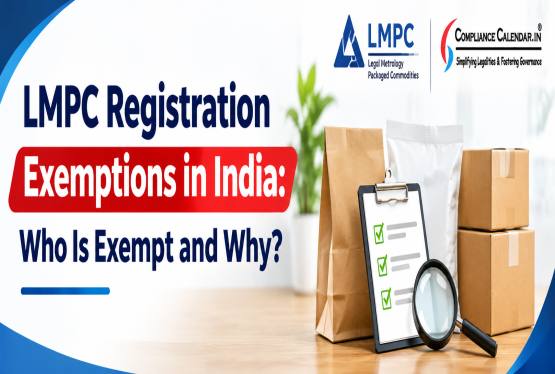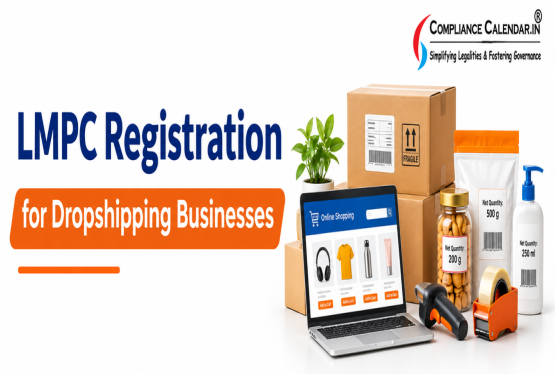



A company may start with one warehouse in Delhi and gradually expand to Mumbai, Bengaluru and Hyderabad. As orders increase, managing inventory becomes easier with multiple storage locations. However, this expansion can also raise important questions about Legal Metrology compliance, especially when products are packed, repacked, labelled or imported through different premises.
LMPC Registration for Multiple Warehouses depends on the business activities carried out at each location. A warehouse used only for storing properly labelled products does not automatically require a separate registration under Rule 27. However, a location where covered goods are pre-packed or repacked may need to be included in the relevant registration particulars.
The Legal Metrology (Packaged Commodities) Third Amendment Rules, 2026 also introduced important changes concerning annual registration updates, certificate validity and declarations at specified bonded warehouses.
What is LMPC Registration for Multiple Warehouses?
LMPC Registration refers to registration under Rule 27 of the Legal Metrology (Packaged Commodities) Rules, 2011. It applies to covered manufacturers, packers and importers dealing in pre-packaged commodities intended for sale, distribution or delivery.
When a business operates multiple warehouses, the important question is not simply how many premises it owns. The business must identify what happens at each location. A warehouse storing sealed products is different from one where employees pack loose goods into retail packages or change the quantity and packaging before dispatch.
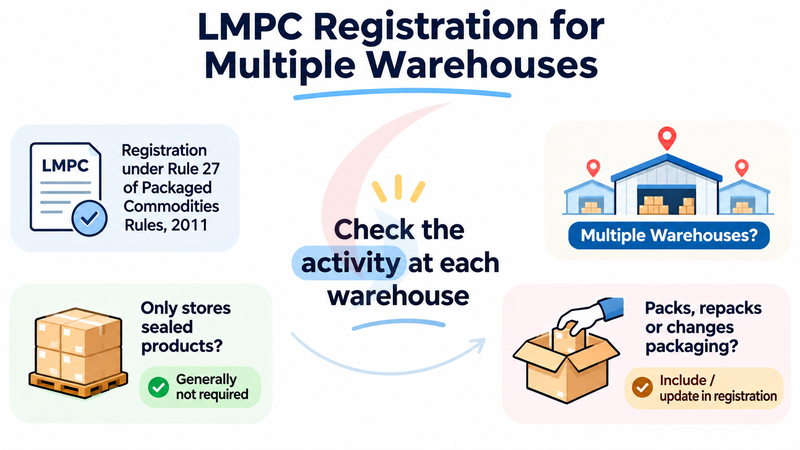
The registration application requires relevant business and premises information. Where packaging activities are conducted at additional locations, the business should review whether those premises must be included or updated in its registration.
Is Separate LMPC Registration Required for Every Warehouse?
A separate Rule 27 registration certificate is not automatically required for every warehouse operated by the same business. The actual registration requirements depend on the legal entity, business activity, premises involved and applicable Central or State authority procedures. Not every packaged commodity is subject to identical Legal Metrology requirements.
|
Warehouse Activity |
LMPC Registration Requirement |
|
Storage of Sealed Products |
Separate Rule 27 registration is not automatically required solely for storage. |
|
Retail Packing |
Covered packing premises must be appropriately disclosed in registration particulars. |
|
Repacking Products |
Registration requirements apply where the activity constitutes regulated pre-packing. |
|
Imported Goods Storage |
Importer registration and applicable package declarations must be maintained. |
|
Third-Party Warehouse |
Responsibility depends on which entity actually imports or packs the goods. |
|
Multiple State Operations |
The competent authority and premises details must be checked against the business's operations. |
For example, a company storing finished products in four warehouses may have different obligations from a company operating four independent packing units.
Businesses can refer to our LMPC Registration and Legal Metrology Compliance Guide to understand the basic registration requirements.
A Practical Story: An E-Commerce Company Expanding Across India
Imagine QuickKart Retail, a fictional Delhi-based company selling packaged household accessories through its website and online marketplaces. Initially, QuickKart operates one warehouse in Delhi, where products are packed, labelled and dispatched. After growing its customer base, the company opens additional warehouses in Mumbai and Bengaluru.
The Mumbai warehouse receives finished, properly labelled products and dispatches them without changing the packaging. The Bengaluru warehouse, however, receives products in bulk and packs them into smaller retail units. QuickKart must therefore review the Bengaluru packing operation separately rather than assuming that all three warehouses have identical registration requirements.
The company should verify its existing certificate, update relevant premises details and ensure that the products packed in Bengaluru carry the correct declarations. This example illustrates why warehouse expansion should begin with a review of business activities, not merely a count of storage locations. E-commerce businesses using multiple fulfilment centres should also ensure that their product listings match the declarations printed on retail packages.
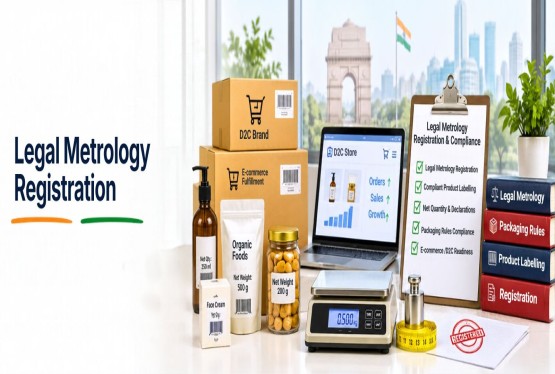
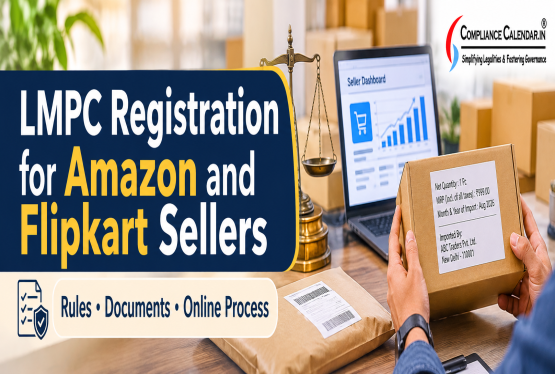
Read our guide on LMPC Registration for Amazon and Flipkart Sellers to understand online selling requirements, product labelling, and registration applicability.
Laws and Legal Provisions Governing Multiple Warehouse Registration
LMPC compliance is primarily regulated under the Legal Metrology Act, 2009 and the Legal Metrology (Packaged Commodities) Rules, 2011, as amended.
|
Applicable Provision |
Legal Requirement |
|
Requires applicable pre-packaged commodities to carry prescribed declarations. |
|
|
Addresses offences involving non-standard packages and related violations. |
|
|
Rule 6, Packaged Commodities Rules, 2011 |
Prescribes mandatory declarations on retail packages. |
|
Rule 10 |
Contains provisions relating to applicable declarations and address particulars. |
|
Rule 27 |
Governs registration of manufacturers, packers and importers. |
|
Rule 28 |
Allows registration of a shorter address for eligible manufacturers and packers. |
|
Rule 32 |
Addresses specified contraventions of the Packaged Commodities Rules. |
|
Governs relevant customs requirements for imported packaged goods. |
Rule 27 requires the applicant to provide the complete address of premises where the relevant pre-packing or importing activity takes place. Consequently, businesses must ensure that their registration particulars accurately reflect their operations. Rule 28 also permits eligible manufacturers and packers to seek registration of a shorter address, subject to approval by the competent authority.
Documents Required for LMPC Registration for Multiple Warehouses
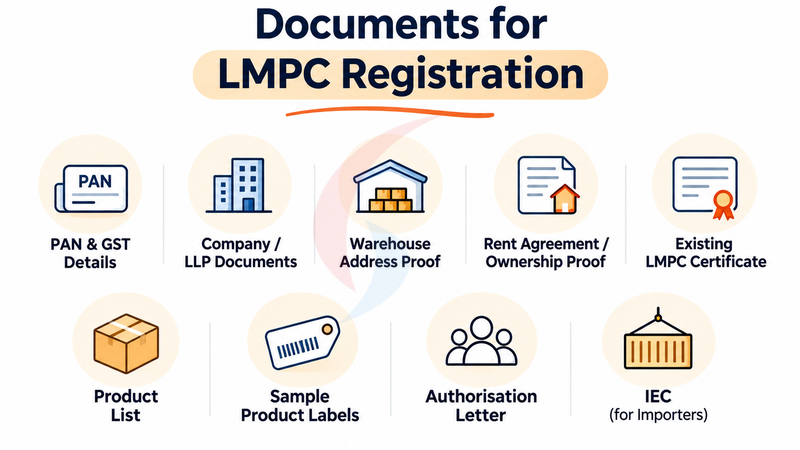
The documents depend on whether the company manufactures, packs or imports products and whether it is applying for a new registration or updating an existing certificate.
|
Document |
Purpose |
|
PAN and GST Details |
Establish the business's tax and registration identity. |
|
Company or LLP Documents |
Confirm the applicant's legal constitution. |
|
Warehouse Address Proof |
Identifies the relevant packing or importing premises. |
|
Rent Agreement or Ownership Proof |
Supports lawful occupation of applicable premises. |
|
Existing LMPC Certificate |
Required when requesting an amendment to current particulars. |
|
Product List |
Identifies commodities manufactured, packed or imported. |
|
Sample Product Labels |
Supports review of mandatory declarations. |
|
Authorisation Letter |
Identifies the authorised applicant. |
|
Relevant where the business imports packaged commodities. |
The competent authority may request additional documentation depending on the applicant's activities and registration particulars.
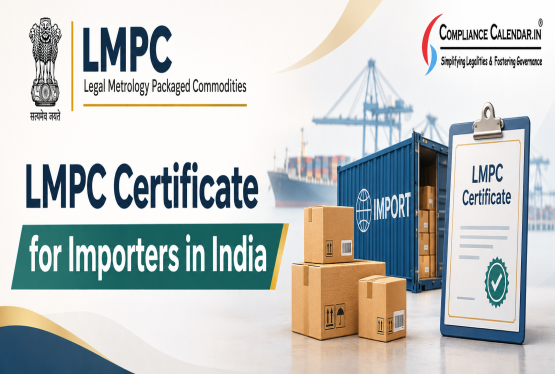
For import-related requirements, read our article on LMPC Certificate for Importers in India.
LMPC Registration Process for Multiple Warehouses
Businesses should begin by identifying all premises and the exact activities undertaken at each location.
|
Step |
Registration Procedure |
|
Step 1: Review Warehouse Activities |
Identify storage, packing, repacking and importing operations. |
|
Step 2: Check Existing Registration |
Examine the certificate and premises already recorded. |
|
Step 3: Identify the Authority |
Confirm the competent Central or State Legal Metrology authority. |
|
Step 4: Prepare Documents |
Collect warehouse addresses, product details and business documents. |
|
Step 5: Submit Application |
Apply for registration or amendment through the prescribed process. |
|
Step 6: Pay Government Fees |
Pay the applicable registration or alteration charges. |
|
Step 7: Update Records |
Maintain accurate certificates, labels and premises information. |
LMPC Registration Fees and Validity in 2026
Rule 27 prescribes an application fee of Rs 500 and an alteration fee of Rs 100 under the relevant provisions.
|
Particulars |
Prescribed Position |
|
New Rule 27 Registration |
Rs 500 |
|
Alteration of Registration Certificate |
Rs 100 |
|
Registration Validity |
Remains valid until cancelled under the 2026 amendment. |
|
Annual Information Update |
Required for companies and firms under the amended provisions. |
These are Rule 27 charges and should not be confused with other State-specific licences or professional service fees. The Legal Metrology (Packaged Commodities) Third Amendment Rules, 2026 introduced the provision that registration certificates remain valid until cancelled. However, companies and firms must update relevant details annually through the prescribed online facility.
Mandatory Labelling Requirements Across Warehouses
Businesses operating multiple warehouses must ensure that covered retail packages comply with Rule 6. A properly registered packing location does not excuse missing or incorrect product declarations.
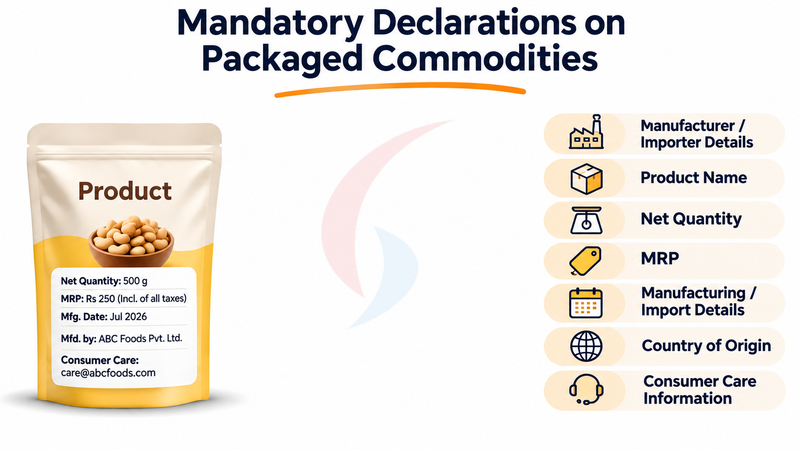
|
Mandatory Declaration |
Requirement |
|
Manufacturer or Importer Details |
Applicable name and address particulars. |
|
Product Name |
Common or generic name of the commodity. |
|
Net Quantity |
Accurate weight, volume or number of units. |
|
MRP |
Maximum Retail Price inclusive of applicable taxes. |
|
Manufacturing or Import Details |
Prescribed date information, where applicable. |
|
Country of Origin |
Required for applicable imported packages. |
|
Consumer Care Information |
Prescribed contact details for consumer complaints. |
A business should review labels whenever products are transferred between packing locations or new packaging arrangements are introduced. Businesses operating multiple packing or distribution centres should maintain consistent product labels across all locations.
Our article on LMPC Labelling Rules: Mandatory Declarations on Packaged Goods explains MRP, net quantity, manufacturer details, consumer care information, and other declarations required under Legal Metrology rules.
Latest LMPC Registration Updates in 2026
The Legal Metrology (Packaged Commodities) Third Amendment Rules, 2026, notified on 29 May 2026 through G.S.R. 418(E), introduced several changes particularly relevant to businesses operating multiple warehouses.
|
Latest Update |
Importance for Warehouses |
|
Registration Validity |
Rule 27 certificates remain valid until cancelled. |
|
Annual Updates |
Companies and firms must update applicable registration particulars annually. |
|
Responsible Director |
Rule 27 requires the name of the company director responsible for violations. |
|
AEO Bonded Warehouses |
Eligible importers may make mandatory declarations at specified AEO Tier-2 and Tier-3 bonded warehouses before goods leave. |
|
Address Information |
Annual updates include relevant changes to business address details. |
The amendment also provides for online updating of product information, quantities and country-of-origin details relating to the preceding year. The bonded warehouse provision is important for importers, but it does not grant every ordinary warehouse permission to complete missing retail declarations after import.
Example: An Importer Using a Bonded Warehouse
Suppose a Mumbai company imports packaged electronic accessories from overseas suppliers. The company uses a bonded warehouse operated by an eligible AEO Tier-2 certified operator. Under the May 2026 amendment, mandatory package declarations may be completed at the qualifying bonded warehouse. However, all required declarations must appear on the retail packages before they leave that warehouse. This permission is distinct from the ordinary storage arrangements used by many e-commerce and distribution businesses.
Why Choose Compliance Calendar LLP ?
At Compliance Calendar LLP, we assist businesses with Legal Metrology registration, documentation and related compliance requirements.
|
Our Services |
How We Help |
|
Applicability Assessment |
Review which warehouse activities require registration. |
|
Document Preparation |
Assist with business records and premises details. |
|
Application Support |
Help prepare registration and amendment applications. |
|
Packaging Compliance |
Guide businesses on relevant label declarations. |
|
Ongoing Compliance |
Support annual updates and changes in business operations. |
Explore our Legal Metrology Registration Services for professional assistance.
For personalised support, contact Compliance Calendar LLP on 9988424211 or email - info@ccoffice.in
Frequently Asked Questions (FAQs)
Q1. Is LMPC Registration mandatory for every warehouse in India?
Ans: No. Rule 27 registration depends on whether the business manufactures, packs or imports covered commodities. A warehouse that only stores properly labelled products does not automatically require separate registration. However, relevant packing and importing premises must be correctly disclosed.
Q2. Can one LMPC certificate cover multiple warehouses?
Ans: One registration may cover relevant premises operated by the same legal entity, subject to the competent authority's requirements. Businesses should verify that the relevant packing or importing addresses are included in their registration particulars. Separate legal entities may have separate obligations.
Q3. Is LMPC Registration required for warehouses in different states?
Ans: Operating warehouses in different states does not automatically mean that every location requires a separate Rule 27 certificate. The requirement depends on the activities undertaken, applicable registration particulars and competent authority. State-specific weighing and measuring requirements may also apply.
Q4. What documents are required for LMPC Registration for multiple warehouses?
Ans: Common documents include PAN, GST details, business constitution documents, relevant warehouse address proofs and product information. Existing registration certificates may be required for amendments. Importers should also maintain their IEC and applicable import records.
Q5. What is the government fee for LMPC Registration in 2026?
Ans: Rule 27 prescribes a registration application fee of Rs 500 and an alteration fee of Rs 100. Other permissions or professional assistance may involve additional costs. Businesses should verify the applicable government payment requirements before applying.
Q6. Does an LMPC certificate require renewal every year?
Ans: Under the May 2026 amendment, Rule 27 registration certificates remain valid until cancelled. However, companies and firms must update applicable registration particulars annually. Businesses should distinguish between certificate validity and the obligation to maintain updated information.
Q7. Is LMPC Registration required for third-party warehouses?
Ans: A third-party warehouse does not automatically need its own Rule 27 registration merely because it stores products. If the warehouse operator undertakes regulated packing activities, separate obligations may arise. Responsibility must be determined from the actual operations and legal arrangements.
Q8. Can imported products be labelled inside a warehouse?
Ans: The May 2026 amendment permits mandatory declarations at bonded warehouses operated by eligible AEO Tier-2 and Tier-3 certified operators. All prescribed declarations must be completed before the packages leave those warehouses. The permission does not automatically apply to ordinary warehouses.
Q9. What are the latest LMPC updates for warehouses in 2026?
Ans: The May 2026 amendment introduced continued certificate validity until cancellation, annual updating of specified details, identification of a responsible director and a labelling provision for qualifying bonded warehouses. Businesses must also follow other applicable Legal Metrology amendments.
Q10. Can Compliance Calendar LLP assist with multiple warehouse LMPC Registration?
Ans: Yes. Compliance Calendar LLP provides guidance on registration applicability, documentation, premises information, application amendments and packaging compliance. Businesses can contact our team to review their warehouse operations and understand the relevant Legal Metrology requirements.
Article last updated on : 17 Nov 2026.











_learn_crop10_thumb.jpg)