


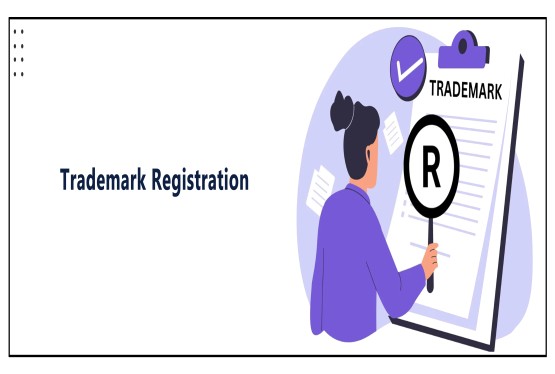
Trademark registration is one of the most important steps for protecting a brand name, logo, slogan, tagline, label, packaging style or business identity. A trademark helps a business create a separate identity in the market and gives legal protection against unauthorised use by others. Whether you are starting a new business, launching a product, running a service brand, selling online or expanding your existing company, filing a trademark application with the right documents is very important.
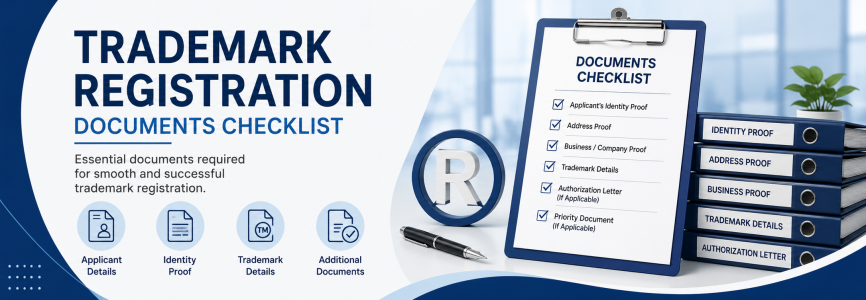
Many trademark applications face objections, delays or formalities issues because the applicant details, brand details, Power of Attorney, user proof or supporting documents are incomplete. Therefore, before filing a trademark application, every business should keep a proper documents checklist ready. As per the official IP India filing process, a trademark application generally requires applicant details, trademark representation, description of goods or services, user affidavit if applicable, and Power of Attorney if applicable.
What is Trademark Registration?
Trademark registration is the legal process through which a brand owner applies for protection of a mark under the Trade Marks Act, 1999. A trademark may include a brand name, logo, word, symbol, device, label, shape of goods, packaging, slogan or a combination of these elements. Once registered, the trademark owner gets the exclusive right to use the mark for the goods or services covered under the registration. It also helps the owner take legal action against infringement, misuse, copying or brand imitation.
Why is a Documents Checklist Important?
A trademark application is not just about submitting a brand name. The applicant must provide correct ownership details, proper business documents, clear trademark representation, correct class description and proof of use, if prior use is claimed.
A documents checklist helps in:
-
Avoiding filing mistakes
-
Reducing chances of formalities objections
-
Selecting the correct applicant name
-
Supporting prior use claims
-
Ensuring correct authorisation of attorney or agent
-
Saving time during examination and hearing
-
Creating a stronger trademark application
If the documents are not properly prepared, the Registry may raise objections or ask for additional documents. In some cases, even small mistakes in applicant name, address or user date may create future issues in enforcement, assignment or renewal.
Basic Documents Required for Trademark Registration
The documents required depend on the type of applicant and whether the trademark is proposed to be used or already in use. However, the basic checklist generally includes the following:
-
Applicant’s name
-
Applicant’s address
-
Applicant’s nationality or country of incorporation
-
Legal status of the applicant
-
Trademark name or logo
-
Description of goods or services
-
Trademark class
-
Date of first use, if already used
-
User affidavit, if prior use is claimed
-
Supporting proof of use
-
Power of Attorney, if filed through an attorney or agent
-
MSME or Startup certificate, if concessional fee is claimed
-
Identity and business proof, depending on applicant type
Applicant Details
The first requirement is correct applicant information. The applicant may be an individual, proprietor, partnership firm, LLP, private limited company, public limited company, trust, society, HUF, government body or foreign entity. The applicant name must be accurate because the trademark will be owned by the person or entity mentioned in the application. If a business is run as a company or LLP, the application should usually be filed in the name of that legal entity. If the brand is owned by an individual proprietor, the application may be filed in the name of the proprietor. The address should also be complete and proper because all official communication and legal records are linked with the applicant details.
Trademark Representation
Trademark representation means the actual mark that is being filed. If the mark is a word mark, the brand name should be mentioned clearly in plain text. If the mark is a logo, device, label or stylised design, a clear image of the mark must be provided. For logo applications, the image should be clear, readable and preferably in high resolution. The mark should not contain unnecessary elements unless those elements are also part of the brand identity. Businesses should decide carefully whether they want to file a word mark, logo mark or both. A word mark protects the brand name in text form, while a logo protects the visual design. For stronger brand protection, many businesses file separate applications for both.
Goods and Services Description
Every trademark application must mention the goods or services for which protection is required. Trademark classes are divided under the Nice Classification system. There are 45 classes in total. Classes 1 to 34 cover goods, while Classes 35 to 45 cover services.
For example, clothing usually falls under Class 25, advertising and business services under Class 35, education and training under Class 41, software and technology services under Class 42, and legal services under Class 45. Choosing the wrong class may weaken the application and may not protect the actual business activity. Therefore, the goods and services description should be carefully drafted according to the real nature of business.
Power of Attorney
Power of Attorney is required when the trademark application is filed through a trademark attorney or authorised agent. It authorises the attorney or agent to act on behalf of the applicant before the Trademark Registry. The Power of Attorney should be properly signed by the applicant or authorised signatory. It should also be stamped as per applicable state stamp law. IP India also provides stamp duty information for Power of Attorney on its official portal. If Power of Attorney is not filed properly, the Registry may issue a formalities objection. Therefore, it should not be treated as a mere formality. It is an important authorisation document.
User Affidavit and Proof of Use
If the applicant claims that the trademark is already in use, a user affidavit is generally required. The affidavit supports the claimed date of first use of the trademark. Along with the affidavit, proof of use should also be attached. Proof of use may include invoices, bills, product packaging, website screenshots, social media pages, advertisements, brochures, catalogues, business cards, letterheads, purchase orders, photographs of signboards, online marketplace listings or any other document showing actual use of the mark. If the mark has not been used yet, it can be filed on a “proposed to be used” basis. In that case, user affidavit and proof of use may not be required at the time of filing. The Registry may ask for user affidavit and supporting documents where a prior user date is claimed. Official Registry correspondence also shows that supporting documents such as bills and invoices may be required when user date is claimed.
Documents for Individuals and Sole Proprietors
For an individual or sole proprietor, the documents may include:
-
PAN card
-
Aadhaar card or other identity proof
-
Address proof
-
Trademark name or logo
-
Business proof, if available
-
Power of Attorney, if filed through an attorney
-
User affidavit and proof of use, if prior use is claimed
-
MSME certificate, if applicable
In proprietorship cases, care should be taken to mention the correct proprietor name. Since a proprietorship is not a separate legal entity like a company or LLP, the trademark is generally filed in the name of the individual proprietor trading as the business name.
Documents for Partnership Firm
For a partnership firm, the checklist generally includes:
-
Partnership deed
-
Firm name and address
-
Names of partners
-
Authorisation in favour of signing partner
-
PAN of firm
-
Trademark name or logo
-
Power of Attorney
-
User affidavit and proof of use, if applicable
-
MSME certificate, if fee concession is claimed
If the partnership firm is registered, registration proof may also be kept ready. The signing partner should be properly authorised to sign documents on behalf of the firm.
Documents for LLP
For a Limited Liability Partnership, the documents may include:
-
LLP incorporation certificate
-
LLP agreement
-
PAN of LLP
-
Registered office address proof
-
Details of designated partner or authorised signatory
-
Board/resolution or authorisation, if required
-
Trademark name or logo
-
Power of Attorney
-
User affidavit and proof of use, if applicable
-
MSME or Startup certificate, if applicable
The trademark should normally be filed in the name of the LLP if the brand belongs to the LLP.
Documents for Company
For a private limited company, public limited company, OPC or Section 8 company, the checklist may include:
-
Certificate of incorporation
-
Company PAN
-
Registered office address
-
Authorisation or board resolution
-
Details of authorised signatory
-
Trademark name or logo
-
Power of Attorney
-
User affidavit and proof of use, if applicable
-
MSME or Startup certificate, if applicable
The authorised signatory should sign the documents on behalf of the company. The company name should match the incorporation documents and PAN records.
Documents for Trust, Society or NGO
For trusts, societies and NGOs, the documents may include:
-
Trust deed, society registration certificate or incorporation document
-
PAN of organisation
-
Address proof
-
Authorisation letter or resolution
-
Details of authorised signatory
-
Trademark name or logo
-
Power of Attorney
-
User affidavit and proof of use, if applicable
Such entities may register trademarks for their name, logo, campaign identity, publication, educational programs or service marks.
Documents for MSME and Startup Applicants
Small businesses, startups and MSMEs may be eligible for reduced government filing fees, subject to applicable rules and proper supporting documents. For this, the applicant may need to provide:
-
Udyam Registration Certificate for MSME
-
Startup India recognition certificate, if applicable
-
Applicant details matching the certificate
-
Power of Attorney
-
Trademark details
The MSME or Startup certificate should be in the name of the applicant. If the trademark is filed in a different name, the concession may not apply.
Common Mistakes in Trademark Documents
Many applicants make simple but costly mistakes while preparing documents. Some common mistakes include:
Filing in the wrong applicant name
Using an unclear logo image
Selecting the wrong trademark class
Claiming prior use without proof
Not attaching user affidavit
Providing incorrect user date
Filing unstamped or improperly signed Power of Attorney
Mismatch between business name and applicant name
Using generic descriptions of goods or services
Not checking similar existing trademarks before filing
These mistakes can delay the process and may even weaken the brand’s legal protection.
Final Checklist Before Filing Trademark Application
Before filing, check the following:
Is the applicant name correct?
Is the address complete?
Is the trademark clearly written or uploaded?
Is the correct class selected?
Are goods or services properly described?
Is Power of Attorney signed and stamped?
Is user affidavit prepared, if prior use is claimed?
Are invoices or proof of use available?
Is MSME or Startup proof attached, if fee benefit is claimed?
Has a trademark search been conducted?
A trademark public search can help identify existing similar marks before filing. IP India provides a public search facility for trademarks.
Conclusion
Trademark registration is an important legal step for brand protection, but the strength of the application depends heavily on correct documentation. A proper checklist helps avoid unnecessary objections, delays and future ownership issues. The basic documents usually include applicant details, trademark representation, goods or services description, Power of Attorney, user affidavit if prior use is claimed, and supporting proof of use. For companies, LLPs, partnerships, proprietorships, trusts and startups, the supporting documents may vary according to the applicant type.
Before filing a trademark application, businesses should carefully verify the applicant name, trademark class, user date, authorisation documents and proof of use. A well-prepared trademark application not only improves filing accuracy but also helps build long-term brand value and legal protection.
FAQs
Q1. What are the basic documents required for trademark registration?
Ans. The basic documents include applicant details, trademark name or logo, address, goods or services description, Power of Attorney if filed through an attorney, and user affidavit with proof of use if prior use is claimed.
Q2. Is Power of Attorney mandatory for trademark filing?
Ans. Power of Attorney is required when the application is filed through a trademark attorney or authorised agent. If the applicant files directly, it may not be required.
Q3. Is user affidavit required for every trademark application?
Ans. No. A user affidavit is generally required when the applicant claims that the trademark has already been used before the filing date. If the mark is proposed to be used, it may not be required at filing.
Q4. What can be submitted as proof of trademark use?
Ans. Invoices, bills, product labels, packaging, website screenshots, brochures, advertisements, social media pages, signboard photos and online marketplace listings can be used as proof of trademark use.
Q5. Can a trademark be filed without business registration?
Ans. Yes, an individual can file a trademark even without a registered company or LLP. However, the applicant details must be correct and supported by identity and address proof.
Q6. What documents are required for company trademark registration?
Ans. A company may need its incorporation certificate, PAN, registered office address, authorisation or board resolution, trademark details, Power of Attorney and proof of use, if applicable.
Q7. What documents are required for proprietorship trademark registration?
Ans. A proprietor may need PAN, Aadhaar or identity proof, address proof, business proof if available, trademark details, Power of Attorney and proof of use, if prior use is claimed.
Q8. Is MSME certificate required for trademark registration?
Ans. MSME certificate is not mandatory for trademark registration, but it may be required if the applicant wants to claim concessional government filing fees.
Q9. Can I file a logo and brand name together?
Ans. Yes, a logo containing the brand name can be filed as a device mark. However, for better protection, many businesses file separate applications for the word mark and logo.
Q10. What happens if trademark documents are incomplete?
Ans. If documents are incomplete or incorrect, the Trademark Registry may raise a formalities objection or ask for clarification. This can delay the registration process.


_(b)_of_the_Trademark_Act,_1999_(1)_crop10_thumb.jpg)


_crop10_thumb.jpg)


_crop10_thumb.jpg)
_crop10_thumb.jpg)


_crop10_thumb.jpg)


_crop10_thumb.jpg)


_crop10_thumb.jpg)


_crop10_thumb.jpg)


_crop10_thumb.jpg)


_crop10_thumb.jpg)


_crop10_thumb.jpg)


_crop10_thumb.jpg)


_crop10_thumb.jpg)









_crop10_thumb.jpg)





























































































_crop10_thumb.jpeg)




























































_crop10_thumb.jpg)