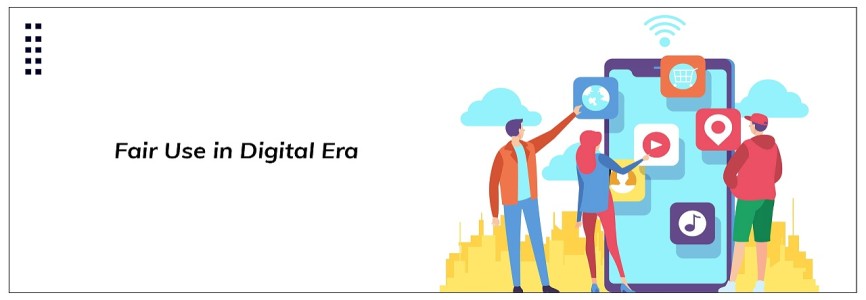



The original literary, artistic, dramatic, musical, cinematographic, and other creative works are granted protection and exclusive right under the Copyright law. These rights enable authors and creators to control the reproduction, communication, distribution, and adaptation of their works.
However, the protection granted under the Copyright Law is not absolute, if all uses of copyright materials required permission from copyright owners then education, research, criticism, journalism, and public discourse would become nearly impossible to achieve. Therefore, copyright law provides for some limitations and exceptions, one of them is Doctrine of Fair Use or Fair Dealing.
Fair use allows limited use of copyright materials for serving the interest of larger public, includes criticism, review, reporting on current events, teaching and research, and private study. The primary objective of the doctrine is to balance the rights of creators against the rights of the public.
In today's digital age, in which information can be disseminated instantaneously via multiple platforms, the significance of the doctrine of fair use has increased. In light of this, journalists, content creators, educators, and social media users frequently utilize copyright materials when providing public information.
The exclusive right possesses by the Creators over their original works (artistic, dramatic, literary, musical etc.) as provided by the Copyright includes rights to control the reproduction, communication, distribution, and adaptation of these works as per the copyright laws.
Doctrine of Fair Use and Legal Context
Fair use is an exception to the infringement of copyright and enables a restricted usage of copyrighted works without the prior consent of the individual holding copyright against the original copyrighted work. This doctrine is based on the principle that certain uses of copyrighted works should be permitted because they serve larger public interests and socially beneficial purposes. In India, it is recognised under Section 52 of the Copyright Act, 1957 and generally referred as “fail dealing” which lists various types of uses that would not fall under copyright infringement, including:
-
Use for research or study
-
Use for criticism or review
-
Use for reporting on current events
-
Use for judicial proceedings or education
The primary objective of the Fair Use doctrine is to ensure that copyright protection does not act as a hinderance to the sharing of knowledge and information.
Fair Use in the Digital Platform
The landscape of copyright has been significantly changed in today’s Digital Era. Various social media platforms (Instagram, YouTube, Snapchat etc.), video-sharing websites, and online news portals use certain portion of copyrighted work it while creating new material regularly.
Some common examples include:
-
Use of short clips in news segments
-
Use of book excerpts in lectures
-
Movie, song, and product reviews on YouTube
-
Citations in academic papers
-
Use of images and videos while preparing the report of the event
The frequently use of such activities becomes a grey area and raises questions regarding whether the use amounts to copyright infringement or falls within the scope of exceptions to it.
The challenge becomes greater because digital content becomes increasingly difficult to protect from widespread copying and easy distribution within seconds. Therefore, Courts are required to balance the extent of copyright protection with the need for freedom of expression and the right to information.
Role of Judiciary in Interpreting “Fair Use”
In India, the doctrine of Fair Use is established mainly through court decisions. While section 52 of the Copyright Act of 1957 specifies some exemptions to copyright infringement, but does not explain the extent of use of Fair Use. Therefore, the Indian courts have been very important in interpreting and defining how to interpret Fair Use. The courts have consistently stated in their cases that they are trying to create a balance between the rights of an author under copyright law and the public interest, freedom of expression, education, criticism, and news reporting.
Civic Chandran v. Ammini Amma (1996) was one of the first and important cases on fair dealing. In this case, the defendant created and performed a play that made comments and criticism of the original work created by the plaintiff. The plaintiff sued for copyright infringement and the defendant claimed that he had created the work simply for criticism and social commentary. The Kerala High Court found that the use of the plaintiff's work was fair because it was used for criticism instead of reproduction. The Court stated that the interpretation of copyright law must not limit people's freedom of expression or stop them from conducting fair criticism. Further, the Court noted that in determining whether a use of a work is fair or not, an examination will need to take place to look at the reason for the use, the amount of material used and the impact that a use has on the value of the original work. This ruling established the foundation for interpreting fair dealing under copyright law in India.
Moreover, in the case of India TV Independent News Service Pvt Ltd vs Yashraj Films Pvt Ltd., India TV had utilized short video clips from domestically produced motion pictures for the purpose of giving news stories and movie reviews in the entertainment sector. The owner of the copyrights claimed that this would have constituted an infringement on their Copyright, but the High Court of Delhi held that the use of such short clips for the purposes of criticism, review, or reporting current events may have constituted fair dealing as per the provisions of section 52 of Copyright Act. The High Court recognised that most news broadcasters/writers often need to be able to provide a little amount of their works under copyright to convey information to the general public. The Court was very clear that as long as it is genuine, limited in size, and does not serve as a substitute for the copyright owner’s original work, then it will not be an infringement of their copyrights.
Recently in February, the Delhi High Court reviewed Associated Broadcasting Company Limited v. Google LLC & and Others, which was a most highlighted recent case about the scope of fair dealing in the digital age. The plaintiff (the TV9 Network) filed suit against YouTube for copyright infringement due to notices of copyright infringement representing their YouTube channel. The plaintiff contended that these videos had only been used for reporting current events and matters of public interest. The court found that the videos contained mostly newsworthy and factual events; however, only small segments of those videos were included in the larger context of their news broadcasts. The court also determined that the defendants had no proof of ownership to several of the infringing works. The plaintiff's use of copyrighted materials was protected by fair dealing and de minimis due to it only being for purposes of legitimate news reporting and providing the public with access to information. Ultimately, this case confirms that copyright should not be used to impede genuine journalism or prevent people from reporting factual information via digital channels.
Hence, Indian courts continuously recognize that copyright protection v. public's rights are necessary to receive Information, Education, Criticism and News. Copyright Laws protect Creators Creativity while allowing for legitimate Public Interest Activities to take place in a Balanced Manner by the Judiciary, and this has continued to be true with the development of Fair Dealing Doctrine by the courts in India.
Purpose of Fair Use for News Reporting
In our democratic society, the News reporting plays a crucial role to a society at large. Citizens highly depend upon news channel and media organizations to get update with authentic information with respect to every national or international events. Moreover, it is the responsibility of the journalists and media organizations to provide accurate and timely information regarding all such events.
In many circumstances, reporting current events requires the use of photographs, videos, speeches, and other copyrighted materials. If journalists were required to obtain permission for every such use, reporting would become impractical.
Fair use therefore performs several important functions:
-
Promotes freedom of speech and expression
-
Facilitates sharing of information
-
Encourages public awareness and reinforces right to information
-
Safeguard Independence of Journalist
-
Backs democratic accountability
The decision in the case of Associated Broadcasting recognizes how the fair use safeguards the ability of news organizations to inform the public without fear of unwarranted copyright claims by legitimate use of the copyrighted work.
Challenges of Fair Use in the Digital Age
While fair dealing doctrine is essential for fostering creativity, education, and expression, it is also faced with multiple challenges in the current digital age. Below are five relevant challenges:
Automated Copyright Infringement Detection Systems
Automated systems that identify copyright infringement are utilized by digital platforms such as YouTube, Facebook, and Instagram to detect copyrighted content. These copyright infringement detection systems often identify copyrighted work without an examination of whether or not that supposed infringement qualifies as "fair dealing" in accordance with the Copyright Act of 1957. As a result, content that is created and used for criticism or review, education, research, or news reporting, may be wrongly removed or blocked. These automated actions negatively impact journalists, educators, researchers, and other creators that use and rely upon the exemptions provided by the fair dealing exceptions for legitimate purposes.
No Clear Legal Definitions Guiding Fair Dealing
While Section 52 of the Copyright Act of 1957 provides for the exceptions to copyright infringement, it does not provide definitions for the "fair dealing" exceptions. Therefore, courts have been provided the discretion to determine whether a use is "fair dealing" on an individual basis based upon the particular facts and circumstances that are present in the specific case by considering amount of work used, purpose of the use, and the effect on the original work. The lack of defined scope of fair dealing often creates uncertainty in the minds of creators, which has resulted in courts having inconsistent interpretations of fair dealing resulting solely from the lack of clear statutory definitions and subsequently leading to increased litigation.
Improper use of copyright claims
In the digital age, there is an issue with the improper use of copyright mechanism – copyright is often inappropriately claimed to take down user-generated content that is within the bounds of fair use. Such misuse is often employed to undermine criticism, limit competition and prevent the spread of information which inhibits legitimate expression and creates situations where there are unnecessary copyright disputes amongst content creators and media companies.
Balancing Copyright Protection and Public Interest
Protecting the exclusive rights of copyright owners while at the same time protecting the public interest is one of the biggest challenges to copyright. On the one hand, creators require protection of their original works from being used by others without their permission; however, on the other hand, the over-enforcement of copyright against creators may inhibit education, research, criticism, and journalism with respect to current events. At the same time, a very wide interpretation of fair use may negatively impact the commercial interests of copyright owners. Two of the ongoing challenges for courts and legislatures, therefore, includes finding a balance between the exclusive rights of copyright owners and the public interest in access to information, education, and research.
Conclusion
The doctrine of fair use represents one of the most important safeguards within the Copyright Law. While copyright protection encourages creativity and innovation, and fair use ensures that such protection does not restrict education, research, criticism, journalism, and public discourse.
The digital age has significantly increased both the significance and complexity of fair use. As the amount of content produced and shared through different platforms increases over time, courts must ensure that they maintain an appropriate balance between protecting the work of creators and maintaining public access to new information.
Therefore, the decision rendered by the High Court of Delhi in the case of Associated Broadcasting Company Limited v. Google LLC and Ors. is an important step in this direction. The Court recognized the legitimacy of limited use of factual content for news reporting, and upheld that copyright law should promote rather than restrict, the free flow of information in a democratic society.
Hence, the future of copyright law depends upon maintaining the aforementioned balance. Fair use will continue to serve as an important mechanism for the promotion of creativity and innovation, while safeguarding the public interest in a wide spreading digital world.


_(b)_of_the_Trademark_Act,_1999_(1)_crop10_thumb.jpg)


_crop10_thumb.jpg)


_crop10_thumb.jpg)
_crop10_thumb.jpg)


_crop10_thumb.jpg)


_crop10_thumb.jpg)


_crop10_thumb.jpg)


_crop10_thumb.jpg)


_crop10_thumb.jpg)


_crop10_thumb.jpg)


_crop10_thumb.jpg)


_crop10_thumb.jpg)


_crop10_thumb.jpg)








_crop10_thumb.jpg)








































_crop10_thumb.jpeg)