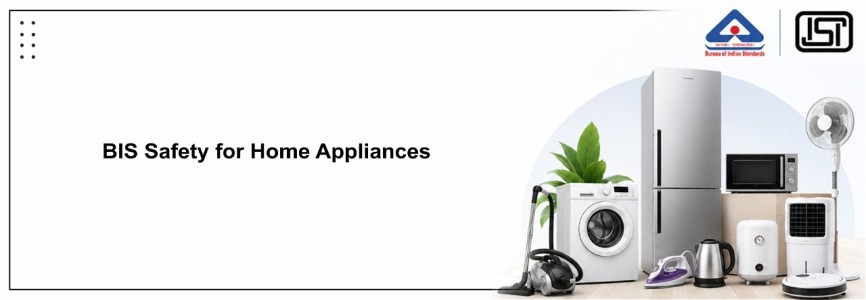



Electrical home appliances have become an integral part of modern life. Products such as vacuum cleaners, mixers, food processors, room heaters, air purifiers, electric irons, cooking appliances and personal-care devices are now widely used in Indian households, offices and commercial establishments.
Although these appliances offer convenience and efficiency, they also involve electricity, heat, moving components, water, steam and other factors that may create serious safety risks. A product may appear well designed externally while still containing defective wiring, inadequate insulation, poor-quality components or ineffective earthing arrangements. For this reason, the Bureau of Indian Standards requires applicable home appliances to undergo prescribed safety, performance and quality testing before they are certified and permitted to carry the BIS Standard Mark.
Regulatory Framework for Home Appliances
The Government of India has introduced mandatory quality-control requirements for several categories of household, commercial and similar electrical appliances. Products covered under an applicable Quality Control Order must comply with the relevant Indian Standard and obtain the prescribed BIS certification before they are manufactured, imported, distributed or sold in India. For many electrical appliances, the primary safety requirements are prescribed under IS 302, which deals with the safety of household and similar electrical appliances. The general requirements are contained in IS 302 Part 1, while appliance-specific requirements may be covered under the relevant Part 2 standard.
The applicable certification requirement depends on several factors, including the product category, intended use, rated voltage, design, construction, technical specifications and the relevant Quality Control Order. Therefore, BIS applicability should not be determined solely on the basis of the product’s commercial name. A detailed technical assessment is necessary to identify whether the appliance falls under mandatory BIS certification, another certification scheme or a separate regulatory framework.
Why Home Appliances Require Safety Testing
Home appliances operate through electrical current and may include heating elements, motors, sharp blades, moving components, water reservoirs, steam systems or high-temperature surfaces. If the appliance is poorly designed or manufactured using unsuitable components, it may cause electric shock, fire, overheating, mechanical injury or damage to property. Safety testing enables manufacturers and regulatory authorities to identify such risks before the product reaches consumers.
Protection Against Electric Shock
Electric shock is one of the most significant risks associated with electrical appliances. Damaged insulation, exposed conductive parts, inadequate wiring or improper separation between live and accessible components may allow electric current to pass through the user’s body.
Safety testing verifies whether live parts remain inaccessible during normal use, cleaning and routine handling. It also examines whether insulation, protective barriers and enclosures provide adequate protection against accidental contact.
Prevention of Short Circuits and Fire
Loose electrical connections, undersized wires, defective heating elements and unsuitable internal components may result in short circuits or excessive heat generation. Appliances such as room heaters, ovens, electric cookers and fryers are particularly vulnerable because they operate at elevated temperatures.
Testing determines whether the appliance remains within safe temperature limits and whether protective devices such as fuses, thermal cut-outs and thermostats function correctly under normal and abnormal conditions.
Insulation Failure
Insulation may deteriorate over time because of heat, moisture, vibration, ageing or continuous use. Even when an appliance performs normally during an initial demonstration, weak insulation may eventually lead to electrical leakage or breakdown.
Electrical-strength and insulation-resistance tests assess whether the appliance’s insulation system can withstand the prescribed electrical stress without failure.
Current Leakage
Leakage current refers to unintended electrical current flowing from the appliance’s internal circuits to accessible metal parts or earth. Even a small amount of leakage may pose a risk, particularly in appliances used in kitchens, bathrooms or other moisture-prone environments. Leakage-current testing measures whether the current remains within the permissible safety limits specified in the applicable standard.
Moisture-Related Hazards
Appliances used in kitchens, bathrooms, cleaning operations and outdoor environments may be exposed to water, humidity, steam or condensation. Moisture can reduce insulation performance and create unintended conductive paths. Moisture-resistance testing evaluates whether the appliance remains safe after exposure to the environmental conditions associated with its intended use.
Mechanical Injuries
Many home appliances contain blades, fans, rollers, grinders, hinges, handles or other moving components. Inadequate guards or weak enclosures may expose users to cuts, crushing injuries or entanglement. Mechanical-strength and stability tests examine whether the appliance can withstand expected handling and use without breaking, overturning or exposing dangerous components.
Unsafe Materials and Components
The overall safety of an appliance depends heavily on the quality of its individual components. Switches, plugs, power cords, thermostats, capacitors, heating elements, motors and insulation materials must be suitable for the electrical and thermal conditions in which they operate.
Construction and component verification helps confirm whether critical components are correctly selected, properly installed and capable of performing safely throughout the product’s expected life.
Major Safety and Performance Tests for Home Appliances
The exact test programme depends on the nature and construction of the product. However, the following tests are commonly conducted during BIS certification.
Protection Against Electric Shock
This test verifies whether users can accidentally touch live electrical parts during normal operation, cleaning, maintenance or foreseeable handling.
Leakage Current Test
This test measures unintended current flowing from live circuits to accessible metal parts or the protective earthing system. The results must remain within the limits prescribed under the applicable Indian Standard.
Electrical Strength Test
A specified high voltage is applied across the insulation system to determine whether it can withstand electrical stress without breakdown, sparking or failure.
Heating and Temperature-Rise Test
This test measures the temperature of internal components, external surfaces, wires, terminals and surrounding materials while the appliance is operating. It helps confirm that the product does not overheat during normal use.
Abnormal Operation Test
The appliance is tested under reasonably foreseeable fault conditions, such as blocked ventilation, overloaded operation, stalled motors or failure of a control device. The purpose is to confirm that such conditions do not create an unacceptable safety risk.
Moisture-Resistance Test
This test evaluates the appliance’s resistance to humidity, splashing water, steam or other moisture-related conditions relevant to its intended use.
Earthing Continuity Test
For appliances that require protective earthing, this test confirms that accessible conductive parts are properly connected to the earthing terminal and that the connection has sufficiently low resistance.
Mechanical Strength Test
The product’s enclosure, handles, guards and supporting structures are subjected to impact, pressure or other mechanical conditions to ensure that they remain secure and do not expose hazardous parts.
Stability Test
This test determines whether the appliance is likely to tip, slide or overturn during normal use. It is particularly relevant for heaters, cooking appliances and floor-standing equipment.
Resistance to Heat and Fire
Insulating materials, enclosures and internal components are examined to determine whether they can withstand heat and resist ignition or the spread of fire.
Power Input and Current Test
The appliance’s actual power consumption and current are measured and compared with the values declared by the manufacturer. Significant deviations may indicate an unsafe or incorrectly designed product.
Construction and Component Verification
The laboratory examines internal wiring, terminals, creepage distances, electrical clearances, switches, cords, thermal protection devices and other critical components to ensure compliance with the applicable standard.
Why Testing Is Required During BIS Certification
Testing is an essential part of the BIS certification process because declarations, photographs and technical drawings alone cannot establish that a product is safe. Laboratory testing provides objective evidence that the appliance has been assessed under defined operating and fault conditions. It helps BIS determine whether the product’s construction, components, safety features and performance comply with the applicable Indian Standard.
For home appliances covered under the BIS licence scheme, the manufacturer may be required to submit test reports, technical documents and factory-related information. BIS may also examine the manufacturing facility, production controls, quality-assurance system and in-house testing arrangements. Only after the prescribed requirements are satisfied can the manufacturer be granted permission to use the BIS Standard Mark for the approved product and model range.
Importance of Testing Through a BIS-Recognised Laboratory
Where third-party laboratory testing is required, samples must be tested by a laboratory recognised by BIS for the relevant Indian Standard and product category. A BIS-recognised laboratory has the necessary technical infrastructure, calibrated equipment and approved testing scope to conduct the prescribed tests. Its report provides independent technical evidence supporting the certification application.
The product details mentioned in the test report must correspond with the product proposed for certification. Model number, rated voltage, power input, construction, components and safety features should be consistent across the application documents, product sample and laboratory report. Any material discrepancy may result in additional clarification, repeated testing or delay in the certification process.
Benefits of Mandatory BIS Compliance for Manufacturers
BIS testing is not only a regulatory obligation. It also provides several practical and commercial benefits to manufacturers.
-
Reduction in Product Defects: Testing helps identify design weaknesses, unsuitable components and manufacturing deficiencies before large quantities of the product are released into the market.
-
Lower Risk of Product Recalls: Manufacturers that detect safety issues at the development or certification stage are less likely to face expensive product recalls or market withdrawals.
-
Improved Product Reliability: Compliance with recognised standards improves consistency, durability and safety across different production batches.
-
Stronger Consumer Confidence: Consumers are more likely to trust products that carry a valid BIS Standard Mark because the mark indicates conformity with prescribed safety and quality requirements.
-
Lawful Market Access: Manufacturers and importers must obtain mandatory BIS certification before selling products covered under an applicable Quality Control Order. Compliance therefore enables lawful access to the Indian market.
-
Improved Brand Reputation: Manufacturers that consistently meet applicable standards are better positioned to build a reliable and responsible brand image.
-
Reduction in Warranty Claims and Liability: A safer and more reliable product generally results in fewer complaints, warranty claims, accidents and potential liability arising from product failure.
-
Prevention of Regulatory Action: Manufacturing, importing or selling a covered product without the required BIS certification may result in enforcement action, seizure of goods, penalties or other consequences under the applicable law.
Practical BIS Certification Process for Home Appliances
The certification process generally involves the following stages:
-
Product Identification: The manufacturer must examine the product’s intended use, technical specifications, rated voltage, construction, model range and operating method.
-
Applicability Assessment: The next step is to determine whether the product is covered under a mandatory Quality Control Order, a separate BIS scheme or another regulatory framework.
-
Identification of the Indian Standard: The applicable general and product-specific Indian Standards must be identified. For many appliances, this may include IS 302 Part 1 along with the relevant Part 2 standard.
-
Certification Scheme Assessment: The manufacturer must determine the appropriate BIS certification route and understand the applicable product manual, sampling guidelines and testing requirements.
-
Application Preparation: Technical documents, manufacturing details, component information, quality-control records and supporting documents are prepared for filing.
-
Sample Selection and Testing: Representative samples are selected in accordance with the applicable grouping guidelines and submitted to the appropriate laboratory for testing.
-
Factory Inspection: Where applicable, BIS may inspect the manufacturing facility to assess production capabilities, quality-control arrangements, testing facilities and conformity practices.
-
Submission of Test Reports and Documents: Laboratory reports and supporting records are submitted to BIS as part of the certification application.
-
Response to BIS Observations: If BIS raises technical or documentary observations, the manufacturer must provide appropriate clarifications, revised documents or corrective action.
-
Grant of Licence or Registration: Once compliance is established, BIS may grant the licence or registration for the approved product scope.
-
Marking and Ongoing Compliance: After certification, the manufacturer must comply with marking requirements, inspection and testing obligations, surveillance conditions, licence renewal and other post-certification requirements.
How Compliance Calendar LLP Helps Home Appliance Manufacturers
Compliance Calendar LLP assists Indian manufacturers, importers and foreign manufacturers in understanding and managing the BIS certification process for home appliances. The assistance begins with a detailed product-applicability assessment. The product’s intended use, technical specifications, construction and applicable Quality Control Order are examined to identify the correct Indian Standard and certification route.
Compliance Calendar LLP also assists with coordination with BIS-recognised laboratories, sample-testing arrangements, preparation of technical documents, application filing and compilation of manufacturing and quality-control records. Where factory inspection is applicable, support may be provided for inspection preparation, document review and coordination. The team also assists manufacturers in responding to BIS queries, technical observations and requests for additional information.
After the grant of certification, assistance may be provided for licence renewal, inclusion of additional models, changes in product ratings or components, factory-address updates and other post-certification requirements. The certification outcome depends on the product’s technical conformity, documentation, laboratory results and compliance with BIS requirements. Therefore, no professional service provider should offer an unconditional assurance of approval or a fixed certification timeline.
Contribution to a Safe India
Mandatory BIS testing plays an important role in protecting consumers from unsafe electrical appliances. Every compliant product reduces the likelihood of electric shock, fire, overheating, insulation failure and mechanical injury.
\By helping manufacturers understand and fulfil applicable safety requirements, Compliance Calendar LLP supports the broader objective of ensuring that safer and standard-compliant products are placed in the Indian market. This contribution is not limited to documentation. Proper compliance encourages manufacturers to improve product design, component selection, testing practices and internal quality controls.
Contribution to Make in India
BIS compliance also supports the Make in India initiative by encouraging domestic manufacturers to produce goods that meet recognised safety and quality standards.
Manufacturers that adopt standardised testing and quality-control systems are better equipped to compete with established Indian and international brands. Compliance improves product credibility, manufacturing discipline and market acceptance.
Compliance Calendar LLP contributes to this objective by helping manufacturers integrate regulatory requirements into their product-development and production processes. This allows businesses to treat compliance as part of responsible manufacturing rather than as a last-minute administrative formality.
Conclusion
BIS safety testing is not merely an administrative requirement for obtaining a certification mark. It is an important product-safety mechanism that protects consumers, strengthens manufacturing discipline and promotes responsible market access.
Home appliance manufacturers must ensure that their products comply with the applicable Indian Standards and mandatory Quality Control Orders before entering the Indian market. Early planning, correct product classification and timely testing can help reduce compliance difficulties and prevent unnecessary delays.
Manufacturers, importers and foreign manufacturers seeking assistance with BIS applicability assessment, laboratory testing and certification may obtain professional support to ensure that the process is handled systematically and in accordance with the applicable regulatory requirements.
Frequently Asked Questions
Q1. Is BIS certification mandatory for every home appliance?
Ans. No. BIS certification is mandatory only when the product is covered under an applicable Quality Control Order, compulsory certification requirement or other notified framework. Applicability depends on the product category, technical specifications, intended use and relevant Indian Standard.
Q2. Which home appliances require BIS compliance?
Ans. Various categories of electrical appliances may require BIS certification, including cooking appliances, heaters, cleaning appliances, personal-care products, air-treatment equipment and commercial electrical appliances. A product-specific assessment is necessary before confirming applicability.
Q3. Why is laboratory testing required?
Ans. Laboratory testing provides objective evidence that the appliance complies with the prescribed safety requirements. It evaluates the product under normal and abnormal operating conditions that cannot be assessed through documents or visual inspection alone.
Q4. Can manufacturers use their own laboratory reports?
Ans. The acceptability of an in-house test report depends on the applicable BIS scheme, product manual and laboratory requirements. Where a BIS-recognised third-party laboratory report is mandatory, an ordinary internal laboratory report will not be sufficient.
Q5. What happens if the product fails safety testing?
Ans. The manufacturer must identify the reason for failure and make the necessary changes to the product, component or design. The modified product may then require fresh testing before the certification process can continue.
Q6. Do imported home appliances also require BIS certification?
Ans. Yes. Imported products covered under mandatory BIS requirements must obtain the prescribed certification before they are imported or sold in India. Foreign manufacturers may also be required to appoint an Authorised Indian Representative.
Q7. Does every model require separate testing?
Ans. Not always. BIS may permit model grouping where products share similar construction, components and ratings. However, substantially different models may require separate or additional testing.
Q8. How long does BIS testing and certification take?
Ans. The duration varies depending on the product, testing requirements, laboratory capacity, document readiness, factory inspection, BIS observations and corrective action. There is no single timeline applicable to every product.
Q9. Is factory inspection compulsory?
Ans. Factory inspection is generally required under the BIS licence scheme for many products. The exact requirement depends on the applicable certification route, product standard and BIS guidelines.
Q10. What happens if a manufacturer sells a covered appliance without BIS certification?
Ans. Selling, manufacturing or importing a covered product without the mandatory BIS certification may result in regulatory action, penalties, seizure of goods or other consequences under the BIS Act and the applicable Quality Control Order.
Q11. Does a BIS licence require renewal?
Ans. Yes. A BIS licence is granted for a specified validity period and must be renewed in accordance with the applicable requirements. Manufacturers must also maintain ongoing compliance during the validity of the licence.
Q12. How can Compliance Calendar LLP assist manufacturers?
Ans. Compliance Calendar LLP can assist with product classification, identification of the applicable Indian Standard, laboratory coordination, documentation, application filing, factory-inspection preparation, responses to BIS observations, model inclusion, renewal and post-certification compliance.


_(b)_of_the_Trademark_Act,_1999_(1)_crop10_thumb.jpg)


_crop10_thumb.jpg)


_crop10_thumb.jpg)
_crop10_thumb.jpg)


_crop10_thumb.jpg)


_crop10_thumb.jpg)


_crop10_thumb.jpg)


_crop10_thumb.jpg)


_crop10_thumb.jpg)


_crop10_thumb.jpg)


_crop10_thumb.jpg)


_crop10_thumb.jpg)


_crop10_thumb.jpg)









_crop10_thumb.jpg)



























































































_crop10_thumb.jpeg)