


Blue jeans began as a patent. On 20 May 1873, Jacob Davis and Levi Strauss received U.S. Patent No. 139,121 for riveting the stress points on work trousers. For the next seventeen years, Levi Strauss & Co. (“Levi’s”) held the exclusive right to produce riveted denim. When the patent expired in 1890, the design entered the public domain, and competitors flooded the market Levi’s had pioneered. The company lost its legal monopoly but retained its status as the original. Ever since, it has relied on trademark law to safeguard that reputation. The company’s experience illustrates both the power and the boundaries of trademark protection in fashion—an industry that has always flourished through imitation.
How Trademark Law Helped Levi’s Defend Its Brand
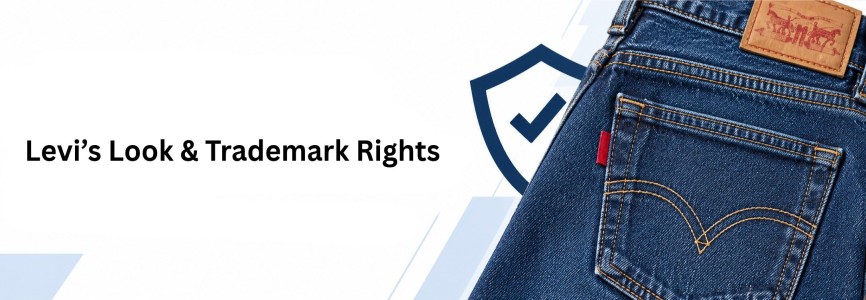
A patent is for a limited time, and when it expires the subject matter is forever public. A trademark registration is a sign that identifies the source of a product for consumers and can last indefinitely, provided the trademark is used and remains distinctive. Levi’s thus shifted its protection from the invention to the identity of the product, and made the back pocket its signature. The pocket has the arcuate stitching (the double arcs) and the Red Tab, a folded ribbon sewn into the rear pocket seam. The Tab was introduced in 1936 in part because the stitching could not be registered at this time which only became possible in 1943. The pocket mark is often referred to as the oldest apparel trademark in the United States. Under the U.S. Lanham Act, a mark is protected if it is distinctive and if a competitor’s use is likely to confuse consumers as to source of the goods. The strategy is to protect the 'this is a Levi's' sign, not the idea of jeans.
Secondary Meaning and Likelihood of Confusion: The Twin Pillars of Levi’s Trademark Cases
Two doctrines do most of the work in Levi’s litigation. The first is secondary meaning. Unlike a coined brand name, a design feature such as stitching is not inherently distinctive. It becomes protectable only when consumers link it to a single source. In the case of (Levi Strauss & Co. v. Blue Bell), the Ninth Circuit found that the Tab had acquired secondary meaning and that the competitor had traded on Levi’s goodwill. The Supreme Court later confirmed in Wal-Mart Stores v. Samara Brothers (2000) that product design is never inherently distinctive and always requires proof of secondary meaning, proof that Levi’s long use, advertising, and public recognition readily supply.
The second doctrine is likelihood of confusion. Courts examine whether a significant number of ordinary consumers are likely to be misled about the source of the goods, weighing factors such as the mark’s strength, design similarity, evidence of actual confusion, and the defendant’s intent. In Levi Strauss & Co. v. Lois Sportswear, the court described the stitching as the very “embodiment” of Levi’s jeans in wearers’ minds, accorded it strong protection, and held that other brand cues on the competing product did not eliminate the confusion. Importantly, confusion need not occur only at the point of sale. Post-sale confusion—where a bystander sees the jeans on someone and assumes they are Levi’s also counts. In fashion, where the visible appearance is a major part of a product’s value, that broader protection is especially significant.
Trademark Battles Across Borders: Levi’s Case against Imperial Online in India
The same logic has been applied in India. In Levi Strauss & Co. v. Imperial Online Services Pvt. Ltd. & Ors. (CS (COMM) 657/2021), Levi’s sought a permanent injunction in the Delhi High Court against defendants who were selling jeans with a similar stitching design on their website and on e-commerce platforms. They allegedly continued despite assurances to stop, which prompted the suit. The key issues were whether the defendants’ conduct amounted to trademark infringement and passing off, whether the “Arcuate Stitching Design” qualifies as a protectable trademark under Indian law, and whether the defendants had breached their undertakings and the court’s interim injunction.
The Delhi High Court has ruled in favor of Levi’s and has recognized the Arcuate Stitching Design as a distinctive and well-known mark. It passed a permanent injunction restraining the defendants from using any deceptively similar design and ordered removal of the infringing products and images from all the e-commerce platforms within 30 days; awarded Rs. 4 lakhs as costs and liberty to Levi’s to come back to the court for any future violations.
The decision is significant for three main reasons. First, it recognises that a distinctive design element on a product can serve as a trademark in India. The Trade Marks Act, 1999 provides a broad definition of a “mark”, encompassing the shape of goods, their packaging and combinations of colours. Accordingly, a stitching pattern may qualify for trademark protection if it is capable of distinguishing one brand’s products from those of others. Second, the recognition of the mark as a “well-known mark” strengthens the scope of protection. Under the Act, such status depends on the mark’s recognition among the relevant public and can extend protection beyond identical goods, including against claims of dilution. Third, the case demonstrates that trademark enforcement extends to online marketplaces, as the relief included the removal of infringing listings from e-commerce platforms. The decision also highlights the concept of position trademarks, in which a mark’s distinctiveness derives from its specific placement on a product, such as a tab attached to a particular pocket or stitching arranged in a defined location. By protecting not only the design itself but also its placement, brands can establish a recognisable identity even when the underlying product, such as a pair of jeans, is otherwise commonplace.
Where Fashion Law Enters: Trademark as a Stand-In for Design Protection
Fashion law is less a distinct legal regime than a practical application of multiple intellectual property doctrines: trademarks, copyright, design rights, and contract and licensing rules, to clothing and accessories. Historically, most of these doctrines have offered only limited protection to fashion. Copyright does not cover “useful articles,” and the Supreme Court’s decision in Star Athletica v. Varsity Brands (2017) clarified that only separable artistic elements of a garment qualify for protection, not its overall cut or silhouette. Design patents are often too slow and expensive for fast-moving seasonal collections, and repeated U.S. proposals for a specialized fashion-design right have never been enacted. In India, the Designs Act, 2000 grants protection to registered designs for a finite period, but it demands both novelty and registration before public disclosure requirements that many fashion businesses routinely fail to meet.
That gap explains why trademark carry so much weight. A brand cannot easily stop a rival from copying a cut, but it can stop a rival from copying the features that identify the brand: a stitching pattern, a logo placement, red-soled shoes, a signature tab. Trademark law becomes an indirect form of design protection, and Levi’s litigation in both the United States and India is the textbook example. The relationship also runs the other way. Back-pocket designs now function in denim as logos do on handbags, and that consumer behaviour is exactly why a court can treat stitching as a trademark. If shoppers did not look at pockets to identify the maker, there would be no secondary meaning to protect.
Legitimate Enforcement or Legal Overreach?
Levi’s has initiated more than one hundred trademark litigation cases since 2001, and they maintain an army of “denim detectives”. There was a sharp increase in enforcement due to the premium denim craze. Calvin Klein started the designer jean category back in 1978, after which the brand 7 For All Mankind, Citizens of Humanity, Joe’s, True Religion and Rock & Republic created the market for $100+ denims where back-pocket design was the distinguishing feature. As Levi’s did not participate in the market, they sued those designs which were similar to their trademarked ones. Even though the founder of Rock & Republic was certain of his back-pocket design being distinctive, still they got sued.
Critics, including communications attorney Gigi Sohn, argue that Levi’s efforts could allow the company to claim control over a particular “look and cut” of clothing. They warn that extending trademark protection to design elements may drive up prices and limit creativity in the fashion industry, where designers often take inspiration from existing styles. Levi’s, on the other hand, maintains that its objective is to safeguard features that identify the source of its products rather than monopolise fashion designs. Its legal actions against established brands such as Polo and Abercrombie & Fitch further demonstrate its commitment to protecting these identifiers. Both arguments present important considerations. Although trademark owners must actively protect their marks to preserve their distinctiveness, excessive protection may blur the boundary between preventing consumer confusion and restricting legitimate competition. Courts have differed on whether additional decorative details on a competitor’s jeans are enough to distinguish them from Levi’s products. The Indian case presented a relatively clear situation, involving almost identical stitching, sales through online marketplaces and continued commercial activity despite undertakings. The more complex disputes arise when competing designers have taken meaningful steps to distinguish their products, requiring courts to balance trademark protection against creative freedom and fair competition.
Originality versus the Classic
Levi’s created a design so successful that it became the template for the whole category. The more universal a look becomes, the closer it drifts to being generic, and the harder it is to claim that any one feature points to a single maker. Without a patent, and with trademark rights limited to specific signs, Levi’s cannot own “blue jeans.” It can only own the particular marks consumers read as Levi’s. As one rival founder put it, everyone is borrowing from Levi’s, and that is inevitable. The lesson is that trademark rewards brands that build recognition into specific, consistently used marks, and that the harder a brand pushes to protect a broad look, the more it invites scrutiny.
Conclusion
When a patent expires, trademark and trade dress can continue to protect a brand indefinitely, provided the marks remain distinctive. Design features become protectable only once they acquire secondary meaning, established through long use, advertising, and public recognition. Courts assess confusion on the basis of overall commercial impression, so simply adding a different label will rarely rescue an imitator. Both the United States and India recognise position and design-based marks, and online sellers remain fully subject to injunctive relief. Ultimately, fashion brands are best served by a layered strategy that combines trademark registration, design registration, and carefully drafted contracts, rather than relying on any single form of protection.
FAQs
Q1. What is a position trademark?
Ans. It is a mark whose distinctiveness lies in its placement on a product, such as stitching or a tab on a specific part of a garment, and not in a word or logo.
Q2. Can stitching on a pocket be a trademark in India?
Ans. Yes, if it is distinctive and identifies one source. The Delhi High Court recognised Levi’s Arcuate Stitching Design as a well-known and distinctive trademark.
Q3. How do trademark and fashion law work together?
Ans. Fashion law applies several IP rights to clothing. Because garment designs get limited copyright or design protection, trademark and trade dress often protect the brand identifiers attached to them.
Q4. Why can copying a garment’s cut be lawful while copying its stitching may not be?
Ans. A cut or silhouette is generally unprotected unless covered by a registered design. Stitching that functions as a trademark identifies the source, and copying it risks confusing consumers.
Q5. What is a well-known trademark under Indian law?
Ans. It is a mark known to a substantial segment of the relevant public, so that use on other goods or services would suggest a connection with its owner.
Q6. What is the difference between infringement and passing off?
Ans. Infringement is a statutory claim based on a registered mark. Passing off is a common-law action based on goodwill and misrepresentation, and it can protect unregistered marks.
Q7. Is Levi’s aggressive enforcement lawful?
Ans. Enforcing a valid trademark is lawful and helps preserve rights. The criticism is that it can stretch protection of a source identifier into control over a style, so each case turns on validity and likelihood of confusion.
Q8. What should a fashion brand do to protect a signature design feature?
Ans. Use the feature consistently, register it as a trademark where possible, keep evidence of use and recognition, consider design and copyright registration, and monitor the market, including online platforms.
Q9. Does registering a design under the Designs Act, 2000 help fashion brands?
Ans. Yes, but only for new designs registered before publication, and only for a limited term. It complements trademark protection but does not replace it.
Q10. Can online marketplaces and sellers be held responsible for infringing listings?
Ans. Sellers can be injuncted and ordered to take down infringing listings, as in this case. Platform liability depends on the facts and the intermediary rules.
Article last updated on : 26 Oct 2026.