



Trademark law has traditionally protected signs that consumers can easily see and recognise words, names, logos, labels, shapes and, in some circumstances, colours. The modern marketplace, however, is increasingly built around consumer experiences. Brands today may seek to distinguish their products through sound, appearance, texture, fragrance and other sensory characteristics.
This development raises an intriguing question: can a smell or taste function as a trademark?
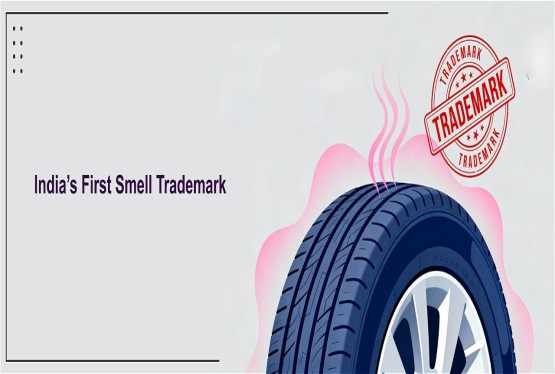
The question is no longer purely theoretical in India. On 21 November 2025, the Controller General of Patents, Designs and Trade Marks passed an order concerning Trade Mark Application No. 5860303 filed by Sumitomo Rubber Industries Ltd. for a “Floral Fragrance / Smell Reminiscent of Roses as Applied to Tyres”. Applied to Tyres”. The Registry accepted the application and directed that it be advertised in the Trade Marks Journal as an olfactory mark. WIPO subsequently described the development as India’s first accepted smell mark.
The development is significant, but it does not mean that every smell or every taste is automatically capable of trademark protection. The real legal questions concern distinctiveness, representation, functionality, consumer perception and the appropriate boundaries of the resulting monopoly.
The Statutory Starting Point in India
The Trade Marks Act, 1999 does not expressly mention “smell marks” or “taste marks”. Instead, the starting point is the statutory definition of a “mark” and a “trade mark”.
Section 2(1)(m) defines “mark” in inclusive terms and includes devices, brands, headings, labels, tickets, names, signatures, words, letters, numerals, shapes of goods or their packaging and combinations of colours, among other things.
Section 2(1)(zb) defines a “trade mark” as a mark capable of being represented graphically and capable of distinguishing the goods or services of one person from those of others. The provision also expressly recognises shapes of goods, their packaging and combinations of colours.
This produces two fundamental questions for a sensory sign: Can the sign be represented graphically in the manner required by Indian law? And can the sign distinguish the goods or services of one person from those of another?
Even if those requirements are satisfied, the application remains subject to the other provisions of the Act, including the restrictions concerning distinctiveness under Section 9.
Why Smell Marks Have Historically Been Difficult
The greatest obstacle to smell marks has traditionally been representation.
A word can be written. A logo can be reproduced. A colour can be identified through an appropriate reference system. A smell, however, cannot easily be communicated to a trademark register through ordinary language.
This problem was examined in detail by the Court of Justice of the European Union in Sieckmann v Deutsches Patent- und Markenamt, Case C-273/00, judgment of 12 December 2002.
The Court considered an olfactory sign and examined whether the proposed representation satisfied the requirement of graphical representation. The case became a leading authority because the Court emphasised the need for a representation to be clear, precise, self-contained, easily accessible, intelligible, durable and objective.
The significance of Sieckmann lies not in establishing that smell marks are inherently impossible, but in exposing the central problem: a trademark register must be capable of identifying the subject matter of the exclusive right with sufficient certainty.
India’s Sumitomo Development
Sumitomo Rubber Industries Ltd. filed Trade Mark Application No. 5860303 on 23 March 2023 in Class 12 for tyres for vehicles.
The proposed mark was described as:
“FLORAL FRAGRANCE / SMELL REMINISCENT OF ROSES AS APPLIED TO TYRES.”
The application was initially objected to, including under Sections 9(1)(a) and 2(1)(zb), raising questions concerning distinctiveness and graphical representation.
The proceedings eventually involved a scientific approach to representing the smell.
A graphical representation was prepared using a seven-dimensional olfactory model, identifying dimensions including floral, fruity, woody, nutty, pungent, sweet and minty characteristics. The Registry considered whether this scientific representation could sufficiently identify the claimed olfactory sign.
On 21 November 2025, the Controller General accepted the application and directed that it be advertised in the Trade Marks Journal as an olfactory mark, together with the graphical representation and description submitted by the applicant.
This was an important development because it demonstrated that the statutory requirement of graphical representation could, at least in an appropriate case, be approached through a scientific representation of an olfactory characteristic.
A Crucial Distinction: Acceptance Is Not the Same as a General Rule
The Sumitomo order should nevertheless be understood precisely.
The Registry’s decision concerns a particular application, a particular smell and a particular class of goods. It does not mean that every smell satisfies Section 2(1)(zb), nor does it remove the distinctiveness requirement under the Act.
The importance of the decision lies in demonstrating that an olfactory sign is not necessarily excluded from consideration merely because it is non-visual.
In other words, the development is better understood as opening a legal pathway for smell marks rather than creating an unrestricted category of sensory monopolies.
Why the Sumitomo Mark Was Different
The relationship between the sensory characteristic and the underlying goods is crucial.
A rose-like fragrance applied to tyres is not ordinarily what consumers purchase when they buy tyres. The fragrance is separate from the essential purpose of the tyre.
That makes the relationship between the smell and the goods fundamentally different from a flavour that is itself an essential part of a food product.
The Registry considered the rose-like fragrance to be distinctive in relation to tyres and addressed its graphical representation through the scientific material placed before it.
This distinction may become important in future cases.
Scent Can Function as a Trademark
The possibility of a scent functioning as a trademark is not unique to India.
In the United States, In re Clarke, 17 USPQ2d 1238 (TTAB 1990) concerned a fragrance applied to sewing thread and embroidery yarn. The Trademark Trial and Appeal Board accepted the possibility of the scent functioning as a trademark because the fragrance was not an ordinary characteristic or functional feature of the goods.
The case illustrates an important principle: a non-traditional sensory characteristic can potentially operate as a source identifier where consumers can perceive it in that manner and where the characteristic is not merely functional.
The lesson is not that every fragrance is registrable. Rather, the relationship between the sensory feature, the goods and consumer perception matters.
Taste Marks Present a More Difficult Problem
Taste is potentially more difficult than smell.
A consumer normally encounters the taste of a product only after consuming or using it. More importantly, flavour is frequently part of the product itself.
Consider chocolate, chewing gum, beverages, confectionery, food products and pharmaceutical tablets.
In many of these products, taste may contribute directly to the product’s quality, palatability or purpose.
Consequently, a business seeking exclusive rights over a taste must confront a fundamental question: Is the taste functioning as a badge of origin, or is it simply a characteristic of the product?
That distinction is central to the future of taste-mark protection.
In re N.V. Organon: The Problem of Functional Flavour
The American decision in In re N.V. Organon, 79 USPQ2d 1639 (TTAB 2006), illustrates the difficulty.
Organon sought registration of an orange flavour for pharmaceutical products, including antidepressant medication in quick-dissolving tablets and pills.
The Trademark Trial and Appeal Board refused registration. Among the reasons was the functional nature of the flavour. Evidence indicated that orange flavour was used in pharmaceuticals to make orally administered medicines more palatable.
The decision demonstrates why trademark protection cannot simply be used to appropriate an ordinary product characteristic.
If a particular flavour serves a practical purpose—such as making medicine easier to consume—granting one undertaking exclusive rights over that characteristic could interfere with legitimate competition.
The case therefore provides a useful comparative lesson for India: the closer a taste is to the functional or utilitarian character of the product, the greater the difficulty in treating it as a trademark.
Food Flavour and Source Identification
The American decision in N.Y. Pizzeria, Inc. v. Syal, 56 F. Supp. 3d 875 (S.D. Tex. 2014), provides another illustration of the difficulties surrounding flavour-based trademark claims.
The dispute involved allegations concerning distinctive flavours associated with restaurant food. The court considered the relationship between flavour and trademark protection and found significant difficulties in treating the taste of food itself as a protectable trademark under the circumstances of the case.
The significance of N.Y. Pizzeria should be kept within its proper limits. It was a US district-court decision involving particular facts; it is not an Indian precedent and does not establish a universal rule that food flavour can never function as a trademark.
Its value is comparative: where the claimed feature is inseparable from the product itself, trademark protection becomes considerably more difficult to justify.
The Indian Law on Taste Marks Remains Open
Unlike smell marks, where the Sumitomo order has now provided a concrete Indian administrative development, there is no equivalent Indian judicial decision establishing a comprehensive test for taste marks.
Accordingly, it would be premature to say that Indian law either categorically permits or categorically prohibits taste marks.
The better approach is to apply the existing statutory framework.
A proposed taste mark would have to confront, among other things, whether it satisfies the statutory requirement of graphical representation; whether it is capable of distinguishing the applicant’s goods or services; whether it possesses inherent or acquired distinctiveness; whether the claimed taste is functional or inherent to the product; whether competitors require the same characteristic for legitimate commercial purposes; and whether consumers actually perceive the taste as identifying commercial origin.
The absence of an express statutory reference to taste therefore does not answer the question by itself.
Representation: The Real Frontier
The Sumitomo development may be particularly important because it shifts the debate from “Can a smell exist as a trademark?” to “Can the claimed sensory sign be objectively defined?”
This is a much more sophisticated question.
Suppose a company claims protection for a “rose-like smell”. Does that cover every rose fragrance, a particular chemical composition, a specific concentration, a particular combination of compounds, or a defined sensory profile?
The answer has enormous consequences.
A trademark gives its proprietor an exclusionary right. Therefore, the boundaries of that right must be sufficiently identifiable for competitors, the Registry and courts.
The scientific representation used in the Sumitomo proceedings is therefore significant not merely because it is technologically innovative, but because it attempts to translate a subjective sensory experience into an objectively communicable representation.
Consumer Perception Remains Fundamental
Scientific representation alone cannot transform every sensory characteristic into a trademark. Trademark law ultimately concerns commercial source identification.
A sensory feature may be scientifically measurable but still fail to function as a trademark if consumers do not associate it with a particular commercial source.
This creates an interesting tension.
Traditional marks can often be recognised before purchase. A consumer can see a logo on a package or read a brand name on a shelf.
Smell and taste may operate differently.
A consumer may not encounter the relevant smell until approaching or opening the product. Taste may not be experienced until after consumption.
This raises questions about how evidence of consumer association should be established.
Potential evidence could include duration of use, advertising, exclusivity of use, market recognition, consumer surveys, sales and marketing evidence, evidence of deliberate branding, and evidence showing that competitors do not ordinarily use the same sensory characteristic.
Functionality: The Boundary of Sensory Trademark Protection
Functionality is likely to become one of the most important limitations on sensory trademarks.
Trademark law is concerned with identifying commercial origin. It should not ordinarily be transformed into a mechanism for granting perpetual control over characteristics that competitors need in order to make or market competing products.
The problem is especially visible with taste.
A pleasant flavour in chewing gum may be commercially attractive, but that does not necessarily mean that the flavour identifies a single source.
Similarly, a flavour that masks the unpleasant taste of medicine may perform a functional role rather than a trademark role.
The same principle can apply to smell.
A fragrance deliberately added to a product may be capable of functioning as a trademark if it is arbitrary in relation to the goods. But a scent that is inherent to the product, necessary for its operation or closely connected with its ordinary purpose presents a different legal problem.
The key question is therefore not simply whether a sensory feature is unusual. It is whether the feature can legitimately perform the function of a trademark without giving its proprietor an unjustified competitive advantage.
The Enforcement Challenge
Even if sensory marks become more common, registration will not be the end of the legal problem. Traditional trademark disputes can involve visual comparison of competing logos, labels or packaging. How should a court compare two smells?
Possible questions include: Are the smells sufficiently similar? What degree of variation is legally significant? Should chemical composition be compared? Should expert evidence be mandatory? How should concentration be considered? Does the smell change with time or environmental conditions? How should subjective human perception be treated?
The Sumitomo order provides an important approach to representation, but it does not create a complete judicial methodology for determining infringement of smell marks.
Future Indian litigation may therefore require a combination of trademark doctrine, sensory science and expert evidence.
The Future of Sensory Branding
The commercial importance of these questions is likely to increase.
Businesses already use sensory experiences as part of brand strategy. Physical retail environments, hospitality businesses, automobiles, consumer products and entertainment spaces can all use distinctive sensory characteristics to create associations with a brand.
Technological development may make sensory marks easier to define and compare.
Advances in chemical analysis, sensory science, electronic noses and computational models may eventually allow trademark authorities to describe smells with considerably greater precision than was previously possible.
But technological capability should not replace the legal test.
The central question will continue to be whether the sensory feature functions as a distinctive indicator of commercial origin and whether exclusive protection is consistent with the principles underlying trademark law.
Conclusion
Smell and taste marks represent a fascinating frontier in the development of trademark law because they challenge a system historically designed around signs that consumers can see and readily reproduce on a register. India has now taken an important step in this direction. Through the 21 November 2025 Sumitomo Rubber order, the Trade Marks Registry accepted an application for a rose-like fragrance applied to tyres and directed its advertisement as an olfactory mark. The decision demonstrates that the statutory framework can accommodate an olfactory sign where the requirements of representation and distinctiveness are addressed in an appropriate manner.
The development, however, should not be understood as granting automatic protection to sensory characteristics. The future of smell marks will depend upon the relationship between the sensory feature and the goods, the ability to define the protected subject matter, consumer perception and the limits imposed by functionality. Taste marks present an even more challenging question. Unlike a fragrance applied to an otherwise unrelated product, taste is often inseparable from the product itself. Comparative authorities such as In re N.V. Organon demonstrate the difficulty of protecting a flavour where it performs a functional or utilitarian role.
India has not yet developed a definitive judicial framework for taste marks. That leaves an important area of trademark law open for future development. Ultimately, the future question is not simply whether a smell or taste can be a trademark. It is whether the law can identify a sensory experience with sufficient precision, establish that consumers perceive it as a source identifier, and protect that identity without giving one trader an excessive monopoly over a feature that competitors legitimately need. If those questions can be answered satisfactorily, smell and taste may move from the margins of trademark law into a genuine new category of brand protection. The Sumitomo development suggests that, at least in the field of smell, that future may already have begun.


_(b)_of_the_Trademark_Act,_1999_(1)_crop10_thumb.jpg)


_crop10_thumb.jpg)


_crop10_thumb.jpg)
_crop10_thumb.jpg)


_crop10_thumb.jpg)


_crop10_thumb.jpg)


_crop10_thumb.jpg)


_crop10_thumb.jpg)


_crop10_thumb.jpg)


_crop10_thumb.jpg)


_crop10_thumb.jpg)


_crop10_thumb.jpg)


_crop10_thumb.jpg)










_crop10_thumb.jpg)























































































_crop10_thumb.jpeg)