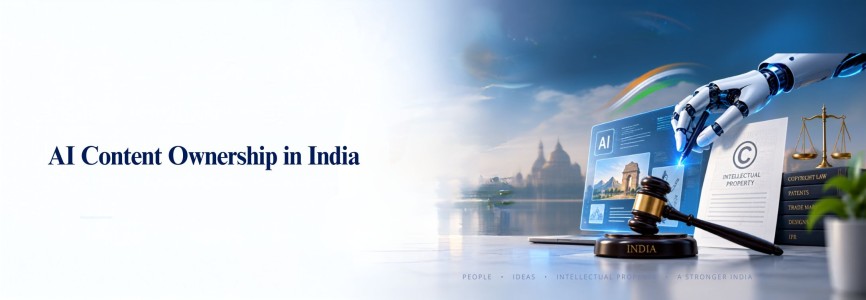



Generative artificial intelligence has transformed the way text, images, music, software and audiovisual material are created. This raises an important intellectual-property question: when a person uses a generative AI tool to produce content, who owns the result?
The answer is not simply that the user automatically owns everything generated by the system. Under Indian law, authorship, originality, ownership and contractual arrangements may all matter. The safest approach is to identify the human contribution to the final work and analyse the relevant statutory provisions and agreements.
The Legal Framework
Section 13 of the Copyright Act, 1957 identifies categories of works in which copyright may subsist. Section 14 describes the exclusive rights associated with copyright. For generative AI, Section 2(d)(vi) is particularly important: in relation to a literary, dramatic, musical or artistic work which is computer-generated, the author is the person who causes the work to be created.
However, this provision does not expressly answer every question created by modern generative AI. It remains uncertain whether merely entering a prompt, operating a system, selecting an output or substantially editing it will always be sufficient to establish authorship in every situation.
AI-Assisted and Predominantly AI-Generated Content
A useful distinction can be made between AI-assisted creation and content generated with minimal human creative intervention. AI-assisted content may involve human conception, detailed instructions, selection between outputs, editing, rearrangement and substantial original additions. The human-created contribution may itself be capable of protection if the legal requirements are satisfied.
Predominantly AI-generated content raises greater difficulty where a person provides a simple instruction and accepts the result without meaningful creative intervention. Indian law has not established a fixed rule stating how many prompts or how much time automatically creates copyright. Each situation requires a factual analysis.
Originality and Human Contribution
In Eastern Book Company v. D.B. Modak, (2008) 1 SCC 1, the Supreme Court rejected a purely mechanical “sweat of the brow” approach and emphasised skill and judgment. In the AI context, meaningful human selection, arrangement, editing and transformation may therefore be relevant to identifying original human expression.
However, effort alone should not automatically be equated with copyright. The important question is what identifiable original expression or creative judgment can be attributed to the human contributor.
Tarun Chaudhary v. Kuldeep Meena
A significant recent development is Tarun Chaudhary & Anr. v. Kuldeep Meena & Ors., CS(COMM) 297/2026, Delhi High Court, order dated 25 March 2026. The dispute involved a song whose lyrics were attributed to a human author while the musical component had admittedly been generated using SUNO AI.
The Court considered Section 2(d)(vi) and recognised the difficulty of determining whether copyright could be asserted over the song as a whole. The Court did not finally hold that all AI-generated works are uncopyrightable. Instead, it treated the issue as requiring further consideration, impleaded the Registrar of Copyrights and did not grant immediate ex parte protection at that stage. The case is therefore an important example of the present uncertainty, not a blanket rule against copyright protection for every work involving AI.
Ownership Is Not Always the Same as Authorship
Section 17 generally provides that the author is the first owner of copyright, subject to statutory exceptions. Therefore, once legally protectable authorship is identified, ownership must still be examined under Section 17 and any applicable employment, commissioning or contractual arrangements.
For example, a company employee, freelancer, agency or client may have different rights depending upon the nature of the relationship and the relevant agreement. Businesses should therefore address ownership of AI-assisted deliverables expressly rather than relying on assumptions.
The Importance of AI Platform Terms
The Copyright Act is not the only relevant framework. Users must also examine the terms governing the AI platform. Different providers may permit commercial use, impose restrictions, disclaim guarantees regarding uniqueness or copyrightability, or allocate contractual rights differently.
Permission to use an output commercially should not automatically be confused with a judicial determination that the entire output is protected by copyright.
A Layered Approach to AI Content
AI-assisted projects may contain several separate intellectual-property layers. A song may include human-written lyrics, AI-generated music, human arrangement and a separate sound recording. An article may include human instructions, AI-generated drafts and substantial human editing.
These elements should not automatically be treated as one indivisible copyright claim. The strongest claim may relate to identifiable human-created expression and other independently protectable components.
Training Data and Ownership Are Different Issues
Whether an AI output can be owned is different from whether the training or generation process infringed another person's copyright. A creator may have questions about ownership of an AI-assisted output while separately facing infringement risks if protected third-party expression is reproduced.
These issues should therefore be analysed separately.
Practical Recommendations
-
Preserve evidence: Keep prompts, drafts, editing histories and source files.\
-
Identify human contributions: Record what was conceived, selected, edited or created by a human.\
-
Check platform terms: Review commercial-use rights and ownership provisions.
-
Use clear contracts: Employers, agencies, freelancers and clients should address ownership expressly.
-
Review outputs: Check commercially important material for possible copying or substantial similarity.
-
Avoid absolute claims: Where the legal position is uncertain, describe ownership claims carefully and identify the human contribution supporting them.
Conclusion
Indian law does not yet provide a single universal answer to who owns every piece of content created using generative AI. Section 2(d)(vi) provides an important starting point, but modern AI creates questions that the statute does not expressly resolve.
The strongest position generally exists where identifiable human creative contribution can be demonstrated. Where content is generated with minimal human intervention, the position remains more uncertain. The Delhi High Court proceedings in Tarun Chaudhary v. Kuldeep Meena show that these questions are now directly confronting Indian institutions and courts.
For creators and businesses, the practical approach is clear: treat AI as a powerful tool, preserve evidence of human creativity, separate the different layers of a work, review contractual terms and avoid assuming that every AI output automatically carries a simple or absolute copyright ownership position.


_(b)_of_the_Trademark_Act,_1999_(1)_crop10_thumb.jpg)


_crop10_thumb.jpg)


_crop10_thumb.jpg)
_crop10_thumb.jpg)


_crop10_thumb.jpg)


_crop10_thumb.jpg)


_crop10_thumb.jpg)


_crop10_thumb.jpg)


_crop10_thumb.jpg)


_crop10_thumb.jpg)


_crop10_thumb.jpg)


_crop10_thumb.jpg)


_crop10_thumb.jpg)








_crop10_thumb.jpg)








































_crop10_thumb.jpeg)