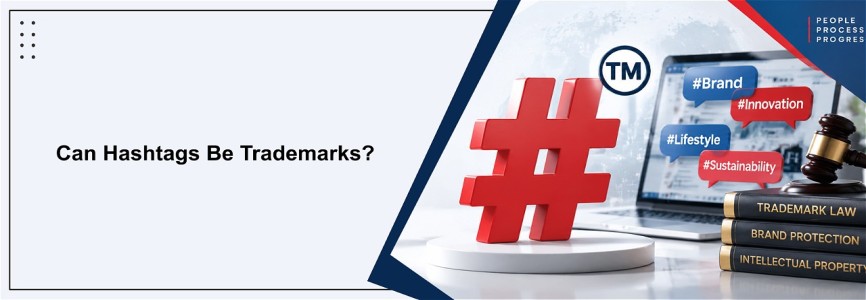



Social media has changed the way businesses communicate with consumers. A short expression preceded by the familiar “#” symbol can become the centre of a marketing campaign, identify a commercial initiative or help consumers associate content with a particular brand. This raises an important question under Indian intellectual-property law: can a social-media hashtag be registered as a trade mark in India?
The answer is potentially yes, but not automatically. Indian law does not create a separate statutory category called a “hashtag trade mark”. A hashtag must instead satisfy the ordinary requirements applicable to trademark. The central issue is whether the relevant expression is capable of functioning as a distinctive identifier of commercial origin. The presence of the “#” symbol alone does not create proprietary rights.
The Legal Framework
Section 2(1)(zb) of the Trade Marks Act, 1999 broadly defines a trade mark as a mark capable of graphical representation and capable of distinguishing the goods or services of one person from those of others. Distinctiveness is therefore central to the analysis.
Section 9 provides important grounds on which registration may be refused, including where a mark lacks distinctive character or consists exclusively of descriptive or customary indications, subject to the statutory. Accordingly, a hashtag is not assessed merely because it is popular online. The legal question is whether the expression actually performs, or is capable of performing, the function of identifying commercial origin.
A Hashtag Is Not Automatically a Trade Mark
Many hashtags primarily perform a categorising or conversational function. Expressions such as #Travel, #Food or #Cricket generally help users locate or participate in discussions. Their ordinary function is not necessarily to identify a single commercial source.
Adding a “#” to an ordinary word does not ordinarily transform that word into a distinctive proprietary mark. A business should therefore distinguish between a hashtag that merely describes a topic and one that consumers recognise as a badge of origin.
Distinctiveness and Registrability
A highly descriptive hashtag may be commercially useful but legally weak. Expressions such as #BestCoffee or #HealthyLiving may face difficulties if they merely describe or promote the relevant goods, services or lifestyle.
The position can be different where the underlying expression is inherently distinctive or has acquired distinctiveness through use. If a business consistently uses a distinctive phrase in connection with its goods or services and consumers associate that phrase with a particular commercial source, a stronger case for trade-mark protection may arise.
Registration of the Hashtag and the Underlying Words
From a practical perspective, the commercially significant element may often be the words following the hashtag rather than the “#” symbol itself. A business considering a long-term brand strategy may therefore need to examine whether protection should be sought for the underlying word or phrase, a stylised representation, a logo, or another commercially used form of the expression.
Section 17 is relevant where a registered mark consists of several matters, because registration of a composite mark does not automatically create an independent monopoly over every non-distinctive component.
Prior Use, Goodwill and Passing Off
Registration is not the only form of protection recognised under Indian law. Section 27(2) preserves the remedy of passing off in relation to unregistered trade marks.
However, prior use of a hashtag does not automatically give its user exclusive rights over the expression. A claimant relying on passing off would need to establish the necessary elements, including goodwill or reputation, misrepresentation and damage or a likelihood of damage. Digital evidence such as dated posts, campaign materials, advertising records and proof of consumer recognition may become important.
Hashtags in Digital Trade-Mark Enforcement
Recent Delhi High Court proceedings illustrate that hashtags can be relevant in the broader context of online trade-mark enforcement. In Hardwyn India Limited & Anr. v. Rajenndra Engitech LLP, the relief described in the proceedings referred to use of disputed marks as a brand name, domain name, metatag, hashtag, web address or otherwise in online environments. The matter was ultimately decreed in terms of a settlement.
Similarly, YC Electric Vehicle v. Nipun Sanyantra Private Limited referred to use of relevant marks as brand names, domain names, metatags, hashtags and web addresses. The dispute was resolved through a consent decree.
These cases should be used cautiously. They do not establish that every hashtag is automatically registrable as a trade mark. They demonstrate that hashtag use may be relevant as one context in which an allegedly infringing mark can appear online.
Can a Hashtag Be Used Infringingly?
Yes, depending on the circumstances. If a registered trade mark is used as a hashtag in the course of trade in a manner that satisfies the statutory requirements for infringement, the addition of the “#” symbol will not necessarily prevent legal consequences.
The analysis may depend on the nature and reputation of the earlier mark, the goods or services involved, the manner of use and the likelihood of confusion. At the same time, not every online reference to a mark is necessarily infringement. Commentary, reporting and other legitimate uses must be assessed in context.
Campaign Hashtags and Hashtag Hijacking
Campaign hashtags can occupy a more complicated position because businesses may use them across advertising, packaging, websites, social-media campaigns and promotional events. Consistent use may strengthen the argument that a distinctive expression functions as part of a commercial identity.
However, popularity or virality is not the same as trade-mark distinctiveness. A phrase does not automatically become registrable merely because millions of people use it online. Likewise, a business cannot automatically prevent the public from mentioning or discussing its brand through social-media hashtags.
Practical Guidance for Businesses
Businesses intending to use a hashtag as a long-term commercial asset should conduct a clearance search, prefer distinctive expressions, consider protecting the commercially important core wording where appropriate, preserve dated evidence of use, and monitor potentially confusing commercial uses online.
At the same time, enforcement should be based on a proper legal analysis. Not every similar hashtag creates a valid claim for infringement or passing off.
Conclusion
Can social-media hashtags be registered as trade marks in India? The most legally defensible answer is: yes, potentially—but not automatically. Indian trade-mark law does not create special registration rights simply because an expression contains a “#” symbol. The relevant expression must satisfy the ordinary legal requirements governing trade marks, particularly the requirement of distinctiveness and the capacity to distinguish one person's goods or services from those of others.
A common hashtag used merely to categorise a public conversation is unlikely to become a strong proprietary right simply because it is popular online. By contrast, a distinctive expression consistently used as a badge of commercial origin may potentially qualify for protection, depending on the facts and the applicable statutory requirements. The safest approach is therefore to treat hashtags as potentially valuable elements of digital brand strategy while recognising that commercial popularity, social-media visibility and legal registrability are not the same thing.


_(b)_of_the_Trademark_Act,_1999_(1)_crop10_thumb.jpg)


_crop10_thumb.jpg)


_crop10_thumb.jpg)
_crop10_thumb.jpg)


_crop10_thumb.jpg)


_crop10_thumb.jpg)


_crop10_thumb.jpg)


_crop10_thumb.jpg)


_crop10_thumb.jpg)


_crop10_thumb.jpg)


_crop10_thumb.jpg)


_crop10_thumb.jpg)


_crop10_thumb.jpg)








_crop10_thumb.jpg)





















































_crop10_thumb.jpeg)














































_crop10_thumb.jpg)