


The trademark is an origin indicator – an identifier which identifies the source of goods/services of one person from those of another through sign, symbol, words or any combination thereof. Upon its registration, the owner acquires exclusive statutory rights in terms of infringement suit, licensing of the mark and prevention of misuse by third parties. But registration is not something which is sacrosanct or perpetual and is immune to challenge
. In various jurisdictions of trademark laws including the Indian Trade Marks Act, 1999, the United States Lanham Act and the UK Trade Marks Act, 1994, there is provision for situations where despite having been placed on the register, the trademark may cease to be deserving of the protection which it is entitled to receive. This process by which the mark ceases to remain on the registry is called Cancellation (sometimes termed as rectification under various regimes).
Cancellation proceeding is the remedy for correction available within the regime of trademark registration. The trademark registries operate on ex parte examination at the time of filing; examiners do not have all the facts relating to pre-existing rights, bad faith etc.
Need of Cancellation of Trademark
The need for cancellation provisions arises from several practical and doctrinal concerns:
-
Preventing monopolization of language and commerce: Trademarks that have become generic, or that were never truly distinctive, obstruct fair competition if allowed to remain registered.
-
Protecting prior rights holders: A subsequent, confusingly similar mark may be wrongly registered due to oversight, and cancellation offers an avenue of redress to the earlier user or proprietor.
-
Deterring fraudulent and mala fide registrations: Bad-faith applicants sometimes register marks belonging to foreign or lesser-known proprietors with the intent to extract licensing fees or block market entry; cancellation acts as a remedy against such conduct.
-
Encouraging genuine commercial use: Trademark law is premised on use in trade, not mere reservation of a sign. Non-use provisions compel proprietors to either exploit their marks commercially or relinquish them for others to use.
-
Maintaining public confidence in the register: A register cluttered with deceptive, abandoned, or wrongly granted marks undermines the reliability of the register as a source of truth for businesses conducting clearance searches.
The importance of cancellation, therefore, is not punitive but corrective it maintains equilibrium between the proprietary interests of registrants and the larger public interest in a competitive, honest marketplace.
Significance
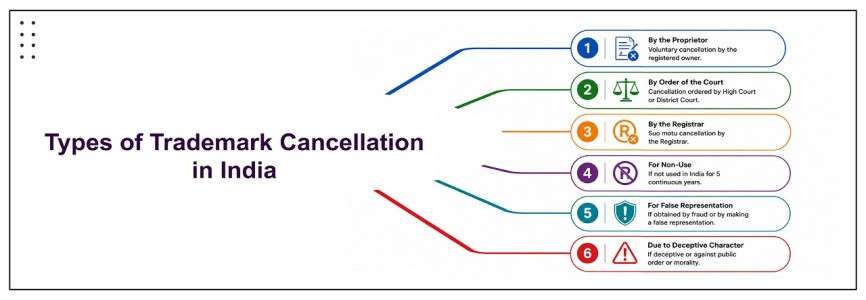
Cancellations are not singular remedies; rather, they take place in various forms depending upon the basis on which it is claimed, the time period of the trademark, and the defect involved. Some of the types of cancellations are described below:
Cancellation for Non-Use
Undoubtedly, the most common type of cancellation claim is the one for non-use. These cancellations involve trademarks which have not been in use during any statutorily required continuous period ranging from three to five years after registration.
The basic reason is based on the idea that trademarks require use to earn exclusive rights; and thus, when the registrant registers a mark but does not use it or stops using it for a prolonged period with no intentions to start using it again, he loses his basic grounds to retain exclusive rights.
Cancellation for Incorrect or Improper Registration
This classification deals with marks that should not have been registered in the first place, due to a defect that was present at the time of registration.
This category is typically divided into the following two sub-categories:
-
Cancellation based on absolute grounds - in which case the mark lacked inherent distinctiveness, was merely descriptive, generic, deceptive, scandalous, or otherwise against public policy or morals at the time of registration.
-
Cancellation based on relative grounds - in which case the mark was identical or deceptively similar to an earlier registered or well-known mark, likely to cause confusion or infringement upon other's common law rights or proprietary interests.
Cancellation in Case of Fraud/Misrepresentation
In cases where a registration was obtained by means of fraud, such as false representation of use of the trademark, non-disclosure of pertinent information, or intentional registration over an existing mark of another party in bad faith, the aggrieved party or any person with interest in the matter can institute cancellation proceedings based on fraud. The standard for proof in cases of fraud is high because of the grave nature of fraud, and thus there is the need for higher level of certainty in establishing fraud than other civil wrongs.
Cancellation Based on Abandonment
Unlike statutory non-use, which involves non-use of a registered mark for a certain period of time, abandonment cancellation refers to cases where actions of the owner clearly indicate an intention to abandon the mark. Such actions include, among others, discontinuance of business operations or failing to renew the mark after being advised to do so.
Cancellation as a Consequence of Non-Renewal
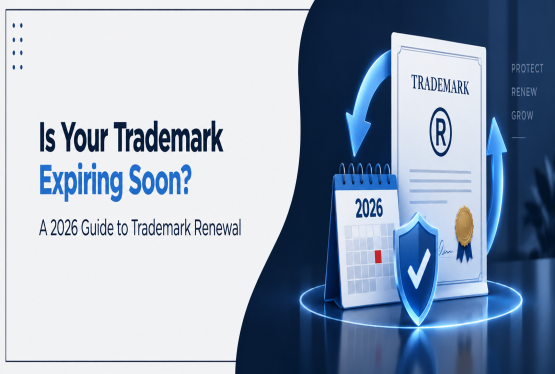
The duration of the validity of trademark registrations is limited and consists of a fixed number of years (usually, 10). The registration should be renewed regularly on paying the corresponding fees. Failing to renew within the prescribed timeframe, including a grace period, will lead to the deletion of the mark from the register. This is not always regarded as a separate procedure, but the result will be the same: the rights of the proprietor of the mark are lost, and anyone else can use it.
Cancellation Because of the Changes of the Nature of the Mark or Its Deception After the registration
Even if the mark was legally registered, after some time it might become deceptive and contrary to the public interests because of the changes that happened later. The composition of the goods became misleading as to their geographical origin, ingredients, and quality, for example. This kind of supervision deceptiveness can serve as a reason for cancellation.
Partial Cancellation
Cancellation does not have to be complete every time. In cases where the mark is on validly used for some of the goods or services listed in its registration, many countries allow for partial cancellation, whereby cancellation of the protection of the mark will apply only to the goods or services not in genuine use.
Cancellation Sua Sponte by the Registry
Besides the process of initiation of cancellation by an aggrieved person, the trademark registries in many countries have the authority to sua sponte bring a cancellation proceeding against a mark after it has been registered if there are found to have been violations of the law at the time of registration.
Key Legal Principles
-
Presumption of Validity – A presumption of validity is afforded to a registered trademark, and the burden to prove cancellation grounds usually falls on the party applying for cancellation.
-
Standing ("Person Aggrieved") – Most legislations stipulate that the party applying for the cancellation must be a "person aggrieved" or have an actual business/legal interest, to avoid frivolous/vexatious claims.
-
Burden and Standard of Proof – While ordinary cancellation grounds are determined based on balance of probabilities, any fraud-based cancellation must be proven using clear and convincing evidence.
-
Acquiescence/Laches/Estoppel Doctrine – Any undue delay in applying for cancellation together with the registrant's reliance on the registration can result in denial of relief on these equitable grounds.
-
Continuous and Genuine Use Principle – Any token use by way of defeating a non-use cancellation cannot be accepted as continuous and genuine use.
-
Territoriality – The grounds for cancellation such as distinctiveness, deceptiveness, and prior rights tend to be considered from the perspective of the perception of the relevant public in the territory of registration.
Key Legal Principles
Digitization and AI-based evidence review: Trademark authorities are turning to AI-based search and surveillance systems which can help identify non-use, generosity trends, as well as duplicate/deceptive submissions, potentially allowing for proactive suo motto cancellation.
International harmonization: Further development of international regulations will inevitably lead towards more uniform cancellation proceedings and schedules, preventing forum shopping and divergent outcomes in different legal regimes.
Generic ide risks linked to e-commerce and metaverse: The development of novel categories of digital goods and NFTs poses new risks of generosity of marks with respect to brand-new technological categories.
Strict assessment of bad-faith filings: The increase of trademark squatting, especially in rapidly growing markets, will probably result in legal changes reinforcing cancellation remedies based on fraud and bad faith.
Administrative adjudications in lieu of costly litigation: Legal authorities are increasingly tending to administrative panels rather than litigation in order to speed up and decrease cost of legitimate cancellation disputes. Increased use of data analysis in proving non-use: Sales records, e-commerce metadata, and even digital marketing footprint are likely to become routine proofs of non-use
Legal Effects of Cancellation
Cancellation consequences can be quite profound and go beyond simply deleting a mark from the register. Once a mark has been cancelled, the holder of the registration will lose the statutory presumption of validity and the monopoly over use of the mark as it relates to the specified goods or services, with the mark effectively becoming public property or open to appropriation by others (unless there remain any common law rights of the former holder based on usage). Cancellation will prevent the former holder from bringing a statutory infringement claim, but not necessarily a passing off claim, should goodwill have been actually established. The crucial point here is that cancellation is regarded as having taken effect prospectively from the date of the order, except for those cases where the basis for the order is either fraud or a fundamental flaw present since the inception of registration.
In such circumstances, some jurisdictions view the registration as being void ab initio. This has important implications for licensing arrangements, pending disputes, and vested rights which accrued while the mark was registered.
Comparative Jurisdictional Perspective
Though the reasons for cancellation might be the same in different countries, there may be procedural differences. According to the Indian laws, the petition for cancellation and rectification can be filed either before the Registrar of Trademarks or before the High Court where “the person aggrieved” test will be followed and non-use actions require five years and three months of continuous non-use before filing a petition.
In the US, the cancellation process in TTAB is similar to court litigation, including discovery, depositions, and briefs, while the marks which are five years old or more will get some special incontestability protection from being challenged in the future. The EU/UK regimes allow cancellation actions against marks before the EUIPO or the UK IPO either because of the absolute grounds, relative grounds, and revocation because of non-use or genericide with an option to appeal to the boards and further to the courts. This procedural difference is extremely important for multinational companies, as a mark, which could be cancelled in one country, could stay protected in another one.
Strategic and Practical Consideration for Trademark Owner
In terms of practice, business owners may adopt a number of precautionary measures to minimize the risk of cancellation. Having reliable, dated proof of use – bills, packaging, advertisements and electronic commerce information – is a must to fend off non-use-based attacks. Companies should also refrain from defensive registration of trademark over too many classes of products or services that they do not plan to actually use, because so-called "trademark bracketing" is highly questionable nowadays and is subject to cancellation in part.
Periodic audits of your trademark portfolio, prompt renewal and appropriate response to cancellation letters are also important, since non-response leads to automatic cancellation of trademarks ex parte. As for countermeasures against existing trademarks, businesses willing to clean up the register before filing a new one would be wise to choose non-use cancellation as a more economical route than long-lasting opposition and costly infringement lawsuits.
Conclusion
Trademark cancellation is an essential form of remedy that sustains the credibility, integrity, and fairness of the trademark registry. Rather than merely serving a technical or disciplinary role, it represents the core philosophy that the right to exclusive use of a trademark is only conferred on proprietors who use the sign in good faith and in an uninterrupted manner for identifying its source in the market. With the ever-evolving landscape of commerce becoming more global and virtual in nature, the rules concerning cancellation may have to adapt, but one thing will always be true: that the registry will always reflect genuine and merited rights.


_(b)_of_the_Trademark_Act,_1999_(1)_crop10_thumb.jpg)


_crop10_thumb.jpg)


_crop10_thumb.jpg)
_crop10_thumb.jpg)


_crop10_thumb.jpg)


_crop10_thumb.jpg)


_crop10_thumb.jpg)


_crop10_thumb.jpg)


_crop10_thumb.jpg)


_crop10_thumb.jpg)


_crop10_thumb.jpg)


_crop10_thumb.jpg)


_crop10_thumb.jpg)








_crop10_thumb.jpg)











































_crop10_thumb.jpeg)






























_crop10_thumb.jpg)